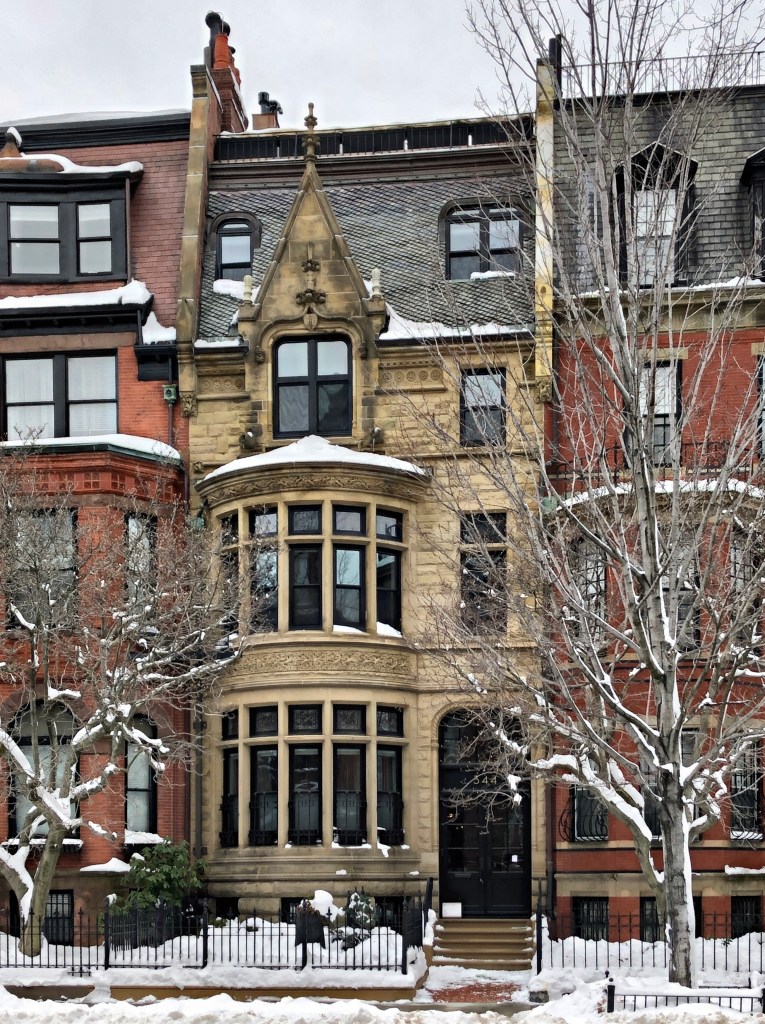
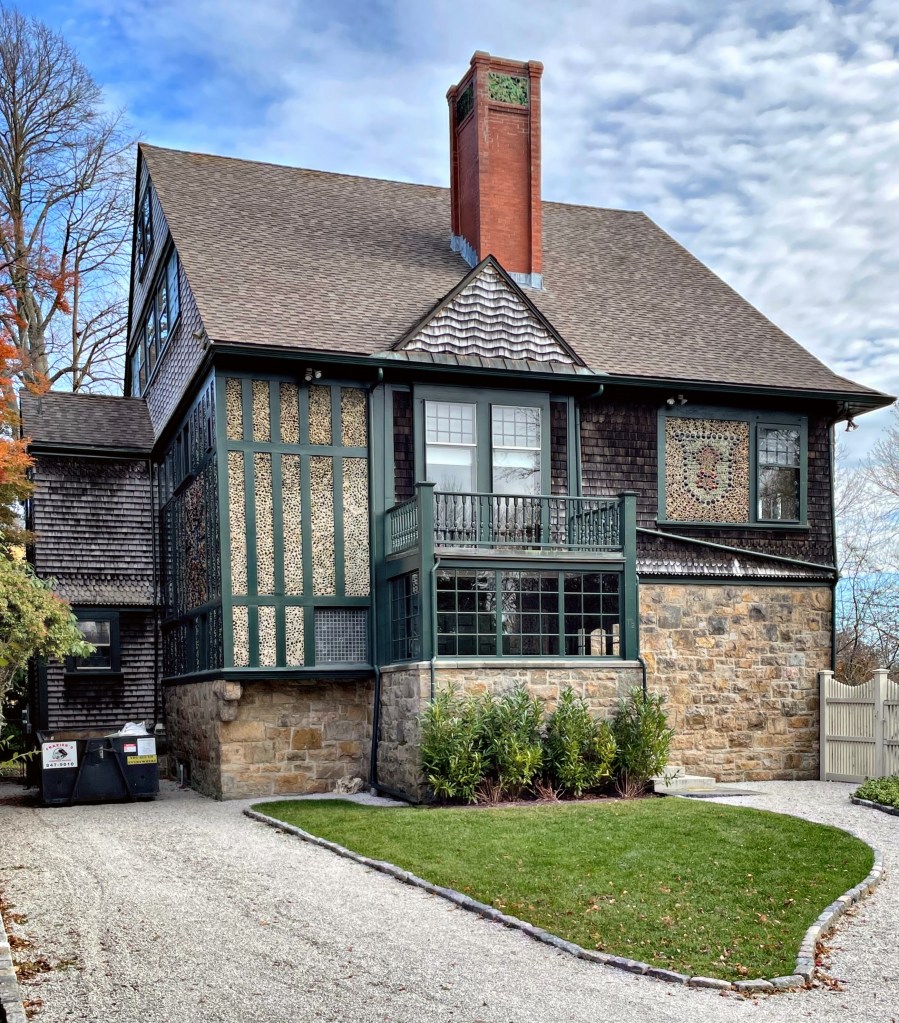
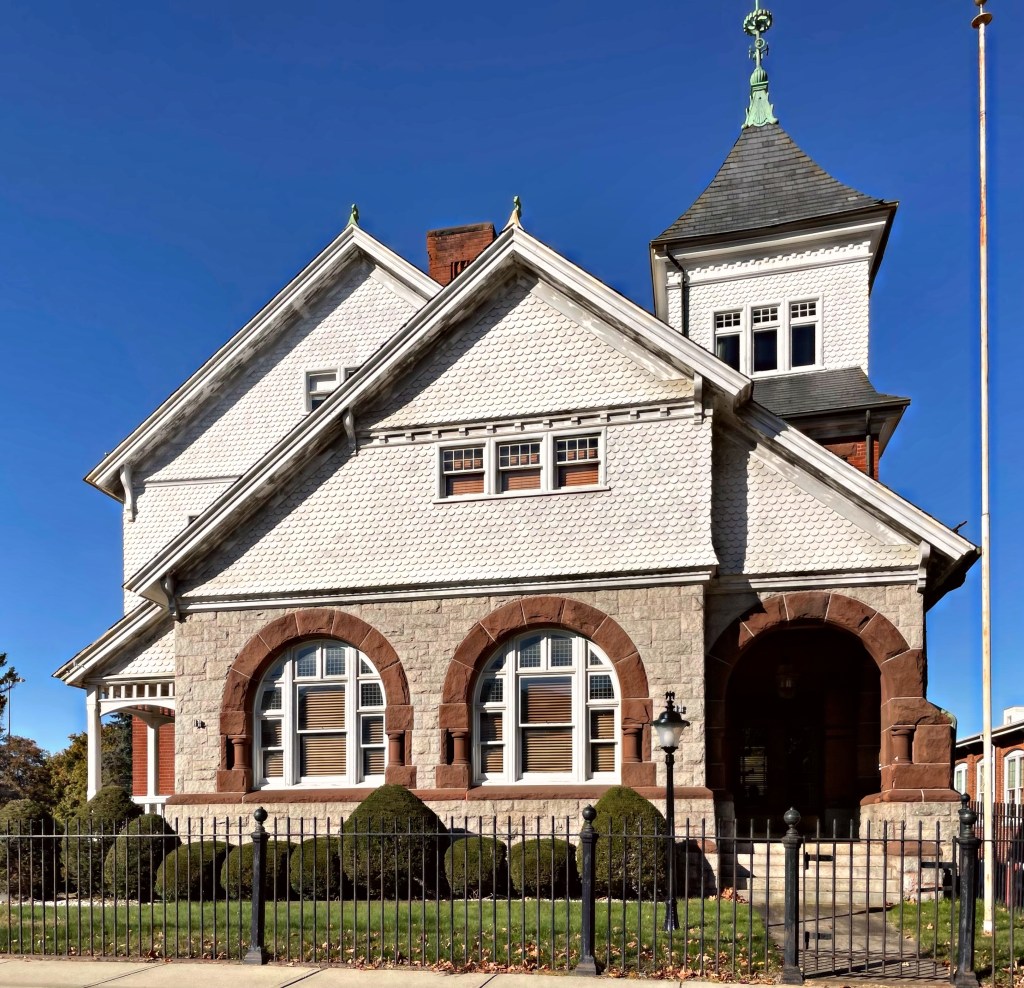
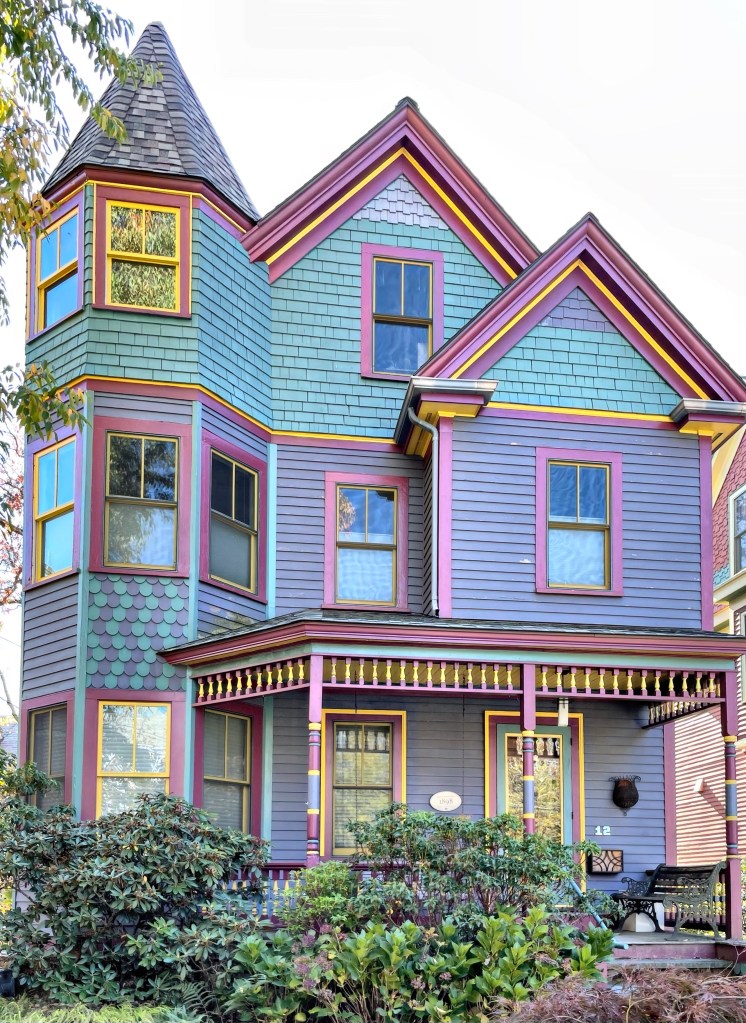
This charming Victorian cottage in Newport was built in 1878 for Henrietta and Dr. Stephen Cambreleng Powell as their summer cottage. The well-connected couple hired New Haven architect David R. Brown to design the residence, which is an excellent example of the Queen Anne and Stick/Eastlake architecture styles. David Brown, the architect, apprenticed under the famed Henry Austin for years in New Haven, Connecticut before becoming a partner of the firm. As any good summer cottage needs a fun name, the couple named their cottage “The Anchorage”. The cottage is now known as the Old Beach Inn, and is among Newports many charming old inns.
South of the Ware River in Ware’s Industrial Village, you will find this absolutely charming former manufacturing office on the side of the road. The building was constructed in 1885 for the George H. Gilbert Co., a textile manufacturer, as the company offices. The building’s architect could not be readily located, but the building appears to have been the work of a skilled designer. When the Gilbert Company relocated north to a new industrial village of Gilbertville, the Joseph T. Wood Shoe Company moved in. The building now appears to be owned by the present occupant of the mill building nextdoor, American Athletic Shoe Company. The former Gilbert Co. Office is one of the more high-style buildings in the town of Ware and exhibits the best in Queen Anne and Romanesque Revival architecture.
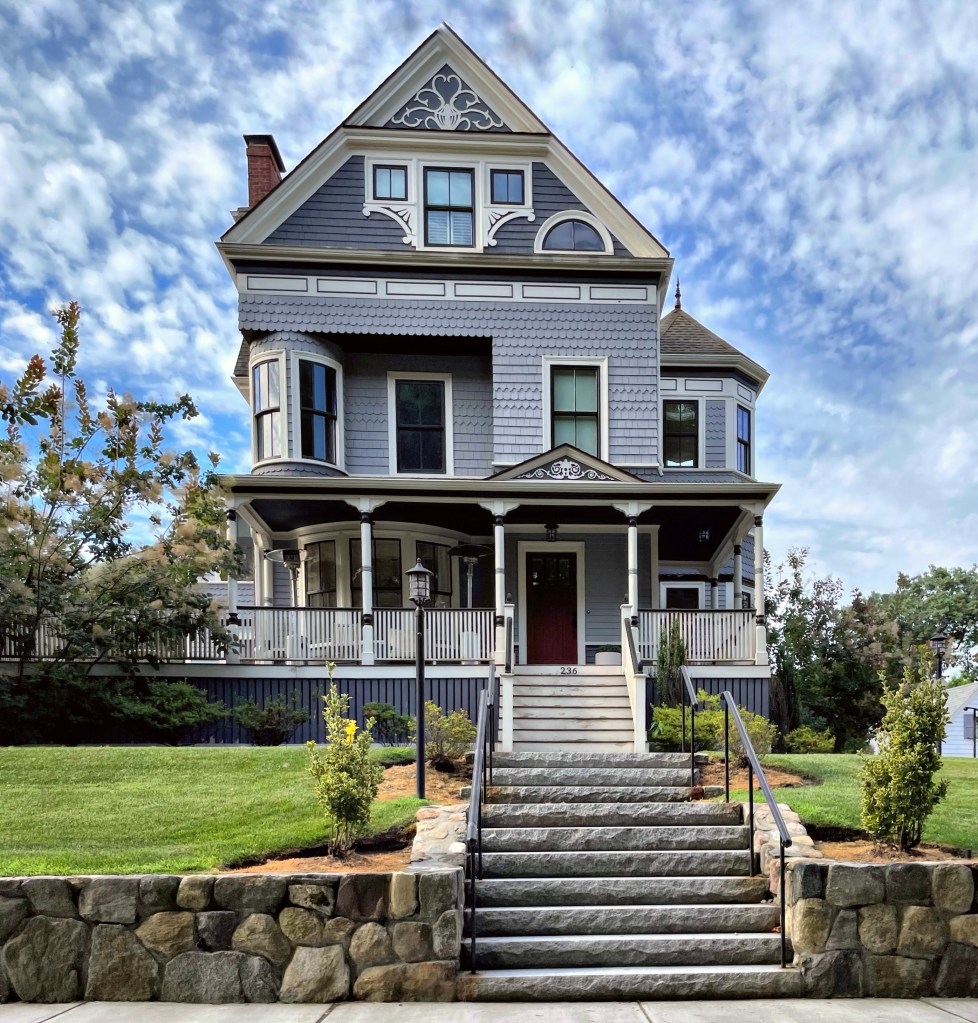
Behold this Queen Anne painted lady in all her glory! This home was constructed in 1898 as a late Victorian addition to Newton’s built landscape. The home’s earliest known owner was a T. C. Sullivan, who left the property to his family upon his death. The house is painted some pretty bold colors, which does an effective job at highlighting the many architectural details and intricacies in the design, but the home would have never been painted like this historically. A little history lesson: the “painted lady” trend took off in San Francisco when after WWII, disinvestment in the urban core led many Victorian homes there to be demolished, altered and covered with siding, and many were painted gray with war-surplus Navy paint (battleship gray). In 1963, San Francisco artist Butch Kardum began combining intense blues and greens on the exterior of his Italianate-style Victorian house. His house was criticized by some, but other neighbors began to copy the bright colors on their own houses. Kardum became a color designer, and he and other artists / colorists began to transform dozens of gray houses into Painted Ladies. By the 1970s, the colorist movement, as it was called, had changed entire streets and neighborhoods. This process continues to this day. The trend took off all over the United States as urban centers saw re-investment and gentrification. While not historically appropriate, the Painted Ladies can really make people happy and show pride in ownership.
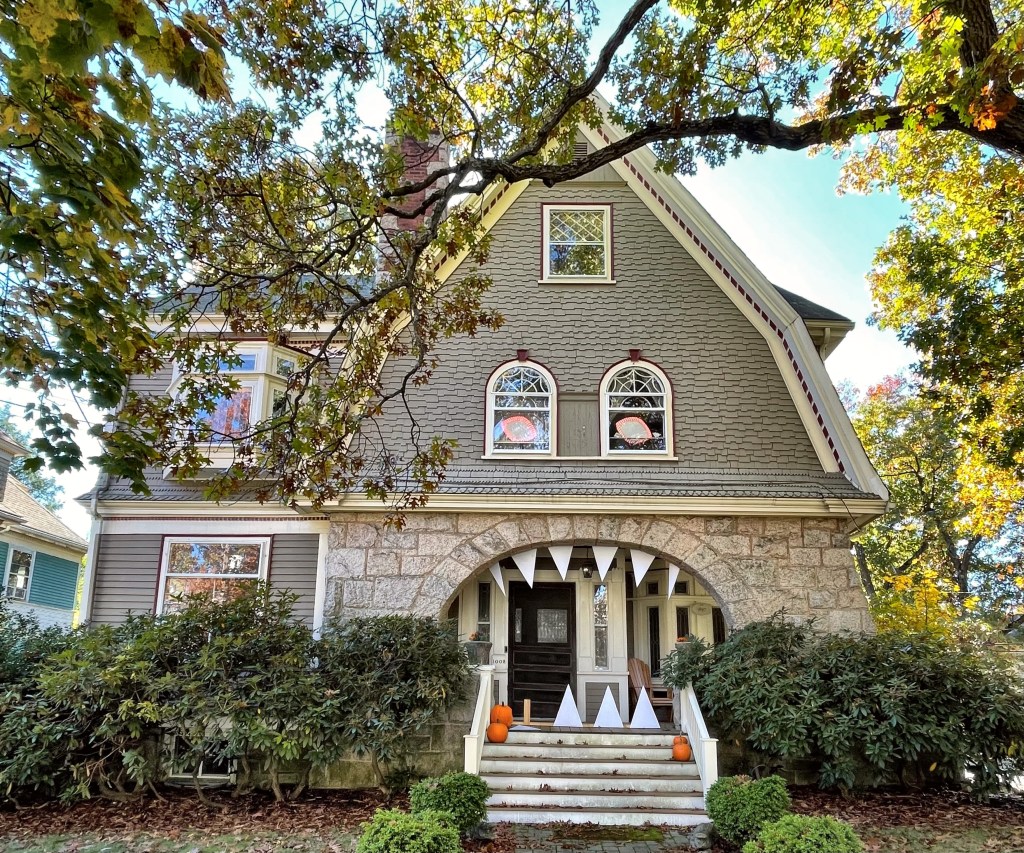
Happy Halloween! To celebrate I wanted to feature one of the more creatively decorated houses in the Boston area, which blends spookiness with architecture! This is the Barrows-Goddard House, so named after its first two owners. The house is located in Newton and was built in 1898 as an eclectic Queen Anne/Shingle style home. The original owner was Joseph Barrows, who developed the property and sold it within a year, relocating to a new home on a less busy street. The property was owned next by Christopher Goddard, an insurance agent with offices in Boston. Architecturally, the gable roof of the main block is intersected by an over-scaled gambrel cross-gable clad in patterned cut wood shingles. The focal point of the design is the Syrian-arched entrance porch of coursed, dressed fieldstone which this time of year, eats trick-o-treaters!
In 1895, when the Queen Anne style was no longer in vogue among architects and builders in the Boston area, the Allston Real Estate Company took a gamble and built this house in a scarcely developed section of Waban Village in Newton on spec, hoping to find a buyer. They found one in Oscar Raymond Rice and his wife Maud Lois Sargent Rice. Oscar worked as a salesman, and Maud volunteered locally with various causes. The family home is a great example of Queen Anne Victorian architecture with varied siding styles, asymmetry, a tower, rounded bay window, porch with turned posts, and applied decoration in the gables. The house underwent a large renovation about five years ago and it still looks great! The listing from 2017 gives me serious house envy.
Eclectic homes that can not be pigeonholed to a single architectural style are among my favorite as they blend features elegantly into a single, unique composition. This house on Windsor Road in the Waban village of Newton, Massachusetts is an example of an “eclectic” late 19th century home. This old house exhibits elements of the Queen Anne and Tudor Revival styles. The house was built in 1897 for Daniel and Ida Baker. After their death, the home was purchased by a James H. Mason, who got it for an estimated $25,000 in 1909. A listing at the time mentions the property included a 14-room house and large stable, the latter still stands at the rear of the lot (since converted to a car garage).
Marblehead is known for its Colonial-era architecture, so its always fun to find a stellar Queen Anne house in town! In 1884, Jacob M. Cropley, a shoe manufacturer, built one of Marblehead’s finest victorian residences on a hill overlooking the harbor. Cropley ran shoe and leather mills in Massachusetts and Wolfeboro, NH, making great money. The house was located on a prominent site on Pleasant Street, and was purchased by the U.S. Government in 1904 about the time that Cropley and his family moved to Boston. The house was purchased by David Lefevour, a grocer, who moved it back on the lot, saving the house from the wrecking ball. On the former house site, a post office was built by the U.S. Government.
When you look up Queen Anne architecture on Google, this house in Wilton, NH should pop up! The Frederick Colony House was built around 1885 for the mill-owner who built a large cotton mill (last post) in town at the same time. Frederick Colony (1850-1925) was from a prominent textile and cotton mill-owning family based in Massachusetts and Keene, New Hampshire. Colony purchased land along the Souhegan River and built a new mill, there to make his own fortune, and that he did! The Frederick Colony House remains as one of the best-preserved homes in Wilton, and recently sold. Those interiors!
David Whiting (1810-1892) was one of the most prominent men in Wilton, NH in the 19th century. He was involved in local business and politics, eventually using his prominent land at a convergence on Main Street to erect the Whiting House, a large hotel. The building burned down in 1874, along with his other buildings nearby. He donated some of the land to the town, who built the present Town Hall, and he built a new home on another part of the site. This house was likely built for David Whiting as his own residence, shortly after the fire. The house was designed in the fashionable Stick style and represents the best in Victorian-era architecture.