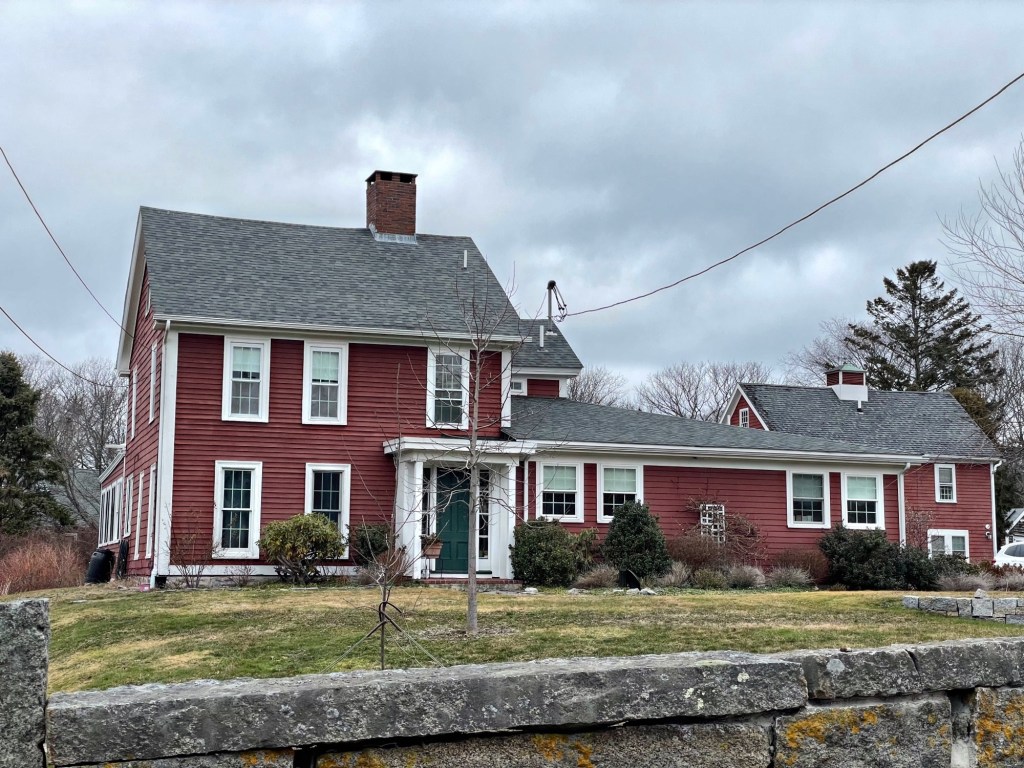
Norwood-Babson Farmhouse // 1799

Located in northern Rockport, Massachusetts, you will find this charming Colonial-era farmhouse set amongst the backdrop of ocean cliffs and granite quarries. At the tip of Pigeon Cove, adjacent to the present-day Halibut Point State Park, James Norwood purchased land and would erect this house by 1799 for his family (possibly built from an older dwelling formerly on the site). After James’ death, the property was willed to his daughter and son-in-law and sold a few times until 1820, when it was purchased by David Wallis Babson who raised his family here. As granite-quarrying became a lucrative trade in Rockport by the early-mid 19th century, David’s son Joseph bought twelve of the Babson Farm acres from other family members to organize a stone cutting business here. The property would leave the Babson Family decades later, but retained the family name until today. Edwin Canney would purchase the remaining 70-acre Babson Farm, selling it to the Rockport Granite Company. For the next thirty years, industrial-scale mining and shipping would redefine Halibut Point over the next thirty years. The quarries are now a State Park, and the former Norwood-Babson farmhouse remains intact as a significant piece of the town’s earlier history.

Samuel Read Hall House // 1831

Samuel Read Hall (1795–1877) was an American educator, who in 1823, started the first normal school, or school for training of teachers and educators, in the United States. He helped found the American Institute of Instruction in 1829, the oldest educational association in the U.S. He served as pastor in Brownington and Granby, Vermont from v 1846 to 1875 and would also become the principal and teacher at the Orleans County Grammar School in Brownington. He lived in this Federal style house in the village until his death. The Hall House is now a part of the Old Stone House Museum and Historic Village. Fun Fact: Samuel Read Hall is said to have been the earliest person to introduce the blackboard to the American classroom!

Cyrus Eaton House // 1834

Built in 1834 by Cyrus Eaton, a businessman who emigrated to Orleans County from Canada, this cape house blends Federal and Greek Revival styles under a charming roof. Mr. Eaton was a trustee of the Orleans County Grammar School in Brownington, Vermont and helped African American Alexander Lucius Twilight build the Old Stone House. Two of Eaton’s sons and one daughter enrolled at the school, located just nextdoor from their home. In 1971, the property was purchased from a private owner, and has since been part of the Old Stone House Museum and Historic Village’s gorgeous campus.

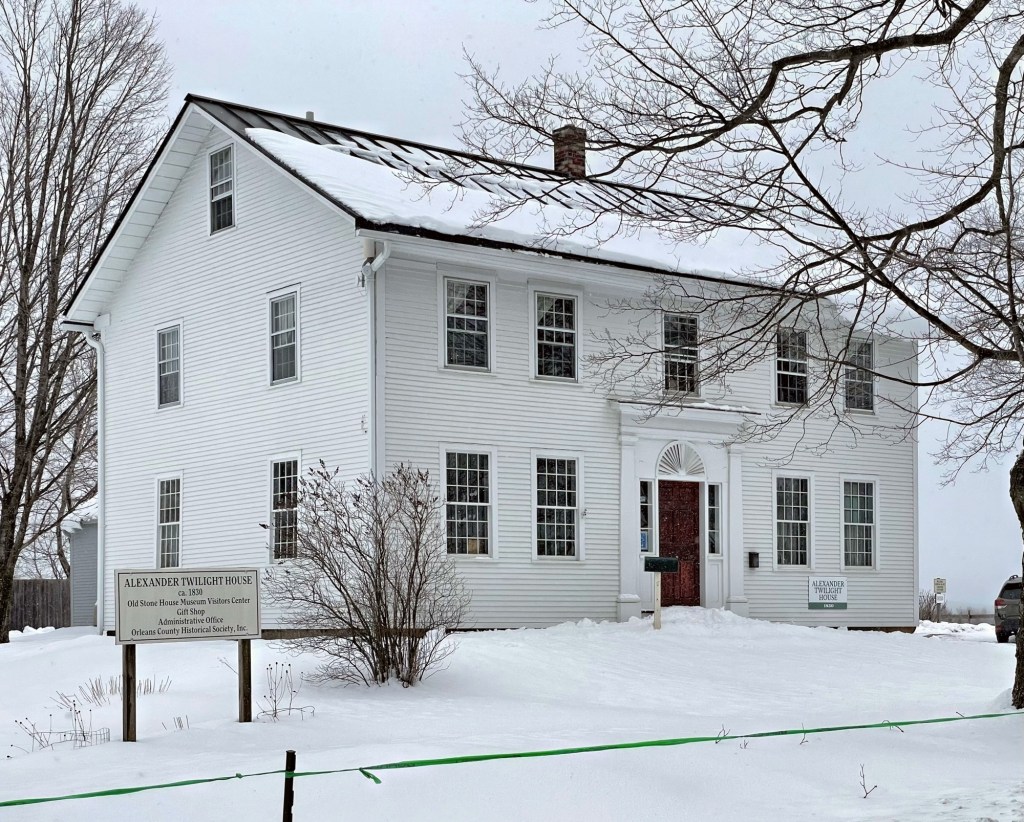
Alexander Twilight House // c.1830

The highlight of the town of Brownington, Vermont is the Old Stone House Museum & Historic Village, a collection of amazing 19th century architecture set amongst the rolling hills of the Northeast Kingdom. One of the buildings in the village is this structure, the Alexander Twilight House. Alexander Twilight (1795–1857) was born in Corinth, Vermont, on September 23, 1795. He was raised by a fair-skinned mother, Mary Twilight, and a mixed-race father, Ichabod Twilight. Twilight entered Middlebury College in 1821 and graduated in 1823, possibly making him as the first person of color to graduate from an American college. Alexander Twilight accepted the call and moved to Brownington to serve as the town’s reverend.  He also served as headmaster of the Orleans County Grammar School.  To meet growing enrollment needs, he designed, raised funds for, and built the first granite public building in Vermont, Athenian Hall, which contained classrooms and a dormitory. He had this Federal style house built in the village, large enough to house some students in his home. Before building his Federal style home, he lived in a much smaller, vernacular home, which was added onto the rear of this home as an ell (later separated by the museum). Elected to the Vermont General Assembly in 1836, Twilight became the first African American to serve in a state legislature in the United States. In 1847, after conflicts with the Orleans County school administrators, Twilight moved to Quebec, Canada for five years, but then returned to serve as headmaster in Brownington.  He died on June 19, 1857 and is buried in the Brownington churchyard

Original Twilight House

Cornè House // 1822

What does this house and the tomato have in common? Keep reading to find out!

Michele Felice Cornè (1752-1845) grew up in Naples Italy and became disillusioned with the Napoleonic Wars. After the French occupation of Naples in 1799, he fled and was brought to the United States on the ship Mount Vernon, commanded by Elias Hasket Derby Jr., and settled in Salem, Massachusetts. Cornè moved to Boston in 1807 and lived and worked there until 1822 when he moved to Newport, Rhode Island, purchasing a property containing a barn. Cornè either had the barn renovated into this 1822 house or built the Federal period house from its timbers. Here, Cornè would paint many maritime scenes as murals in homes and businesses. However, his true contribution to his adopted country was convincing his neighbors to eat the tomato. While in Newport, it is reputed that Cornè introduced the tomato into the American diet. In early 19th century New England tomatoes were thought to be deadly poison. Cornè was accustomed to eating tomatoes in his native land and would regularly eat them without ill effect and, thus, allayed the fears of the residents of his adopted country. Today, the popularity of the tomato in American cuisine can be credited (in part) to Cornè and his love for the tomato.

Second Congregational Meetinghouse of Nantucket // 1809

Located on a fairly quiet street on Nantucket Island, you will find the Second Congregational Meetinghouse of Nantucket, towering over the rows of historical homes nearby. Erected between 1808-1809, the church was constructed to house Nantucket’s growing population of Congregationalists on land formerly occupied by a dwelling house and barn. The bell was brought from Lisbon, Portugal, in 1812 by Captain Thomas Cary, was placed in the square belfry in 1815. The Great Fire of 1846, combined with the collapse of the whaling industry, brought hard times to the island. The congregation found itself unable to support a minister, and for the next forty years the church struggled on the brink of financial collapse. The building and its congregation persevered and the building is both an architectural and cultural landmark to the charming island community.

Folger Block // 1831

Built the same time as the stately brick, Folger House on Main Street (last post) in Nantucket, owner Philip H. Folger (1792–1865) in 1831 erected these rowhouses quickly selling them for profit. Each of the five connected dwellings were sold to private owners, and have seen alterations over time adding to the intrigue on this block. The Folger Block is comprised of five Federal-style, 2.5-story, wood-frame buildings with wood-frame party walls between each unit. Each row house sits atop a raised brick basement and has a side-gable roof pierced by twin front-gable dormers. Charming door surrounds include sidelights and transoms to allow light into the entries.

Folger House // 1831

Located in the middle of the commercial Main Street on Nantucket, the 1831 Folger House stands as a fully developed example of the Federal style in masonry construction. The house’s double bow front, brownstone lintels and Ionic portico, guilloche frieze, and cast-iron railings are the finest of their type in the community. Although the house was turned into commercial use in the mid-19th century with the addition of storefronts and the removal of its original hip roof, it retains substantial architectural elements of a more decorated design than was customary even among Nantucket’s wealthiest merchants in this period. The house was built for Philip H. Folger, a merchant and it was inherited by his son upon Philip’s death in 1865.

Pacific National Bank // 1818

Whaling captains and crew upon returning to the island of Nantucket, would be flush with cash and goods and needed a safe and secure institution to hold their earnings. By the late 18th century, the depletion of the whale population in the Atlantic required whaling vessels to travel further and further in search of oil to fill the barrels in their holds. Ships began sailing to the Pacific and due to the distance, would be out at sea for years rather than months. Money from the Pacific voyages flowed back to the island, which soon required real banking facilities, and the Pacific Bank was established in 1804 and immediately prospered. The bank erected this stately brick building at the end of Main Street Square. Details such as the blind arches filled with sandstone panels that surround the building’s windows, the semi-circular Ionic entry portico and the high brown sandstone stoop with wrought-iron railings are unique on Nantucket and among the finest examples of their type in the region. Also interesting about the building is the fact that it contained living quarters for the cashier whose presence was intended to provide security. The building is now (of course) home to a Bank of America.

Thunder Castle // c.1830

This charming Federal period dwelling in Mansfield, Massachusetts, was built around 1830 by Solomon Pratt and his brother-in-law, Elkanah Bates as a boarding house for the workers at their nearby cotton mill. The duplex was historically split down the middle with a unit on each side, accessed by the shared center stairhall. Local lore states that the Irish immigrant families who lived in this property reported that there were “supernatural” noises in the house, which frightened the occupants, they would tell friends it was “thundering in the castle”, giving the property the nickname, Thunder Castle.