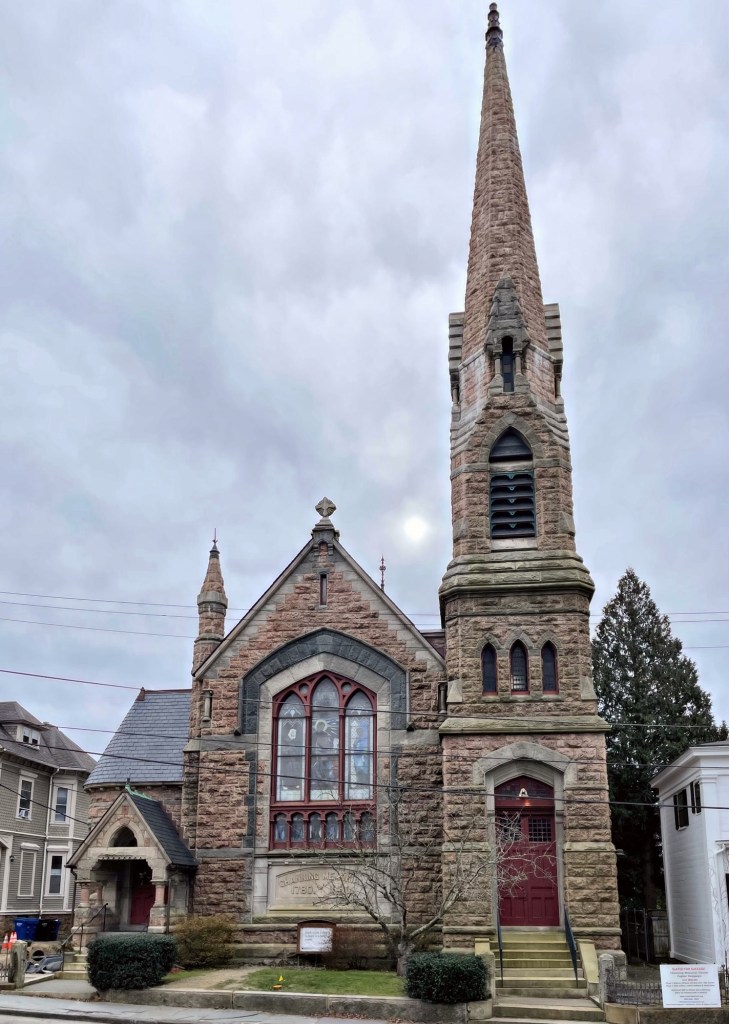
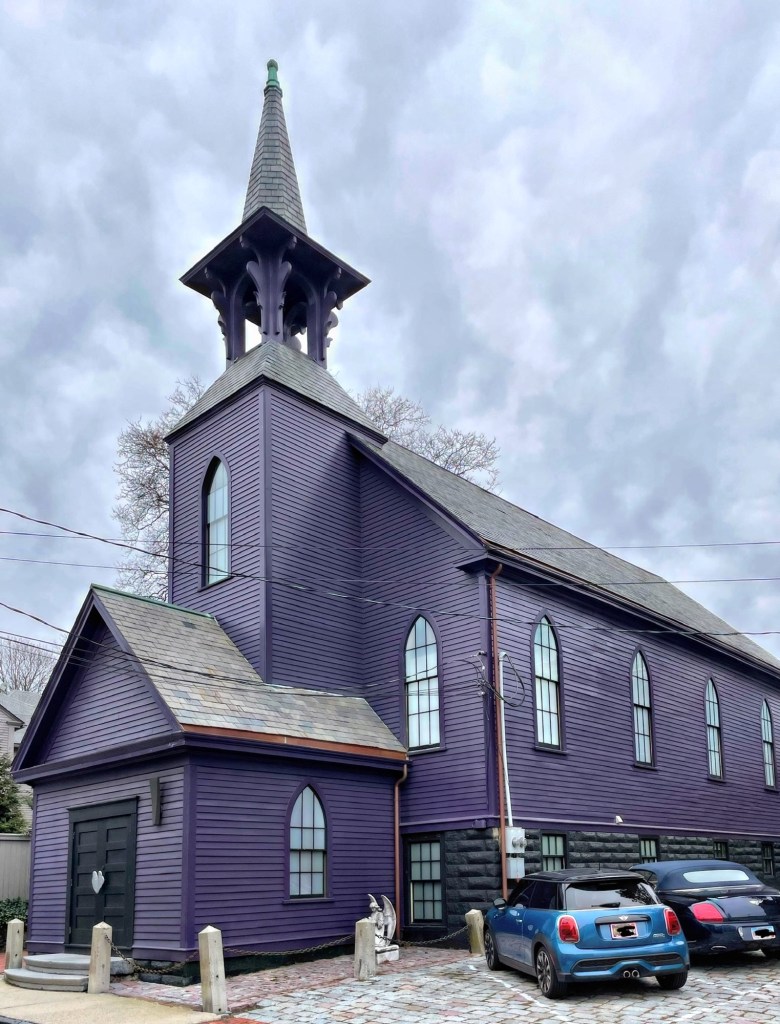
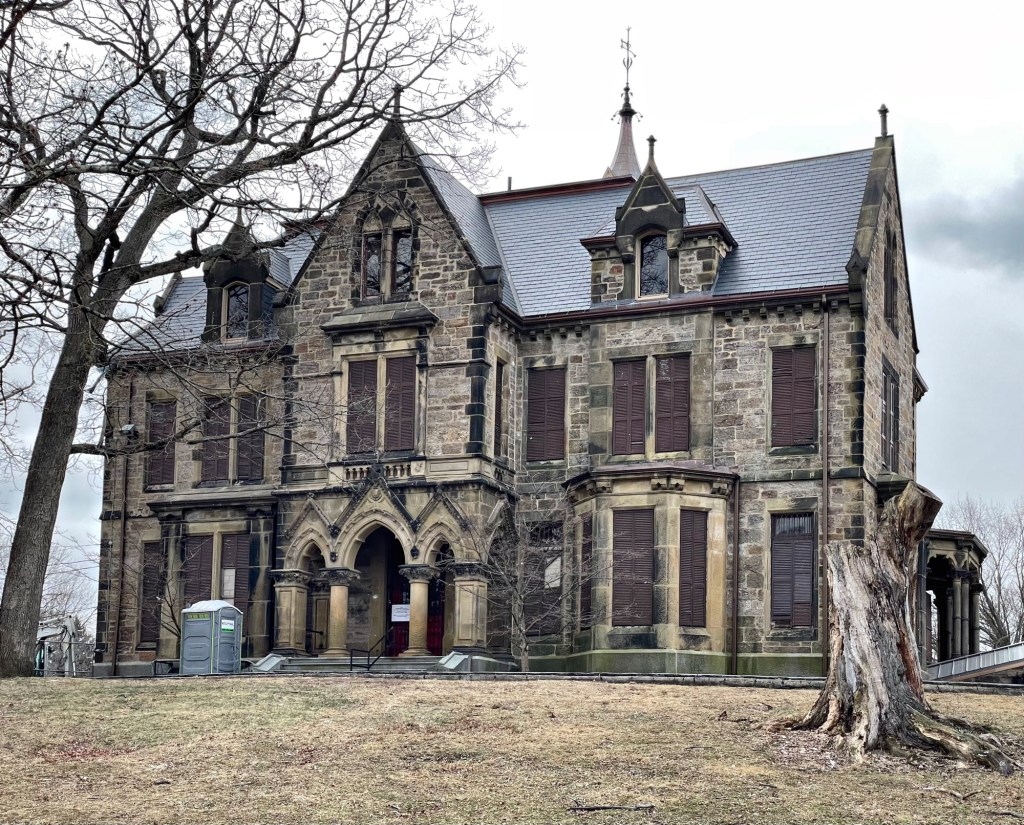
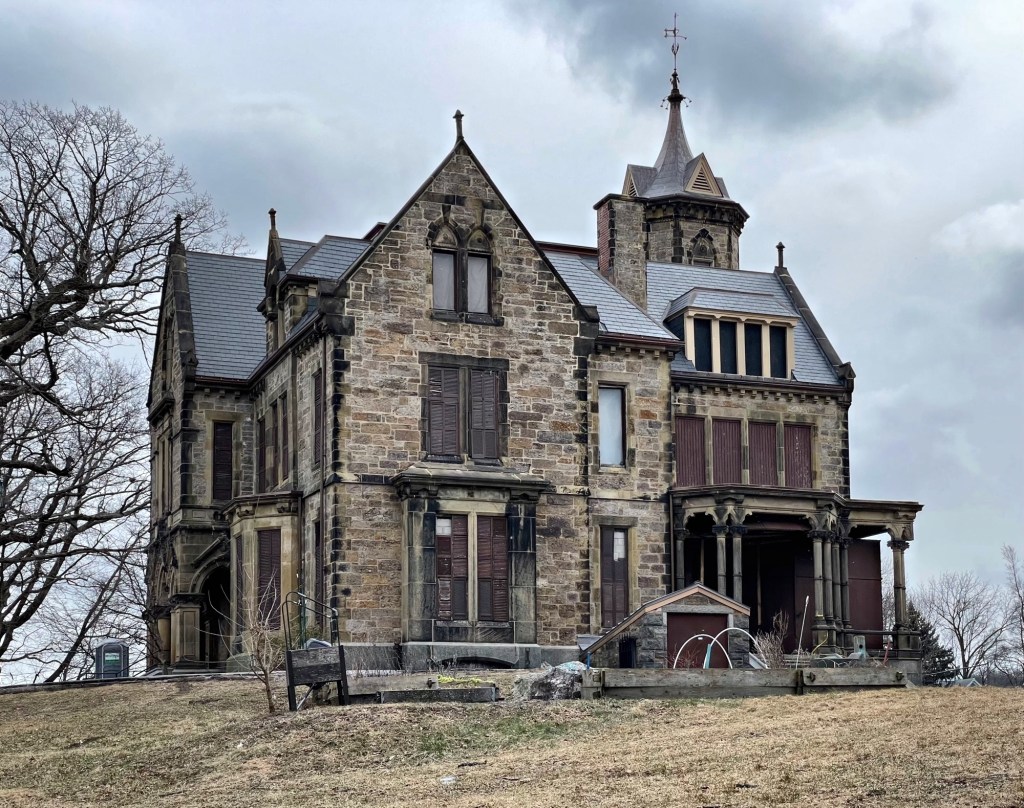
Soldier’s Memorial Library of Mansfield // 1901

Arguably the most beautiful building in Mansfield, Massachusetts is the Soldier’s Memorial Library in the center of town. Constructed in 1901, the Soldiers’ Memorial Library is a well-preserved example of 19th
century High Victorian architecture with Shingle style elements, designed by the prominent Boston architectural firm of Peabody & Stearns. In as early as 1896, the idea of constructing a building as a memorial to the soldiers who died in the Civil War had prominent local members of the community. In 1898, a relatively new resident in town, Mrs. Elizabeth Noble, donated a parcel of land for the building with the stipulation that the first floor was to be used as a library and the second floor as an “audience room”,
banquet room, and kitchen for the use of the G.A.R. The architects created one of their most significant civic buildings with an interesting juxtaposition of Gothic elements with Shingle style details. The Gothic lancet window and door surround blends surprisingly well with the use of rubblestone on the first story with buttresses and shingle siding above which give the building a fortress-like appearance.

Sudbury Aqueduct Waste Weir Control House // 1878

The Sudbury Aqueduct was constructed between 1875 and 1878 and runs for 16 miles from Framingham, Massachusetts to the Chestnut Hill Reservoir in Boston, and was in use for almost 100 years. It was designed to carry water from the watershed of the Sudbury River to Boston and its surrounding communities, supplying the ever growing metro area with fresh drinking water. Along the route, meter and control houses were built along with the Echo Bridge, to guide the running water to Boston for distribution all over the city. City architect of Boston, George A. Clough designed many of the structures along the route including this waste weir structure in Newton Centre. The weir was known as “Clarks Waste Weir” as it was built on the edge of land owned by Charles P. Clark. The aqueduct was taken out of regular service in 1978 but remains an emergency backup. Much of the aqueduct’s route is open to the public as an unimproved walking trail.

Charles H. Bennett Cottage // c.1868

Another of the charming gingerbread cottages in Newton Centre built on Charles Davis’ “Mount Pleasant” estate is this charmer. Like the Charles Davis rental cottage on Pleasant Street nearby, this home was rented by Mr. Davis to tenants briefly before it was purchased by George A. Rollins who later sold the property to its longest owner, Charles H. Bennett, a Boston stockbroker. The house is one of four near-identical gingerbread cottages developed by Davis, all retain their decorative bargeboard trim and porch detailing. This one may be my favorite!

Charles S. Davis Cottage // c.1868

When wealthy Boston manufacturer Charles S. Davis began subdividing his suburban Newton Centre estate, “Mount Pleasant”(last post) in the 1860s he was extremely particular on the dwellings and residents that would be his new neighbors. He sold off some parcels to friends and affluent members of the community and he also built some small gingerbread cottages – like the house seen here – for rent. This Victorian Gothic gingerbread house was rented to provide Mr. Davis with some additional income. It was eventually sold off to a private owner and has been meticulously preserved ever since.

Bunker Hill Baptist Church // 1889

The Second Baptist Church of Jefferson, Maine, was organized in 1808 and originally rented a schoolhouse for its services. After eighty years of cramped-quarters, the members of the church had enough funds to erect their own purpose-built church, this stunning edifice on Bunker Hill Road, in West Jefferson. The congregation broke ground in 1889 and the church was dedicated in January of 1890. Apparently, the belfry was originally at the center of the roof, but the heavy bell required a new steeple to be built at the corner, in its present configuration. This well-preserved church building was a treat to stumble upon when driving through the town.

St. Mary’s Roman Catholic Church // 1870

The second oldest Roman Catholic parish in Connecticut can be found in New Haven, at the St. Mary’s Roman Catholic Church. The parish was originally established in 1832, largely by Irish immigrants who settled in the area for work. The current St. Mary’s church building, located on Hillhouse Avenue near Yale University, was designed in 1870 by ecclesiastical architect James Murphy, and it was dedicated in 1874. The construction of a Catholic church on Hillhouse Avenue was strongly opposed by the Protestant elite who lived in the area, but the congregation prevailed. The Victorian Gothic style church is constructed of local blue stone and granite and while plans by Murphy originally included a corner spire for the building, it was not built until 1982 when the building was restored courtesy of the Knights of Columbus. The Knights of Columbus fraternal organization was actually founded in 1882 in New Haven by Father Michael J. McGivney, who originally held meetings in the basement of this church.

South Weare Union Church // 1875

In 1874, the Congregationalist citizens at South Weare, New Hampshire, decided to tear down their old church as it was in very poor condition and build a new one. The issue was that the Universalists owned a share of the old church, so, they decided to build a Union Church together. They broke ground in 1875 and it was completed months later in January 1876. The construction and furnishings were a group effort. The interior was furnished with circular ash pews, trimmed with black walnut. Osgood Fifield of Boston, a native of Weare, gave the beautiful pulpit; the Ladies Sewing Circle gave the carpet, assisted by the Universalists. The Victorian Gothic church building is impressive for such a small, rural congregation at the time. It has lancet windows, a circular rosette window in the gable end, and a steep gable roof capped by a towering belfry. The church even retains its historic horse sheds at the rear!

Yale University – Street Hall // 1866

Closing out this series on Yale’s Old Campus, I present one of the finest Victorian Gothic collegiate buildings in the United States, Street Hall. Street Hall was designed by Peter B. Wight (who had just completed the Venetian Gothic style National Academy of Design in New York City) and opened in 1866. The building opened as the Yale School of the Fine Arts, which was the first art school on an American college campus. The building was named after Augustus Russell Street (1791–1866), a Yale graduate and New Haven businessman who donated the funds for the building’s construction on the condition that all residents of the city could enroll in the school, wanting a bridge between citizens of New Haven (“Town”) and the college “Gown”). Augustus Street and his wife, Caroline Leffingwell had seven daughters together, all of whom predeceased them. It was likely the fact he was around so many women in his life that he also required the Yale School of the Fine Arts to admit both male and female students (Yale would become co-educational and admit women to all programs in 1969.) Street Hall is a landmark example of the Victorian/Venetian Gothic style with lancet arches, polychromatic stone, and trefoil and quatrefoil stone medallions. Street Hall is now connected to, and is a part of the Yale University Art Gallery.

Yale University – Lawrance Hall // 1886

Lawrance Hall was built in 1886 following a financial gift to the college by Frances (Garner) Lawrance, as a memorial to her late son, Thomas Garner Lawrance (1862-1883), who died unexpectedly during his senior year at Yale. The building was designed by New York architect Russell Sturgis, who previously designed Farnam and Durfee halls as well as the Battell Chapel, all enclosing the northeastern edge of the Old Yard. Lawrance Hall is the last Victorian Gothic style building constructed at Yale and also Sturgis’ last commission at the college. Here, Sturgis designed a Gothic building to provide continuity to his earlier dormitories nearby, but added French flair seen at the end towers and rounded turrets at the street facade. The French inspiration may have been a suggestion by Mr. and Mrs. Lawrance as they operated Cercle anglais, an English Club in Pau, France where they occupied Villa Lawrance, when living there. Today, Lawrance Hall is the freshman dormitory for Ezra Stiles College at Yale.

Yale University – Battell Chapel // 1874

As the Old Campus of Yale was being enclosed at its north and east by Farnam and Durfee halls, architect Russell Sturgis was again tasked to design a new building, but for a corner site; though this time, he would design a college chapel. Built between 1874–76, it was funded primarily with gifts from Joseph Battell. Succeeding two previous chapel buildings on Yale’s Old Campus, it provided space for daily chapel services, which were mandatory for Yale students until 1926, which were all-male and mostly Protestant. The large stone chapel is constructed of New Jersey brownstone with decorative elements in sandstone. The design of the Victorian Gothic chapel is great, but how it sits with the entrance unceremoniously dumping out to the end wall of Durfee Hall leaves much to be desired.