Mumford-Brown House // 1847

Incredible triple-decker vibes with this beauty on Providence’s College Hill neighborhood. In 1847, this home was built as a single-family, Greek Revival style home for Henry G. Mumford, who worked as a City Marshal for the City of Providence at City Hall. The house was likely originally a one-story or two-story Greek Revival cottage which was upgraded in a BIG way after Mumford’s death! His heirs sold the family house in 1859 it was owned by John A. Brown and his wife, Ellen. It was likely Ellen who had the property converted to a triple-decker with three units in the home. It was modernized with Italianate detailing, including the elaborate window hoods, front portico and side porch, round arched windows, and extra floor for additional rental unit. The property was later owned by Governor and member of the Taft Political family Royal C. Taft as an income-producing property.

Eliza and Samson Almy House // 1859

The College Hill neighborhood of Providence has some of the finest residential architecture in New England, and some really fun stories of those who built these grand homes. In 1859, the house was built with a concave mansard roof punctuated with dormers and a bold bracketed cornice below. The use of round headed windows on the second floor is a really great design detail. The residence was first owned by Eliza Talbot Almy (1808-1886), who held the title to the property. Wives holding the title of properties in this period was fairly common as it would protect their personal property and residence from financial risk if the husband was met with lawsuits or financial hardship. Eliza’s husband was cotton broker and manufacturer Samson Almy (1795-1876), who had already been sued in a case heard before the United States Supreme Court in 1851. After Eliza’s death in 1886, her daughter, Susan Smith (1837-1917) and husband, Amos Denison Smith (1835-1912), a Civil War veteran, occupied the house into the early 20th century.

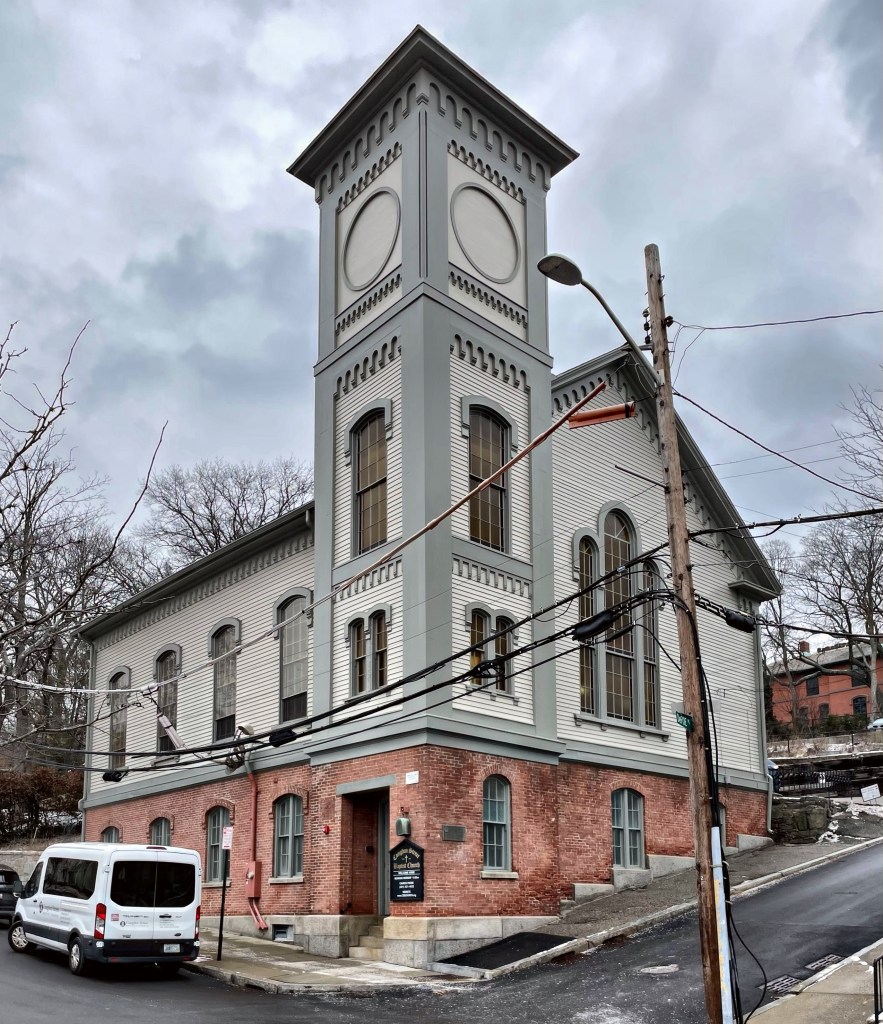
Congdon Street Baptist Church // 1875

The Congdon Street Baptist Church on College Hill is extremely significant as part of the rich history of Providence. Its origins began in 1819, when Moses Brown, an abolitionist, industrialist and member of the Brown Family (who profited on the institution of slavery) gave land to “the people of color” of Providence for a schoolhouse and meeting house. The original building stood slightly north of the present structure and it was built in 1821. The structure provided the first schoolhouse for Black children in Providence. In 1869 the building was torn down, without the approval or knowledge of the congregation by white neighbors because “its proximity displeased them”… Eventually the congregation arranged an exchange of lots with one of the church’s neighbors and architects Hartshorn & Wilcox were commissioned to design the new church building. Hartshorn was the successor of Thomas A. Tefft and this church echoes many of his designs in the Italianate style. The new building was completed in 1875 at the cost of $16,000. It was renamed the Congdon Street Baptist Church. The church has since 1875 served as an important landmark and gathering place for many Providence’s Black residents past and present.

Welcome Congdon House // c.1820

In 1820, Joseph Dorr, a trader, purchased this house lot in Providence’s East Side overlooking present-day Downtown. He had this Federal style house built with a symmetrical five-bay facade with fanlight transom over the door. He occupied the house until 1827 when he sold the property to a Charles Hadwin. In 1832, the property was acquired and soon after purchased by Welcome Congdon (1794-1874) who lived there until his death. The house was more recently added onto with a Modern addition on the side, to provide additional, private space for the owners who live directly next to a public park.

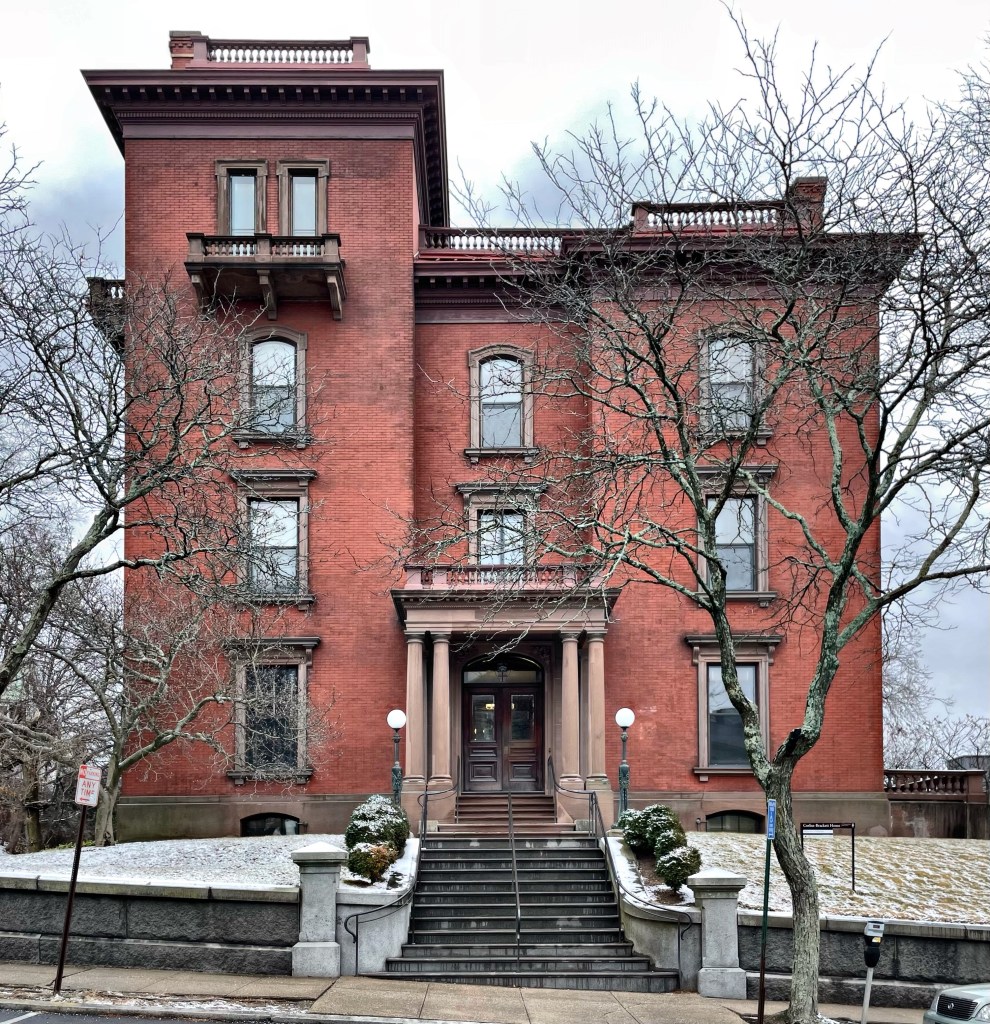
George Corliss – Charles Brackett House // 1878

This mansion, one of the finest in Providence, was built in the late 1870s by George H. Corliss for his second wife. Corliss (1817-1888) was the inventor of the most widely used industrial steam engine of the nineteenth century. Corliss’ first wife Phebe died in 1859. Seeking companionship, George remarried in 1866 to Emily Shaw who was eighteen years younger than he. Ms. Shaw suffered from poor health and she with the assistance of her doctor, convinced Mr. Corliss that she escape the cold winters of Rhode Island for Bermuda. It does not appear that they relocated to Bermuda, but Corliss stated, “I will build Bermuda for Mrs. Corliss.” He did, and this is it. Corliss used his engineering skills to build a state-of-the-art, climate-controlled building, cool in the summer, warm in the winter. The Italianate Villa is one of the largest in town but employed a style that was dated upon completion. In 1929, Corliss’s great-nephew, screen-writer and movie producer for Paramount Studios Charles Brackett inherited the house. He in turn eventually transferred the house over to Brown in 1955, who have maintained the old mansion to this day!

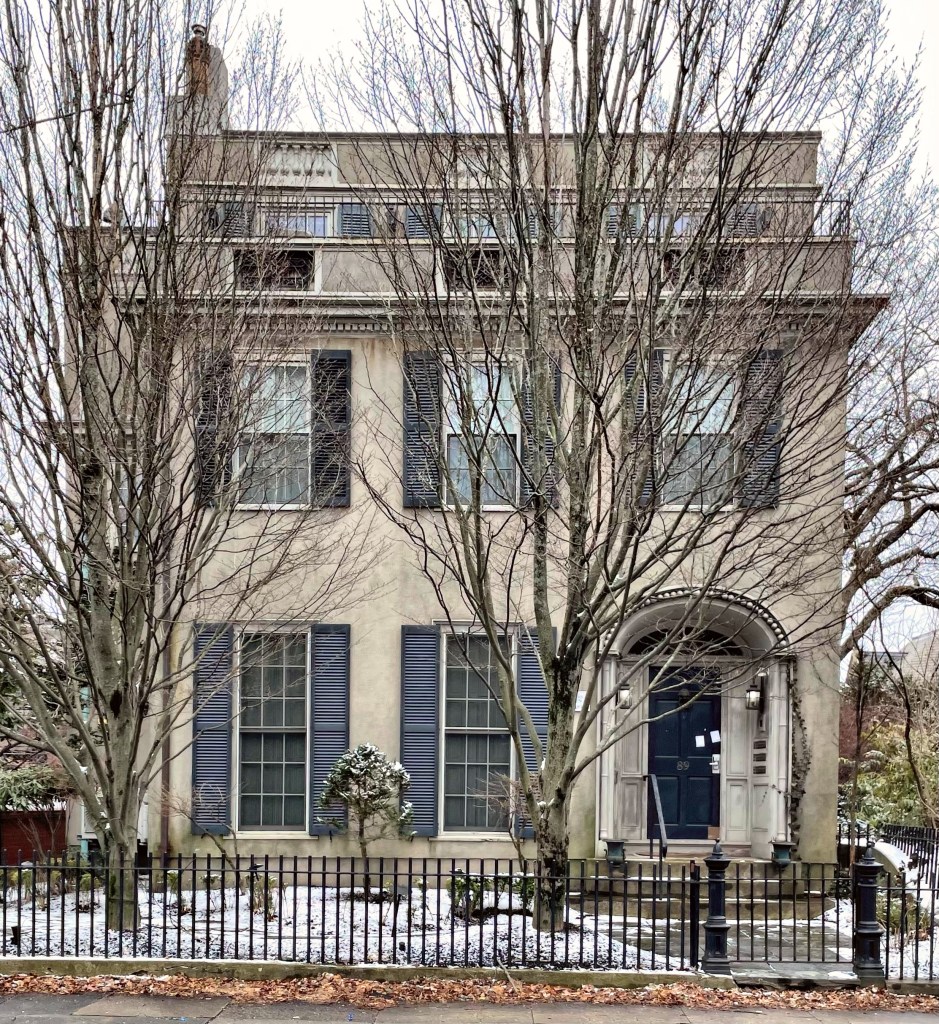
Benjamin Bliven House // 1849

Although Benjamin Bliven built this house, he never owned the property, but the name lives on! This house on Angell Street in Providence was originally constructed in 1849 in the Greek Revival style, popular at the time. Bliven, a musician, rented the property to tenants until the deed was transferred to Abby W. Watson, wife of Robert W. Watson (owner of the property next door and featured on this account previously). The first owner-occupants were Grace A. and Eugene H. Greene, who bought the property in 1898. The house was completely remodeled in the early decades of the 20th century with Regency/Colonial Revival detailing. Changes including the former roof with its gable-end facing the street boxed off, a new modillion cornice with parapet above; recessed attic story with balustrade; small wing to the east. The stucco siding and Federal entry is icing on the cake!

Samuel B. Wheaton House // 1850

Another Italianate mansion on Angell Street in Providence is the Samuel B. Wheaton House which is presently occupied by Brown University’s English Department. Samuel Burr Wheaton (1807-1863) was a merchant who also served as president of the Phenix Bank. The building is capped by a shallow hip roof which is not visible from the street and wide, overhanging eaves supported by brackets. The house is a Villa in plan as it features irregular massing and not a symmetrical form, just sans tower. The Wheaton House was acquired by Brown University who has since added onto the rear of the house for the English Department offices and classroom spaces. LLB Architects is credited with the contextually designed additions which utilizes lead-coated-copper clad connectors that are recessed between sensitively-scaled brick pavilions that preserve the integrity of the original house by letting it stand proud of the later additions.

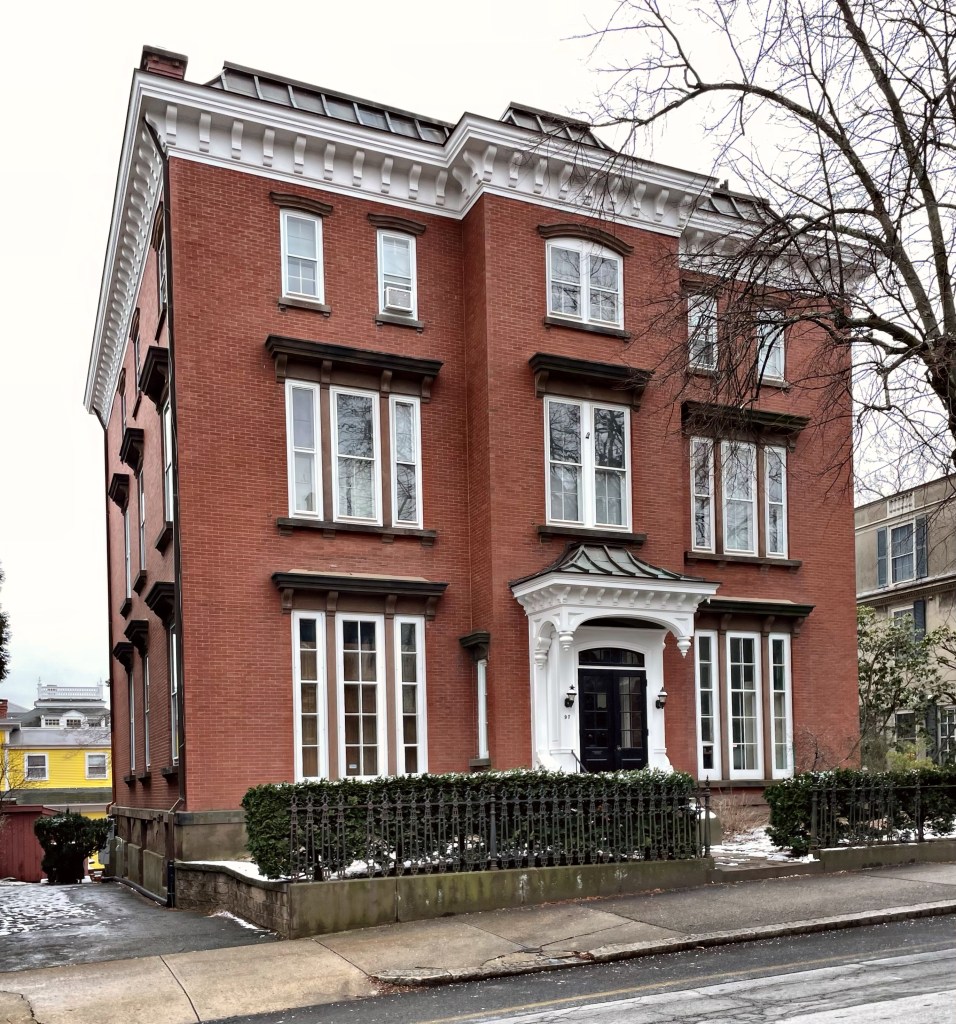
Watson-Knight Mansion // 1854

No town does Italianate architecture quite like Providence! Case in point, the Watson-Knight Mansion, a relatively overlooked example of the style found on Angell Street in College Hill. In 1854, a house lot here was purchased by an elderly Matthew Watson (1786-1857), who possibly lived in half of the house for a few years until his death. Directories also list his son Robert as living in the home in 1854. The three-story brick mansion has a boxy form with symmetrical facade. Brownstone hoods and sills are located at the windows and add depth to the otherwise blank facade. A projecting wooden door hood with hanging pendants covers the large entry. The home remained in the Watson Family until it came under the possession of Robert Brayton Knight (1826-1912) a businessman and mill owner who became the largest individual owner of cotton mills in the world, with upwards of twenty distinct establishments under his personal control. He co-founded what became the Fruit-of-the-Loom brand with his brother in the 1850s. The building has since been divided into apartment/condominiums.

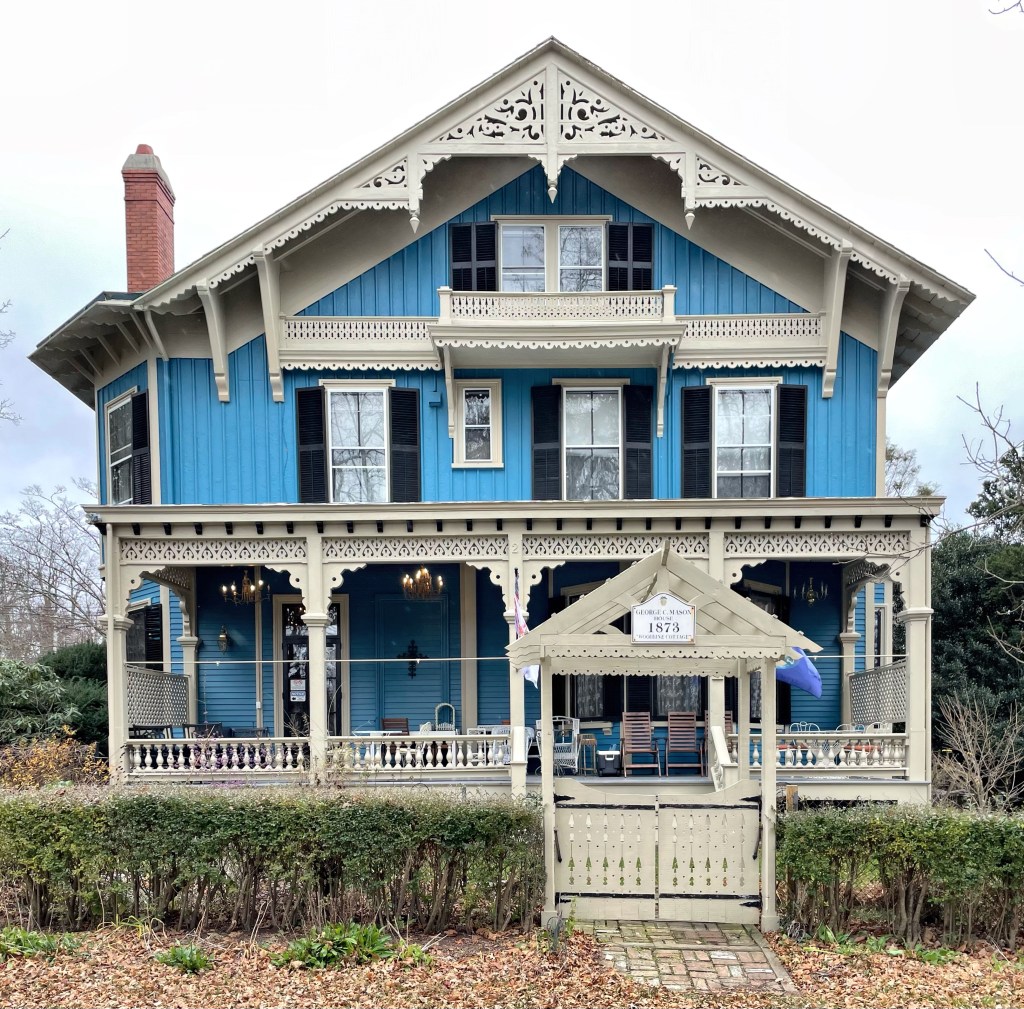
Woodbine Cottage // 1873

George Champlin Mason (1820-1894) can be credited as one of the most influential people who helped make Newport what it is today. He was born in the old Colonial town in 1820 and after a brief period working in New York City in dry goods, he traveled to Europe in his twenties to study art in Rome, Paris, and Florence, specializing in landscape paintings. Mason spent the 1840s trying unsuccessfully to make a living as landscape painter and published Newport and Its Environs, a collection of 11 engravings of his landscape views of Newport that is one of the earliest books about Newport to showcase its potential as a vacation destination. In 1851, Mason switched professions and became part owner and editor of the Newport Mercury newspaper. He often wrote on architectural subjects. In around 1858, he took his love for art and architecture and became an architect/developer, just as Newport was seeing early stages of development as a summer colony. He was hired by some early summer residents to design their homes, and did not disappoint, gaining notoriety all over the northeast. His son George C. Mason, Jr. (1849-1924), followed in his father’s footsteps and is said to have been the first professional architectural preservationist in the United States. George Sr., built this house as his primary residence in 1873, a stunning and rare example of Swiss Chalet architecture in New England, notable for the use of pierced bargeboards, board-and-batten sheathing, and cut-out railings. The property also included a charming stone English Revival tower in the rear yard, built in the 21st century as a workshop for the previous owners. How cool!

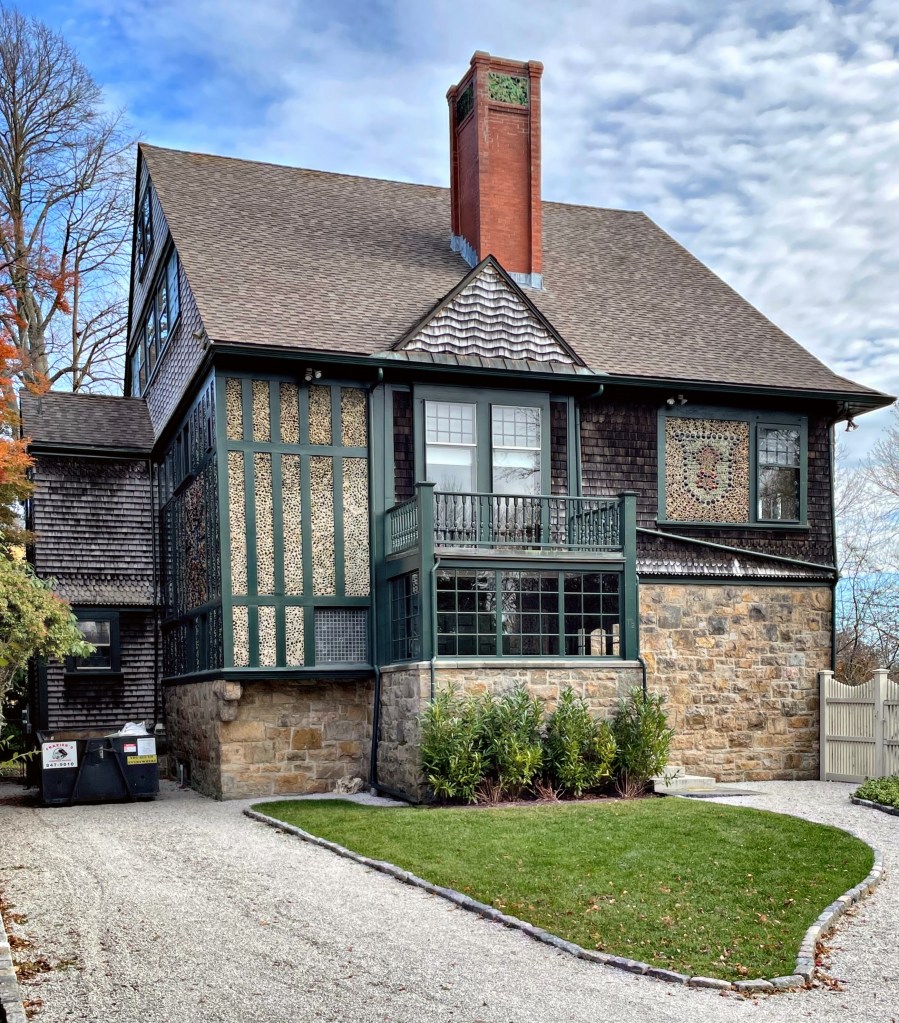
Samuel P. Tilton Cottage // 1880

One of the most well-designed and least-pretentious summer cottages in Newport is this charming dwelling on a dead end street. The Samuel P. Tilton Cottage was designed in 1880 by the prestigious firm of McKim, Mead & White as an idiosyncratic blending of Queen Anne and Shingle architectural styles. Mr. Tilton was a milliner (maker and seller of women’s hats) with stores in Boston and Paris, France. He had this cottage built to summer close to the nation’s wealthiest, likely marketing some hats at elaborate Gilded Age events. The facade is assertively Queen Anne with its massing and decorative panels, with shingled side elevation seemingly sprouting from the earth. The architectural terminology for these unique decorative panels is “sgraffito” where here, cement or plaster siding is set and adorned with shells, pebbles, colored glass, and pieces of coal into a cartouche design. The house is one of the finest in Newport, and shows that bigger isn’t always better!