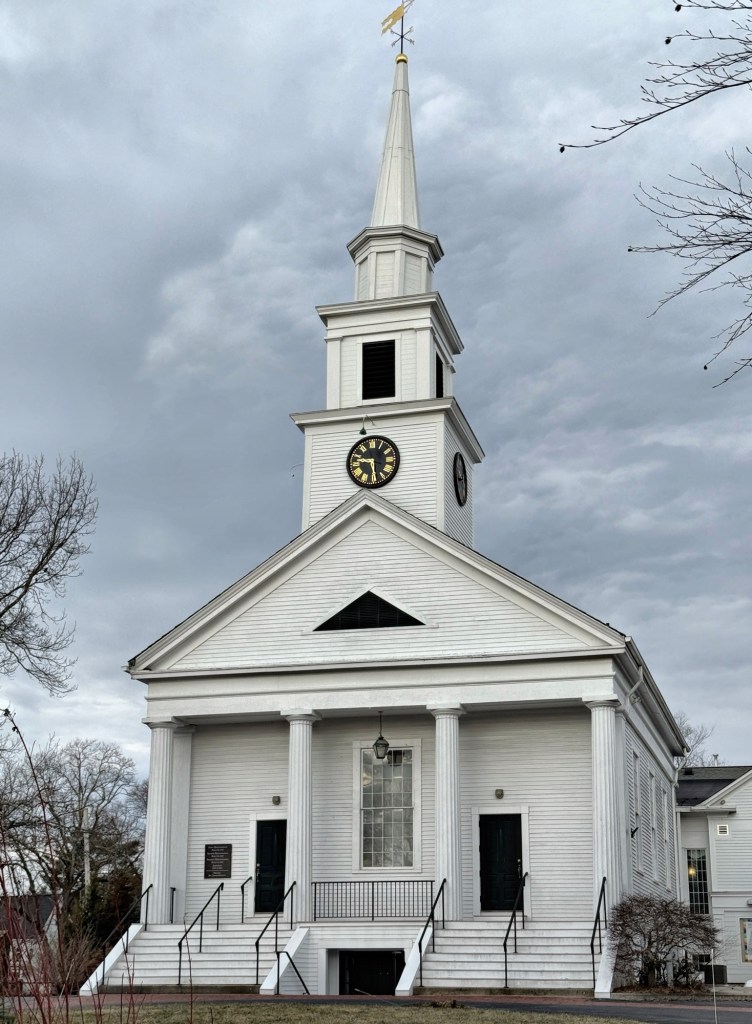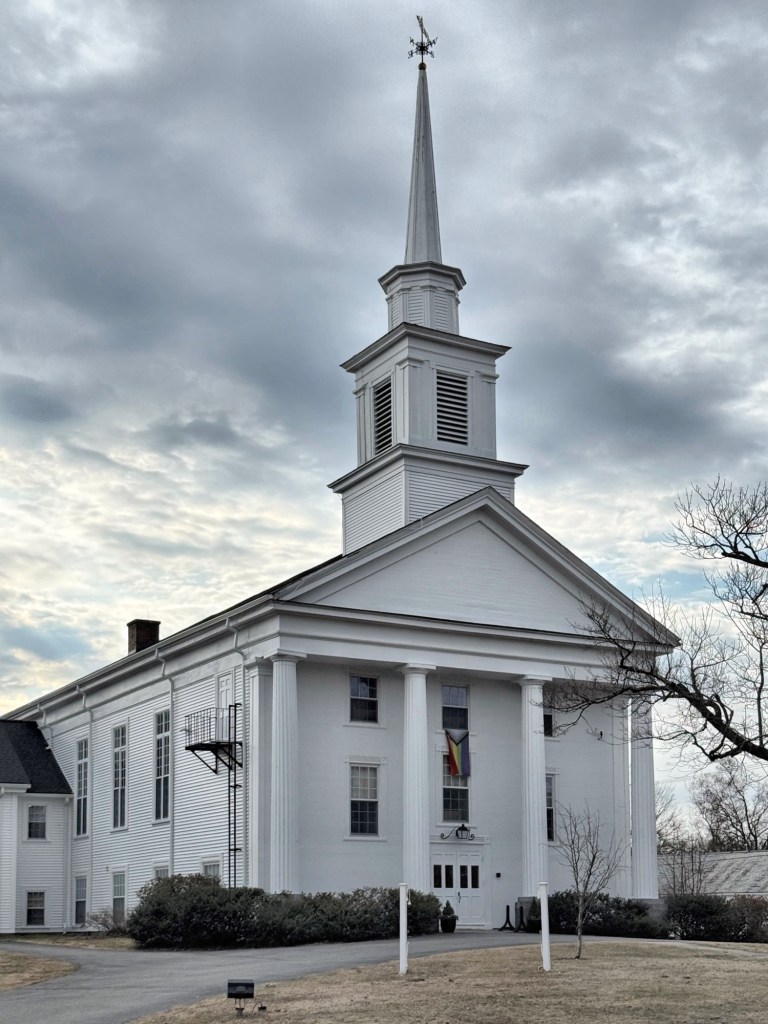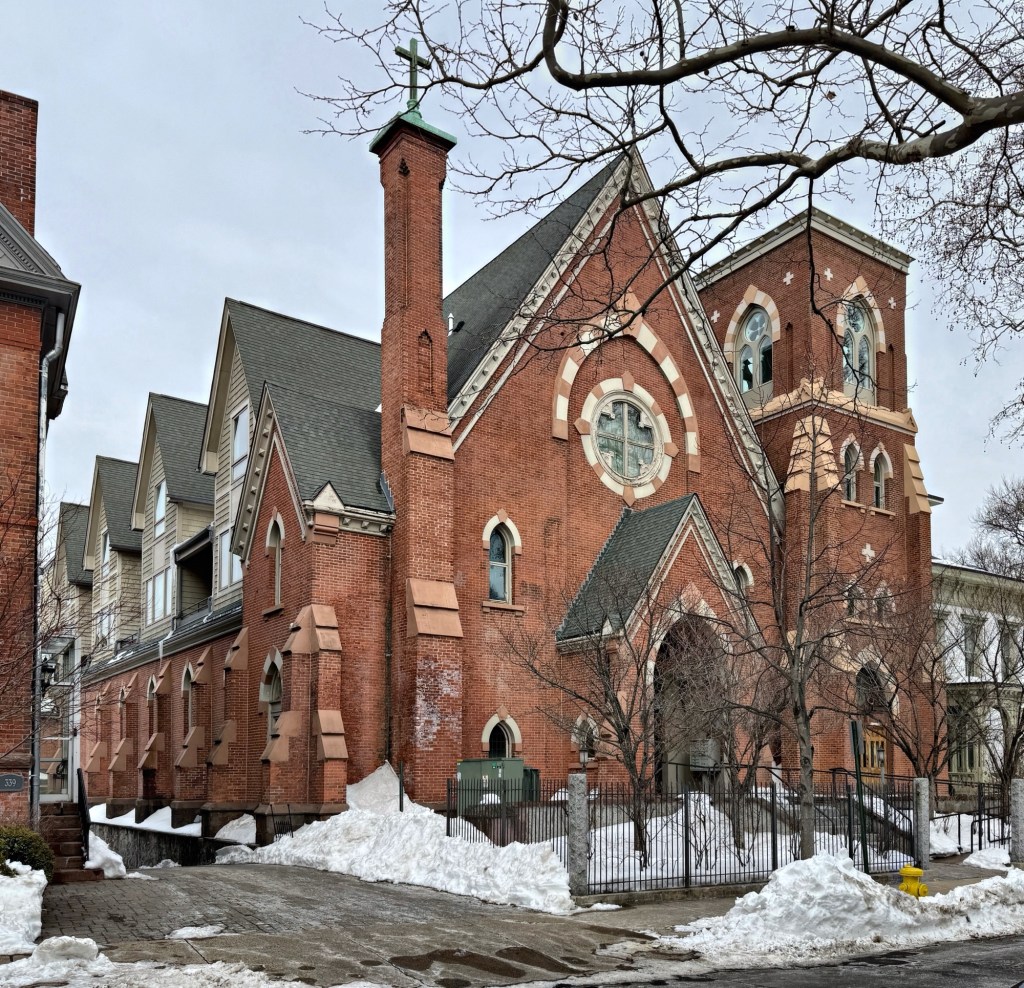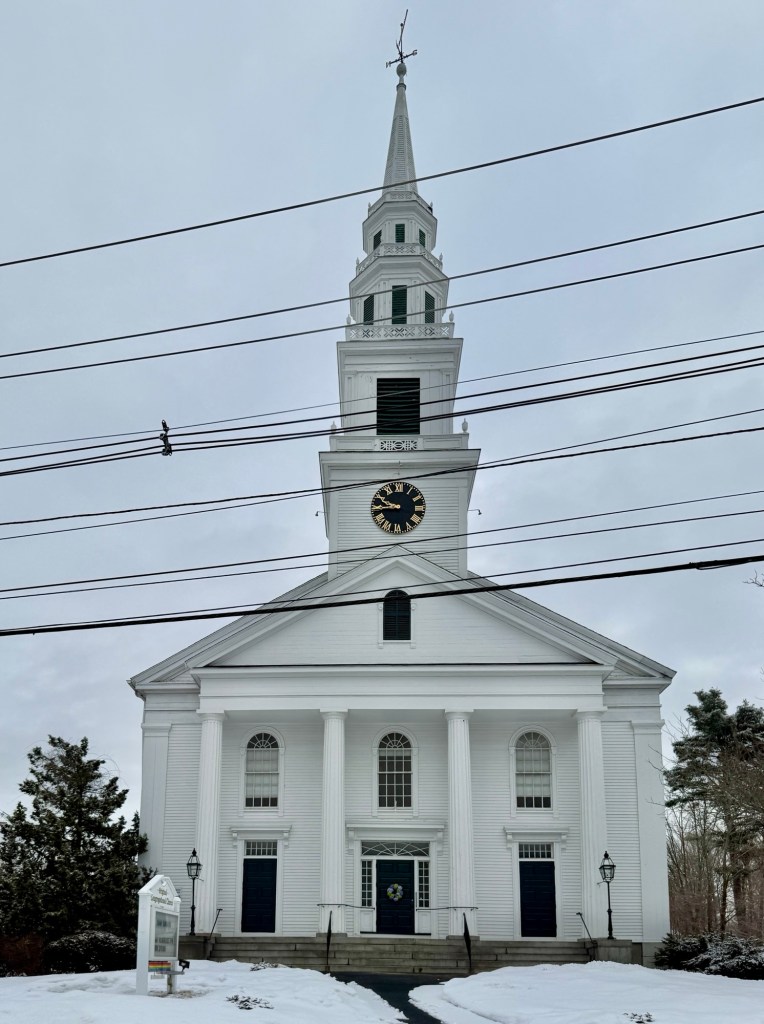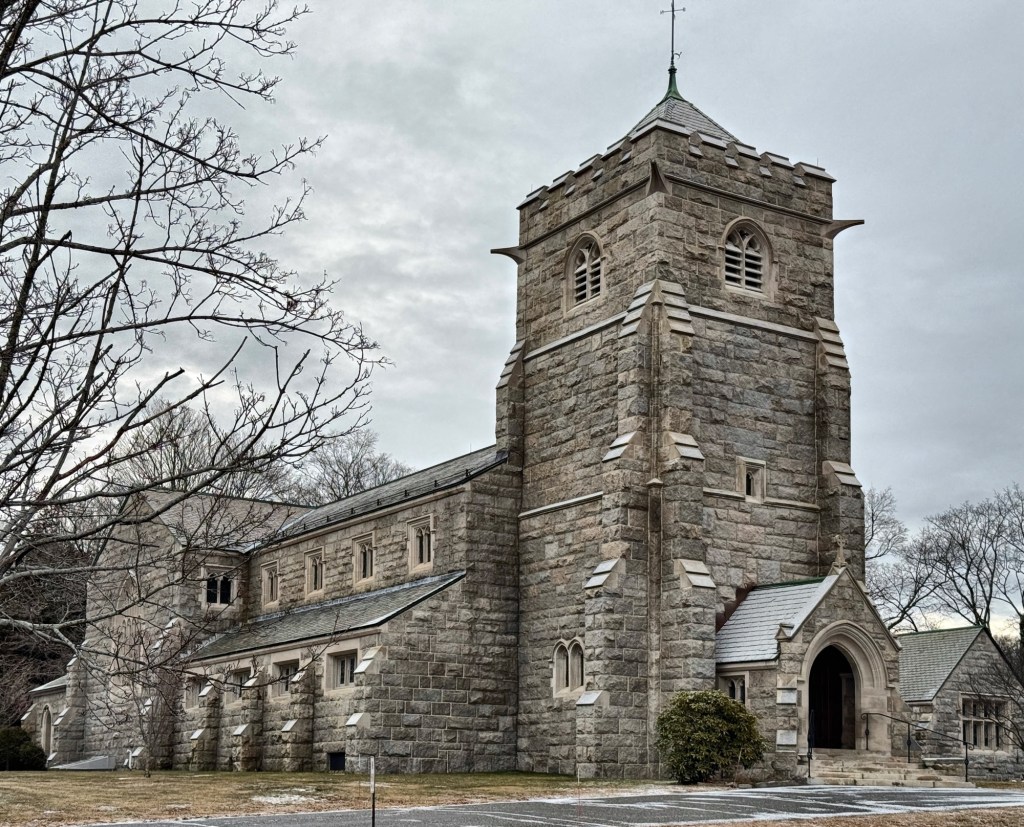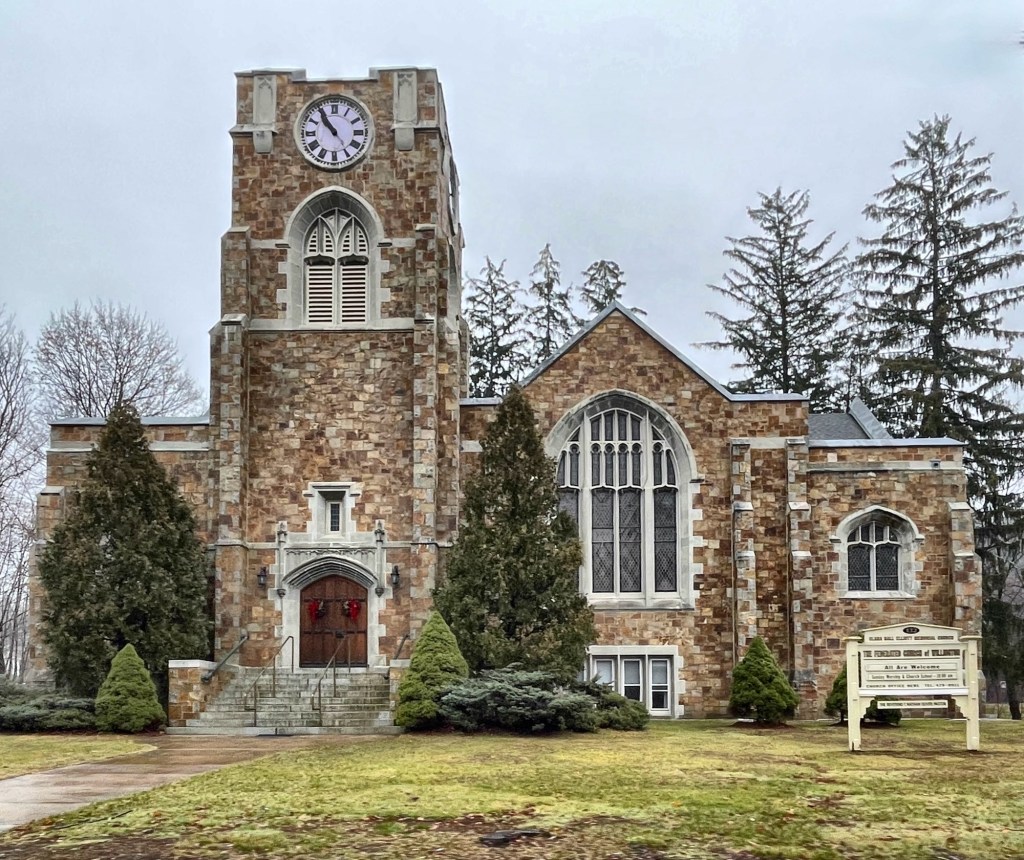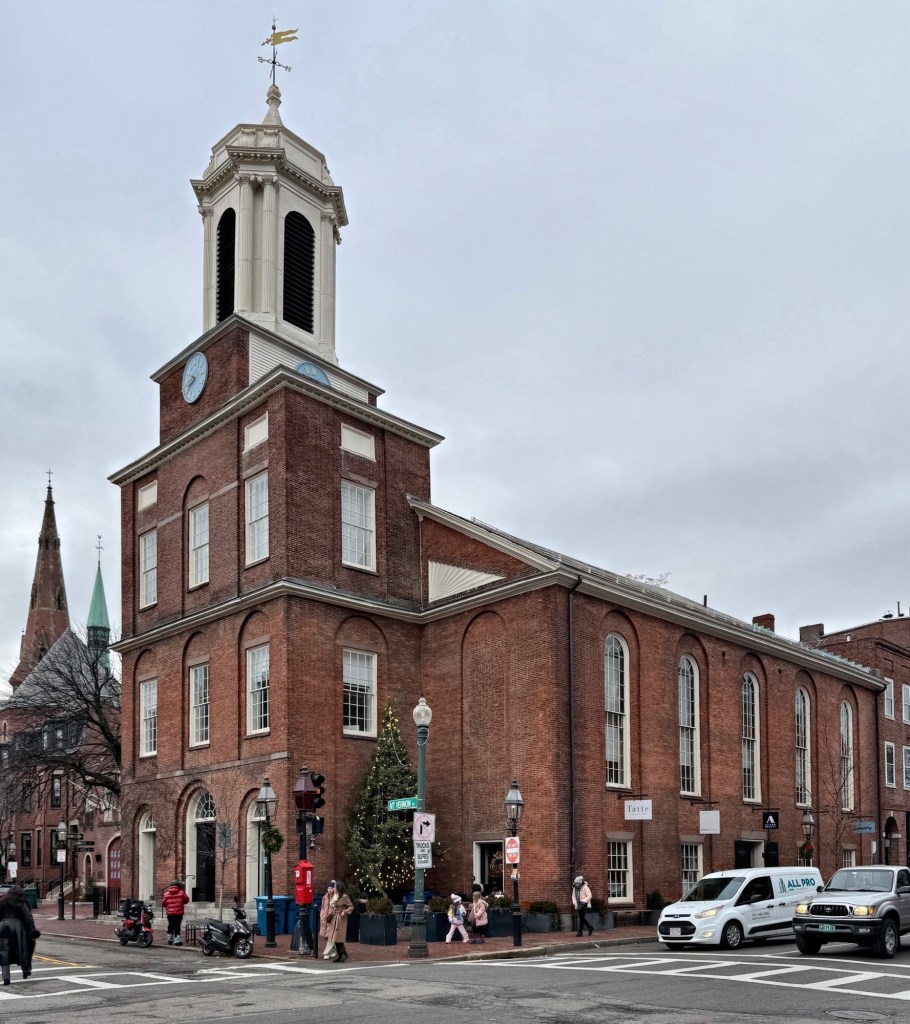
Congregational Church of Deep River // 1833

The town of Deep River, Connecticut, was originally a part of the Saybrook Colony, a large area at the mouth of the Connecticut River that was settled by English colonists. As what has become Old Saybrook grew, settlers moved further and further away from the original settlement and, eventually they received permission to form their own parishes so that they would not have to travel so far on Sundays to attend church services. As these outlying parishes grew, they separated from Saybrook and became the present day towns of Lyme, Old Lyme, Westbrook, Chester, Essex, and Deep River. Residents of present-day Deep River traveled to church services in Centerbrook, a village in Essex until this church was built in 1833. First services were held here the following December. The Greek Revival style church is ecovative of many similar 1830s village churches in New England, employing elements of the Greek Revival architecture style, with large doric columns, corner pilasters, and square belfry also with pilasters. The congregation here has been active for nearly 200 years.

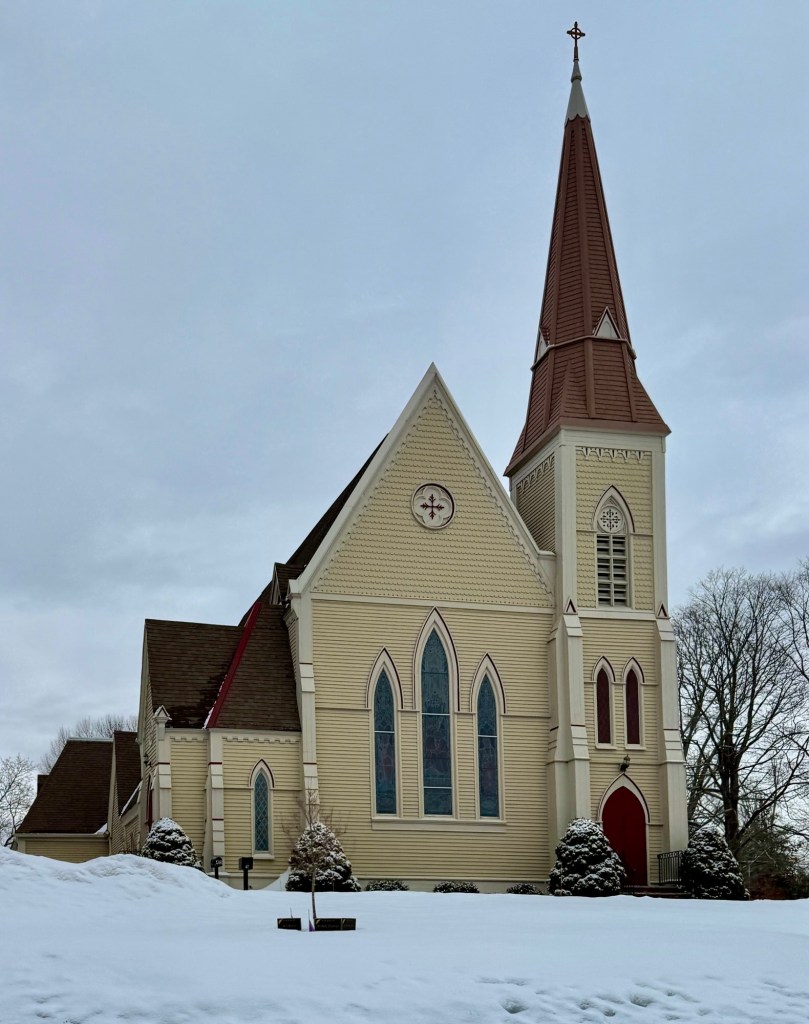
Swedenborgian Church of Lancaster // 1881

Built in 1881, the Swedenborgian Church of the New Jerusalem in Lancaster, Massachusetts, is a handsome Victorian-era chapel that has been well-preserved for nearly 150 years. The Queen Anne/Shingle style church was designed by architect Francis Ward Chandler of the firm, Cabot & Chandler, for the local Swedenborgians in Lancaster, some of which likely spent summers in Lancaster from Boston. The membership of the church dwindled in the early 20th century, and the congregation sold the church to a local women’s social group, the Current Topics Club in 1923. The women’s club met in the old church and maintained the building for nearly a century until the building sold to private owners in about 2007, who converted it to a residence, preserving the unique architecture we still see today.

Chester Baptist Church // 1835

The Baptists of Chester, Vermont, first built a wood-frame meetinghouse in 1788 for meetings and worship. The congregation here was established a year prior by Aaron Leland (1761-1832), a successful pastor and preacher, who settled in town with the task of building up a church there. Active in politics, Leland served in local offices including Town Clerk and Selectman, and was Windsor County Assistant Judge for eighteen years, he was later elected into the Vermont House of Representatives and served as Lt. Governor. After his death, the Federal style building was outgrown and sold by the 1830s. The original meetinghouse was moved to its current location across from the town’s Congregational Church and planning began for a new house of worship. The current Baptist Church, an impressive brick edifice in the Gothic Revival style, features a high slated spire that was likely added in the early 1870s, replacing a more traditional wooden crenelated tower. The 1870s spire was destroyed in 1953 and reproduced in 1999. The congregation here remains active and maintains the church well.

First Parish Church, Kingston // 1851

The original Congregational Church of Kingston was part of the established, tax-supported church of the Commonwealth of Massachusetts, and was built in 1718, after present-day Kingston established itself as Plymouth’s North Parish. The church was replaced in 1798 with a more substantial building with two steeples. In 1833, when the separation of church and state was finalized in the Commonwealth, two new religious societies formed in Kingston and established churches. The 1798 church, which had been built as the only church in town, was now too large for its diminished population and suffering from structural difficulties. In the spring of 1851, the 1798 church was taken down, and the present church, the third on the site, was constructed. The church blends Greek Revival and Italianate styles, both popular for ecclesiastical buildings of its time, and the structure looks much like it did when built 175 years ago. The congregation here is Universal Unitarian.

Tabernacle Congregational Church of Salem // 1923

The Tabernacle Congregational Church at Washington and Federal streets in Salem, Massachusetts, was built in 1923 for one of the oldest congregations in the Commonwealth. The Tabernacle Church’s congregation traces its origins to the founding of the First Church of Salem in 1629. The church was originally located a few blocks away until a fire destroyed the wooden building in 1774. The congregation built a new wooden church on this site by 1777, and have remained on the site ever since the United States was established. The present, stone church building, was constructed from designs by the Boston firm of Philip Horton Smith and Edgar Walker in 1922. This dignified and graceful Colonial Revival church building (with attached parish house) is the third ecclesiastical structure to stand on this site. It replaced a large wooden Italianate church which the parish occupied from 1854 until it was torn down in 1922. Its predecessor, which stood from 1776 to 1854, possessed an elegant three-stage tower which Samuel McIntire added in 1805. The Tabernacle Church is a stone-veneered masonry building with a prominent engaged tower which contains a large arched entry, and a giant order porch consisting of four Tuscan columns and associated pilasters of the same type, which supports a pedimented roof that shelters the entrance. The tower is surmounted by a square, wood-frame belltower with pilastered corners above which is an open octagonal cupola with bell-cast roof. What a great Colonial Revival style church!

Church of the Holy Name of Jesus, Chicopee // 1857

With crop failure a common occurrence in 1830s Ireland, immigration from Irish to New England surged with workers and families looking for a better life. Labor opportunities were abundant in the newly established mill town of Chicopee, with the Irish flocking here to dig canals, build dams and mills and later work in those same buildings. Their wives and daughters would work as cooks and maids, but later as operatives in those same mills. As many Irish were Catholic, it became apparent that a Catholic congregation should be established, St. Matthew’s was first organized in Chicopee in 1838. An earlier wood-frame church was built and used for a number of years until a large site on South Street was purchased by the Diocese for a new campus. Irish-born ecclesiastical architect Patrick Keely designed the church building which was constructed between 1857-1859 in the Gothic Revival style. The church was dedicated the “Holy Name of Jesus” church and exhibited sandstone-topped buttresses, rows of pointed dormers running down the clerestory on the sides, and a prominent central steeple. In 1910, the present copper spire replaced the original steeple which was damaged and burned in a lightning strike. The complex grew throughout the 19th and 20th centuries, with a rectory, schools, convent and monastery built on the site. Sadly, due to dwindling membership and fiscal considerations, many of these buildings were demolished in the past decades. The church appears now to be closed and is still owned by the Archdiocese of Springfield. I hope something can be done to preserve this landmark structure and the remaining buildings on the site.

United Church of Norwood // 1886

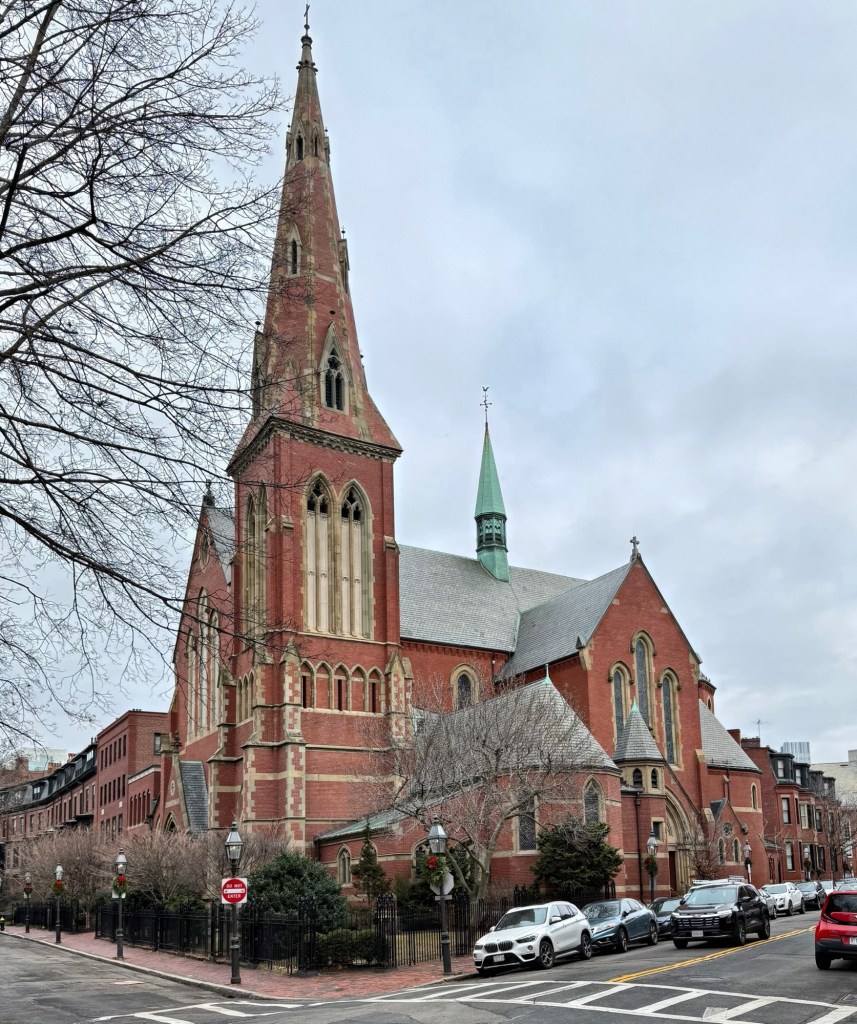
Located across from the church-like Norwood Town Hall, the United Church of Norwood is a landmark example of the Victorian Gothic architecture style and an important historical landmark for the town. The cornerstone of this present church was laid in 1885 and was completed and consecrated by December of 1886. Boston architect J. Williams Beal, got his start at the firm of McKim, Mead & White, designed the church here for the local Universalists, who lost their previous church to fire in 1884. In 1934, the town’s Universalist and Methodist congregations merged and they joined together in this, as a Union Church. Built of Milford granite and pressed brick, the United Church of Norwood features a side chapel and clock in its steeple which are unique and add charm to the historic church.

Katsbaan Reformed Church // 1732

The first church on this site in Katsbaan, Saugerties, New York, was a 1732 simple stone church built by Dutch and German settlers. Church services were first held in the German language,  and gradually came to be also held in Dutch and English, as the village and surrounding area developed. The original church was rebuilt in 1816 using the same stone base, but the entrance was shifted away from the street. Larger windows and the steeple were added at this time. In 1867, the steeple was heightened and the windows were enlarged with Gothic points, giving the building its present appearance. The Katsbaan Reformed Church remains an architectural and historical landmark noting the early history of Ulster County and its growth.

St. Alban’s Episcopal Church // 1891

Tucked away off Broad Street in the Danielson village of Killingly, Connecticut, you will find this charming and eclectic church building, long-occupied by the St. Alban´s Episcopal Church. Episcopalians began congregating in the town in the 1860s, and it would be in 1865, when an old academy building on this site was acquired and converted for use as an Episcopal church. By 1891, the relative prosperity of members of the church made it so a new church building was to be built on the site. Worcester-based architect Stephen C. Earle was hired to furnish plans for the new edifice which is eclectic with Victorian Gothic and Shingle style elements. The congregation appears to have either disbanded or merged with a nearby church as the building does not appear to be occupied. 

St. John’s Episcopal Church, Highgate // 1831

St. John’s Episcopal Church stands in a grove of pine trees at the southeastern end of the Highgate Falls village green in Highgate, Vermont. The church is built in a transitional style which combines the pointed arches of Gothic architecture with a unique Gothic-Palladian window, but with a traditional plan and massing commonly found in Federal style churches in New England. The church was built between 1831-1833 by Joel Whitney of nearby Enosburg, and was consecrated on May 21, 1834, by Rev. John Henry Hopkins, the first Bishop of the Episcopal Diocese of Vermont. The congregation was a full parish until 1896 and maintenance has since struggled due to dwindling use. The wooden steeple was removed in the late 20th century, but the church stands as an important architectural landmark for the small town.