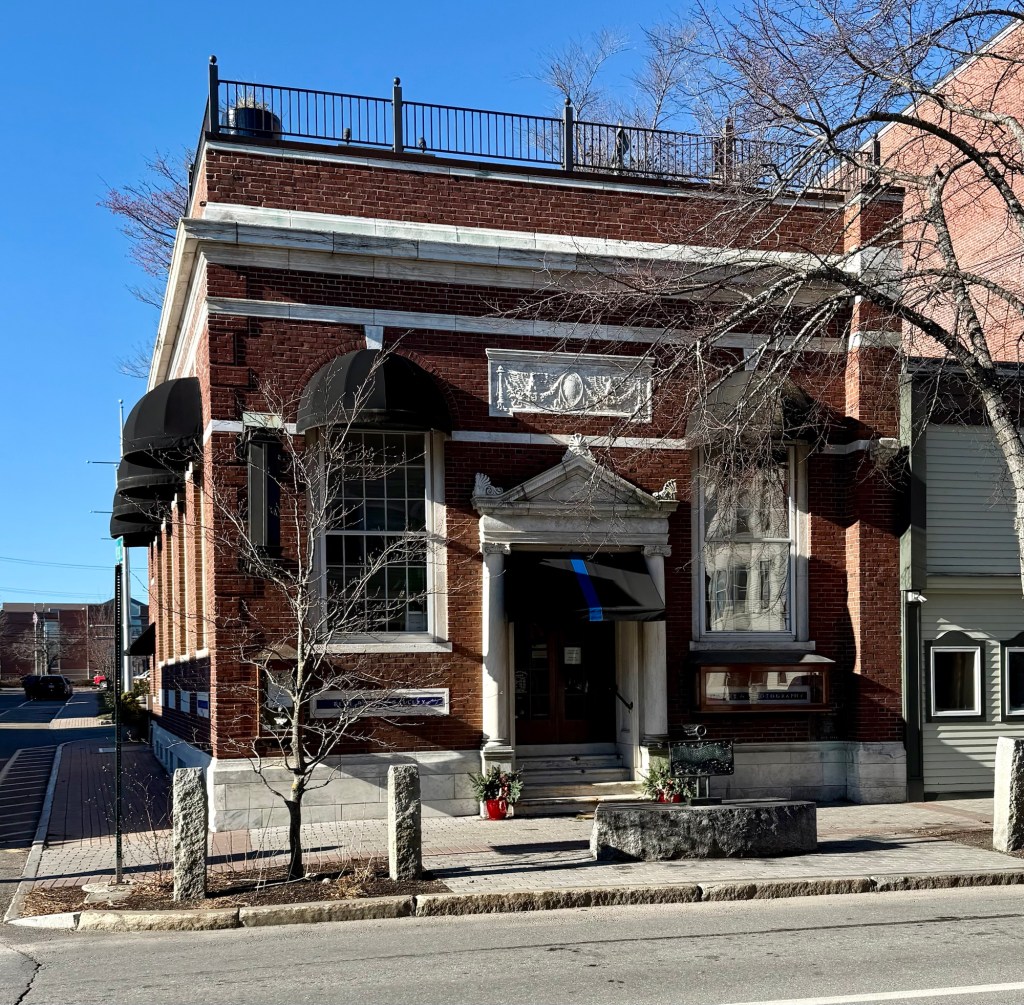
Rockland Security Trust Building // 1912

The Rockland Security Trust Building is a significant Colonial Revival style bank structure located on Main Street in Downtown Rockland, Maine. Built in 1912 from plans by Boston architect Richard Clipston Sturgis, the brick building is trimmed in marble, to provide a visual representation to the financial wealth and stability the bank could provide its clients. The bank closed and the building is presently occupied by an art gallery. Sadly, the rooftop deck railing takes away so much from the building’s presence.

Tapley Memorial Hall // 1930

Years after the Danvers Historical Society acquired the Jeremiah Page House, saving and relocating it to its present location on Page Street, the society began planning for a new facility to house its collections. After a successful fundraising campaign, the society solicited plans from local architect, Lester S. Couch, a partner in the firm, Little & Browne, and member of the historical society, to design the new memorial building. Designed in 1930 and completed a year later, the Colonial Revival style building is constructed of fireproof brick walls with a hipped roof. Two entrances are located on the side elevation facing the Page House, with pedimented surrounds and blind fanlight transoms. The building is notable for the use of slightly recessed arched bays, common in Federal and Federal Revival buildings. The Tapley Memorial Hall is still maintained by the society and can be rented out for functions.

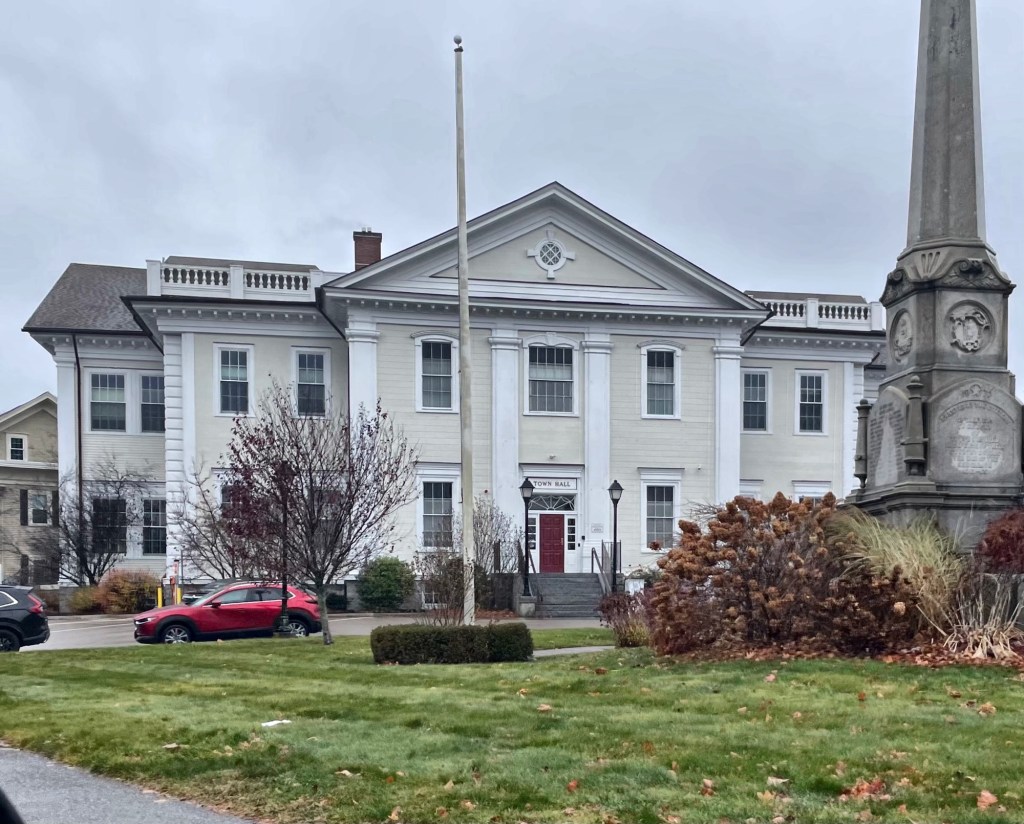
Danvers Town Hall // 1854

The land that is now Danvers, Massachusetts, was once owned by the Naumkeag branch of the Massachusett tribe. Permanent European settlement began in 1636, when present-day Danvers was known as Salem Village, a village of Salem. The historical event for which Danvers is best-known is the Salem witch trials of 1692, which began in the home of Rev. Samuel Parris, in Salem Village. Danvers officially separated from Salem in 1752 and is likely named after Sir Danvers Osborn, a Colonial Governor of New York. In 1757, Massachusetts incorporated Danvers as a town and, according to legend, King George II later vetoed this act of incorporation and returned his decree with the message, “The King Unwilling.” They simply ignored this royal veto, which was later included on the town’s seal! Danvers would eventually build a central town hall building , this structure, in 1854 which partially functioned as a high school as well. Plans were drawn by the Salem architectural firm of Emmerton & Foster in a pleasing blending of Greek Revival and Italianate styles. As the town grew, the building was expanded in 1883, and in the 1890s. When a new, purpose-built high-school was constructed elsewhere in town in the early 1930s, it was decided to renovate the town hall building. Due to financial constraints during the Great Depression, the town got a lifeline by the Federal government, who in 1934, appropriated $6,500 to the town for a renovated town hall as part of the New Deal. Additional funds from the WPA went to murals (many of which still adorn the walls inside). Architect Lester S. Couch of Danvers, a partner in the firm Little & Browne, oversaw the renovations in the Colonial Revival style.

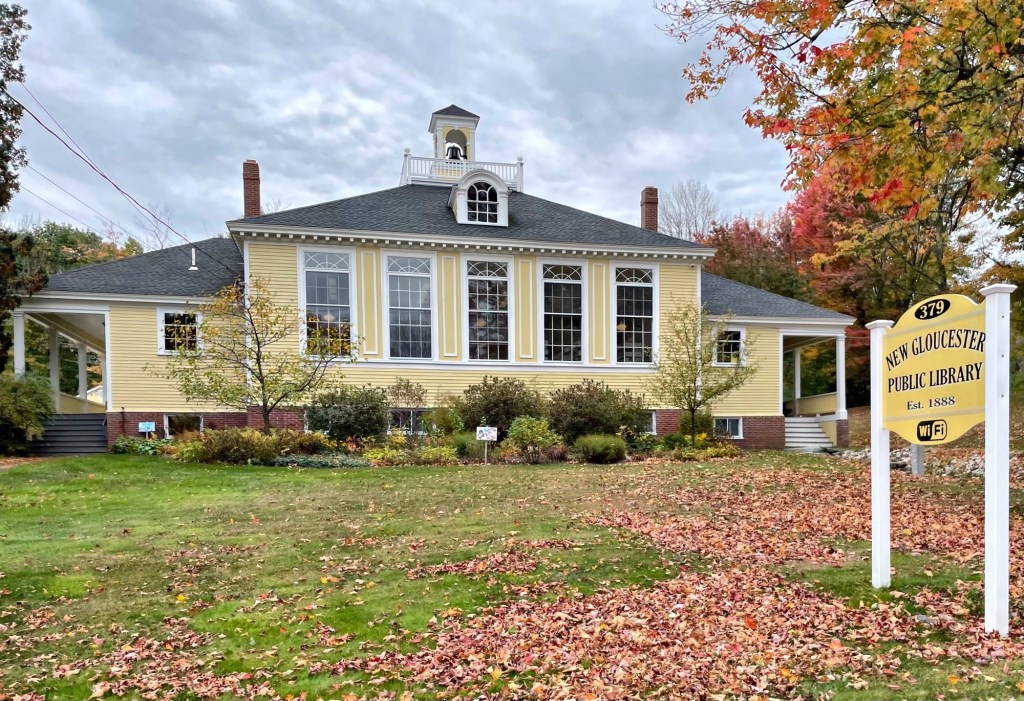
New Gloucester Old High School – New Gloucester Public Library // 1902

This building, the present New Gloucester Public Library, was originally constructed in 1902 as the town’s high school, a use that remained until 1962, when pupils would go to a modern school building in nearby Gray, Maine. The building is an excellent example of the Colonial Revival style with a symmetrical facade dominated by a row of multi-light windows separated by paneling, a segmental-arched dormer, and cupola at the roof with a bell. When the high school moved to its present location, this building sat vacant for some time and would be occupied by the New Gloucester Historical Society for storage and display of their collections until the public library moved into the building by the early 1990s.

Lyman School – Ashby Town Hall // 1903

Originally built in 1903 as the central school for the town of Ashby, Massachusetts, the significant Colonial Revival style Lyman Building is one of the most significant and well-preserved buildings in the village. The building was designed by architect Henry M. Francis of Fitchburg and educated pupils in town from grades 1-12. The two-story, hip-roofed building displays a symmetrical facade with a central section displaying five arched upper story windows, flanked by two pediment-topped pavilions atop projecting, flat-roofed arched entrance vestibules with quoined corners. The symmetry of the original design was preserved when the identical side wings constructed in 1922. Ashby public schools merged with Pepperell and Townsend and this building was later converted to the town hall. I love when towns value their historic buildings and retrofit them for new uses!

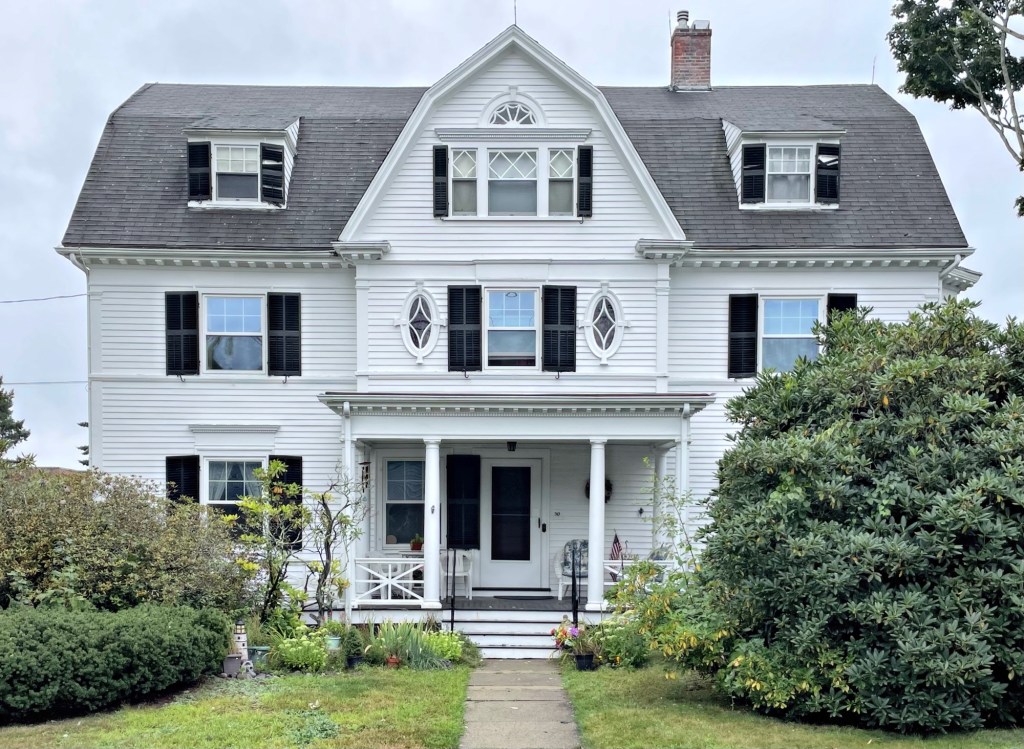
Bigelow-Stuntzner House // 1896

The Bigelow-Stuntzner House is a large, Colonial Revival style dwelling located on a side street in Norwood Center. The house was completed in 1896 for Waldo H. Bigelow (1856-1926), a lumber dealer with offices in Boston. Mr. Bigelow clearly used the best lumber for his own residence here in Norwood, and his Colonial Revival style house stands out for its gambrel gable which exhibits a modified Palladian window with diamond-shaped panes and a key stone arch. The central entrance is sheltered by a portico supported by Tuscan columns. In 1919, the house was sold to Guido Stuntzner (1876-1964), a German immigrant who arrived in the U.S. in 1887 and went on to become a successful Norwood businessman. The Stuntzer’s lived in the home through at least the 1960s.

Atlantic Hall // 1920

Atlantic Hall is one of the most iconic buildings in the well-visited town of Kennebunkport, Maine. The landmark structure was completed in 1920 as a volunteer fire station, by the Atlantic Hose Company. The volunteer fire-fighting company was founded in April 1906, and different members kept different parts of fire fighting equipment in each of their barns without a consolidated station. With the advent of the automobile, the community raised funds and purchased a Chevrolet hose truck, but had no station to put it. Without having the town pitch in money, residents (both permanent and summer “rusticators”) donated funds and a central location in Cape Porpoise was selected as a site for the new station. Construction started on a modest building in 1914, but was halted during WWI. After the war, local resident, Marion Goodall Marland hired the well known firm of Kilham, Hopkins and Greeley to furnish updated designs for the station, in a more elaborate version of the Colonial Revival style, fitting for the charming town. The building opened in 1920 with an engine room at the first floor and a meeting hall on the second floor. It was in 1958 that the Atlantic Hose Company outgrew its station at Atlantic Hall, and a new fire house was built across the street. Atlantic Hall was renovated for library and event use and has remained a significant piece of Cape Porpoise ever since!

Old Brooklyn Savings Bank // 1928

One of the most intact and architecturally significant buildings in Killingly is this stunning example of a bank built in the Georgian Revival style. Located on Main Street in the village of Danielson, the former Brooklyn Savings Bank was designed by the New Haven-based architectural firm of Norton & Townsend for the Brooklyn Savings Bank, which was founded in the adjacent town, Brooklyn, in 1872. The bank relocated to the economic center of the two towns, Danielson, in 1915, later building this landmark bank structure as its primary facility. The two-story bank is covered in red brick with elaborate limestone and marble trim and detailing, showcasing the wealth and stability of the banking institution for potential members. The façade features a two-story pedimented pavilion, round arched windows, and an elaborate swans neck pediment over the door. The structure has been very well-preserved in its nearly 100 year existence and now appears to be the home of a state judicial court.  

New Haven Museum // 1929

New Haven, Connecticut is known for its Gothic and Modernist architecture, but as it is located in New England, some good Colonial Revival architecture is not hard to find! The New Haven Museum building on Whitney Avenue was built for the New Haven Colony Historical Society, which was established in 1862 to collect, preserve, and publish historical matter related to the history of the greater New Haven community. The Society was housed in various locations around the city throughout the 19th century until 1929 when it relocated to its present building designed by J. Frederick Kelly, a noted colonial revival architect. The symmetrical building with its eleven-bay facade is notable for its arched recessed portico and rooftop cupola. The building remains occupied by the New Haven Museum to this day.

Blue Hill Public Library //1938

Some small town libraries really pack an architectural punch! Blue Hill had long had a public library building, which eventually outgrew its limited space in the 1895 Town Hall building. During the mid-late 1930s, in the depths of the Great Depression, plans began for a new library. Adelaide Pearson, who had moved to Blue Hill in 1928, took on the formidable task. She was described as “a small woman who got things done” and had a vision for a library that was an integral part of the community, serving more than as a place to store and retrieve books. To fulfill that dream, she organized a fundraising campaign to buy a vacant lot in town. Local pledges came in ranging from 25 cents to “one dollar or a day’s work.” With the help of librarian Anne Hinckley, Adelaide Pearson petitioned the federal government for funds from the Public Works Administration, part of the New Deal program. At last, in March of 1940, the Colonial Revival style library building designed by Bunker and Savage Architects of Augusta opened its doors. The library has been a centerpiece of life in the coastal town of Blue Hill ever since.