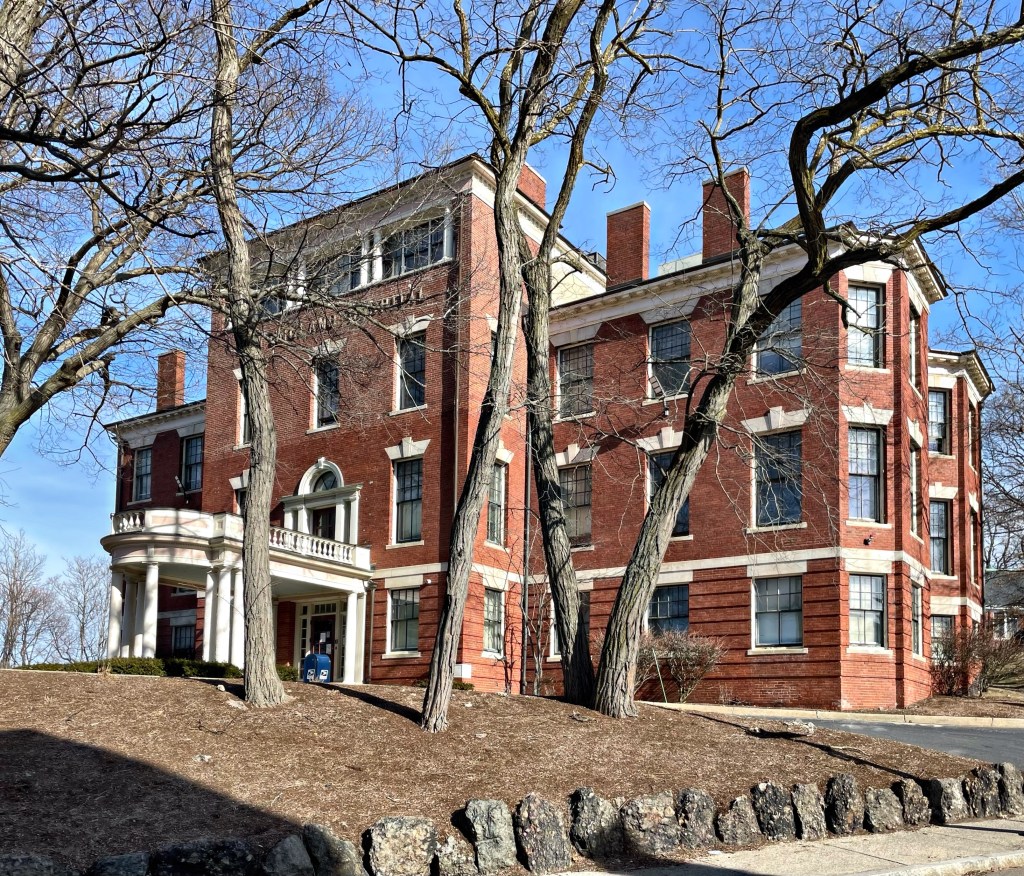
Ellen Banning Ayer Country Estate – “Ledgebrook” // c.1905

Ellen Banning Ayer (1853-1918) of Minnesota married Frederick Ayer in 1884 and her life completely changed. Frederick Ayer was one of the richest men in New England and he was involved in the patent medicine business, but is better known for his work in the textile industry. After buying the Tremont and Suffolk mills in Lowell, Massachusetts, he bought up many textile operations in nearby Lawrence, combining them in 1899 into the American Woolen Company, of which he was the first president. The couple had at least three houses in Lowell, Boston, Pride’s Crossing and had three children (one of whom Beatrice, later married the famed general George Patton). As the Ayer Mansion on Commonwealth Avenue was being built, the family was looking for a country house near the city. One year, Frederick asked Ellen what she wanted for a gift and she said “roses”. Frederick purchased an old farmhouse on Nahanton Street in Newton and had greenhouses and a stable built immediately, followed by a Colonial Revival country house for his wife Ellen. The mansion held lavish parties for the Ayers, who loved to entertain and it was passed down to their eldest daughter Katharine Ayer Merrill. The property was purchased in the 1920s by Clive and Mona Lacy for decades until it sold in the 1980s. The large site was eyed for redevelopment. The architectural firm of Dimella Shaffer was hired, and they restored the Ayer House, and designed forty residential units on the site, all tucked into the woods gently peering out here and there. The old Ayer House remains as the clubhouse of the Ledgebrook Condominiums Association.

United Church of Ware // 1926

The East Congregational Church in Ware was established in 1826, spurred by the industrial growth and subsequent immigrant population boom in the village of Ware, Massachusetts. The Ware Manufacturing Company, a major player in town, contributed $3,000 to towards the construction of a new congregational church in the village, which was matched by residents. The original church was built in 1826, following plans prepared by Isaac Damon, a noted church architect from Northampton, in the Federal style, popular at the time. In 1925, just a year before its centennial, the church burned to the ground. Plans to rebuild the church formulated immediately. Due to changes to the neighborhood since 1826 (notably the construction of tenement housing adjacent to the church), the decision was made to locate the new church setback from the street. Plans were drawn by Frohman, Robb and Little of Boston for the new building, which was to be Federal Revival, a nod to the former church building. The grounds in front were landscaped by the prominent landscape architect Arthur A. Shurtleff. After WWII, population decline and dwindling membership of some churches in town required a few congregations to consolidate, creating a union or united church here. The United Church of Ware came into being in 1969 when the East Congregational Church, United Church of Christ and the Ware Methodist Church, United Methodist Church joined together and became one federated church with ties to two denominations.

All Saints Parish House // 1893

As soon as the All Saints Church of Ware was completed, work immediately began for the parish house which was to be built nextdoor. It is not clear who was retained as the architect, but it could have been Patrick W. Ford, who designed the high-style Victorian Gothic church. The design is almost the complete opposite of the church, in that the parish house is of wood-frame construction, modestly scaled, and is Colonial Revival in style. The parish house features nice proportions with its symmetrical facade, pedimented central bay framed by pilasters and the large Palladian type window at the center.

Kistler House // 1893

In 1852, Beacon Street in Newton was extended westward from Chestnut Hill through Newton Centre. The village’s suburban development accelerated through the activities of real estate developers as the city became connected to Downtown Boston by roadways and rail. This home was built in 1893 for Andrew and Ann Kistler. Andrew Kistler worked as a leather dealer in Boston, and commuted into the city daily. The Kistler House is an excellent example of Colonial Revival with some added oomph.

‘Maplebourn’ – Dorset Colony House // 1885 & 1925

Colonial Revival perfection! This building on the Dorset Town Green was originally constructed around 1885 for Allan Bourn, the purchasing agent of the New York Central Railroad. When Bourn was told by a trusted associate that a railroad stop was going to be built near Dorset, he made the decision to acquire eight acres of pristine land just west of the Dorset Green on Church Street. Bourn, a resident of Westchester, New York, decided to build a vacation home there for his family. The house was named “Maplebourn,” after a large maple tree on the property. Annie Bourn Sheldon, Allan’s daughter, inherited his property after his death in 1925. She and her husband then added two large additional wings onto the house, just at the time that Dorset’s local theater scene was beginning to take-off. After Annie’s husband Harry died in 1942, she began to rent out rooms of her home to visiting actors to the nearby Dorset Playhouse (last post). Actor and playwright, John Nassivera purchased the property and renamed it the Dorset Colony House, converting it to a residency hall. The building has since been purchased by Adele and Herman Raspé, who lovingly have maintained and enhanced the historically and architecturally significant property.

Warren Dunton House // c.1890

Much of Dorset Village was built in the early-to-mid 19th century, but there are some excellent examples of Colonial Revival and Craftsman homes and buildings. This Colonial Revival house was built c.1890 seemingly by Warren Robbins Dunton (1839-1902), who served as a Captain in the American Civil War. Captain Dunton seemingly built his home after moving the older house on the site back on the lot, building this house at the street. Great house, look at those chunky shutters that actually match the window openings!

Woodstock Artists Association & Museum // 1919

By 1919, artists from all over the United States and Europe were living and creating art in Woodstock, NY. As a thriving and expanding group of diverse individuals, the need for a welcoming and open-minded gallery space was quickly recognized. To facilitate this, a group of five painters established two complimentary organizations: The Woodstock Art Association (later changed to Woodstock Artists Association in 1933) who would maintain the exhibition space and set its artistic principles, and the Artists Realty Company who would finance the construction and maintenance of the physical space. The five painters being: Carl Eric Lindin (1869-1942), John F. Carlson (1874-1945), Frank Swift Chase (1886-1942), Henry Lee McFee (1886-1953) and Andrew Dasburg (1887-1979). New York City architect William A. Boring was commissioned to design the new museum and art space for the group. Boring (whos career was anything but boring) briefly worked for McKim, Mead and White for a year before starting his own practice with Edward Tilton in 1891. His most noted work is his 1897 Immigration Station on Ellis Island for which he and Tilton won the design competition as relative unknowns. The refined Colonial Revival building for the Woodstock Artists Association sits right in the middle of the village and its symmetrical façade is defined by a central double door entrance with transom and pedimented enframement. Of particular interest is the row of four elliptical windows above the double-hung windows.

Winona and Winslow Blanchard House // c.1915

This Colonial Revival house on Pine Ridge Road in Waban Village, Newton, is one of a handful of the brick houses in the neighborhood, and one of the more refined examples of the style in the neighborhood without architectural embellishments from other styles. The home was built around 1915 for Winslow Blanchard and his wife Winona. Winslow was an engineer who served as President of the Blanchard Machine Company in Cambridge. It is probable that the couple hired Dorchester-based architect Edwin J. Lewis to design the home; as Winona grew up in the Ashmont section of town where Lewis lived. Additionally, the couple hired Lewis to make alterations to their recently completed home in 1919. The house retains its original slate roof, front door with pedimented entry, and is covered in climbing ivy, which isn’t great for the masonry but looks so good!

Eva Southwick House // 1898

Okay, there is just something about this house that is so intriguing and unique and stands out among all the other (thousands) of Colonial Revival style houses I have seen. I just can’t quite put my finger on it! This late 19th century beauty was built in 1898 for Eva Bailey and Francis Southwick eight years after their marriage and after the birth of their children. It is unclear who the young family hired as an architect to design the home, but they definitely went with a loose adaptation of the Colonial Revival style in an American Foursquare form. The house has a large Palladian window and a minimal front portico supported by Doric columns.

Ernest Zeiss House // 1897

Another eclectic house in Waban is this beauty, a blending of Queen Anne and Colonial Revival styles under an impressive gambrel roof. The home was occupied by Ernest L. Zeiss, a salesman. Waban, which was once a neighborhood within the reach of the middle-class, has since become one of the most desirable neighborhoods in one of the most exclusive towns in the Boston metro. It is safe to say an ordinary 9-5 salesman would not be able to afford a house like this today!