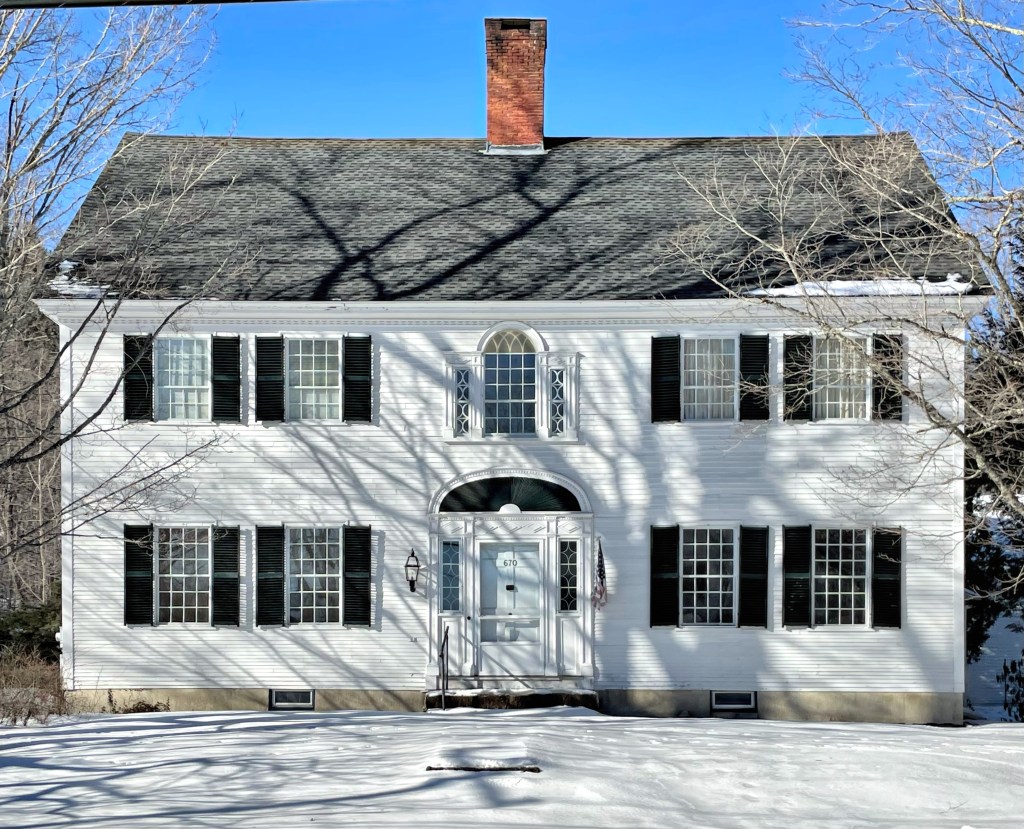
The most architecturally significant example of the Federal style in Waterford, Maine, is this c.1810 home built for Ambrose Knight, who operated a store in town. The high-style Federal home features a well-proportioned fanlight over the entrance with a Palladian window above, all with geometric moulding. The home was likely built by a housewright who employed designs from Asher Benjamin’s pattern books for builders, as the high-style features and Palladian windows are uncommon in this part of Maine.
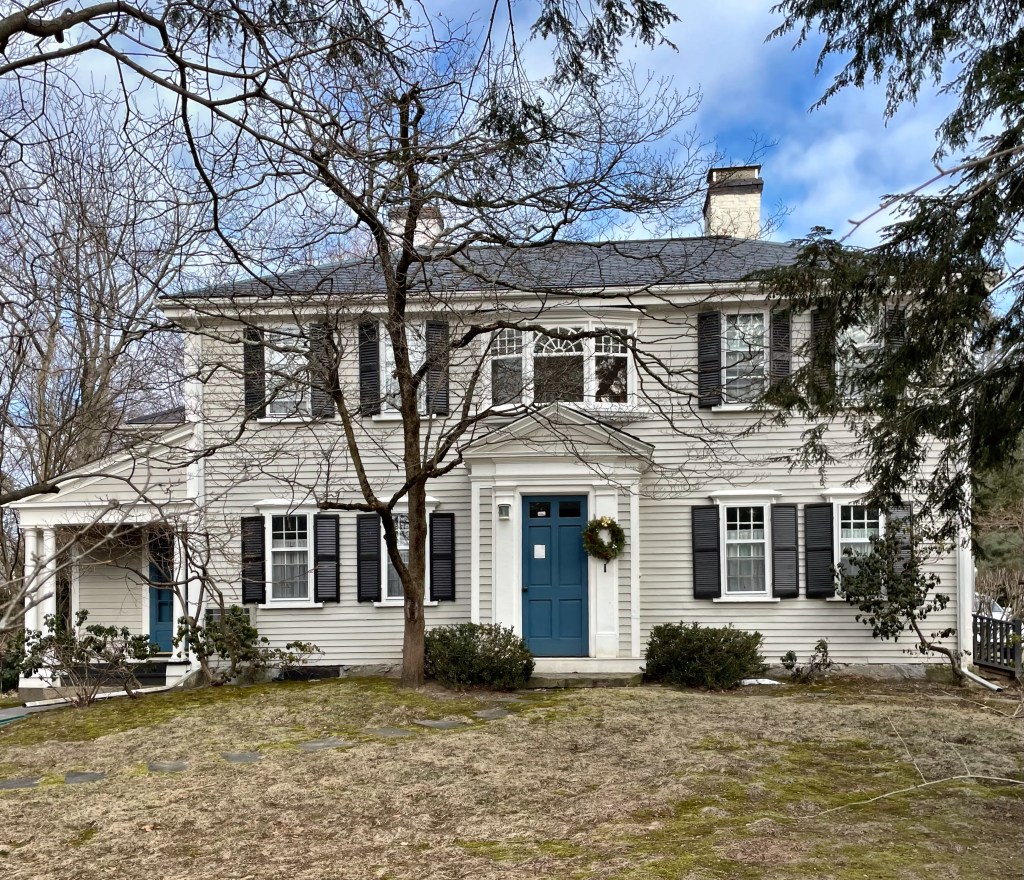
Set along Beacon Street, one of the finest streets in Boston, this townhouse has uninterrupted views of the Boston Common and Public Garden. The house was built around 1825 after a large fire destroyed nearly all the homes on the block. Build it and they will come, and the upper-class Boston elite did! Attorney William Minot (1783-1873) purchased the land here as early as 1817, and is said to have hired Peter Banner, the English architect who designed Park Street Church, to design the first house on this site, which stood less than 10 years. Minot had a new home built in the 1820s and lived there until his death in 1873. By the late 1920s, Christian Archibald Herter lived here. Herter held a number of important offices in state and national government, serving as the Speaker of the Massachusetts House of Representatives, Governor of Massachusetts, and President Eisenhower’s Secretary of State (1959 to 1961). It was Herter who likely added the Federal Revival features on the house, including the porch, dormers and updated door surround.
One of the oldest extant homes in Waban Village, Newton, is this 18th century farmhouse which is an excellent example a Federal-period home in the Boston area. Dates of construction for this house have ranged from c.1765 to 1790. The earliest recorded ownership of 38 acres of land at this location is attributed to Eleazer Hyde (1664-1731), one of Newton’s earliest citizens and one of a long line of Hydes in Newton. From 1772 to 1791, the house was owned by Josiah Starr. Immediately after, this property was owned by a housewright named Capt. Ebenezer Richardson, who possibly built or re-built this house in the current configuration. Thaddeus Tower owned the land from 1844-1866, when the City of Boston took a portion of it in 1848 for the new Cochituate Aqueduct, which ran right behind his home. Not long after, Thaddeus sold the farm to Edward Wyman, a linen importer from Roxbury. He subsequently sold it to his brother Dr. Morrill Wyman in 1869. Dr. Morrill Wyman sold 150-acre property to developers, never appearing to have lived in the home, after the railroad came west from Boston in 1886 and increased the value of the surrounding farmland, later known as the village of Waban. All of the land was developed with homes, and all that remains of the old farm is the farmhouse seen here.
Last up on our tour of Scandinavia (Denmark, Sweden and now Norway) Maine, is Norway. The town of Norway centers around Pennessewasse Lake, which supported native people in the region for thousands of years. It wasn’t until after the American Revolution that European settlers established the town. By 1789, a sawmill and gristmill were established, the first road was built in 1796, and the town of Norway was officially incorporated on March 9, 1797. Before incorporation, the township adopted the name Rustfield, to recognize the contributions of prominent landowner Henry Rust of Salem, Mass and the community once petitioned the Massachusetts General Court to be named Norage, meaning “falls” in the native peoples’ language. Norway won the name, but the origin of the town’s name remains unknown. The town leaned more towards industry than Denmark and Sweden due to the stronger rivers, and its population increased as a result.
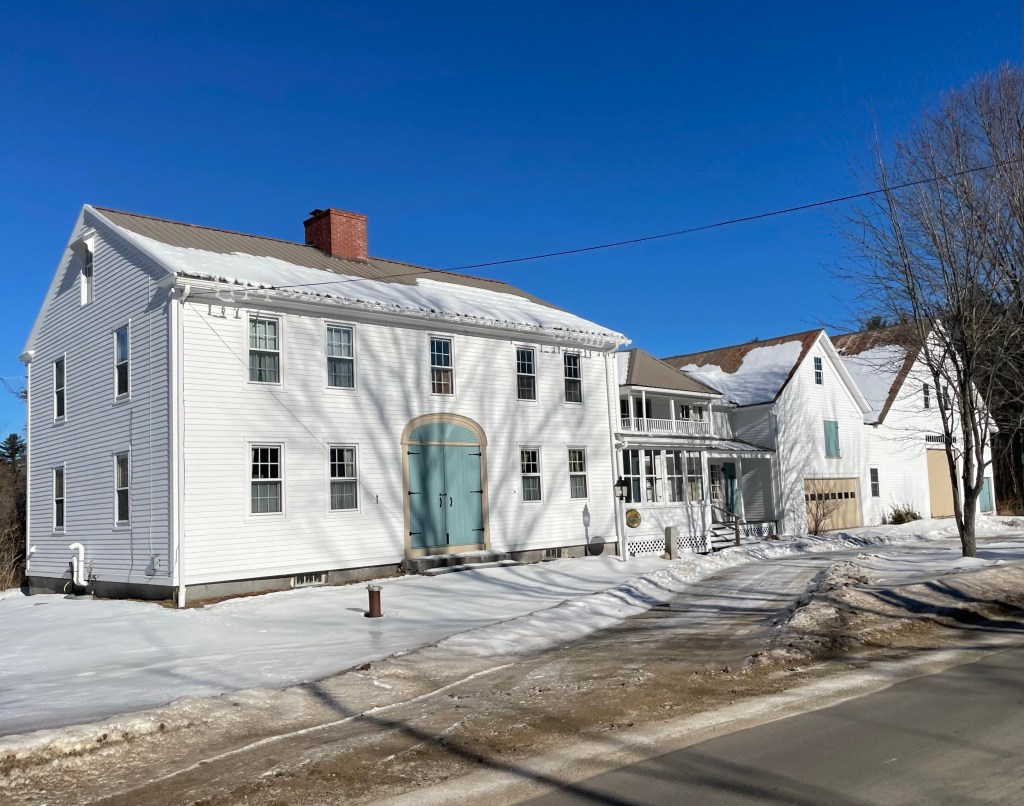
This historic farmhouse sits on the eastern edge of Pennessewasse Lake and is one of the oldest extant homes in town. It was built in 1792 just years after land here was purchased by Nathaniel Bennett in 1790. Nathaniel and Elizabeth Bennett resided in the home until they died, childless. The home was eventually purchased by Don Carlos Seitz, publisher of the New York World, who grew up and was educated in town. Seitz operated the property as a gentleman’s farm, and is responsible for naming the property “Cedarbrook Farm”. His estate sold the property to one of his hired hands in 1927. It remains very well preserved and was listed on the National Register of Historic Places in 1996 as the Nathaniel and Elizabeth Bennett House.
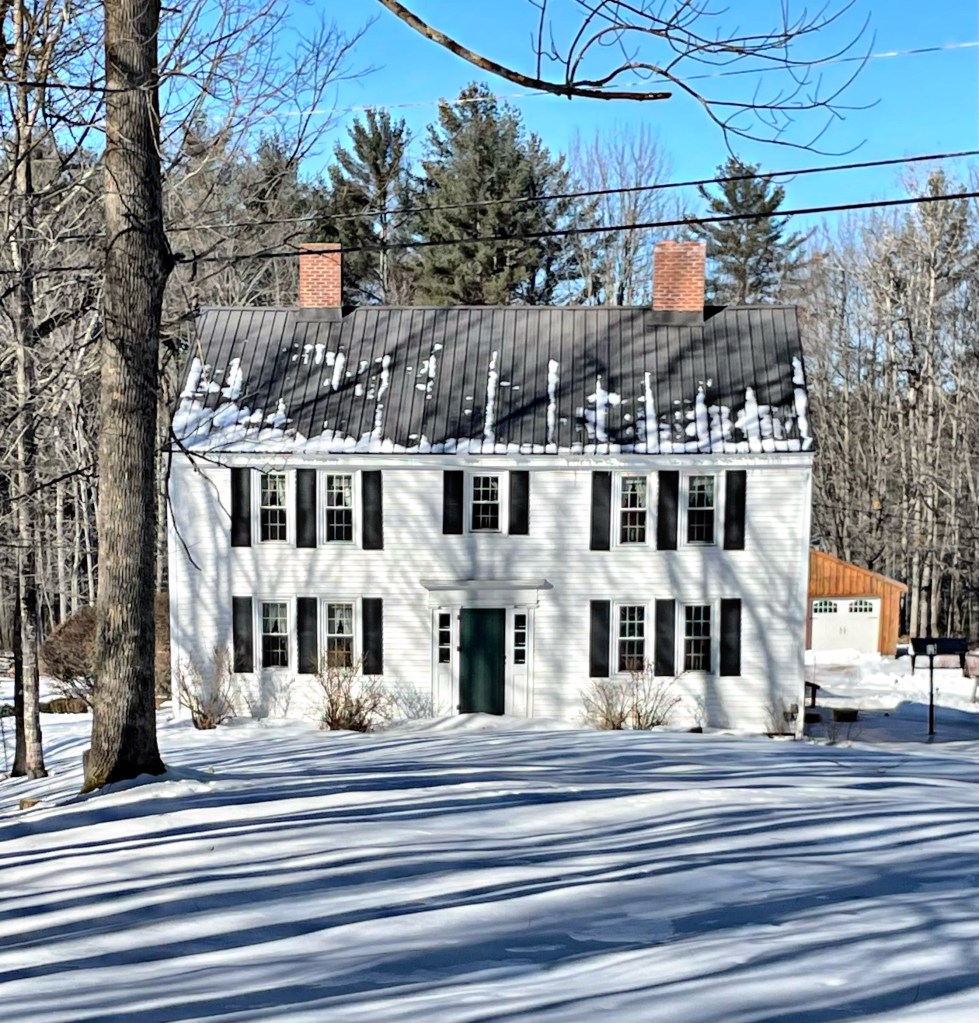
In 1820, just seven years after the incorporation of Sweden Maine, a homesteader, Amos Parker purchased fifty acres of land and began to erect a two-story, Federal house with a center chimney and a detached store beside it. Plagued by debt, Parker sold the unfinished house to Samuel Nevers circa 1833–1835, who purchased the property with the store for his recently married son, Benjamin. By 1860, Benjamin Nevers had a successful store and prospering farmstead. Benjamin died in 1883, and in the next two years, their daughter Charlotte, and her husband, Charles Bennett, dramatically remodeled and modernized the farmstead, adding a connected two-story ell building outward from the main house toward the old 1840 barn, connecting the entire property. I believe that the property remains in the Nevers-Bennett Family, as recently, Steve and Judy Bennett, recently negotiated an easement with the Maine Farmland Trust to protect their hay, beef, and maple sugaring acreage as farmland into the future.
This historic house in West Millbury, Massachusetts, began in the end of the 18th century as a one-and-a-half-story wood-frame farmhouse. By 1810, the home was rotated 90 degrees and a more substantial, two-story brick house was constructed facing the street. The Federal style home was owned by Thaddeus Hall (1779-1855), and after his death, it was owned by his son, Orson Eddy Hall, who possibly rented the property for income while he resided in New Orleans and ran the iconic St. Charles Hotel there. The property was later acquired by Willard Balcom and remained in the family. Oh what I wouldn’t do to see the paint come off this old brick house!!
Newport in 1774 had approximately 153 free Black residents residing in 46 households comprising of thirty-percent of Newport’s population at this time. One of these free Black families was the Jack family who resided around Levin Street (Memorial Boulevard today). The Jack Family appears to have been from Antigua and may have had ties to the Redwood Family (the namesake of the Redwood Library), who owned a plantation on the island and resided in Newport. Alexander Jack, Jr. was a free African American whose trade was a cordwainer or shoemaker. He bought his land in 1811 and is thought to have begun construction almost immediately. Jack heirs remained on this property until 1881. The Newport Restoration Foundation purchased the house in 1969, moved it that same year to Mill Street to save it from urban renewal and the widening of Levin Street as Memorial Blvd.
Smack-dab in the middle of Newport, Rhode Island’s dense network of downtown streets, you’ll find Queen Anne Square, a rare bit of open space in a web of alleys and ways. Did you know that this park is only 50 years old? It’s true! In the late 1960s and early 1970s, Newport (and many cities all over New England) were grappling with suburbanization and dwindling tax revenue with people and businesses moving out. Their solution was “urban renewal”, which entailed the razing of buildings and sometimes, neighborhoods which were deemed “blight”. Historic buildings and communities were destroyed with modern planning (high capacity roads and high-rises connected by open space) to take its place. In Newport, this saw the form of America’s Cup Avenue and Memorial Boulevard, which cut through the city to allow for more cars and less-congested side-streets. Years later, planners realized that Newport was without a traditional town common like many New England towns, so they cleared buildings in front of Trinity Church to provide that traditional feeling. At the time, preservationists were trying to save significant buildings, with the Langley House being one of them. This house was set for the wrecking-ball, from Memorial Boulevard’s construction but moved and restored by Newport Restoration in the last hour to the south side of Church Street. Seven years later when Queen Anne Square was built, this house was moved to the north side, saving it once again. This house is a survivor!
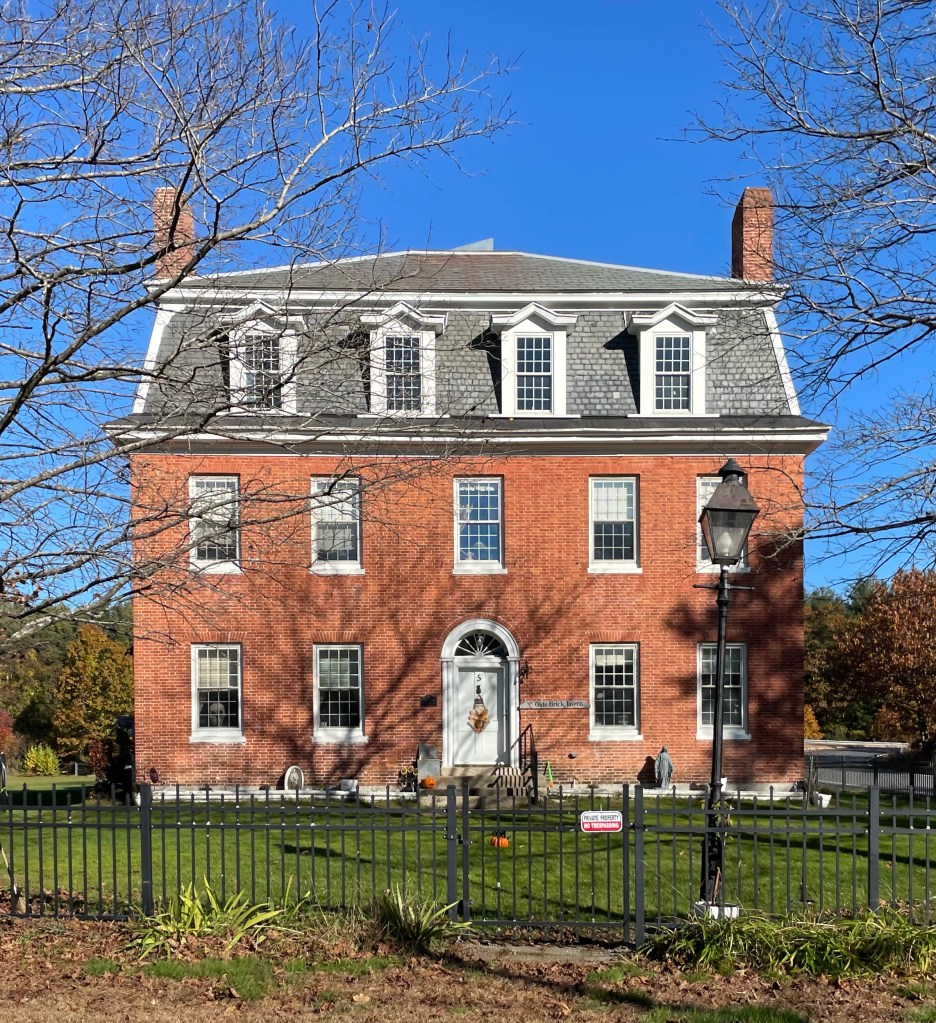
The Brick Tavern was an important stopping point on the old Union Turnpike, and the original two-story brick structure was completed about the time of the turnpike construction by Paul Willard, who with his heirs, operated the inn for 25 years. In the first years of the 1800s, the Union Turnpike Company planned and built a road providing a link for travel from Boston to Albany. Realizing the possibility for an inn along the first leg of the route, Willard financed this substantial brick building for travellers to stop, eat and spend the night. The tollroad was later made free, and less people stayed at the inn. After subsequent ownership, the building started to suffer from deferred maintenance and it was sold to a local Quaker group. The Quakers modernized the building by constructing the mansard roof and updating the interior. They never occupied it, but rented it to tenants for income. After, it was a hospital, boarding house, and in WWII, as a barracks of sorts for soldiers training nearby at a military base. The building is now a house!
The Newhall-Lane House (could be the home of many wives) was built in 1809 by Pliny Newhall, a bricklayer. He purchased the land here at a prominent crossroads in Lancaster in 1808 from his employer who owned a brickyard across the street. At a previous home in town, Newhall’s wife Patty died giving birth to their son, at just 23 years old. Their son also died during childbirth. He remarried and had a full family to grow into the couple’s new house. They relocated to Lincoln and the home was sold to Captain Anthony Lane, who was the son of Deacon Jonas Lane, an important figure in Lancaster town history. Jonas had four wives, outliving three of them. Captain Lane himself, was married twice while living in this house; he had no children from either marriage. Although he was a talented craftsman and cabinetmaker, Captain Lane listed his occupation as farmer. The house is significant architecturally, as a fine example of Federal style architecture in Lancaster . Its sophisticated design is reflected in the graceful entrance. One of the unique features of the house is the pedimented gable of the facade which in combination with the narrow plan of the house, creates a delightful massing in this distinctive combination of Greek Revival and Federal styles.



 Buildings of New England