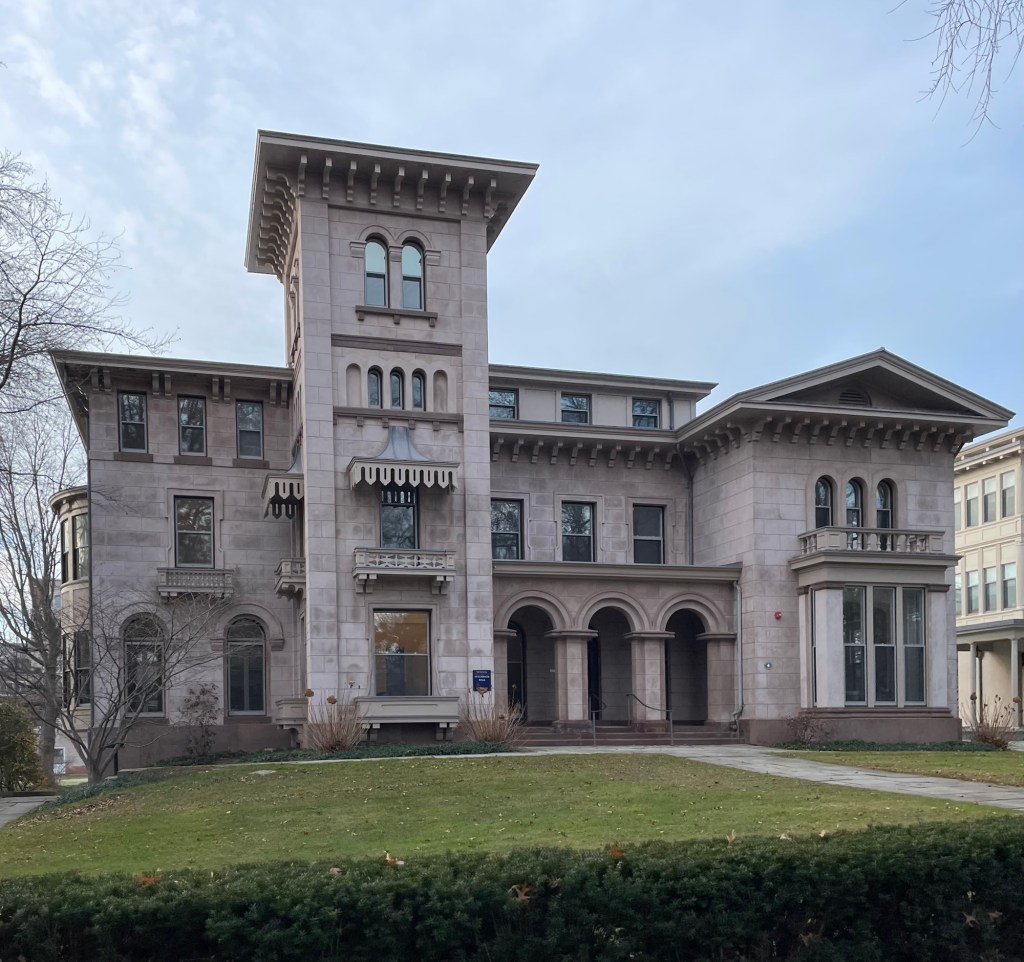
Frederick Fullerton House // 1861

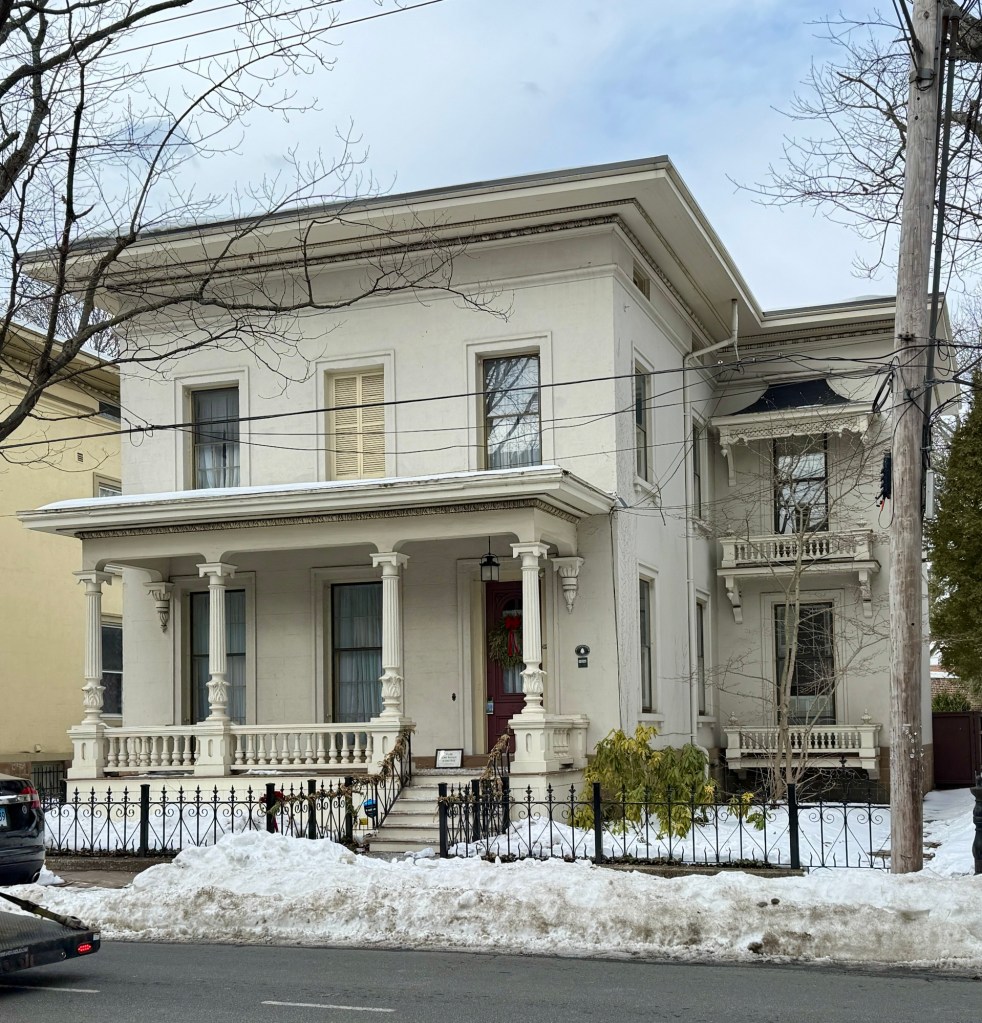
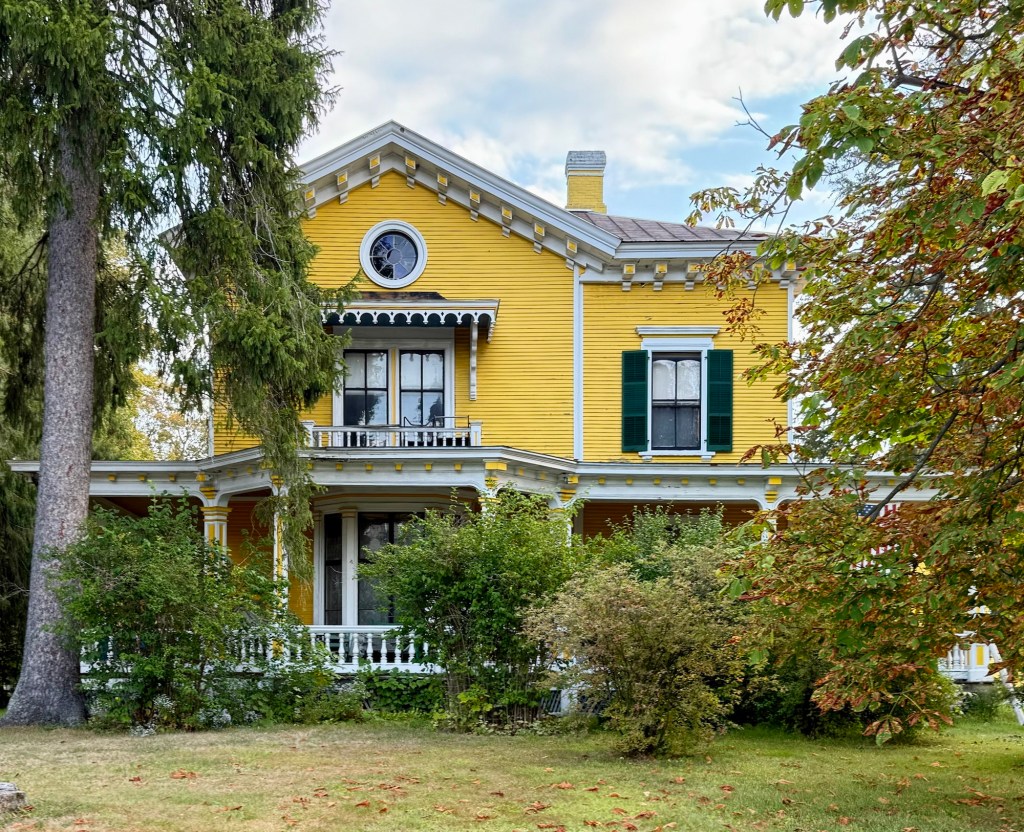
This distinctive Italianate Villa style house in the charming village of Chester, Vermont, was built in 1861 for wealthy merchant, Frederick Fullerton (1817-1869). Mr. Fullerton worked in his family’s mercantile business in Chester, and was involved with cotton manufacture in Springfield and with the Cavendish woolen mill managed by his older brother, Henry, who built an equally distinctive residence in Cavendish called “Glimmerstone“. Basically cubic with asymmetrical gabled corner pavilions, the Fullerton House is an excellent example of an Italianate Villa with bracketed cornice, two-over-two sash windows, a wrap-around porch, and second floor balcony with a bracket-supported hood with decorative valance and an oculus window above. The residence is said to have been designed by architect, William P. Wentworth, who designed the St. Luke’s Episcopal Church across Main Street a decade later.

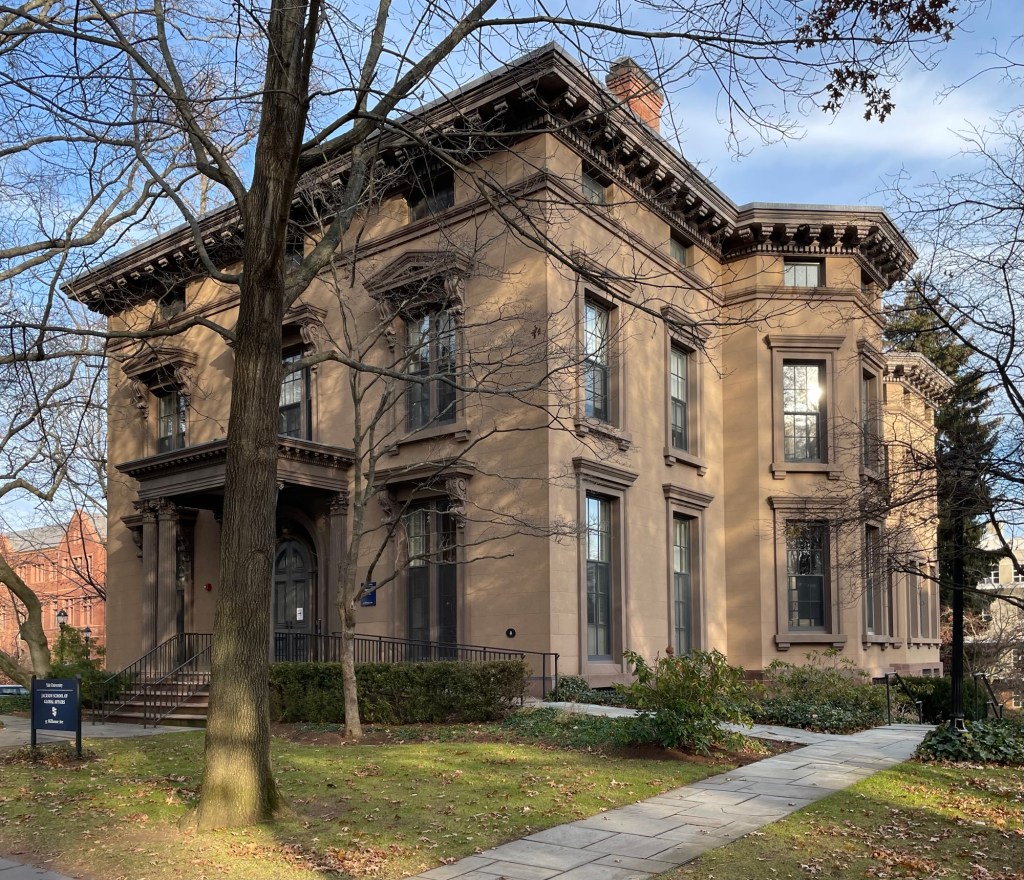
Norton Mansion – Steinbach Hall // 1849

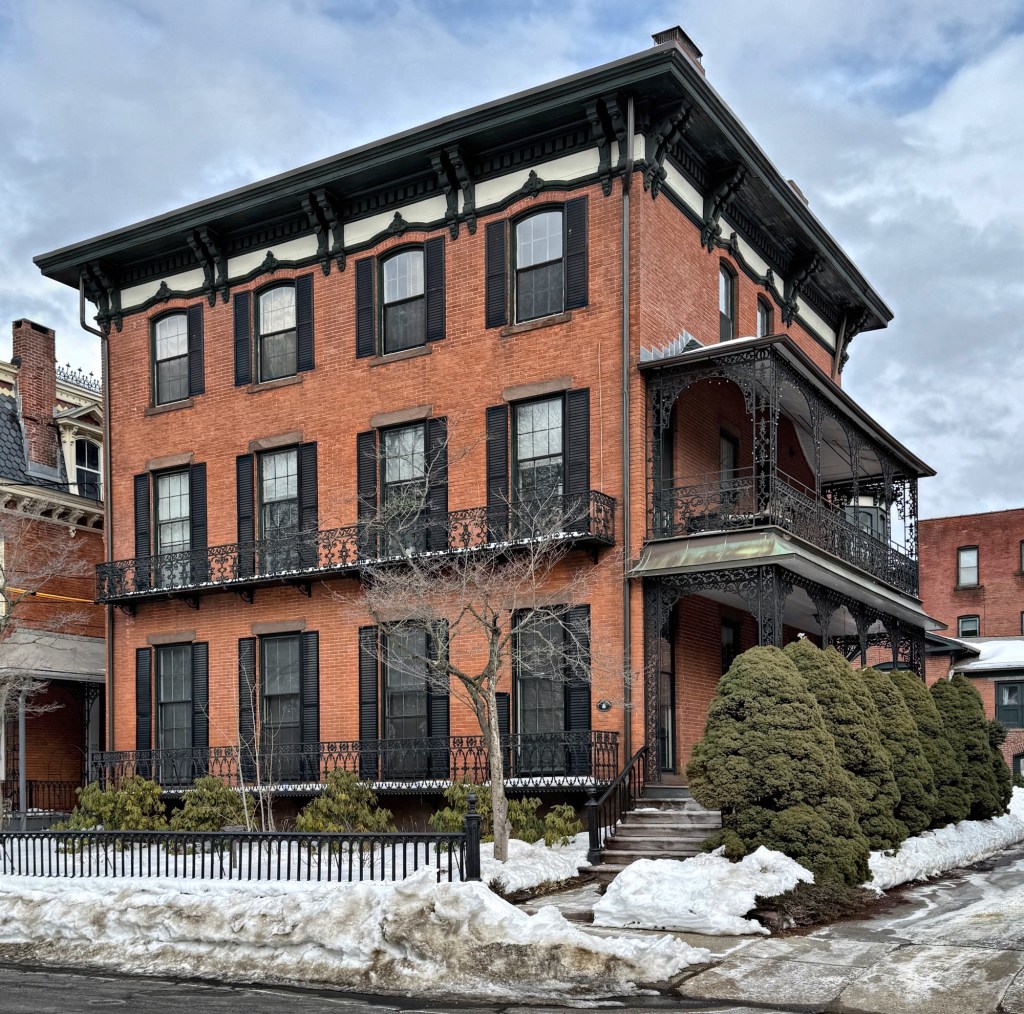
John Pitkin Norton (1822-1852) was a successful educator, chemist, and author, who at just 27-years-old, built this stately mansion on Hillhouse Avenue in New Haven, Connecticut, for his young family. John P. Norton studied chemistry under Benjamin Silliman at Yale College, and was eventually appointed Professor of Agricultural Chemistry at Yale in 1846. He helped to found the Department of Philosophy and the Arts at Yale College and authored many scientific papers, dealing with the chemistry of crops. Coming from an established family and beginning a successful career himself, John hired New Haven-based architect, Henry Austin, to design this large, Italianate villa. The window surrounds, canopies, and flamboyant Moorish entryway are typical of Austin, with the general form and detailing taking cues from architect Alexander Jackson Davis‘ work. The Norton Mansion was purchased by Yale University in 1923 and was long the home to the Yale School of Management and is now occupied by the Jackson School of Global Affairs.

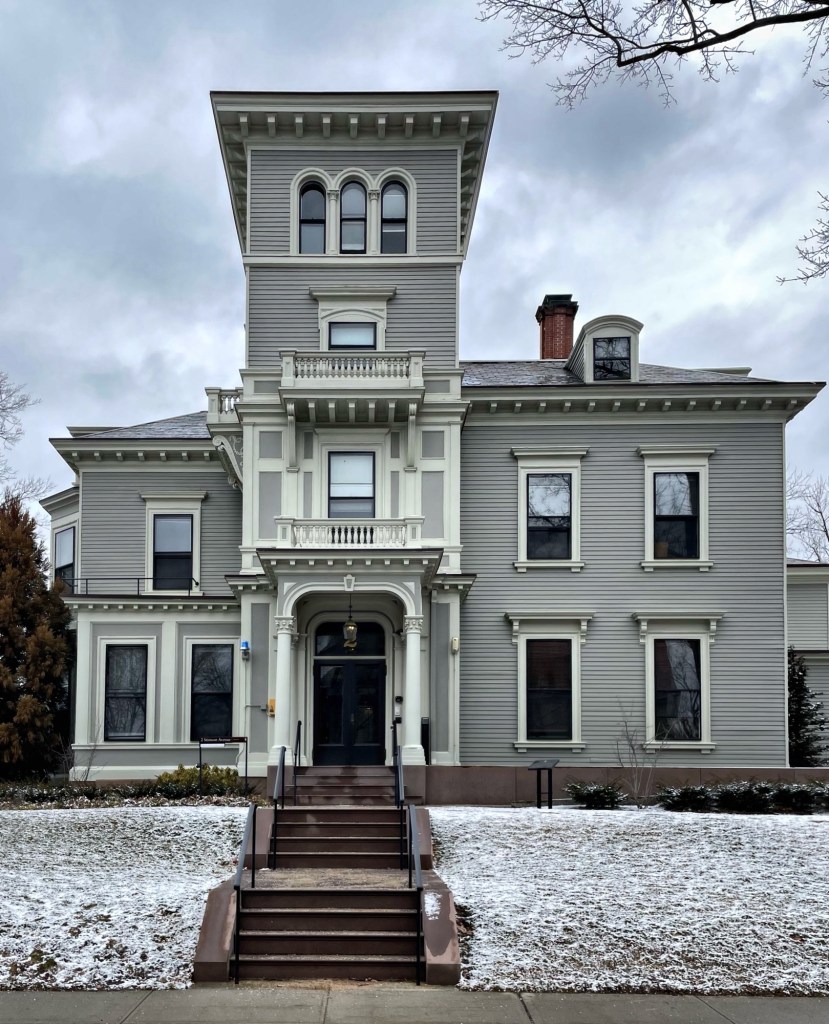
Perit House – Horchow Hall // 1859

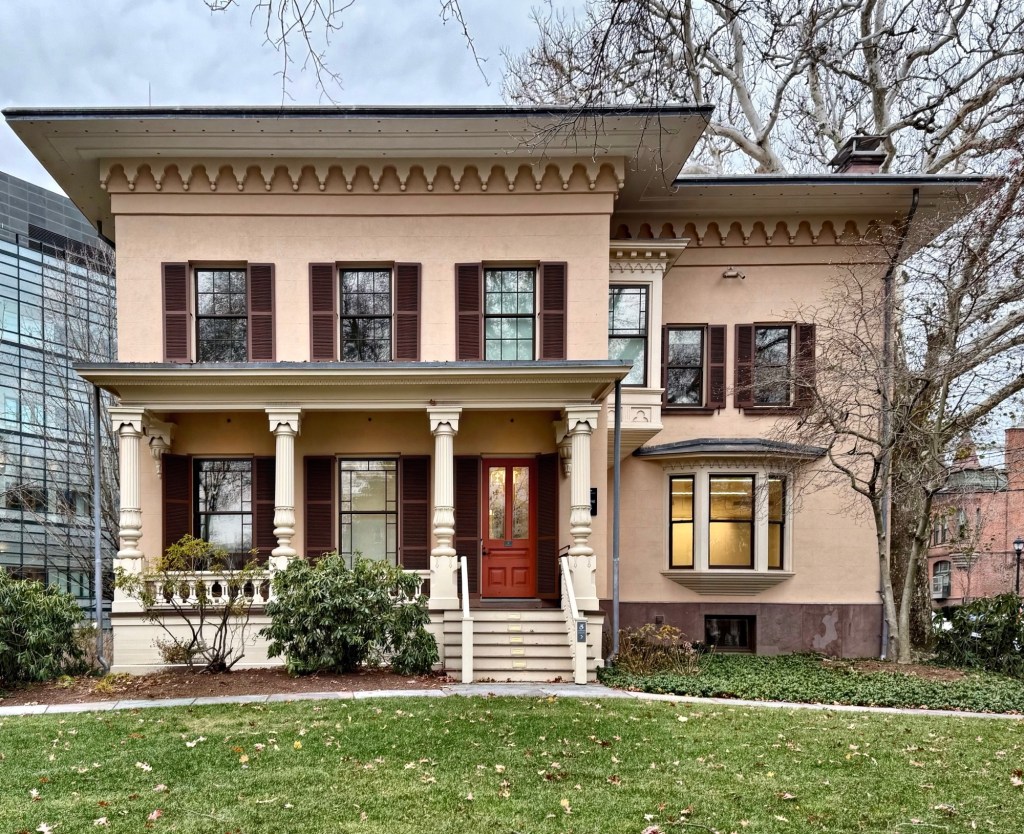
This Italianate Villa style mansion on Hillhouse Avenue in New Haven, Connecticut, was built in 1859 for Pelatiah Webster Perit (1785-1864), a successful New York City shipping merchant and president of the New York Chamber of Commerce. Perit split his time between New York and New Haven and would hire architect, Sidney Mason Stone, to design this home on Hillhouse Avenue in New Haven. The brownstone residence is notable for its elaborate scroll brackets supporting the window pediments and front entry portico with arched doorway with rope moldings. The mansion was occupied by Perit for just four years until his death in 1864, and it was later owned by Henry Lucius Hotchkiss, a businessman. Like nearly all buildings on Hillhouse Avenue, the building was acquired by Yale University and is now known as Horchow Hall, and is part of the Yale School of Management.

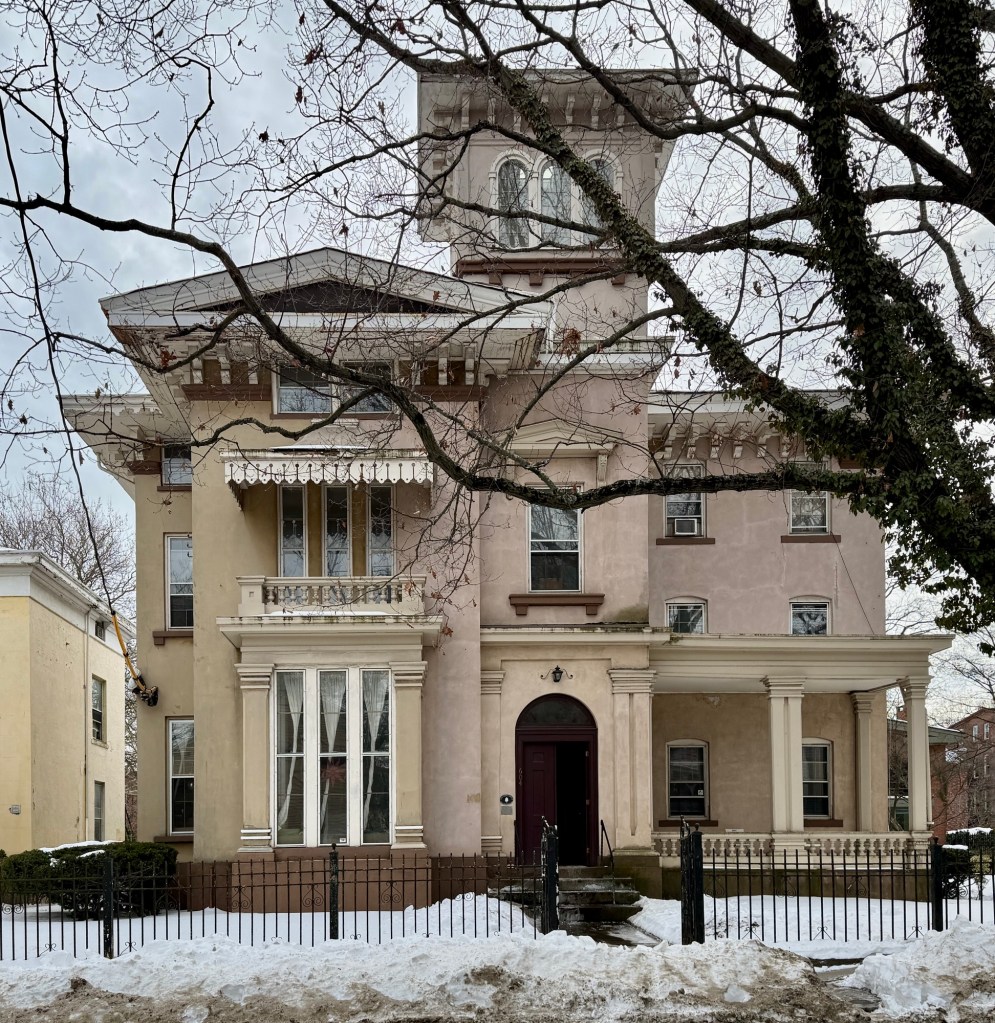
Amos Beckwith Mansion // 1861

To conclude this series on Stimson Avenue houses in Providence, I will showcase the grand dame of Stimson Avenue, the Amos Beckwith Mansion. Built in 1861, the large estate was essentially a country villa when built, as this section of Providence was sparsely developed before the Civil War. Amos Beckwith (1822-1890) was the son of Truman Beckwith and, like his father, was a wealthy cotton broker. He hired architect Alpheus C. Morse to design the house, which is an Italianate Villa, with prominent four-story tower. thick moulded trim, projecting eaves and balconies supported by large brackets and corbels, and the rounded arch windows. In 1882, Beckwith subdivided his land in the area to make half the building lots on Stimson Avenue. Amos Beckwith lived in the home with his wife, Clara, until her death in 1879. Unknown to many, Amos would secretly remarry his housekeeper, a fact that came out after his death when discussions about the estate were raised. Maria Sherman, the 35-year-old housekeeper, stated she was in the will. It is not clear if the family fought this claim and who inherited the property, but what an interesting story!

Butler House // 1865

A true Italian Villa can be found in the dense center of Newport, Rhode Island. This is the Butler House, built in 1865 for physician Samuel Butler (1816-1881) and his wife, Emeline. Dr. Butler was born in Maine and was educated at Harvard before moving to Newport to become a member of high-society there. Besides working as a physician, Samuel Butler served on the Newport School Committee and as a director of the Redwood Library. His house was originally built in 1865 (as the right half) in a late-Greek Revival style as a side-hall house with flushboard siding and pilasters between the bays. As Newport continued to grow in wealth as a summer destination, Dr. Butler modernized his home in 1876, adding the oversized corner tower with round arched windows and bracketed cornice. The two aesthetically opposing styles somehow work well together in this eclectic home, which today, is further enhanced by a color palette to accentuate the two sections.

Chidsey-Dimon House // c.1850

Located on Harbor Road in Southport, CT, this stunning Italianate residence is properly sited on a small bluff overlooking the village’s harbor. According to historic maps, the house was owned by an “I. Chidsey” who appears to be Isaac Chidsey (1793-1865). The large Italianate style home is boxy in form and stands three full stories with two original one-story side wings. Sleeping porches were added in the early 20th century; those along with the rooftop belvedere, would allow for sweeping views of ships entering and exiting the harbor here. The house was recently restored by the architectural firm of Fairfax & Sammons and it looks amazing!

General George Stark House // 1856

Inspired by suggestions from books by Andrew Jackson Downing, the Gen. George Stark House is one of the finest dwellings in the Italian villa style in New Hampshire. Located on a triangular plot just north of Downtown Nashua, the house was built in 1856 by a man who, though then only in his early thirties, was one of New Hampshire’s most experienced civil engineers and surveyors, and was the superintendent of the Nashua and Lowell Railroad. General George W. Stark (1823-1892) was born in Manchester, N.H., and as a young man worked on surveys of the canals and factories being built in the late 1830s in his native city. In 1836, during the first days of railroading in northern New England, Stark was employed with the engineers who laid out the route of the Nashua and Lowell Railroad. He climbed the ladder, eventually working as treasurer and assistant superintendent of theHudson River Railroad, subsequently rising to the position of superintendent. He later became superintendent of the Nashua and Lowell Railroad, whose route he had helped to plan, and in 1857, at about the time he saw the completion of his Italianate villa, he became managing agent of the Boston and Lowell line. In the same year, he was commissioned Brigadier General of the Third Brigade of New Hampshire Militia, giving him his title, General. The Stark House was occupied by General Stark and by members of his family until the property was acquired by The First Church of Christ, Scientist, about 1928. Today, it houses offices but retains a distinct residential character regardless.

George Corliss – Charles Brackett House // 1878

This mansion, one of the finest in Providence, was built in the late 1870s by George H. Corliss for his second wife. Corliss (1817-1888) was the inventor of the most widely used industrial steam engine of the nineteenth century. Corliss’ first wife Phebe died in 1859. Seeking companionship, George remarried in 1866 to Emily Shaw who was eighteen years younger than he. Ms. Shaw suffered from poor health and she with the assistance of her doctor, convinced Mr. Corliss that she escape the cold winters of Rhode Island for Bermuda. It does not appear that they relocated to Bermuda, but Corliss stated, “I will build Bermuda for Mrs. Corliss.” He did, and this is it. Corliss used his engineering skills to build a state-of-the-art, climate-controlled building, cool in the summer, warm in the winter. The Italianate Villa is one of the largest in town but employed a style that was dated upon completion. In 1929, Corliss’s great-nephew, screen-writer and movie producer for Paramount Studios Charles Brackett inherited the house. He in turn eventually transferred the house over to Brown in 1955, who have maintained the old mansion to this day!

Samuel B. Wheaton House // 1850

Another Italianate mansion on Angell Street in Providence is the Samuel B. Wheaton House which is presently occupied by Brown University’s English Department. Samuel Burr Wheaton (1807-1863) was a merchant who also served as president of the Phenix Bank. The building is capped by a shallow hip roof which is not visible from the street and wide, overhanging eaves supported by brackets. The house is a Villa in plan as it features irregular massing and not a symmetrical form, just sans tower. The Wheaton House was acquired by Brown University who has since added onto the rear of the house for the English Department offices and classroom spaces. LLB Architects is credited with the contextually designed additions which utilizes lead-coated-copper clad connectors that are recessed between sensitively-scaled brick pavilions that preserve the integrity of the original house by letting it stand proud of the later additions.