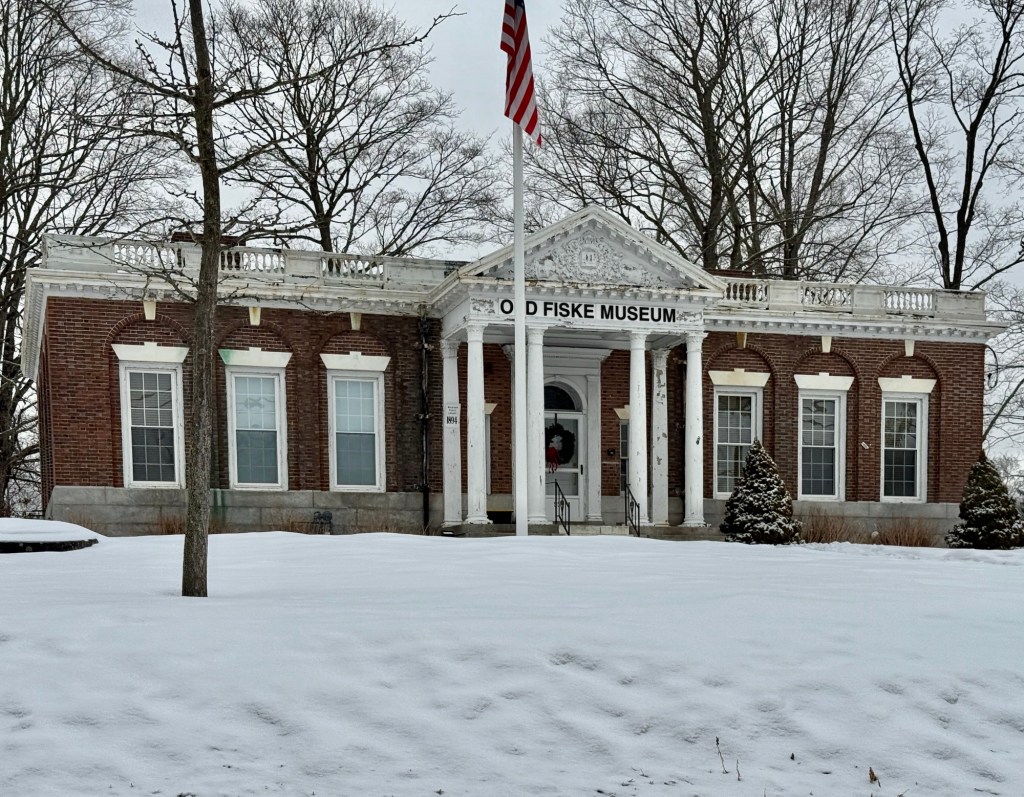
Former Fiske Public Library – Old Fiske Museum // 1896

The former Fiske Public Library building in Wrentham, Massachusetts, is an excellent example of a civic building in the Colonial Revival style. The building was funded and dedicated in the memory of the late Josiah Jones Fiske, a Wrentham-born lawyer and businessman, by his heirs. The family selected plans by Boston architect, William York Peters, who designed the building with a symmetrical facade with central projecting portico supported by Corinthian columns, and tall windows set within slightly recessed arches. The library was eventually outgrown, and instead of building an addition, the town decided to build a contemporary library elsewhere. Now, the former library is home to the Wrentham Historical Commission and the Wrentham Arts and Cultural Commission as the Old Fiske Museum, where the commissions feature local artifacts, art, and showcase the town’s ever-changing history and culture.

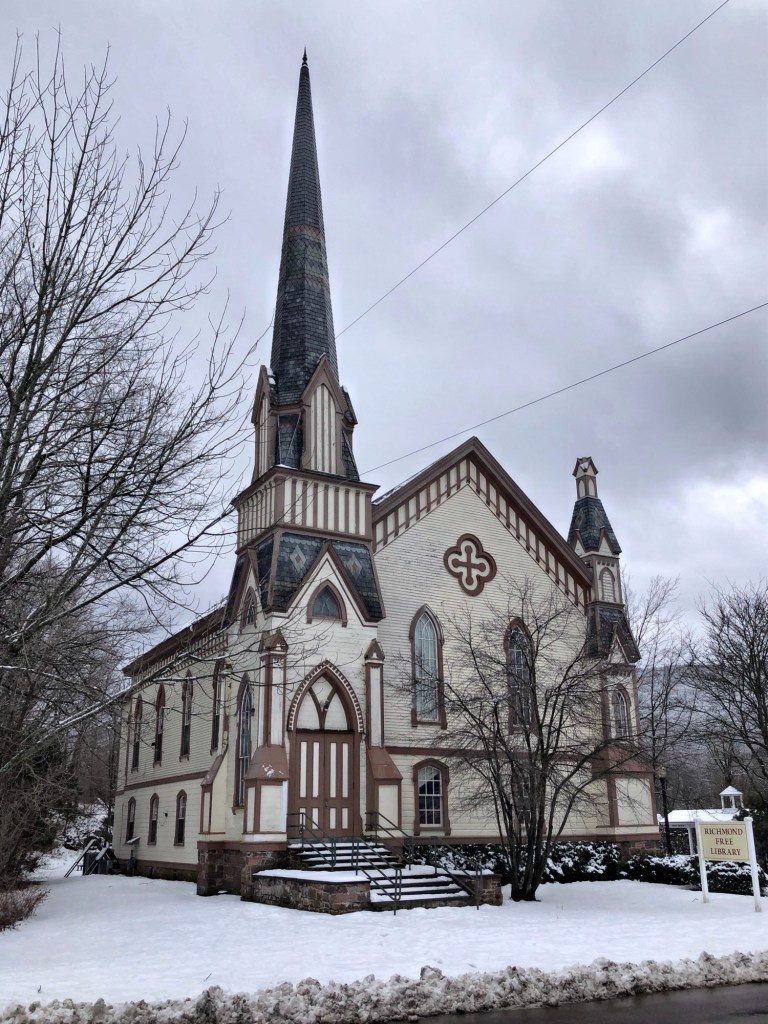
Richmond Universalist Church of the Restoration – Richmond Free Library // 1880

Adaptive reuse of old churches in New England is fairly common; with most conversions into housing or community centers, but have you seen a church turned into a library? Located in the charming town of Richmond, Vermont, this Victorian Gothic landmark was constructed in 1880 after Universalists in the community decided to leave the Round Church where they shared meeting space with other congregations in town. After WWII, the dwindling congregation sold the church to a resident who then offered the property to the Richmond School District, which had its large school next door. Voters accepted the gift at Town Meeting and passed a bond to convert the building into a cafeteria and gymnasium for the school next door. In the mid-1980s, with a new school built elsewhere in town, the school building was abandoned and converted to the Town Hall, with this former church, which served for years as the school gymnasium and cafeteria, eyed for demolition. It was explored to raze the former church and build a new, modern library building in its place. Preservationists petitioned to save the building, acquiring funds to restore the exterior and convert it to a library, and succeeded. Now the town of Richmond is home to one of the greatest examples of adaptive reuse in the state of Vermont.

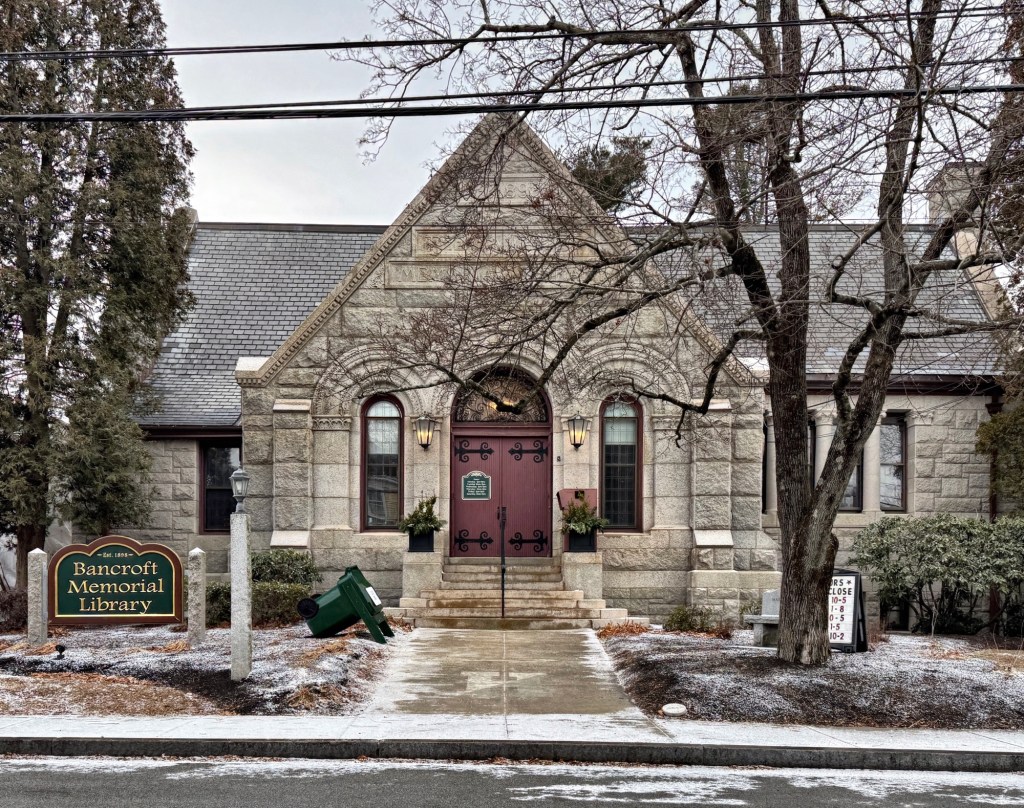
Bancroft Memorial Library // 1898

The Bancroft Memorial Library on Hopedale Street in Hopedale, Massachusetts, was built in 1898 and is one of the finest examples of a Romanesque Revival style library in New England. The library’s benefactor, Joseph Burbier Bancroft (1821-1909), moved to Hopedale and joined the Hopedale Community in 1846, where he became connected with the Hopedale Machine Company founded by the Draper Family. Shortly afterward Mr. Bancroft entered into a partnership with Ebenezer and George Draper, and was put in charge of the cotton machinery department of the Draper Corporation. Joseph married Sylvia W. Thwing, sister of the wives of Ebenezer and George Draper. As he rose through the ranks of the Draper Company, he decided to fund a library as a gift to the company town. Designed by architect, C. Howard Walker of the Boston architectural firm Walker & Kimball, the library is constructed of granite and features arched entry at the facade with carved stone panel above. Before the building was completed, Sylvia died, and the library became a memorial in her memory by Joseph Bancroft.

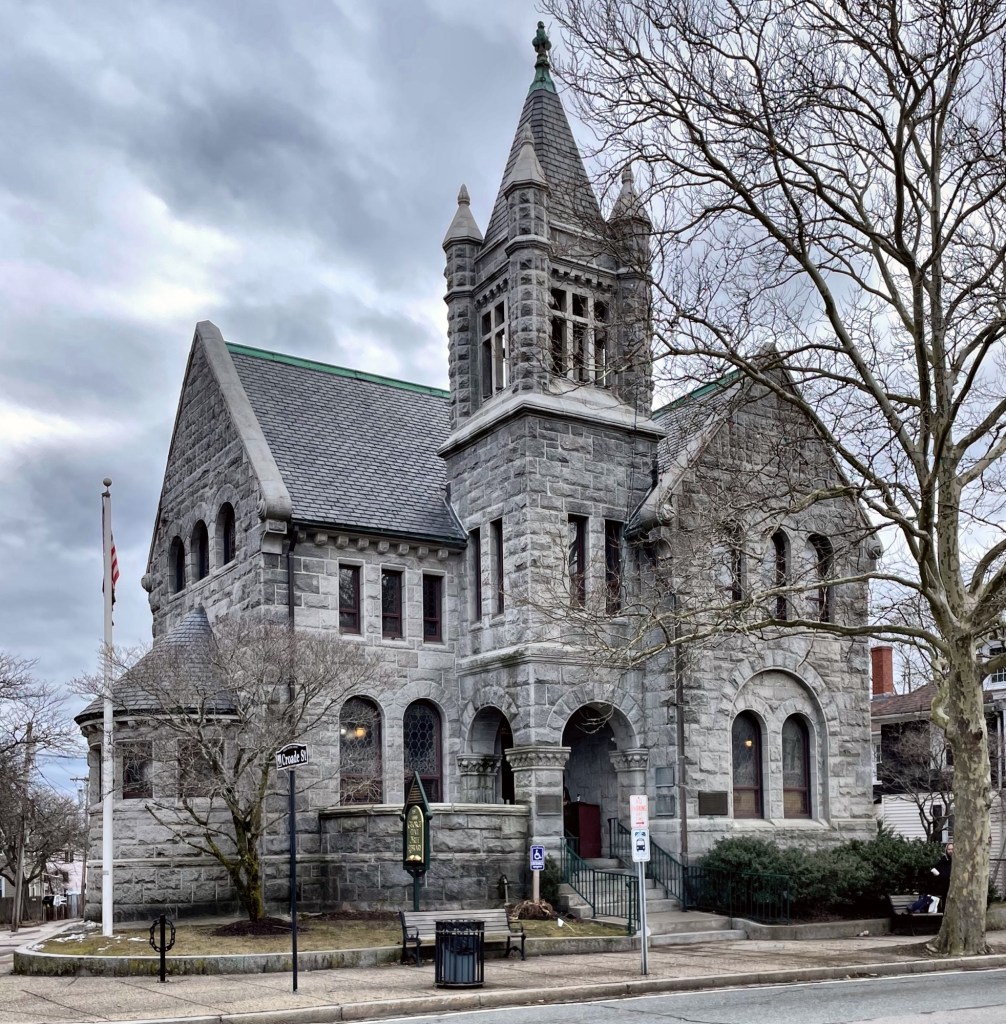
George Hail Free Library // 1888

The George Hail Free Library on Main Street in Warren, Rhode Island, is a unique, Victorian-era public library building that has been lovingly preserved by the community. Built in 1888, the building cost just over $16,000 and was designed in a more vertical expression of the Romanesque Revival style by the Providence architectural firm of William Walker and Son and built of rough-faced granite. The library is named after George Hail (1793-1873), a merchant, philanthropist, industrialist, and native son of Warren. His second wife, Martha Hail died in 1882 and left $5,000 and their home to the Warren Public Library provided that the name of the Library be changed to the George Hail Free Library in memory of her husband. The Library Committee agreed and planning began soon after for a new, purpose built library we see today. The exterior is distinguished, but the interior is also well-preserved, with original cherry woodwork grained to resemble mahogany, brass gaslighting fixtures, fireplaces, and leaded glass windows patterned with stained glass, together with some of the original furniture, that preserve a sense of the original setting.

Chester Public Library // 1907

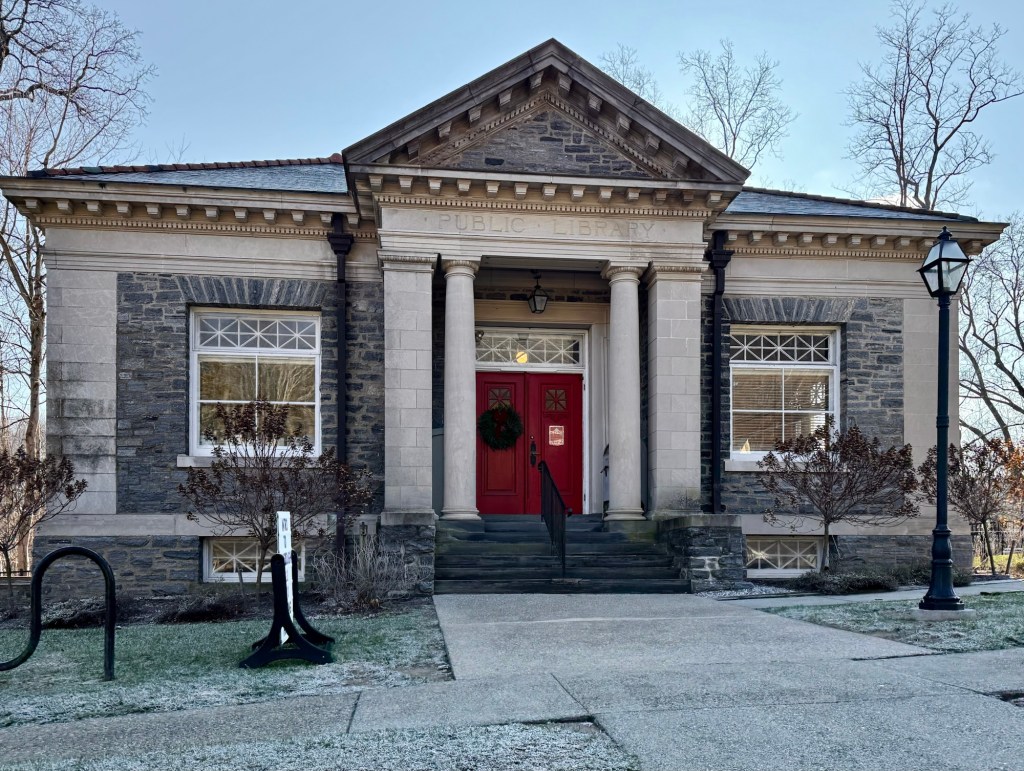
The Chester Public Library in Chester, Connecticut, was formed from a private library when in 1875, a Library Association was formed with members paying fees to take out books. The library grew throughout the 19th century and was housed in rented spaces, including in the Old Stone Store, until the early 20th century, when the collection grew to a point a purpose-built library was needed. A generous donor stepped forward, Mr. Samuel Mills Ely (1837-1909), who grew up in Chester, but made his fortunes in Binghamton, New York. Samuel Ely donated funds to his hometown as a memorial to his parents, Richard and Mary Caroline Ely. The library opened in 1907 and is built of native granite and trimmed with Indiana limestone and resembles many of the Carnegie libraries built at the time with a central, pedimented entry pavilion and recessed side wings, but no Carnegie funds were allocated for this project. The architect is also not known at this time.

Richard P. Spencer House – Deep River Public Library // 1881

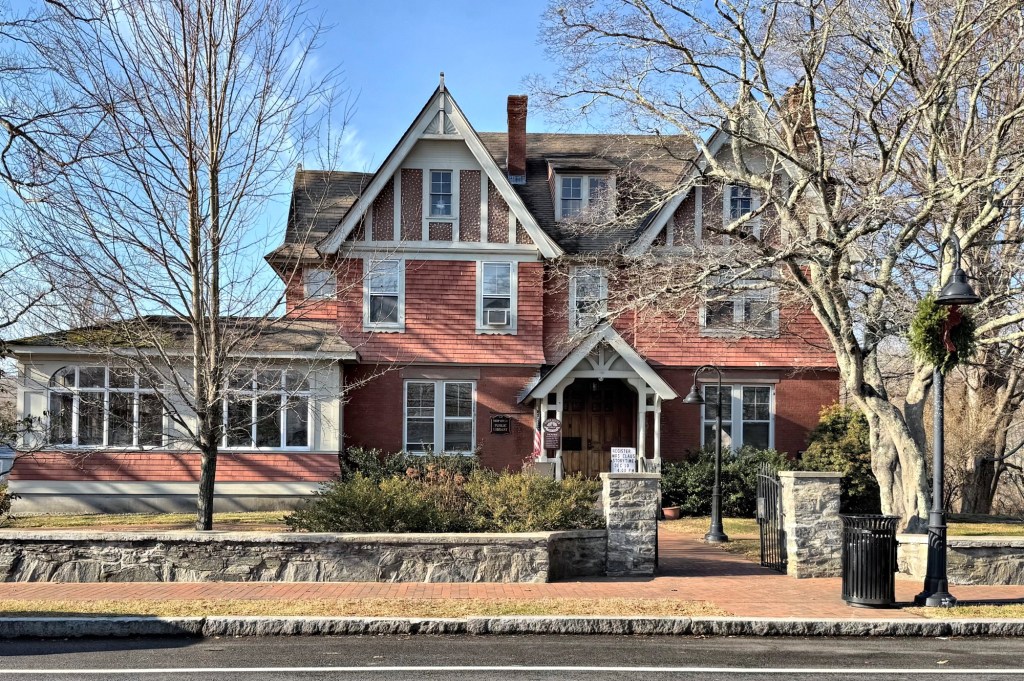
The finest extant Queen Anne Victorian-era house in the town of Deep River, Connecticut, is located on Main Street and since the 1930s, has been home to the town’s public library! How’s that for adaptive reuse?! This residence was built in 1881 for Richard Pratt Spencer (1820-1910), a local prominent businessman who lived to be 90 years old. Spencer lived here with his second wife, Juliana Selden, who was 32 years his junior, and three children until his death in 1910. When Spencer’s widow died in 1932, the heirs sold the property to the Saybrook Library Association (before the town renamed Deep River in 1947), which then, in turn, sold the building to the town for a small price in order to convert it into a library. Opened to the public in 1931, the Deep River Public Library has been preserved inside and out with historic fireplaces, woodwork, and features. The only notable change occured in 1995 when a children’s room addition was built to resemble an old porch. The library even retains the original pebbledash finish in the gables, a rare detail not commonly found in typical old houses of the period.


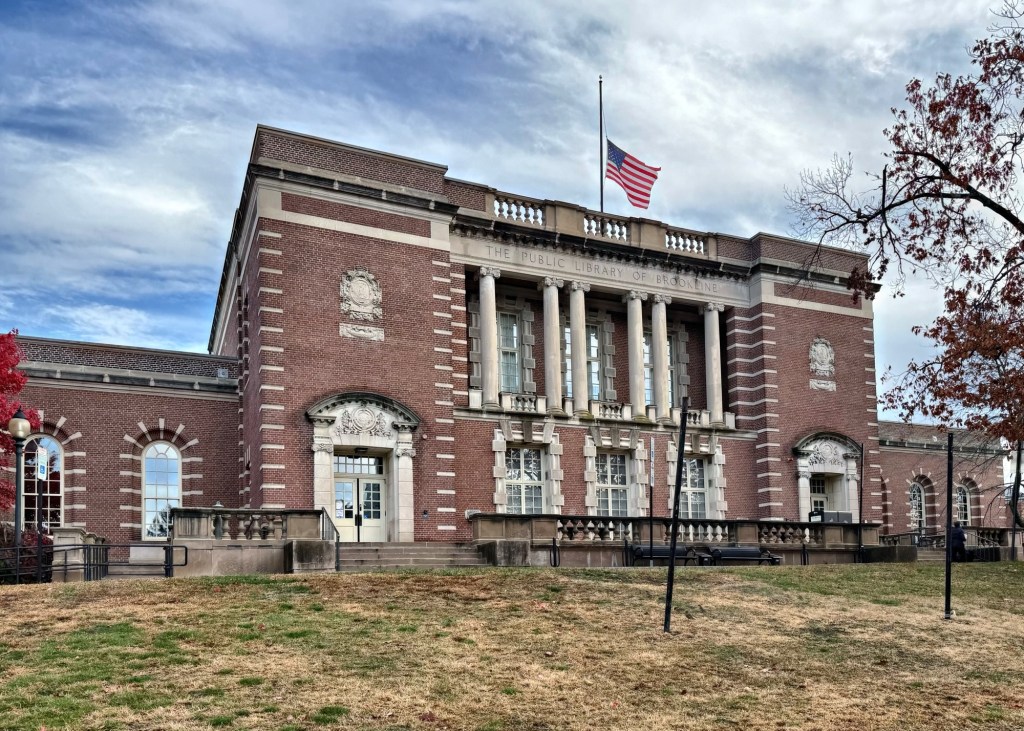
Brookline Public Library // 1910

The Brookline Public Library in Brookline Village opened in 1910 and was designed by R. Clipston Sturgis, one of the great 20th century architects in the Boston area. Taking his cue from the south facade of the Queen’s House at Greenwich, England, Sturgis designed a modest expression of Palladianism in red brick and limestone. The building is the second library on the site, replacing an 1869 mansard roofed building that was outgrown and demolished for this building. The Brookline Library was expanded in 1974 by Integrated Design Services Group and renovated again by Perry, Dean & Rogers.

Wayland Public Library // 1900

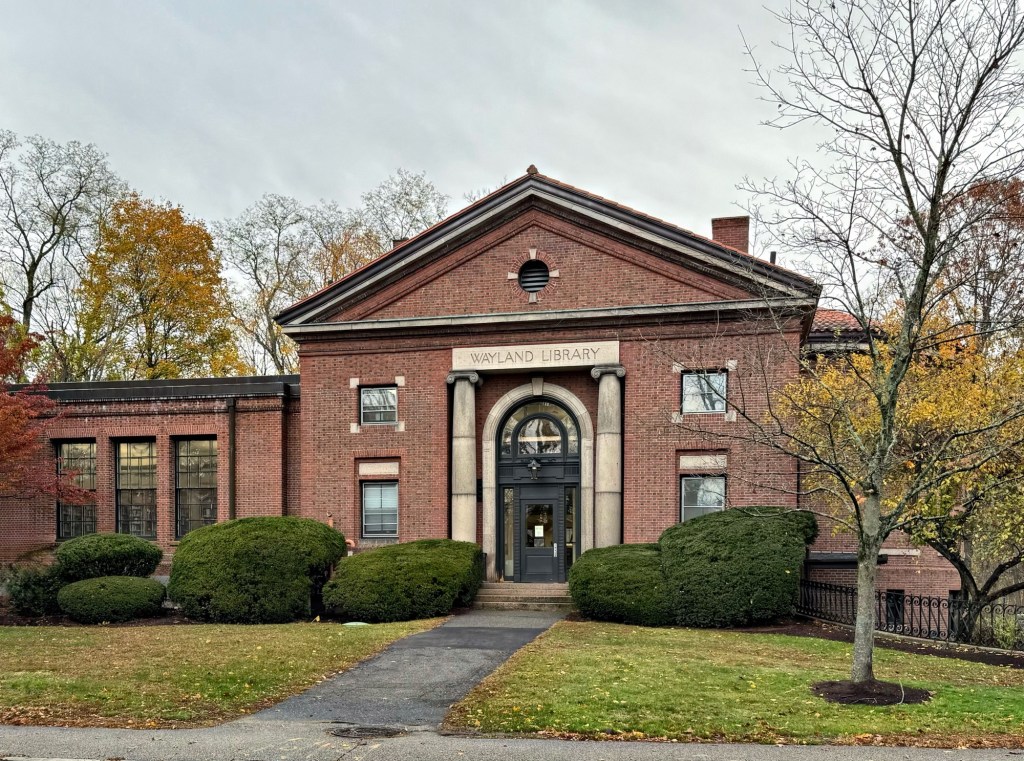
The Wayland Public Library is not only significant architecturally, but also historically as it was founded in 1848, with some claiming that it is the second free public library established in the United States. The first physical space for the Wayland Public Library was established in 1850 using a small room in the Town House. The Town House was outgrown and replaced in the 1870s by a large, Victorian Town Hall (razed in 1957) with designated space in the building for the expanded town library. As Wayland became an affluent Boston suburb in the late 19th century, wealthy resident, Warren Gould Roby (1834-1897), who lived just north of the town hall, donated land and $25,000 to the town for the purpose of constructing a library
that would be as fireproof as possible. Designed by architect, Samuel Mead of the firm, Cabot, Everett & Mead, the handsome building is said to have been inspired by Mead’s travels to Italy where he gained an interest in Roman architecture and Renaissance art. The influence is seen on the exterior with the Romanesque Revival style and on the interior with an ornate frieze around the rotunda. The building was expanded in 1988 by Tappe Associates and remains one of the great early 20th century libraries in New England.


Harcourt Wood Memorial Library // 1902

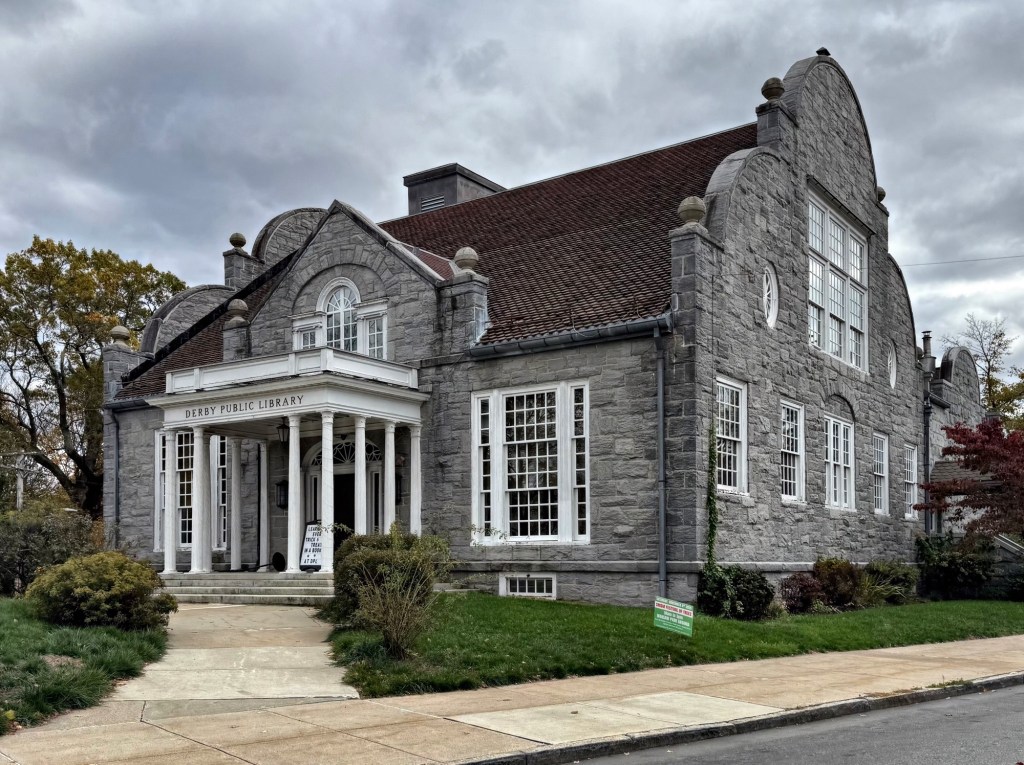
Derby’s main public library building, the Harcourt Wood Memorial Library, is located a few blocks from the city’s downtown on a unique triangular lot formed by Elizabeth and Caroline Streets. The one-story library is one of the finest of its period in all of New England and is built primarily out of Ansonia granite. The library was designed by architect Hartley Dennett and is notable for its Colonial Revival style porticoed entrance and distinctive rounded Flemish gables on the side walls. The interior is said to retain most of its original woodwork and many of its original furnishings. The building was constructed in 1902 following the donation of land and funds for its construction by Hamilton Holton Wood, a native of Montreal who made his fortune operating Derby’s streetcar railway system. The library is named in honor of Wood’s son Harcourt, who died at the age of 12 in 1897. The community does a great job at preserving the structure, which is one of the finest of its type in the region. 

Derby Neck Library // 1907

The Derby Neck Library in Derby, Connecticut, is a beautiful example of an early 20th century library and one of a few Carnegie libraries in the state. The beginnings of the library began in 1897, when Wilbur F. Osborne and his wife, Ellen Davis Osborne, who lived at the nearby Osborne Farm, donated $50 to the nearby school to begin a small library in the building. After years of growth, Wilbur Fisk Osborne, requested funds from Andrew Carnegie, who was donating money to communities all across the country for such purposes, to build a new library for Derby Neck. In 1906, Carnegie donated $3,400 to the community, and planning began on the building. Sadly, Osborne died around the time the library opened in 1907. The building was designed in the Classical Revival style by architect, Henry Killam Murphy of Connecticut. Osborne’s daughter, Frances Osborne Kellogg, who inherited her father’s farmhouse nearby, directed the library until her death in 1956. The building was expanded in 1972 and again in 1999.