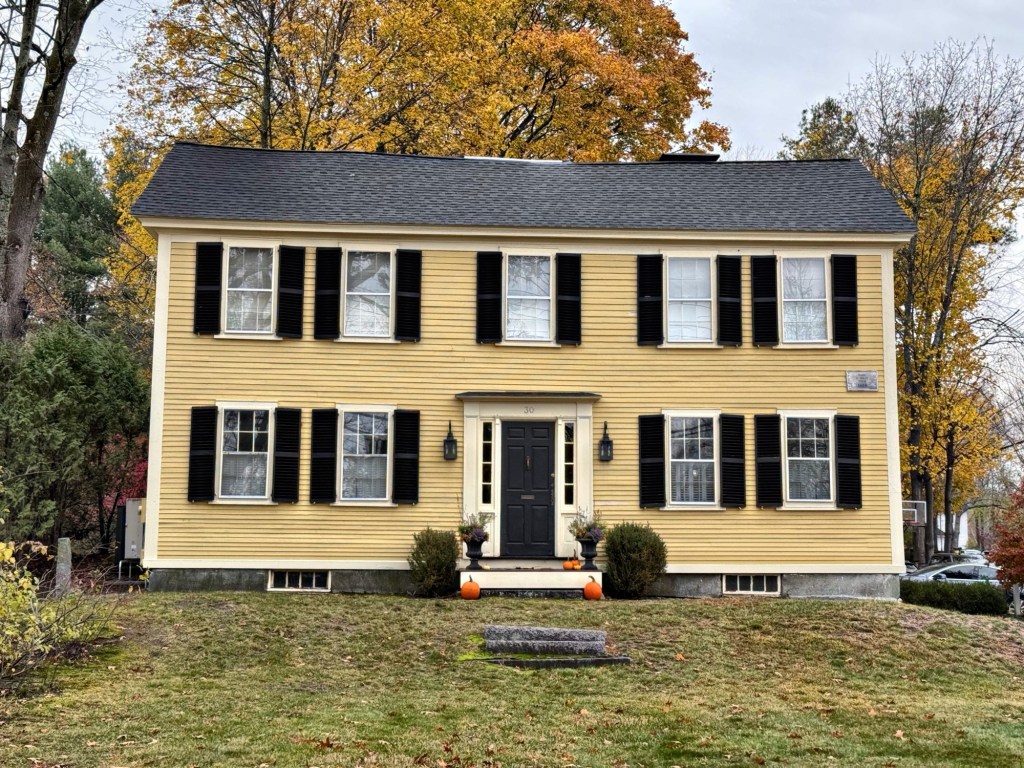
One of the many great old houses in Wayland, Massachusetts, is this well-proportioned Federal style residence at 30 Cochituate Road. The house was built sometime between 1818 and 1821 when owner Mark C. Sibley (1792-1876) married his first wife, Nancy Rice. Mark Sibley was the innkeeper at the Pequod Inn (no longer extant) that had served as an inn and stagecoach stop from when it was built in 1771. Mark Sibley remarried after Nancy died in 1839 and relocated to Weston. The Sibley House was acquired numerous times by real estate speculators. From 1886 until 1922, the property was owned by Anna Bennett, a widow. The five-bay, two-story Federal style house has a center entrance and six-over-six double-hung windows, all with a historically appropriate color scheme.
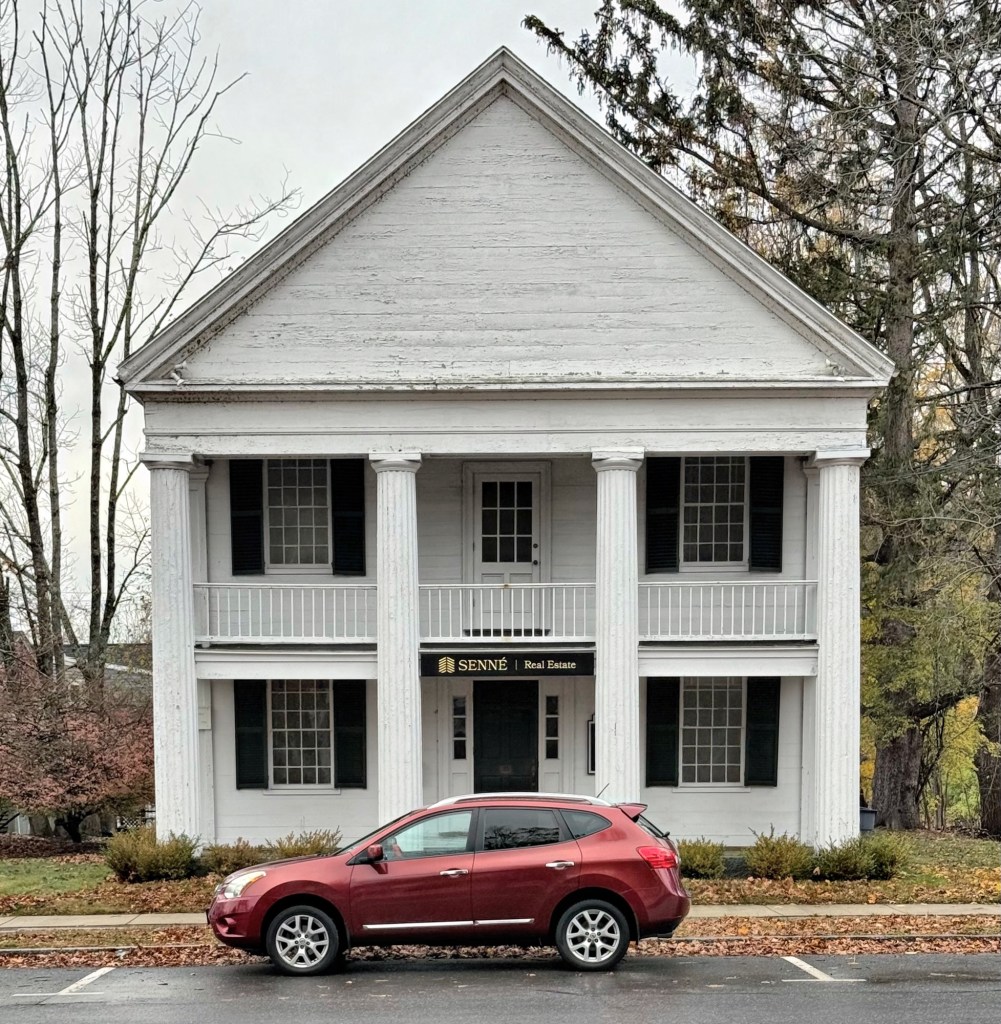
The Old Wayland Town House on Cochituate Road is an imposing Greek Revival temple-front building that has served various uses for the community. The structure was built in 1841 to serve as Wayland’s first municipal building and it was referred to as the Town House, with a large classroom and a small entry space on the first floor and a town meeting hall on the second. In 1850, the Wayland Free Public Library was opened in the building, in a small room in the front of the building. The small building was quickly outgrown for its civic uses, and in 1878, Wayland built a new, large Stick style town hall (demolished in 1958). The old Town House was sold to Lorenzo Knight Lovell (1837-1909), who soon after converted the Town House into a dry goods and grocery store known as Lovell’s Market. Following Lorenzo Lovell’s death, his son William S. Lovell ran the store until about 1922 when he leased the building to Lawrence Collins, who remained here for nearly 60 years operating his own store. Collins Market was eventually purchased in the late 1980s and converted to office space, which remains today.
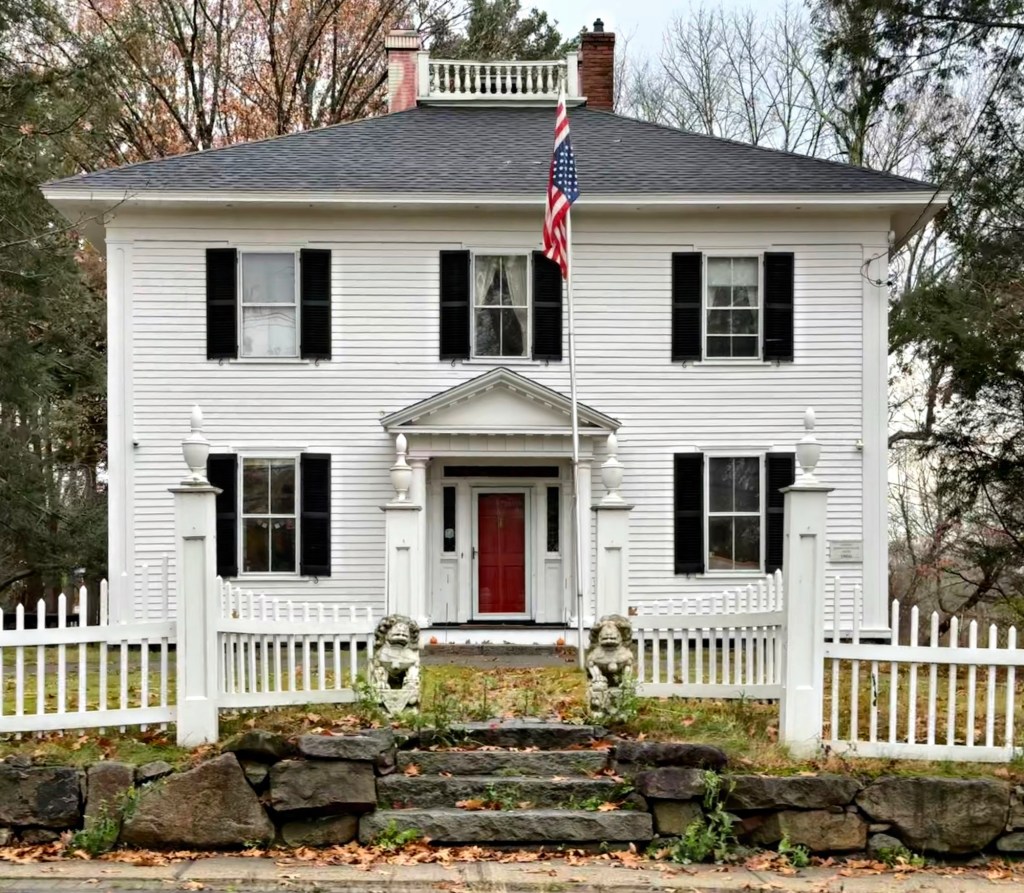
Built around 1865, this stately residence in Wayland, Massachusetts, was originally owned by sea captain, Edward Pousland who came to Wayland with his family around 1859. Interestingly, Mr. Pousland continued working as a sea captain, travelling to Salem and Beverly, where he would be at sea for months at a time. Likely due to his profession, the house features a ‘widow’s walk’, a common feature of houses by the sea where folklore holds that the wives of ships’ captains looked out for the return of their husbands. Edward, his wife Hannah W. (Langmaid) Pousland lived in this house at least until Edward’s death. After successive ownership, the property was purchased by Jonathan Maynard Parmenter (1831-1921), who gifted the house to the First Parish Church across the street, for use as a parsonage a use that continued until 1984 when the church sold the house back into private ownership. The house, designed in the Italianate style, was “modernized” in the early 20th century with Colonial Revival alterations, which added the portico and likely removed the brackets at the eaves.
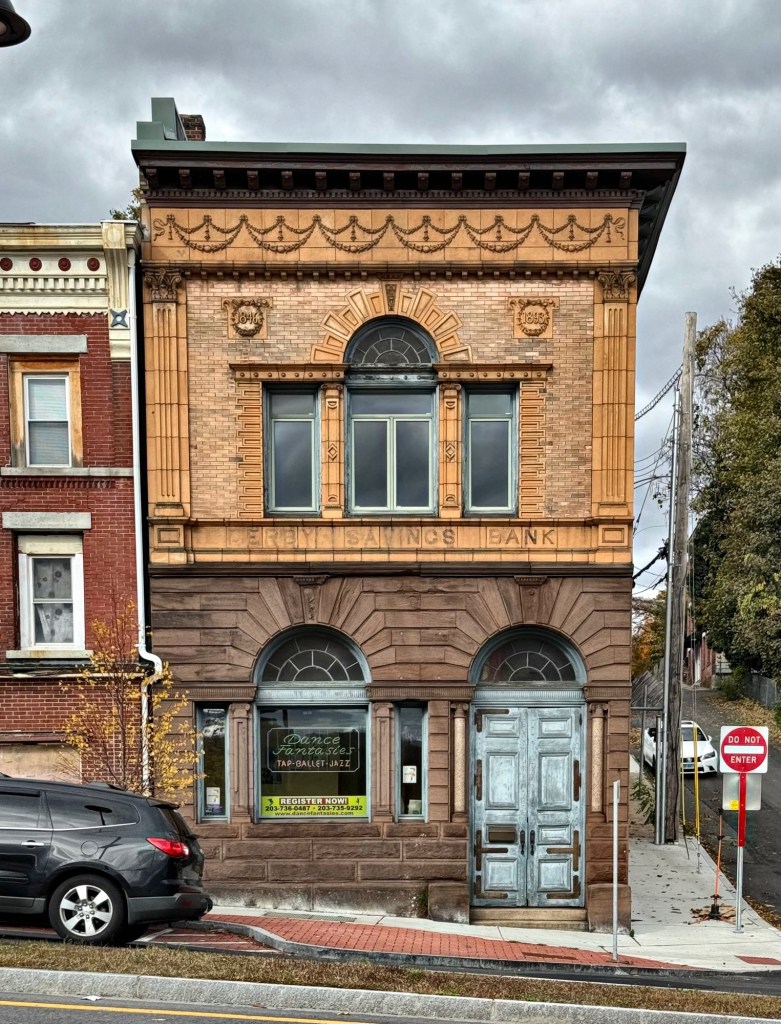
The former Derby Savings Bank stands at the corner of Main and Caroline streets and is one of the many handsome commercial buildings in Derby, Connecticut, which have been preserved. Designed in the Romanesque and Classical Revival styles, the building is adorned by terracotta, brick, and brownstone, with medallions depicting the date of incorporation (1843) and the date of this building (1893) which flank the Palladian window at the second floor. The bank occupied this structure from the date of its completion in 1893 until it built a new banking facility farther down Main Street in 1923. The bank again built a new building during the period of urban renewal in Derby’s downtown in 1976 when the modern structure at Main and Elizabeth streets was completed. The Modern bank is presently used as the City Hall.
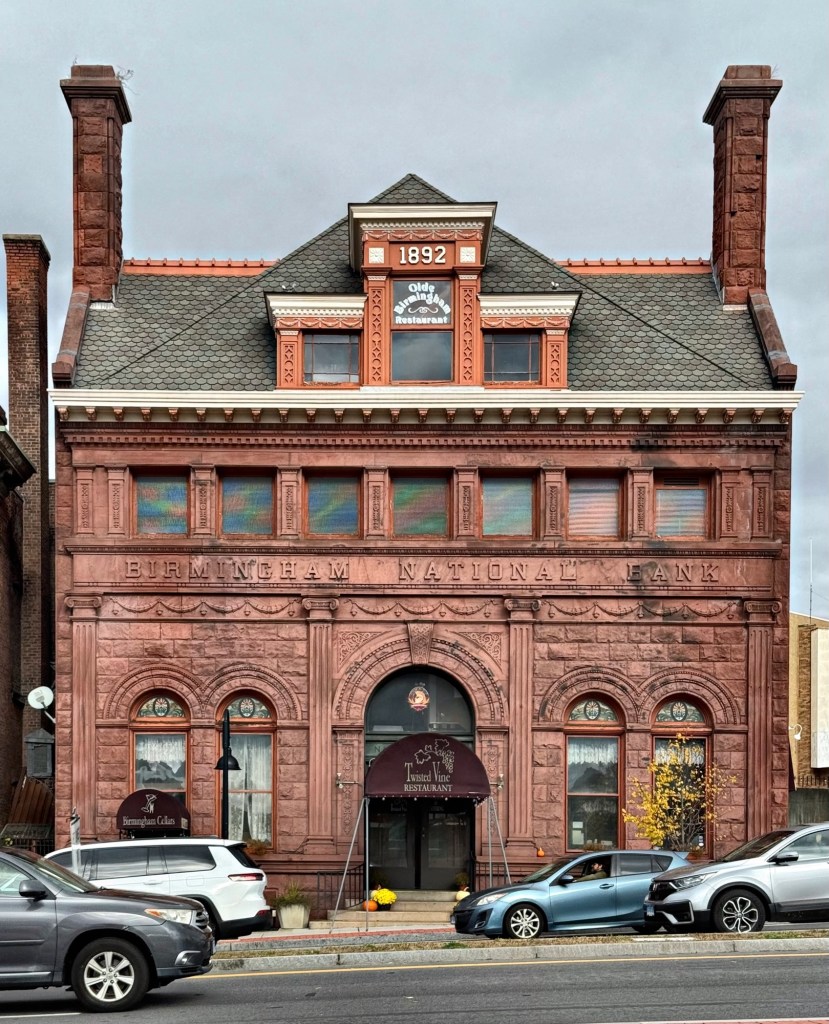
The former Birmingham National Bank building on Main Street in Derby, Connecticut, is one of the finest buildings in the former industrial village of Derby (originally named Birmingham). The bank was originally chartered in 1848 as the Manufacturers Bank of Birmingham, with Edward N. Shelton as its first president, and became a national bank after the Civil War. Designed by architect Warren R. Briggs and constructed in 1892, the building features an elaborately detailed facade of red sandstone with terracotta trim in the Sullivanesque and Romanesque Revival styles. Like many local and regional banks in the mid-late 20th century, the bank merged with others and the building was vacated. Today, the former Birmingham National Bank building is occupied by the Twisted Vine restaurant.
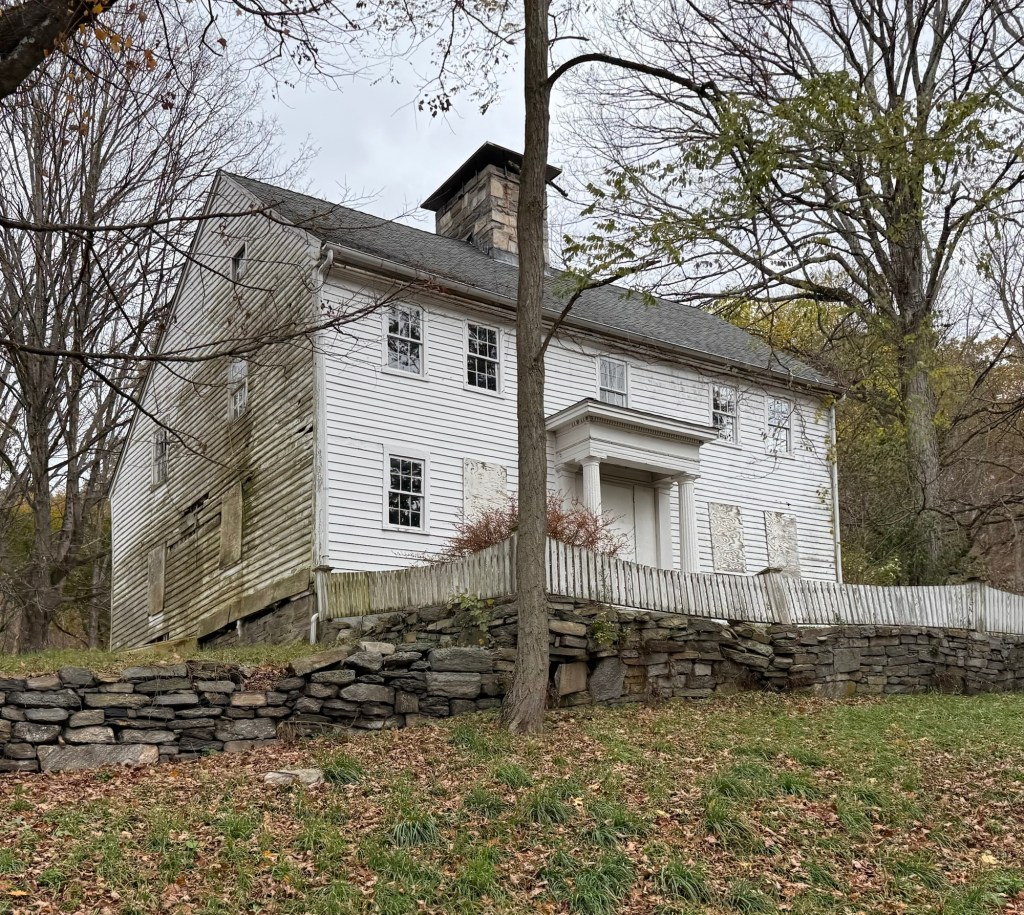
The Smith-Curtiss House, which is possibly the oldest extant building in Derby, Connecticut, has sat vacant and decaying for years and is owned by the State of Connecticut. Believed to have been built sometime between 1714 and 1740, this historic saltbox farmhouse at 411 Hawthorne Avenue is slowly decaying due to lack of maintenance and funding. Early ownership is difficult to determine, but by the 19th century, the property was owned by Ms. Alice E. Curtiss. The old estate was sold by Ms. Curtiss in 1913 to Frances Osborne Kellogg, a businesswoman, philanthropist and environmentalist, as part of her 350-acre dairy farm and land-conservation holdings. The Smith-Curtiss House was used as a residence for the herdsmen who ran the farm nearby. Before her death in 1956, Frances deeded the property to the state as a public park, and allowed her head herdsman life-occupancy of this house for the remainder of his life. The State of Connecticut assumed possession of this house in 1981. The building has suffered from deferred maintenance since this period, with the State attempting to lease the building to tenants. I hope that local and statewide preservation groups can mobilize to secure grants and funding to restore this important property.
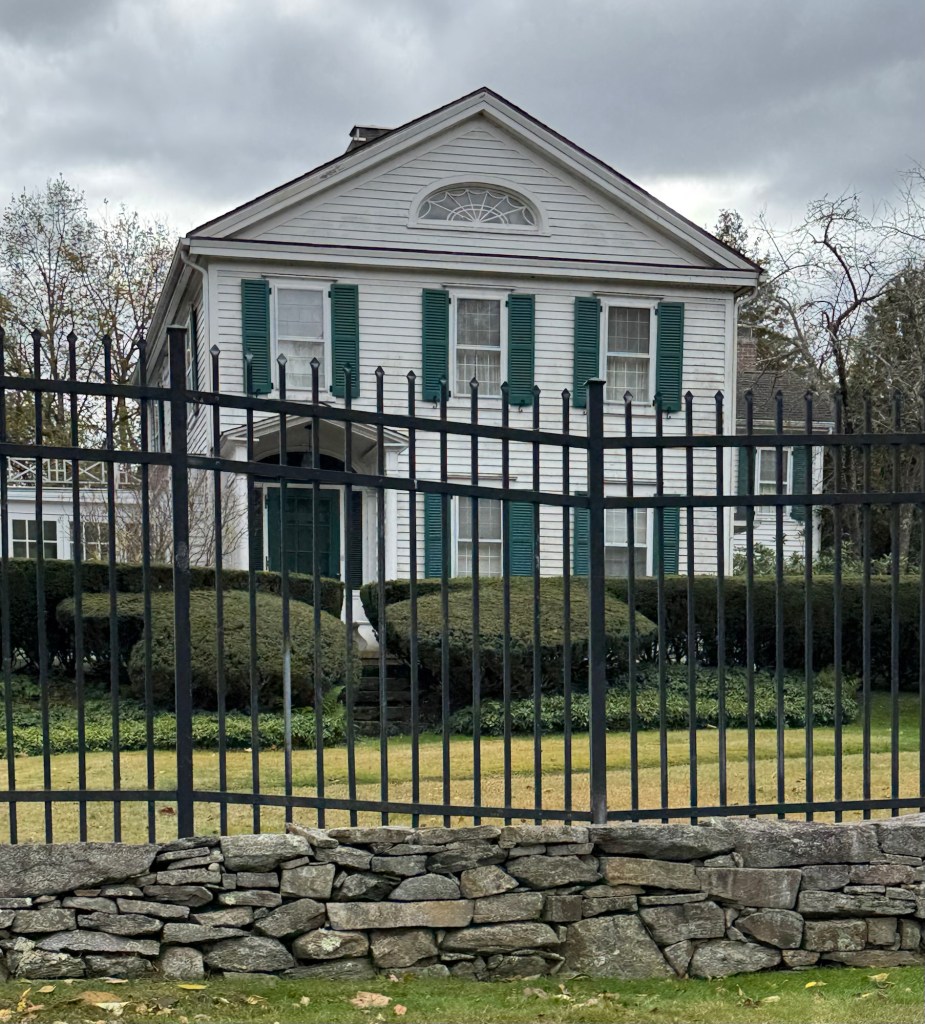
This Greek Revival style farmhouse in Derby, Connecticut, was originally built around 1840, though little is known about its first occupants. In 1867, Wilbur Osborne (1841-1907), who owned and ran several industries in Derby, Ansonia and Bridgeport, and his wife, Ellen Lucy Davis, moved to the house, who together, also ran a dairy farm on their farmland. Their only daughter to survive to adulthood, Frances E. Osborne (1876-1956) took over the farm after her father’s death and became a prominent businesswoman. At age 16, Frances lost the vision in one eye due to an accident, and, as a result, never completed her public school education. Frances Osborne, in an era when women were denied leadership opportunities in the business world, succeeded through pure determination and an excellent business sense. Her achievements included becoming president of Union Fabric Company, vice president of Connecticut Clasp, and treasurer of the F. Kelly Company. She was also a founding partner of Steels and Busks of Leicester, England. She married Waldo Stewart Kellogg in 1919, and he took charge of the dairy, using selective breeding to make the herd “famous throughout New England for quality milk production.” Waldo and Frances Kellogg enlarged and remodeled the house to its current form between 1919 and 1925 adding wings and renovating the interiors in the Colonial Revival style. Waldo Kellogg died in 1928, but Frances stayed in the house until her death in 1956. Just before she died, she deeded her entire 350-acre (140 ha) estate, including Osbornedale, to the State of Connecticut. The state now operates the house and grounds as the Osborne Homestead Museum; the surrounding land comprises Osbournedale State Park.
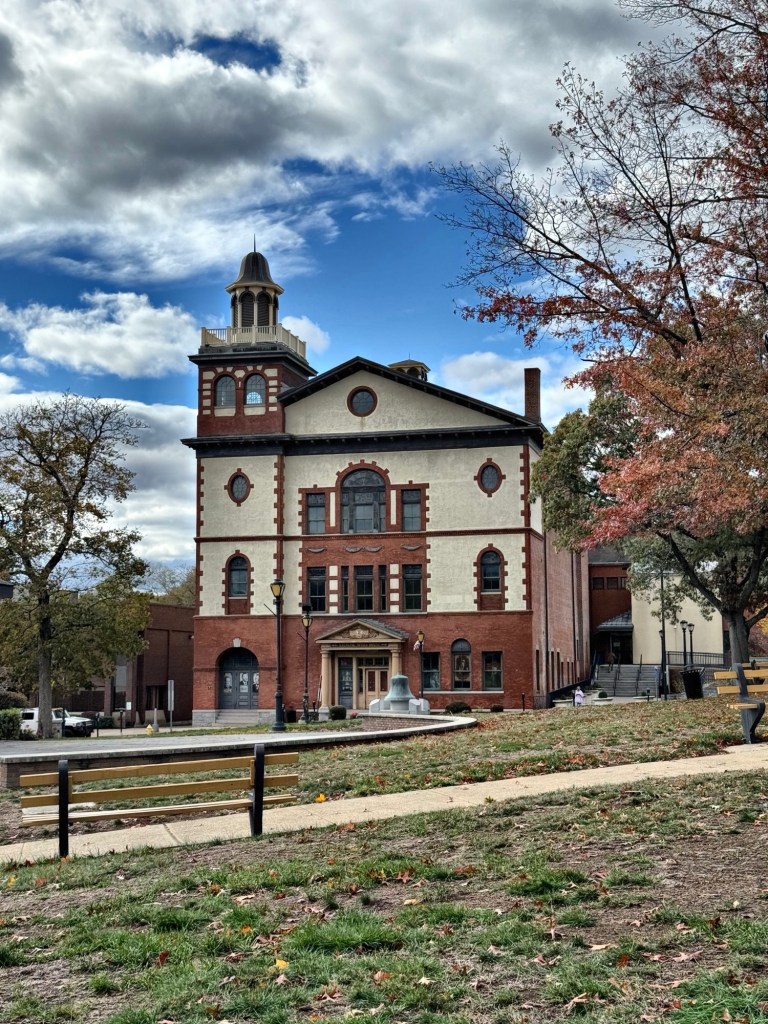
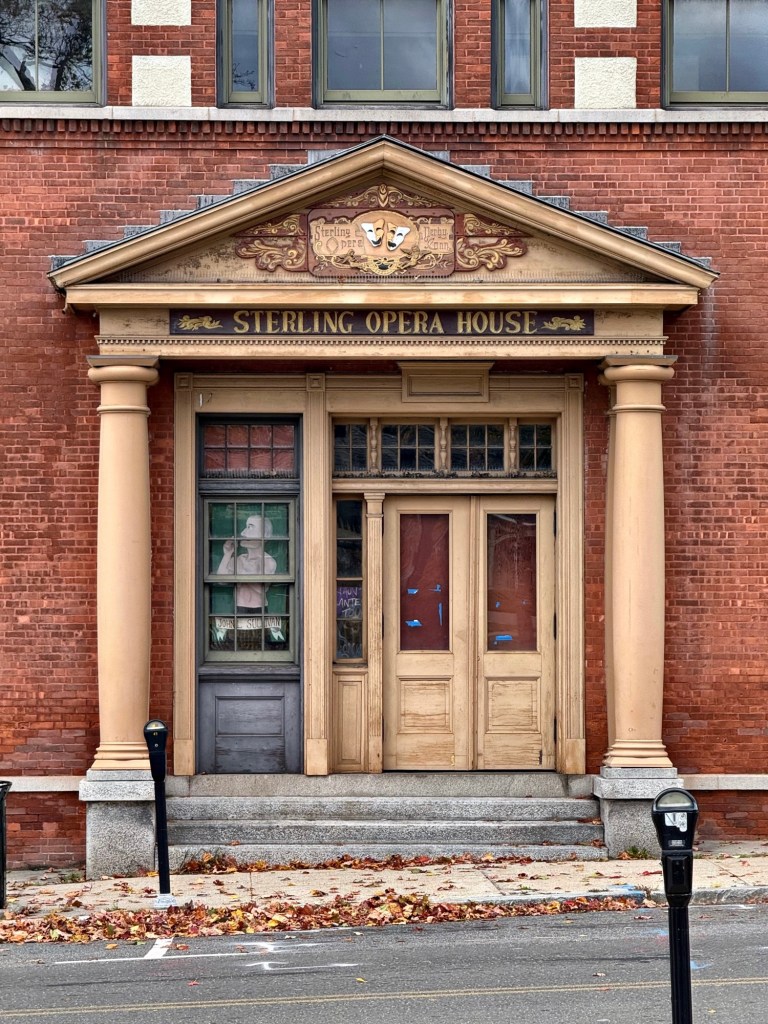
The Sterling Opera House in Derby, Connecticut, is a landmark performing arts venue and civic center in the state and significant as a rare and well-preserved building constructed in the Italian Renaissance Revival style. Built in 1889, the building is named for Charles A. Sterling, founder the former Derby-based Sterling Piano Company, who paid for much of the costs of construction and design for the building. For his namesake building, Charles Sterling hired architect H. Edwards Ficken, who also assisted with the designs for the famous Carnegie Hall in Manhattan, New York, to furnish plans for the unique building. The Opera House was built to serve both political and entertainment needs for the community, with the lower two levels and the basement serving as City Hall offices and the police station from when it opened up until 1965. The auditorium was used for hundreds of shows and live musical performances in its day, with many world-famous performers such as Harry Houdini and Red Skelton taking the stage at the Sterling. Shows were held up until 1945 when the curtain closed for the last time. In the past decades the building has been largely vacant and kept alive by grants and a dream by the city to preserve this significant landmark, possibly for reincorporation as the City Hall.
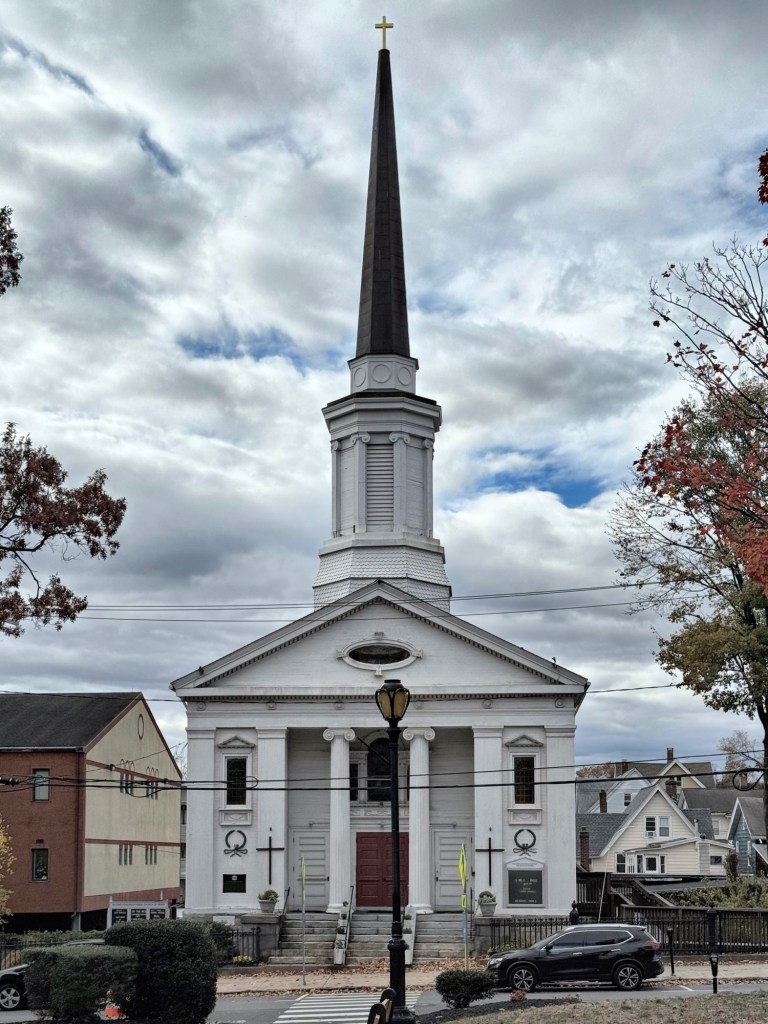
The Second Congregational Church of Derby was built in 1845 by members of the Birmingham Congregational Society, who grew tired of travelling across the river to the First Congregational Church in town. The present “downtown” of Derby was originally known as Birmingham and grew as the industrial center in the city, which historically was much larger than it is today. The Birmingham Congregation had this edifice constructed in the Greek Revival style, and it was added onto in 1859, 1889, and underwent alterations in 1915, when the facade was altered with Colonial Revival flourishes. The additions to the facade include the Palladian window, elliptical leaded window in the pediment, and panels with swags and wreaths. The top of the steeple was damaged by Hurricane Gloria in 1985 and removed, and was replicated in 2021.
 Buildings of New England