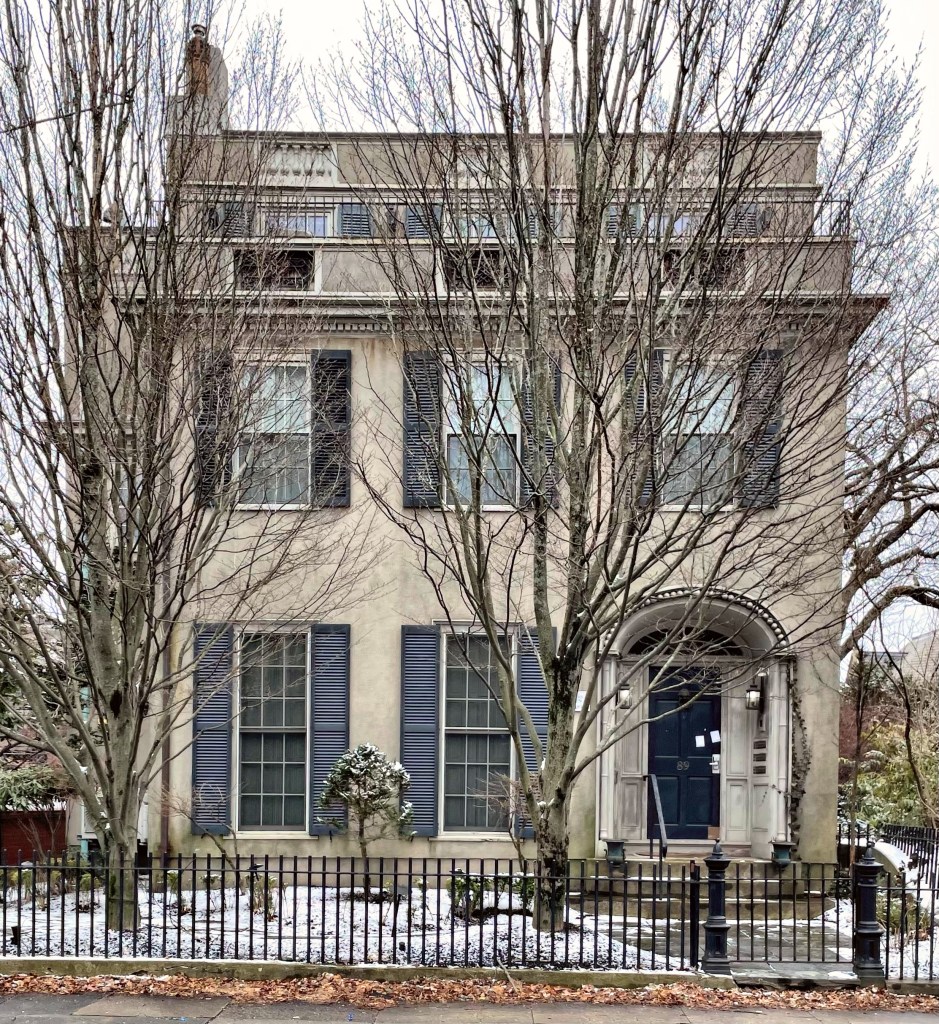
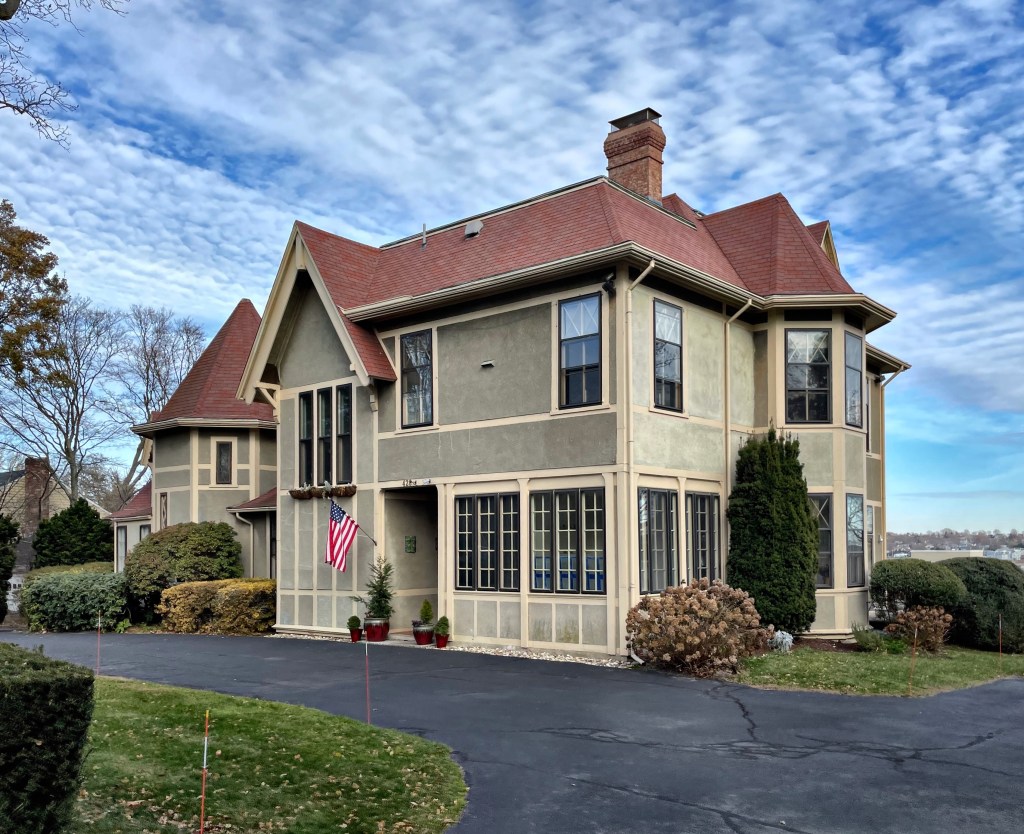
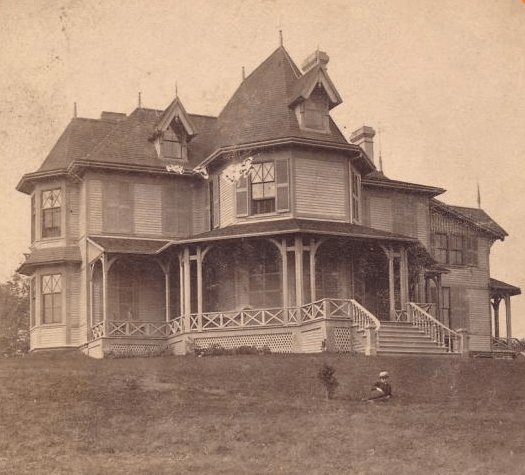
Although Benjamin Bliven built this house, he never owned the property, but the name lives on! This house on Angell Street in Providence was originally constructed in 1849 in the Greek Revival style, popular at the time. Bliven, a musician, rented the property to tenants until the deed was transferred to Abby W. Watson, wife of Robert W. Watson (owner of the property next door and featured on this account previously). The first owner-occupants were Grace A. and Eugene H. Greene, who bought the property in 1898. The house was completely remodeled in the early decades of the 20th century with Regency/Colonial Revival detailing. Changes including the former roof with its gable-end facing the street boxed off, a new modillion cornice with parapet above; recessed attic story with balustrade; small wing to the east. The stucco siding and Federal entry is icing on the cake!
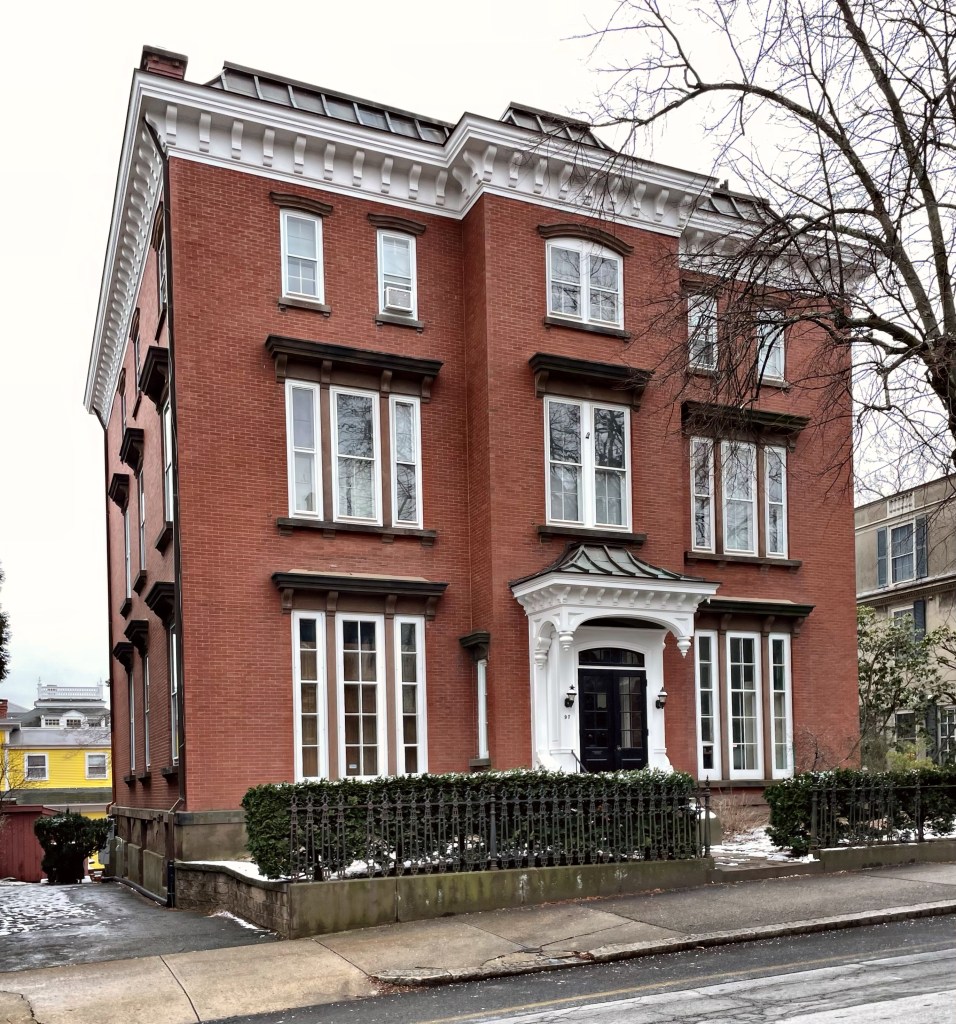
No town does Italianate architecture quite like Providence! Case in point, the Watson-Knight Mansion, a relatively overlooked example of the style found on Angell Street in College Hill. In 1854, a house lot here was purchased by an elderly Matthew Watson (1786-1857), who possibly lived in half of the house for a few years until his death. Directories also list his son Robert as living in the home in 1854. The three-story brick mansion has a boxy form with symmetrical facade. Brownstone hoods and sills are located at the windows and add depth to the otherwise blank facade. A projecting wooden door hood with hanging pendants covers the large entry. The home remained in the Watson Family until it came under the possession of Robert Brayton Knight (1826-1912) a businessman and mill owner who became the largest individual owner of cotton mills in the world, with upwards of twenty distinct establishments under his personal control. He co-founded what became the Fruit-of-the-Loom brand with his brother in the 1850s. The building has since been divided into apartment/condominiums.
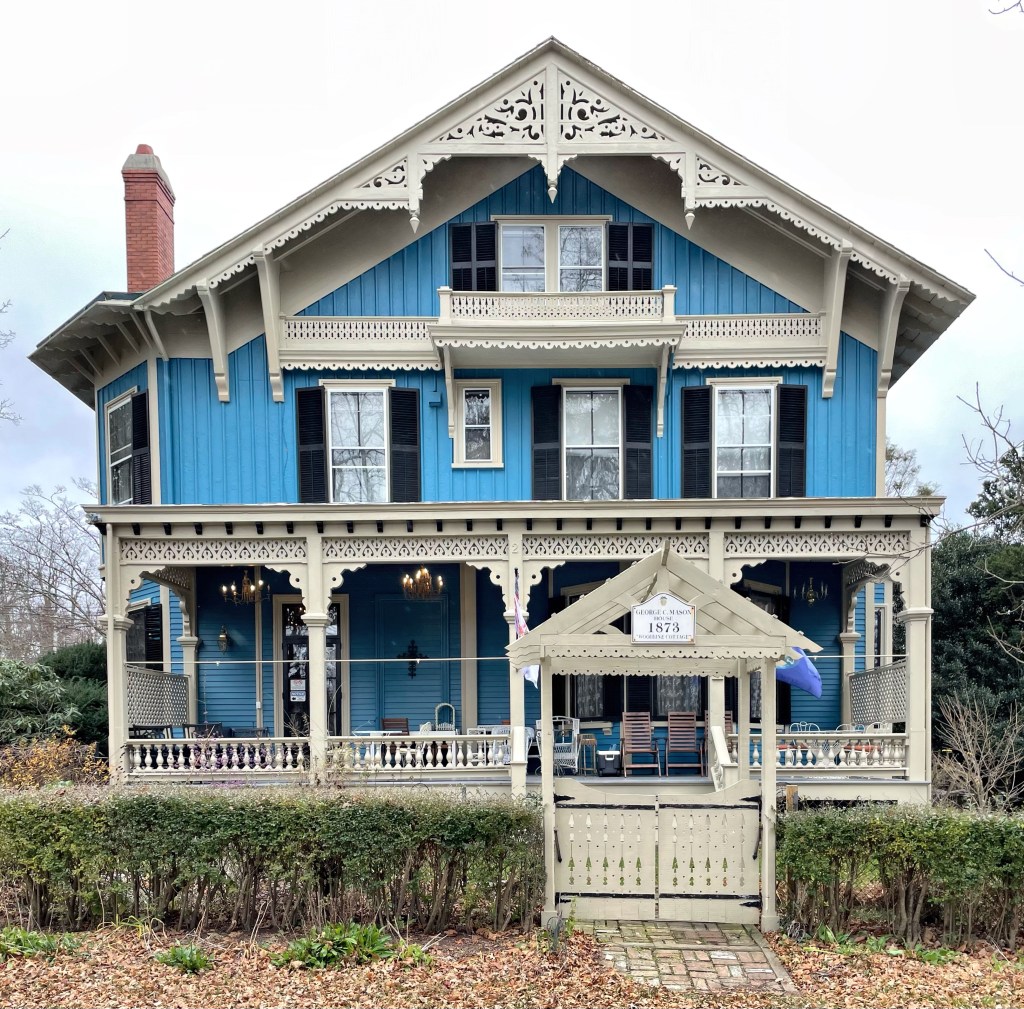
George Champlin Mason (1820-1894) can be credited as one of the most influential people who helped make Newport what it is today. He was born in the old Colonial town in 1820 and after a brief period working in New York City in dry goods, he traveled to Europe in his twenties to study art in Rome, Paris, and Florence, specializing in landscape paintings. Mason spent the 1840s trying unsuccessfully to make a living as landscape painter and published Newport and Its Environs, a collection of 11 engravings of his landscape views of Newport that is one of the earliest books about Newport to showcase its potential as a vacation destination. In 1851, Mason switched professions and became part owner and editor of the Newport Mercury newspaper. He often wrote on architectural subjects. In around 1858, he took his love for art and architecture and became an architect/developer, just as Newport was seeing early stages of development as a summer colony. He was hired by some early summer residents to design their homes, and did not disappoint, gaining notoriety all over the northeast. His son George C. Mason, Jr. (1849-1924), followed in his father’s footsteps and is said to have been the first professional architectural preservationist in the United States. George Sr., built this house as his primary residence in 1873, a stunning and rare example of Swiss Chalet architecture in New England, notable for the use of pierced bargeboards, board-and-batten sheathing, and cut-out railings. The property also included a charming stone English Revival tower in the rear yard, built in the 21st century as a workshop for the previous owners. How cool!
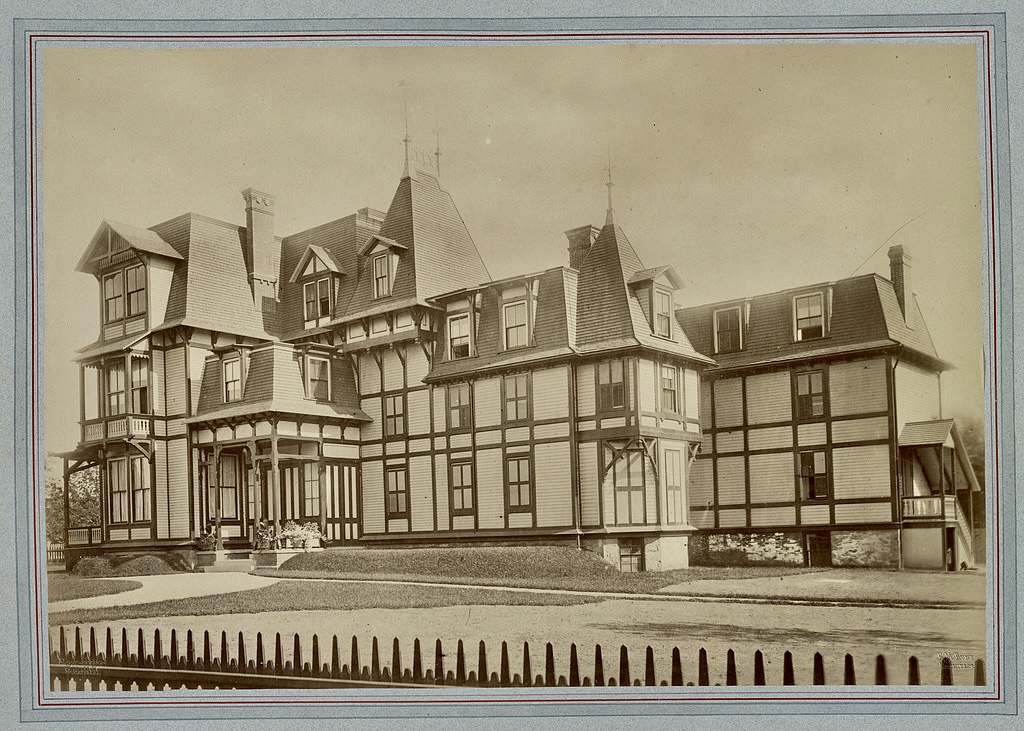
One of the finest Queen Anne style residences New England is this 1877 summer cottage, named “Snug Harbor”. The mansion was designed by architects William Appleton Potter and Robert Henderson Robertson for Charles H. Baldwin, a prominent admiral in the United States Navy. The design utilizes a brick first floor with shingle siding above, a high cross-gabled roof, panels and half-timbering, asymmetrical form, and a porte cochere at the entry. Later owner Arakel Bozyan, painted the entire exterior a deep red color and renamed the house “Gamir Doon”, Armenian for “Red House”. The house was restored back to a traditional color scheme and sold in 2020. The interiors are STUNNING!
In 1885, a 28-year-old Leroy King (1857-1895) and his wife Ethel Rhinelander King (1857-1925) hired one of the country’s most prominent architects, Stanford White, to design a Newport home for their family. Leroy was the son of Edward King, a prominent local merchant, and upon his fathers death in 1875, inherited some of the $100+million dollar fortune he had amassed in today’s dollars. The corner lot at Bellevue and Berkeley avenues was purchased and work was underway on the new mansion. The house is a really interesting take on the Shingle style, but instead of cedar shingle siding, employs fireproof construction. A central hall, large gabled masses, picturesque window arrangements, and a spectrum of surface textures (here conveyed largely in natural stone and brick with flourishes of shingle and pebble dash work), align this house with McKim, Mead & White’s earlier efforts in this style. The interior has been meticulously preserved and maintained by the owners.
Believe it or not, but Newport, Rhode Island was once a “tear-down town”. Despite having arguably the largest extant collection of Gilded Age mansions, many older, properties were razed and redeveloped as tastes changed between the mid-19th century and the turn of the 20th century. And then there was the 1960s… But that’s for another time. This stunning mansion formerly on Bellevue Avenue was built in 1870 for Elizabeth Underhill Coles (1813-1891), the widow of William F. Coles of New York City by the high-society architect Richard Morris Hunt. The “cottage” was their summer residence and one of the finest Stick style residences built in the seaside town. The irregular layout, half-timbering and complex roof forms show the influence on the emerging Queen Anne style. The mansion was sold out of the Coles Family after Elizabeth’s death and was razed by 1900 for the second mansion on the site (next post).
The formal Sitting Room at the Elms in Newport, Rhode Island is one of the many statement-rooms found in the Gilded Age mansion. This room is located directly above the Ballroom and is the first space seen when ascending the main staircase onto the second floor. The sitting room was used by the Berwind Family and their guests as a gathering and socializing space, a little less formal than the ballroom downstairs for more elegant events. The Preservation Society of Newport County has done an amazing job at restoring the building and purchasing furniture and fixtures that were sold off when much of the inside of the property was sold off at auction in the 1960s. The Preservation Society restored the red silk walls fabric in the 1980s, bringing the space back to its original grandeur. I cannot think of a better place to just “sit”.
The Dining Room of the Elms Mansion in Newport, Rhode Island, is represents the Gilded Age in all the best ways. The room sits just off the ballroom and like all of the other rooms in the summer residence of the Berwinds, it was designed by famed interior designer Jules Allard. The dining room was specifically to display a collection of early18th-century Venetian paintings purchased by Mr. Berwind from the Ca’ Corner estate in Venice (the Berwinds were avid collectors of 18th century French and Venetian paintings). The iconic coffered ceiling is not of wood, but of molded plaster, grained and painted to imitate oak. Each coffer is decorated with the winged lion of Saint Mark, the patron saint of Venice. Pour custom-made crystal chandeliers hang in the four corners of the room. At the end of the room is a stunning green marble, agate and onyx fireplace that is framed by a ceiling-high pediment supported by carved Ionic columns. Could you see yourself entertaining in this dining room?
To celebrate, I wanted to feature the library aka the “red room” in the Elms Mansion in Newport, Rhode Island. The library is lined with high wainscoting and walls of inlaid walnut hung with red damask/fabric. The center table, fireplace mantel, and inlaid bookcases were all designed by Jules Allard, and the table in particular displays the exaggerated proportions and classical ornament typical of 16th-century French design. The mantel piece consists of white carved stone with the upper part of richly carved walnut. The room is one of the coziest in the Elms, one of the more refined and “homey” of the Newport Mansions open for tours. From this library, owner Edward Julius Berwind, would keep up with his growing businesses while away for summers in Newport.
Immediately upon entering the main entrance of The Elms, one of the finest Gilded Age mansions in Newport, you are enveloped in the Stair Hall or foyer. The space is stunning, with walls lined in limestone and purple Breccia marble pilasters and columns with bronze capitals and bases. The floors are of white marble bordered in green with stairs in white Italian marble. At the beginning of the stairs, there are two large urns of green marble and pink granite, each with four bronze female figures. The urns bear the name of the decorator, Allard et Fils of Paris, who was responsible for crafting the details of the period rooms for the mansion. At the top of the first set of stairs is the Gallery Hall, a long hall connecting many rooms on the first floor and also serving as a gallery of irreplaceable art including two early 18th-century oil paintings depicting episodes in the history Scipio Africanus, the ancient Roman general who conquered Carthage by Venetian artists Paolo Pagani and Giovanni Antonio Pellegrini. The space is grand, yet cozy and feels more like a home than the larger Breakers mansion.
One of my favorite things to do each holiday season is to explore Newport and the mansions all gussied up with lights, ornaments and holiday cheer. This year, I visited The Elms, one of my absolute favorite buildings in Newport, which is a house museum! Stay tuned for some room features, similar to my series last year on The Breakers mansion.
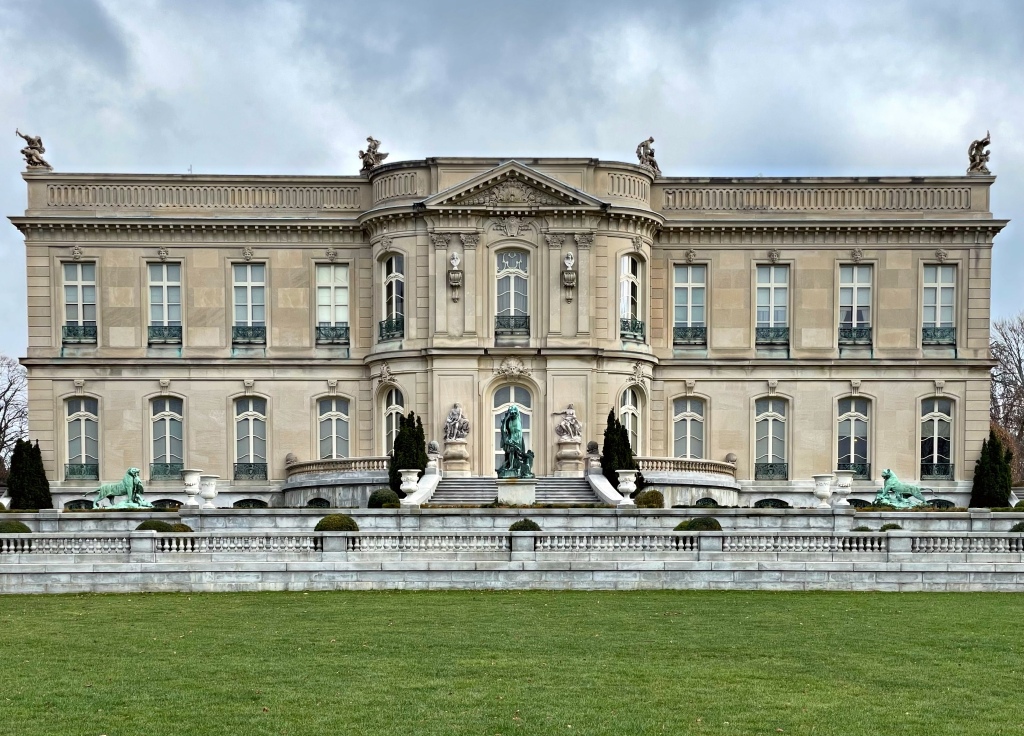
The Elms was commissioned in 1898 by coal baron Edward Julius Berwind (1848–1936) and his wife Sarah Torrey Berwind (1856-1922) as a summer cottage where the couple could escape the woes of city life for a few weeks of every year. Edward was “new money” (his parents were middle-class German immigrants); and by the 1890s, he was hailed as “one of the 58 men who rule America”, making him one of Newport’s most important summer residents. To live up to his new status, he hired Philadelphia architect Horace Trumbauer, who took inspiration from the 18th century Château d’Asnières in France. The site on the iconic Bellevue Avenue is not directly on the water, so Trumbauer sought to enhance the siting of the mansion by elaborate landscaping (more on that later). The house was built to be fireproof, after the complete loss of the original Breakers mansion in 1892 and is clad with Indiana limestone. The couple held many lavish parties in the Elms until 1922, when Mrs. Berwind died. Mr. Berwind invited his youngest sister, Julia, to become his hostess at his New York and Newport houses. Mr. Berwind died in 1936 and Julia continued to summer at The Elms until her death in 1961. Childless, Julia Berwind willed the estate to a nephew, who did not want it and fruitlessly tried to pass The Elms to someone else in the family. Finally the family auctioned off the contents of the estate and sold the property to a developer who wanted to tear it down. In 1962, just weeks before its date with the wrecking ball, The Elms was purchased by the Preservation Society of Newport County for $116,000. It remains one of the most visited house museums in the nation to this day.
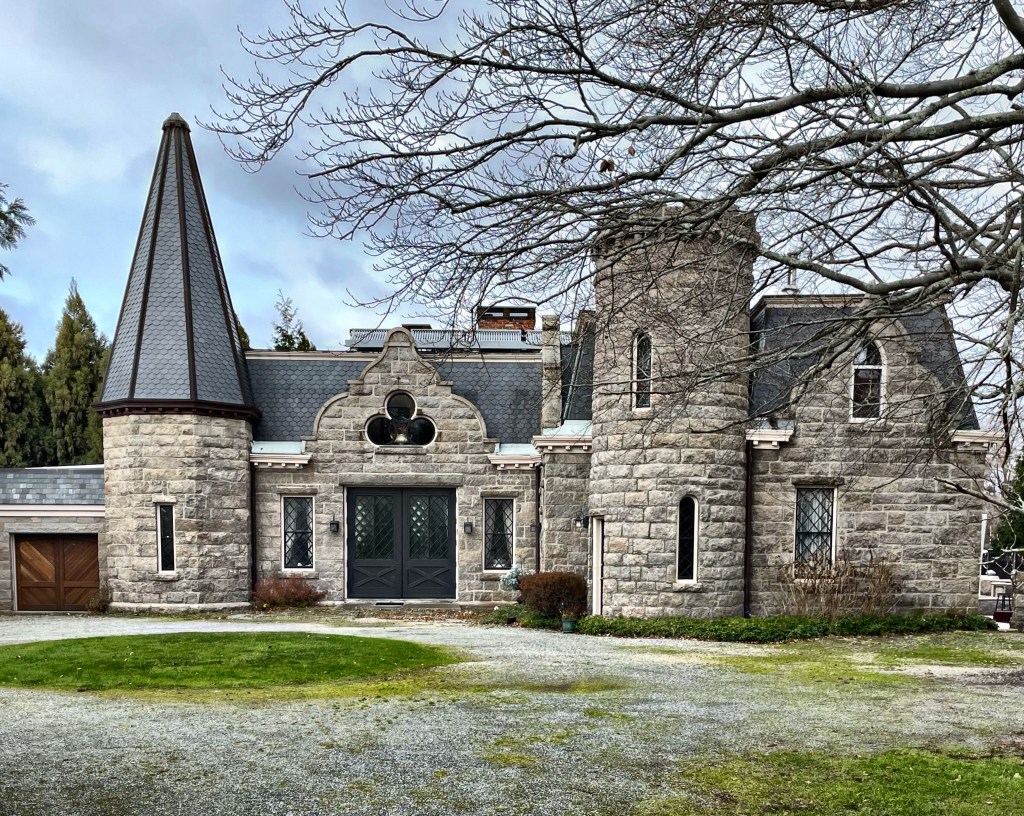
Just past the Belair Gate Lodge (1870), you w5ll find one of the most eclectic and interesting buildings in Newport, Rhode Island. This structure was built around 1875 as the stable to the larger Belair estate, just a stone’s throw away. When it was built, local papers stated the building was “probably one of the most expensive stables in the city.” It was designed by Newport architect Dudley Newton at the same time he redesigned the main mansion and furnished plans for the new gate lodge for owner George H. Norman. Architecturally, there is A LOT going on here. The 1½-story, rough-face-granite-ashlar building is capped by a hexagonal-tile slate mansard roof. On the left is an octagonal tower with an out-of-scale roof pitch and at the other side of the carriage door is a circular-plan tower with battlemented parapet. At the center is a really unique trefoil gable with trefoil window centered within. So cool to stumble upon this!! Oh, and it’s now a single-family home. Swoon.
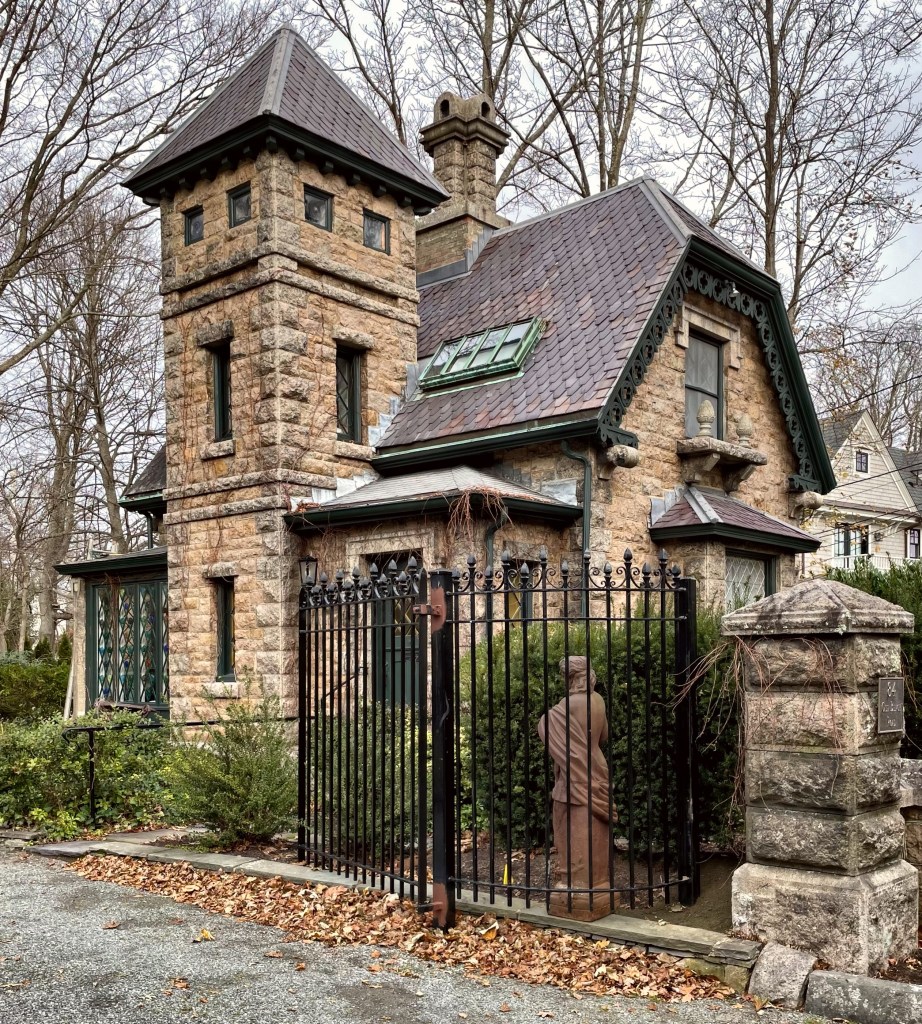
Located at the historic entry to Belair (last post), one of the largest estates in Newport, you would be greeted by this charming stone building, the Belair Gate Lodge. The building is symmetrically massed, 1½-story and built of rough-face-granite-ashlar, similar to the main house. This building can be classified as French Eclectic in style and was designed by Newport architect Dudley Newton, who also designed the 1870 Second Empire renovations to the main house at the same time for owner George Henry Norman. When the Belair estate was subdivided, the gate lodge was sold off as a separate unit, and is now a single family home, aka my dream home. There is something so enchanting about gatehouses!
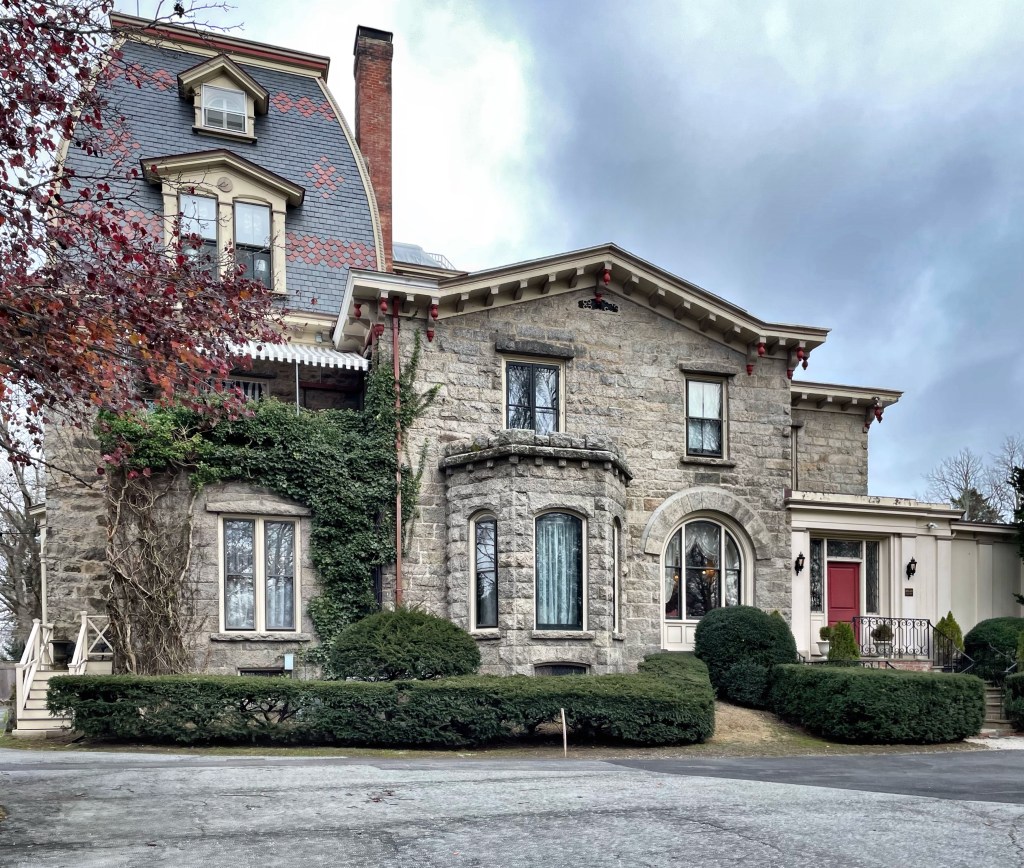
One of the most stunning summer “cottages” in Newport, Rhode Island is this stone behemoth named “Belair”. The house is set back way off the street and was one of the first summer estates built in this section of Newport. Belair was built in 1850 for New York oil baron H. Allen Wright in the Italianate style and constructed of roughly dressed stone and was originally about half of the size of the current footprint. The mansion was designed by architect Seth C. Bradford, who is also credited as architect of the similarly designed Chateau-sur-Mer, built one year later. Wright sold this house to George H. Norman two years after its completion. Norman (1827-1900), founded the Newport Daily News in 1848 and made his fortune as an engineer, first establishing gas works and later water works systems across New England, New York, and the Midwest. Norman made a fortune, and renovated and expanded his mansion in 1870 from plans by Newport architect Dudley Newton, with grand Second Empire additions, including the high convex-mansard corner tower. The original four acre Belair property has been extensively subdivided, and this house now occupies a lot of about an acre; with the original outbuildings sold off, and Belair is now 11 condominium units!
While many of the summer cottages in Newport retain much of their architectural and historical integrity, it is not always the case. This cottage, named “Morningside” barely resembles its original 1873 design. The summer home was built for William Barton Rogers (1804-1882), a scientist, educator, and best-known as founder of the Massachusetts Institute of Technology. He sought a place of rest and leisure, away from the stresses of Boston and running a new college, so he hired the Boston firm of Cabot & Chandler to design a Stick style cottage for him to spend the summer months at. In his diary for October 11, 1872, Mr. Rogers wrote, “Removed [from Cliff House Cottage] to our new home on Gibbs Avenue, at 4.30 o’clock. I have decided to name the place ‘Morningside.'” The house was his respite from stresses and he loved to spend time here with his family. President Rogers died after collapsing during a speech at MIT’s 1882 commencement exercises. His last words were “bituminous coal.” After the property sold out of the Rogers estate, the house was remodeled with stucco siding and much of the original Stick detailing was removed or covered. Morningside is now divided into condominiums.