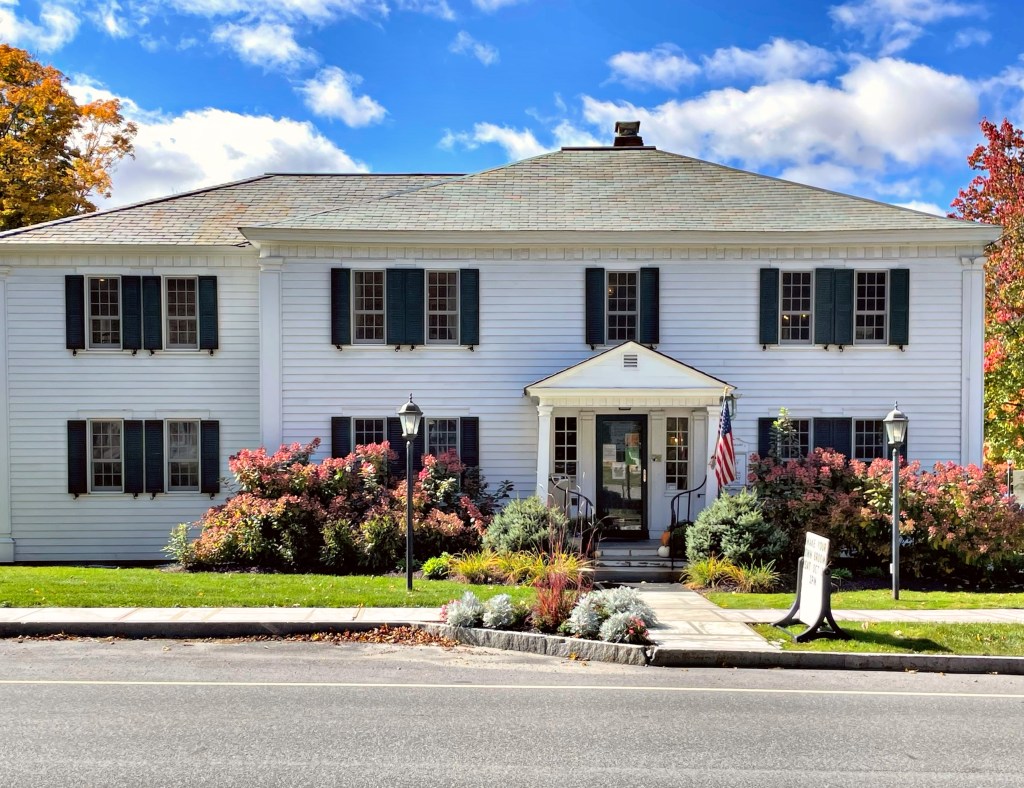
The Dorset Inn // 1796

One of the oldest continually operating inns in America, the Dorset Inn remains a visual and historical anchor to the charming little village of Dorset, Vermont. The Federal period building was historically known as the Hodges Hotel before becoming The Washington Hotel in about 1858 (the porch was added at that time to make it resemble George Washington’s Mt. Vernon home). The name became the Dorset Inn in 1904. As constructed in 1796, the main block possessed a five-bay facade arranged symmetrically around a central entrance; an 1858 extension added two bays on the west, when it was modernized. Though the inn has seen changes and modernizations over time, the building has such a historic character that brings in people from all over the country to experience the best of Dorset every year.

Old Dorset Post Office // 1845

Yet another of the buildings moved to Dorset Village by Charles A. Wade, this amazing classical building stopped me in my tracks when walking along the town’s marble sidewalks. It turns out this little structure was constructed in Enfield, Massachusetts, a town that was flooded in the 1930s for the filling of the Quabbin Reservoir. The building was likely built in the 1840s as a Congregational chapel, and upon hearing about the demise of the town, Wade drove to Enfield and brought back this charming little chapel for his hometown of Dorset. Upon its arrival to Vermont in 1938, the Greek Revival building was used as the town’s post office until a larger building was constructed in the 1960s. This building was converted to a real estate office and is now home to Flower Brook Pottery.

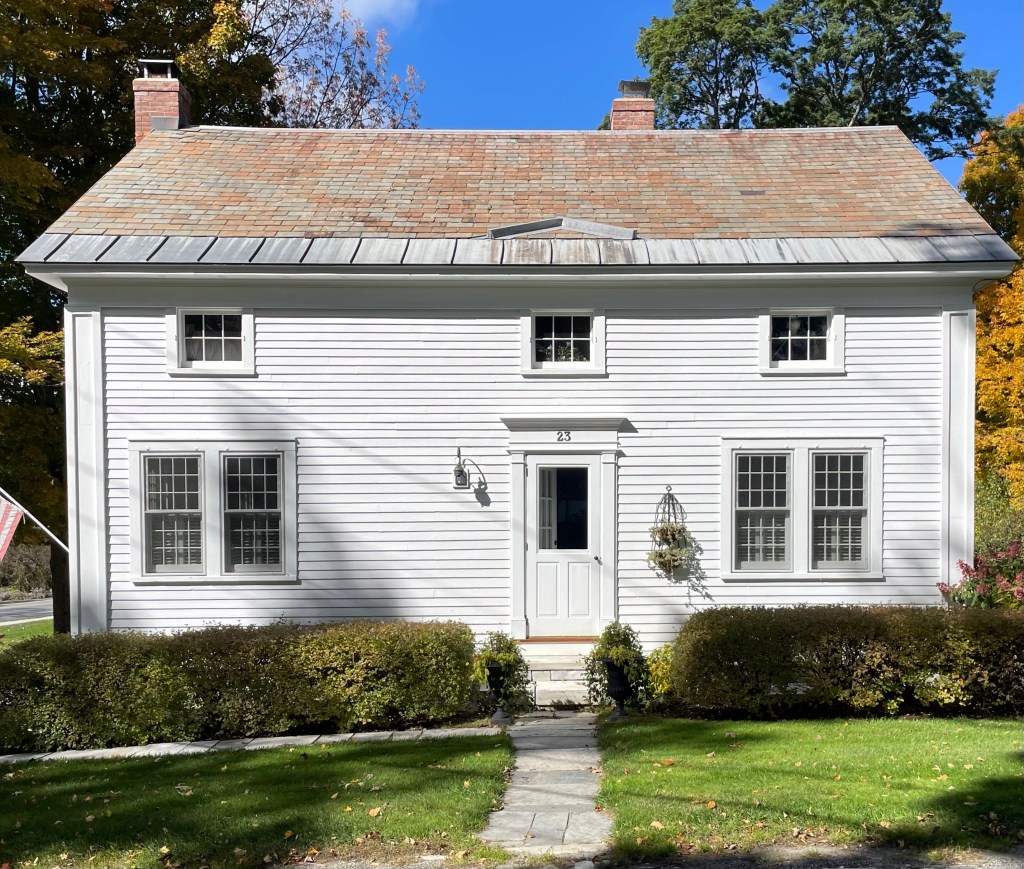
Laura Wade House // 1935

This charming cottage in Dorset is one of four houses in the village which were moved here by Charles Wade in the 1920s and ‘30s. Wade was born in Dorset and saw declining population with the marble industry failing. He sought to re-invigorate the town by advertising its natural beauty and brought in homes and buildings from nearby to fill the “missing teeth” (including the building that presently houses the Dorset Historical Society). Assembled from parts of various Enfield, Massachusetts buildings moved to Dorset this 1½-story, wood-framed, clapboard house stands on a marble ashlar foundation and is said to have been built by Wade for his daughter, Laura Wade.

Annie Sheldon House // 1909

Even with a declining marble industry by the turn of the 20th century, Dorset, Vermont was seen as a beautiful retreat from city life, and it attracted well-to-do middle-class families to escape to the town for parts of the year. One of those families was head by Harry Waters Sheldon (1869-1942) and Annie C. Bourn Sheldon (1875-1958) who lived in Yonkers, N.Y. with their four children. The family lived in this home as a cottage retreat in 1909 and constructed the only Craftsman bungalow in the village of Dorset. The bungalow was later altered and the porches were enclosed, but it was restored in the past few years!

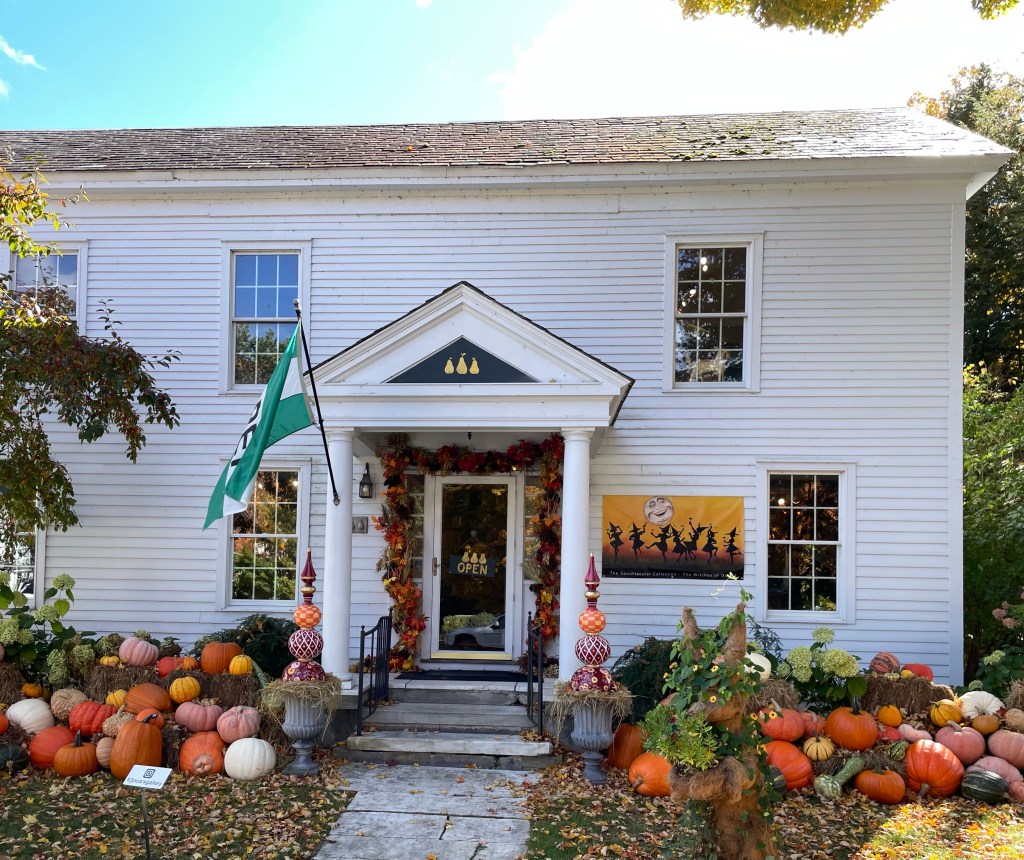
Sheldon House – 3 Pears Gallery // c.1830

This charming vernacular property in Dorset Village was built around 1830 as a one-story cape house. By the early 20th century, the modest home was enlarged with a second story and an extra bay, all in the Colonial Revival style, mixing the functional or minimally detailed historic building with a little oomph. The addition of a doorway portico and the randomly placed windows on the facade add to the charm. The renovation was completed by owner Bernis Sheldon (1866-1941). After Sheldon’s death, the building became home to the Dorset telephone exchange, who occupied part of the building. The building is now home to the 3 Pears Gallery, who have done a FANTASTIC job mainating and highlighting this beautiful building on the Green!

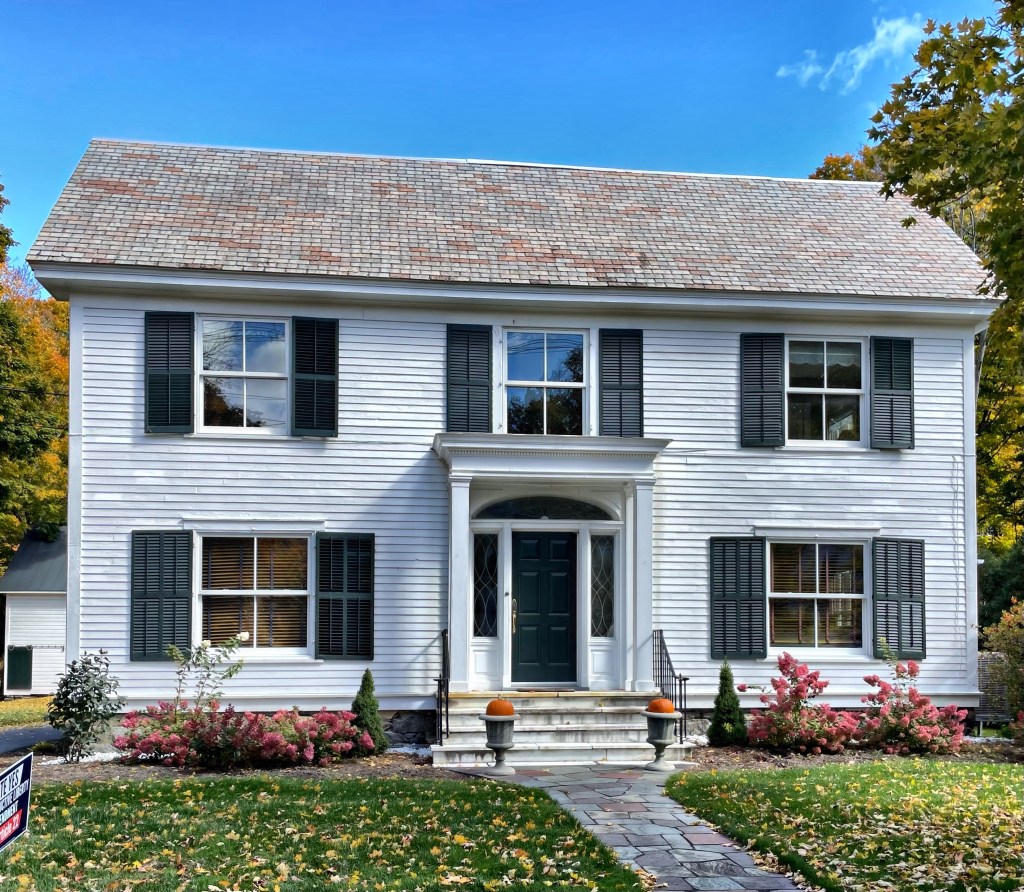
Warren Dunton House // c.1890

Much of Dorset Village was built in the early-to-mid 19th century, but there are some excellent examples of Colonial Revival and Craftsman homes and buildings. This Colonial Revival house was built c.1890 seemingly by Warren Robbins Dunton (1839-1902), who served as a Captain in the American Civil War. Captain Dunton seemingly built his home after moving the older house on the site back on the lot, building this house at the street. Great house, look at those chunky shutters that actually match the window openings!

Gilbert Sykes House // c.1850

This stunning Greek Revival house in Dorset Village was built around 1850 and was long the home of Gilbert Mortier Sykes (1834-1920). Gilbert Sykes operated a general store in Dorset and held various public offices in town and later in the Vermont House of Representatives and Senate. The house has fully embellished entrance with paneled pilasters carrying an entablature and an amazing triangular window with diamond panes in the gable.

Dorset Village Library // c.1800

Dorset, Vermont is one of the most beautiful villages in New England and is often overlooked and rarely featured by “influencers” and blogs compared to nearby Manchester or Woodstock, which get all the love. This building in Dorset Village was built around 1800 and was constructed by John Gray, who kept a tavern here the early 19th century. The tavern was eventually sold out of the Gray family and was donated by Bernard G. Sykes to the Town of Dorset as the village’s library. It was originally known as the Sykes Memorial building so-named as a memorial to Bernard’s late parents, Lydia and Gilbert Sykes. The former tavern was renovated, giving it the Colonial Revival detailing and addition.

Peru Congregational Church Parsonage // 1850

Just five years after the Congregational Church of Peru was built, the congregation acquired land and built this home as a parsonage for their pastor. The parsonage was designed in the Greek Revival style similar to the church. The home sits amongst beautiful, mature trees and exhibits the best in Classical design with bold corner and entry pilasters and a five bay symmetrical facade. They sure don’t make them like they used to!

Congregational Church of Peru // 1845

The centerpiece of the Village of Peru, Vermont is the Congregational Church, a stunning edifice and example of Greek Revival architecture in the small town. Construction on the church began on the Fourth of July in 1845, with contractor and resident J.J. Hapgood utilizing much of the timbers of the former church building in the new church. Since the interior of the old church had been left natural, they decided that wood in the new building should be left unpainted as well. The bell was financed by contributions, most particularly by J.J. Hapgood. In 1853, a tornado swept through Peru, damaging the west end of the church and moving it from the foundation, it survived. The church remains a center of Village life in Peru and is well-maintained by the congregation.

Peru Creamery House // 1895

The Creamery House in Peru, Vermont is perhaps the most “Vermont” building I have ever heard of. The building was constructed in 1895 George Richardson (1852-1920), a local farmer who operated the use as a place where cheese was made from the excess (unsold) milk of the area farmers. Eventually, the building was acquired by the Town of Peru and converted to a town hall, used for meetings, dances, dinners and parties, serving as the true town gathering place. The town relocated its offices to the former Peru Schoolhouse (featured previously) and this building went back to its roots and is presently home to the Peru Historical Society and the Main Street Makery, a community craft workshop and new town gathering place!

Adams House // c.1820

Welcome to Peru…Vermont. The town of Peru sits in Bennington County, adjacent to the previously featured town of Landgrove. Peru was chartered with the name Bromley in 1761 by Benning Wentworth, governor of the Province of New Hampshire as one of the land grant towns in the former hinterland of present-day Vermont. By 1804, the name of the town was changed to Peru. The new name was adopted to attract more people to the town by associating it with the South American province of Peru, which was considered to be a place of great wealth (wishful thinking). This house on the western edge of the village was built c.1820 and significantly modernized since then. The original log house here was built c.1804 by Joel Adams. The home was modernized to the present five-bay facade by the 1820s-30s and operated as a double-house for Joel and his son Joel Adams Jr. The property was also inhabited by Everett Adams, Joel’s grandson, who briefly served in the Civil War.

Old Peru Schoolhouse // 1864

In 1816, the turnpike to Manchester, Vermont was completed and ran through the small town of Peru. As a result, inns and taverns were built, and the young village of Peru began to grow, with farming and lumber businesses being the most common employment in town. A village school was built here and in the town’s other school districts. By the end of the 19th century, the lure of moving to the Western U.S. and cities for industrial work caused some population decline in Peru, and a larger, consolidated school was built in the town village. This schoolhouse on the hill was constructed in 1864, replacing the former one-room schoolhouse on the lot. The school consolidated again in the mid-20th century when further population decline necessitated a school district encompassing Peru and nearby towns. This building was later converted to town offices, a use that remains to this day.

The good news is that the town’s population is seeing a resurgence, led by both tourism and the Bromley Mountain Ski Resort as an anchor.

Landgrove Methodist Church // 1857

Built in 1857 as the Landgrove Methodist Church, this absolutely charming church sits in the middle of Landgrove, a town with a population of just 177. The town’s small population acquired funds to erect a church in their town, opting to not make the trip by horseback or foot to the churches in surrounding towns. The vernacular Greek Revival building was likely constructed by the members of the congregation and possibly the work of a local builder. Methodists commissioned the 30 × 40–foot building to attract a regular circuit rider, and by 1870 it had become a Union church with other denominations. There is something so enchanting about these old white churches in small New England towns!

The River House // c.1820

Sitting on the banks of Utley Brook, which meanders through the Clarksville village in Landgrove, Vermont, you will find this gorgeous Cape home in a perfect yellow color (seemingly to blend in with the turning leaves every Fall). The home dates to the early 19th century, possibly earlier, and was owned by the Harlow Family, who operated a saw mill across the street. The house was listed for sale in 2019 and is absolutely stunning inside and out!