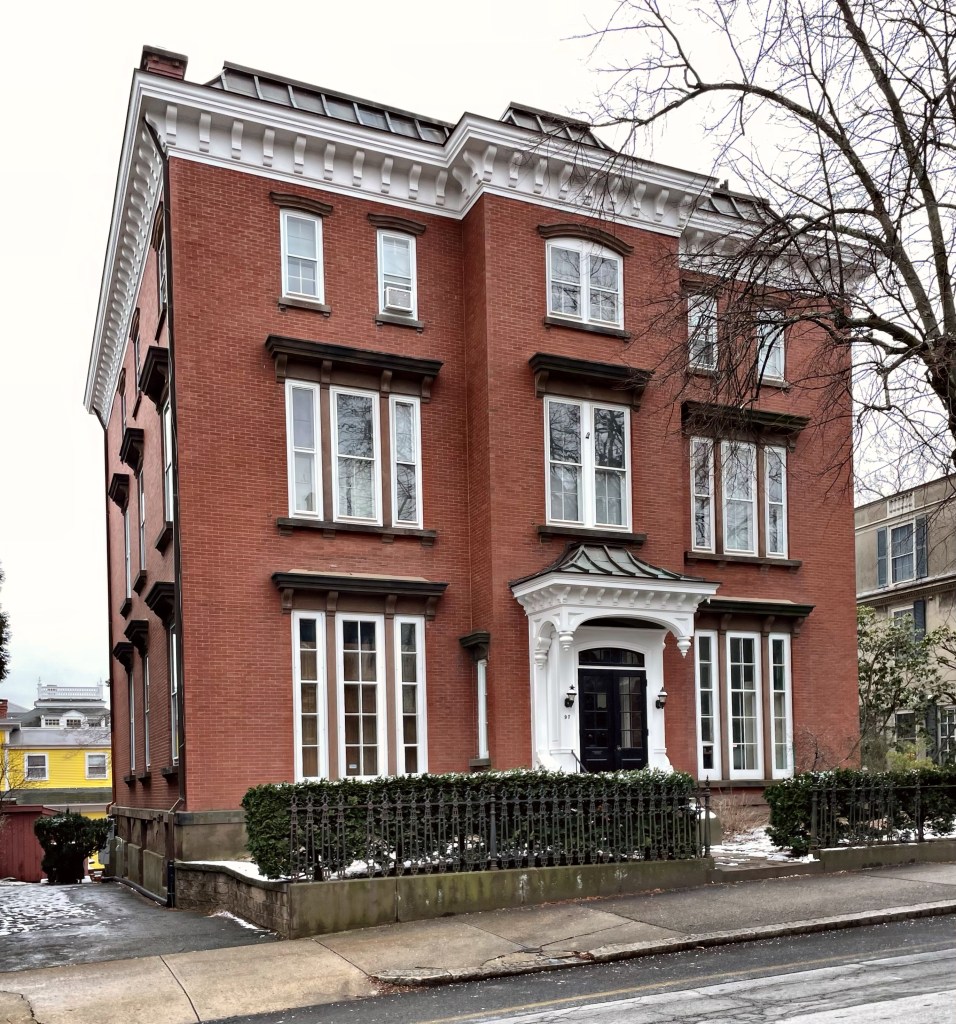
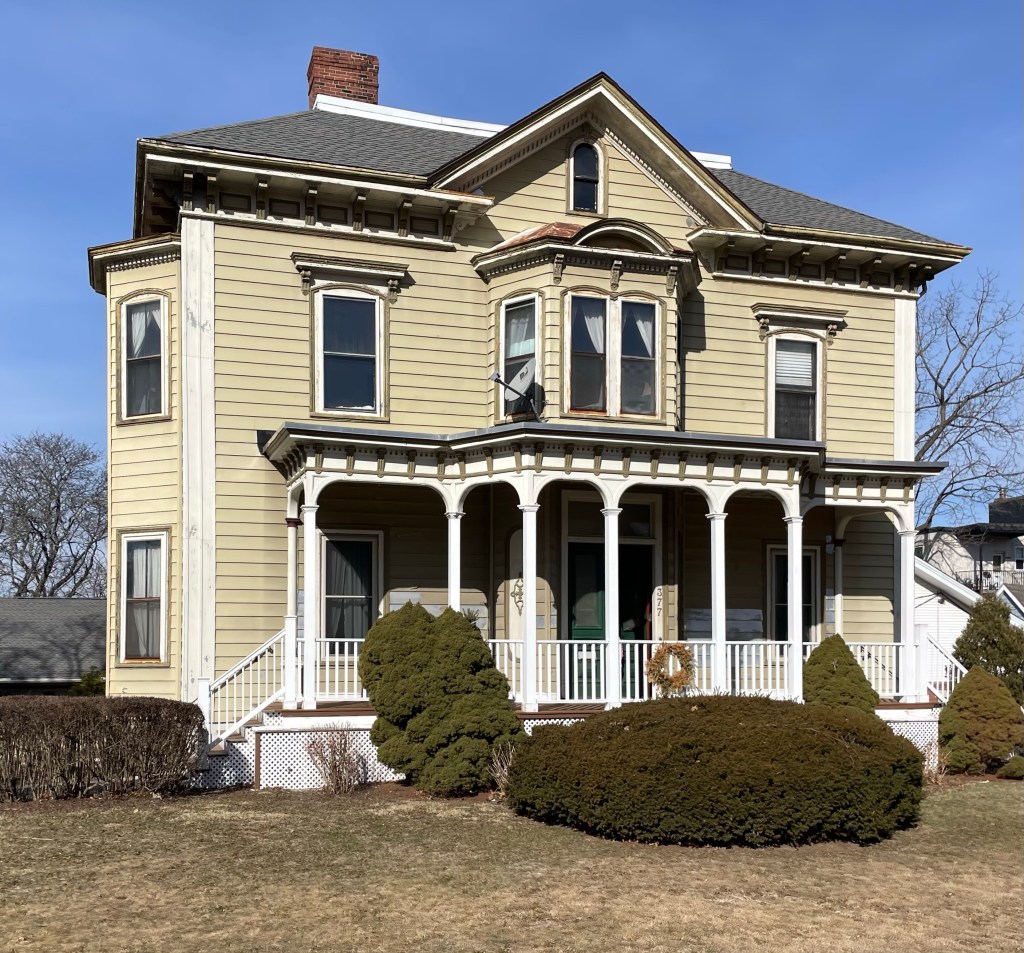
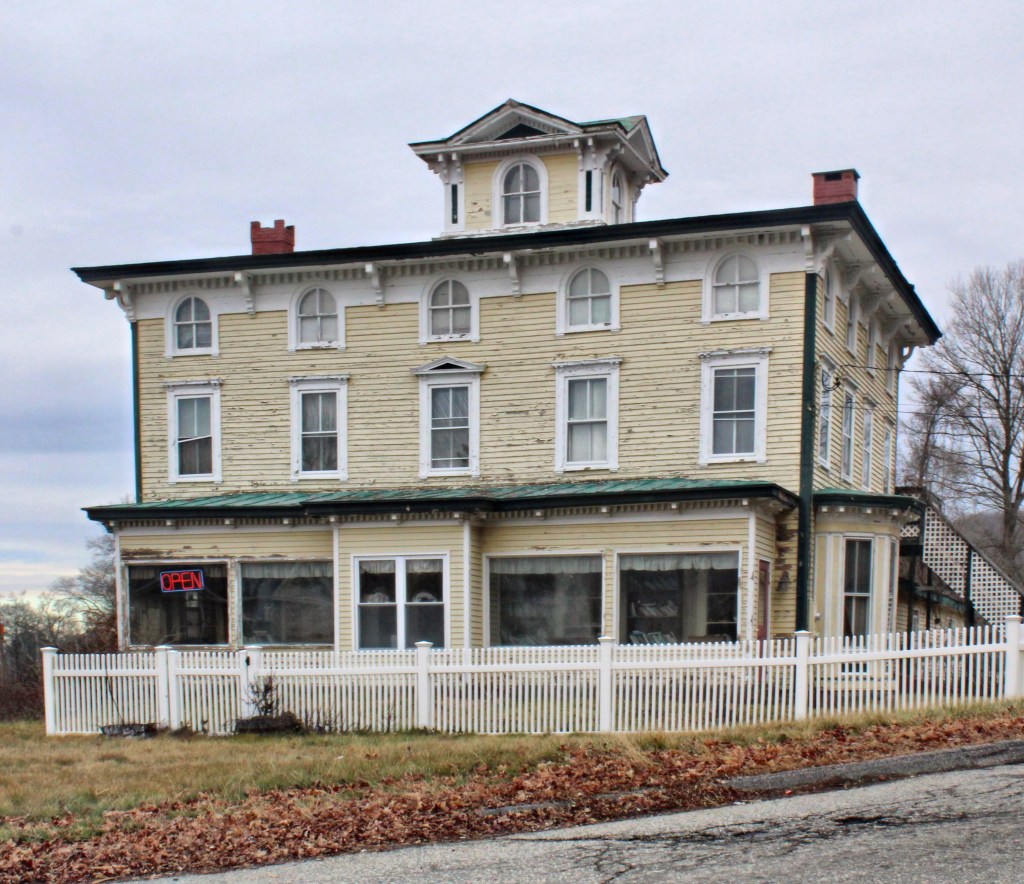
Otis Company Agent’s Residence // 1870

This house in Ware, Massachusetts was built after the Civil War by the Otis Company, the major employer in town, for use as an agent’s house. Crazy I know! Historically, it was a common practice for New England textile companies to provide housing for employees (though agents got the nicest dwellings). Many of the agents were brought from Boston and a comfortable residence was a benefit of the job. The first agent to reside in this house was Sylvester Bowen Bond, agent of the company between 1870 and 1877. Mr. Bond sadly would die in the dwelling of typhoid fever, aged 36. The Italianate style property on a large lot continued to be used as an agent’s residence until the Otis Company left Ware. The property was acquired by the nearby St. Mary’s Church as a convent.

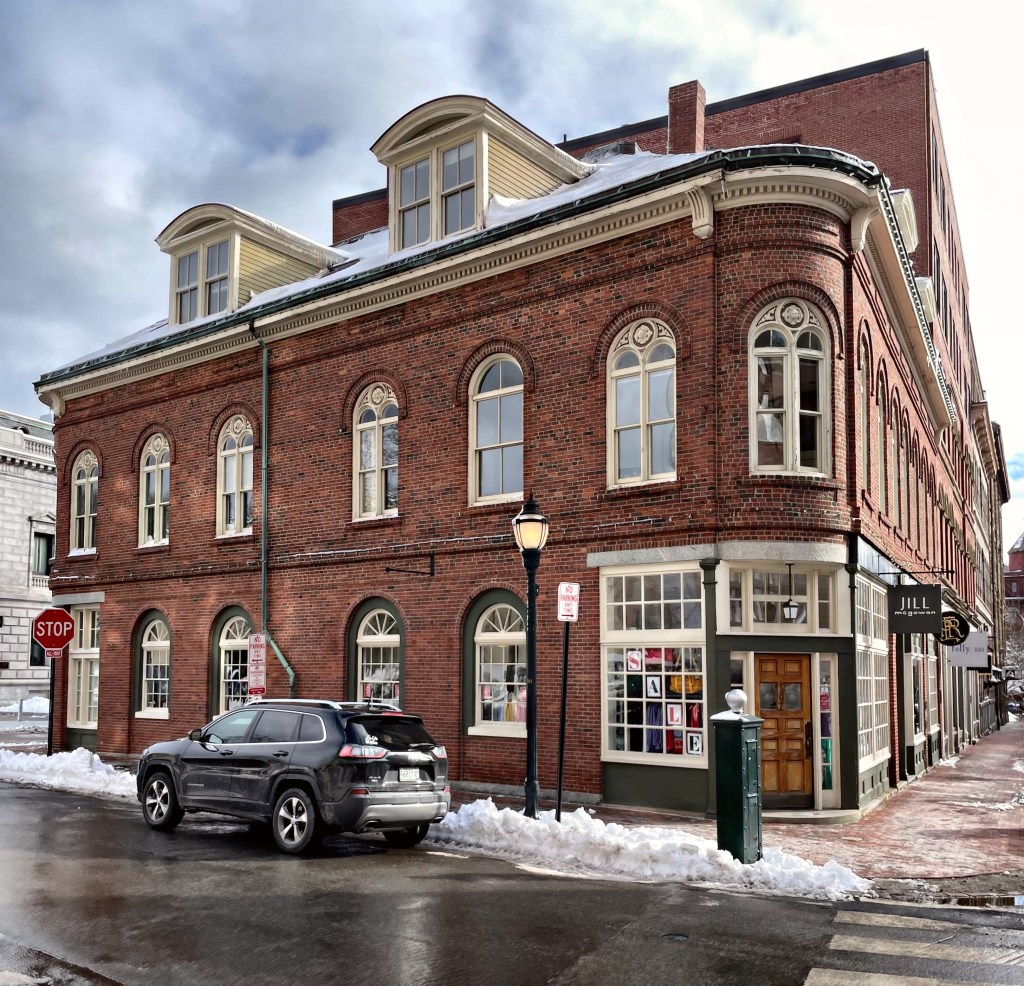
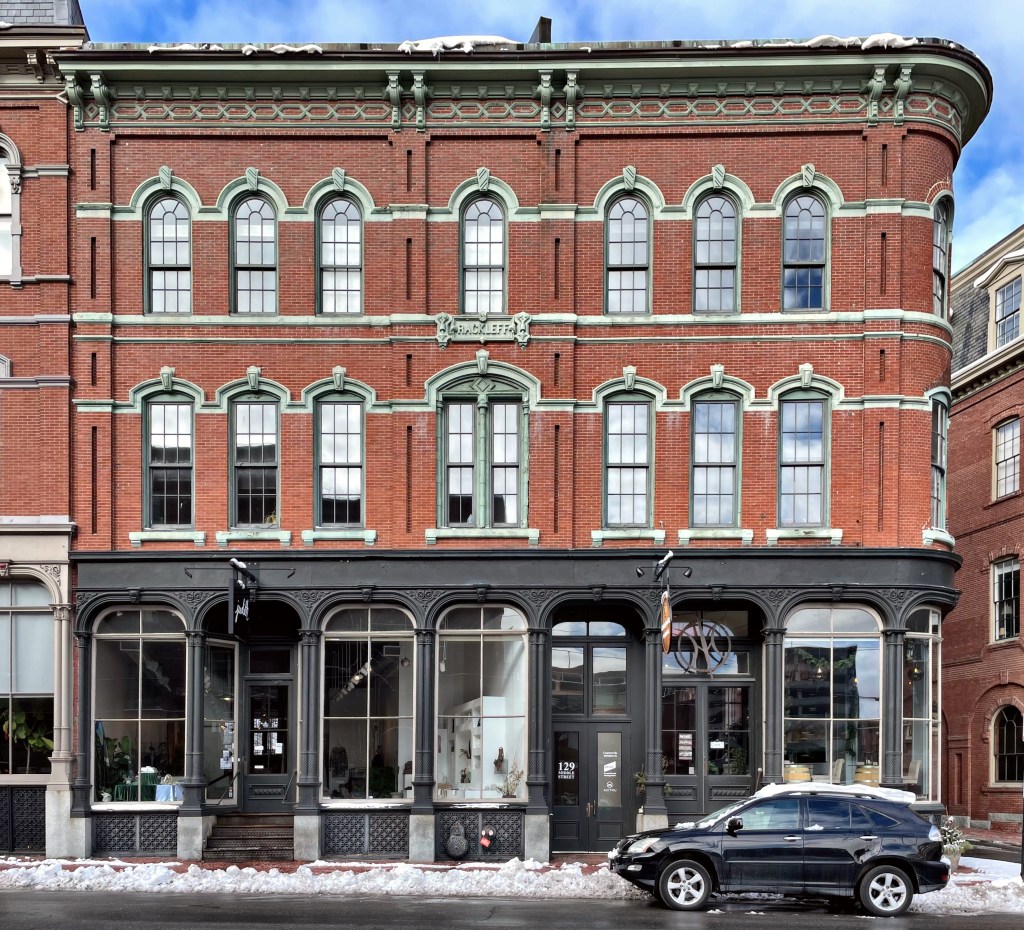
Otis Company Mill #3 // 1856

One of the later mill buildings constructed in the mid-19th century for the Otis Company is this brick building which contributes to the rich industrial heritage of the town. Built in at least three stages, this long industrial building probably grew from a middle section dating 1856, expanded in both directions over the next several decades and but was largely completed by 1869. The building was a major manufacturer, supplying thousands of jobs for the town until it closed after WWII. In 1945, the top two stories of this building along with their towers were removed in 1945, which echoes the history of many similar mills all over New England (but hey, at least this one is occupied today!)

Barnstable Customs House – Coast Guard Heritage Museum // 1855

The former United States Customs House (now the Coast Guard Heritage Museum) in Barnstable is located at the eastern end of the village, and across the street from the Unitarian Church (featured previously). The building was constructed in 1855, likely under the supervision of Ammi B. Young, who was acting as the first Supervising Architect of the U.S. Treasury Department. The Seventh Customs District was established by Congress in 1789, and encompassed Barnstable County except Falmouth, and it ranked fourth in revenue among the state’s customs districts. By 1850, 91,102 tons of materials had been reported through the district, so the need for a new customs house was clear. The Customs House is said to have been the first ‘fireproof’ building constructed on Cape Cod, in contrast to the traditional wood-frame and shingled dwellings found there. This district merged with Boston in 1913, and the building became a local Post Office until 1958. It was converted to a museum and named after Donald G. Trayser. It was renamed the Coast Guard Heritage Museum in 2005.

James Nelson Lasher House // 1884

The James Nelson Lasher House in Woodstock, NY was built by James Nelson Lasher (1829-1906) in about 1884. “Nelson” Lasher, a farmer from Bearsville, acquired 45 acres on the outskirts of the village of Woodstock and established an undertaking business on the property, in 1879. Over the next two decades, he farmed the property with his son Franklin “Frank”, who by 1890, also began to manage the undertaking business. Frank Lasher (1864-1912) may have added the Queen Anne porches and tower to the house around this time. In the early 1900s, the Lasher household consisted of Nelson and wife Elizabeth, and Frank and his wife and three children. Nelson died in 1906 and Frank died six years later, leaving the property to his son, Victor, who continued the family undertaking/funeral home business. The property was sold out of the Lasher family in 1960, but operated as a funeral home until 2019. The property has recently been eyed as a hotel and for town offices, I wonder what its future holds!

Pagoda Building // c.1850-1917

For the last on this series of Lost Boston buildings, I present this little-known landmark which was once neighbors to the Old State House. The Pagoda Building as it was named, was located on the corner of Washington and State Streets and was one of the tallest buildings on the street upon completion. The seven-story building of Quincy granite exhibited round arched windows and an interpretation of a belvedere at the roof which served as a penthouse. The building’s upper six stories were residential, including the spectacular Oriental penthouse at the top, with retail space at the ground floor. The architect was a recent immigrant from Britain named George Snell, who clearly made a name for himself, later entering a partnership with James R. Gregerson. The Pagoda Building, which was originally an early “skyscraper” in Boston was quickly surpassed in height and floor plate size and was deemed inadequate for such a prominent location. It was demolished by 1917.

Frank Howard Tattoo Shop // c.1870-1960s

Ever so often, I stumble across a historic photo and I end up spending way too much time falling down rabbit-holes uncovering a cool history. This is one of those times.

Frank Howard Packer (1857-1925) was born in Providence, Rhode Island and worked at his father’s jewelry store there, later moving to Chicago. Out west, Frank was first tattooed by a friend, and he was hooked. Frank started using his body as a canvas, and when he ran out of space, his wife Annie was covered with tattoos. The couple were discovered by Barnum & Bailey’s Greatest Show on Earth and were hired to tour the country alongside other acts. Frank was the “Original Tattooed Man” and Annie was the first tattooed woman to tour with Barnum & Bailey. At these shows, Frank and Annie would show off their tattoos and then tattoo spectators for money. Eventually, they had enough money to open a tattoo parlor in a Civil War-era building on Court Street in Boston. The space was originally shared with a barbershop, but it later expanded to the entire floor of the building. Annie died in 1911 and Frank remarried a few years later and seemingly began to wind down his tattooing career. He died in 1925. The old shop building was demolished in the 1960s as part of Boston’s Urban Renewal period.

Gregg House // 1869

Located in the western part of the East Village of Wilton, New Hampshire, this stunning Italianate manse stands out as one of the most architecturally grand in the area. The home was built for David Gregg (1816-1880), a merchant who was engaged in lumber dealing in Michigan as an investment. His company was based out of Nashua and manufactured wooden blinds, doors, window sashes and was co-owned by David and his son, David Jr. David was likely retiring from business by the late 1860s and built this large home on a hill outside the village. At about this time, he became involved with local politics, which he was involved with until his death in 1880. The Italianate style home features round arched windows, brackets, a belvedere at the roof, and what appears to be an attached, converted carriage house. The home was eventually turned into a bed and breakfast, but it has since been converted back to a private home.

First Congregational Church, Everett // 1852

The oldest surviving church in Everett, Massachusetts is this one, the First Congregational Church, built in 1852 when the city was still a part of Malden. As in many other communities, this church was formed when the surrounding area of South Malden had grown and had the means to support its own religious society. Before this, residents had to travel to Malden Center for services. In 1848, it was voted to establish the church calling it the Winthrop Congregational Church, as at the time, it was thought that when South Malden would split away, the new town would be named “Winthrop”. When the town finally split in 1870, another town had already taken that name. Originally, the Italianate-style building was sheathed in wood clapboards and outlined by pilasters, both of which were covered or removed for the installation of aluminum siding, very common in the city after WWII. Remaining hallmarks of the Italianate style include the paired cornice brackets and the round-headed windows. The tower was originally capped by a taller steeple above an open octagonal arcaded belfry, but was replaced by the present spire in 1911. The church was possibly an early design by architect Thomas Silloway. Today, the church is occupied by Universal Church USA, a congregation that originated in Brazil, showing how the local community and demographics have shifted in Everett from 150 years ago.

Pollard Block // 1895

Proctorsville Village (in present-day Cavendish, Vermont) was established in last decades of the 18th century along the Black River, where the slope allowed for suitable locations for small water-powered mills. The community grew slowly for the early part of the 19th century as farmers, craftsman and merchants established enterprises around the handful of small mills built along the river. The establishment of the Central Vermont Railroad through the village aided manufacturing expansion, and by the late 1800s, Proctorsville was home to many large mills. As employment in the mills grew, the local economy shifted from the barter economy of a farming community to a cash-based economy generated by wage employment. The general store was essential to this transition supplied the townspeople with essential goods via the railroad, and the major store in Proctorsville was the Pollard General Store. Don Carlos Pollard (1840-1921) was born in Plymouth, Vermont and opened his first store there under his father’s name. He moved to Proctorsville in 1860 and opened a general store in the village. The store was an immediate hit, and later managed by Don’s two eldest sons, Fred and Park out of a brick building. A fire destroyed the brick building in 1895, but construction began of a new building immediately that same year. The present wood-frame building exhibits the retail presence and early commerce in many small villages in New England. It blends Italianate and Classical Revival details with the bracketed eaves and one-story corner pilasters and dentils. Swoon!

Bailey-Keeler House // c.1860

Lewis H. Bailey (1818-1899) was a local banker, merchant, and hotel proprietor in Ridgefield, Connecticut. He had this stunning Italianate Villa home built on Main Street before the American Civil War. Bailey was savvy in realizing the upcoming development boom in town as wealthy New Yorkers began to arrive in town to build summer houses to escape the cramped city living and polluted air, and he began to sell off land and develop streets in the village. To house some shorter-term summer residents, Bailey constructed and operated the old Bailey Inn on a lot adjacent to his own home. The inn was torn down in the 1920s as the town’s dynamic as a summer town began to change with more more year-round residency. The Italianate Villa is a lasting legacy of Bailey and his impact on the town. The home with its square tower and detached carriage house are in a great state of preservation and significantly contribute to the character of Main Street.