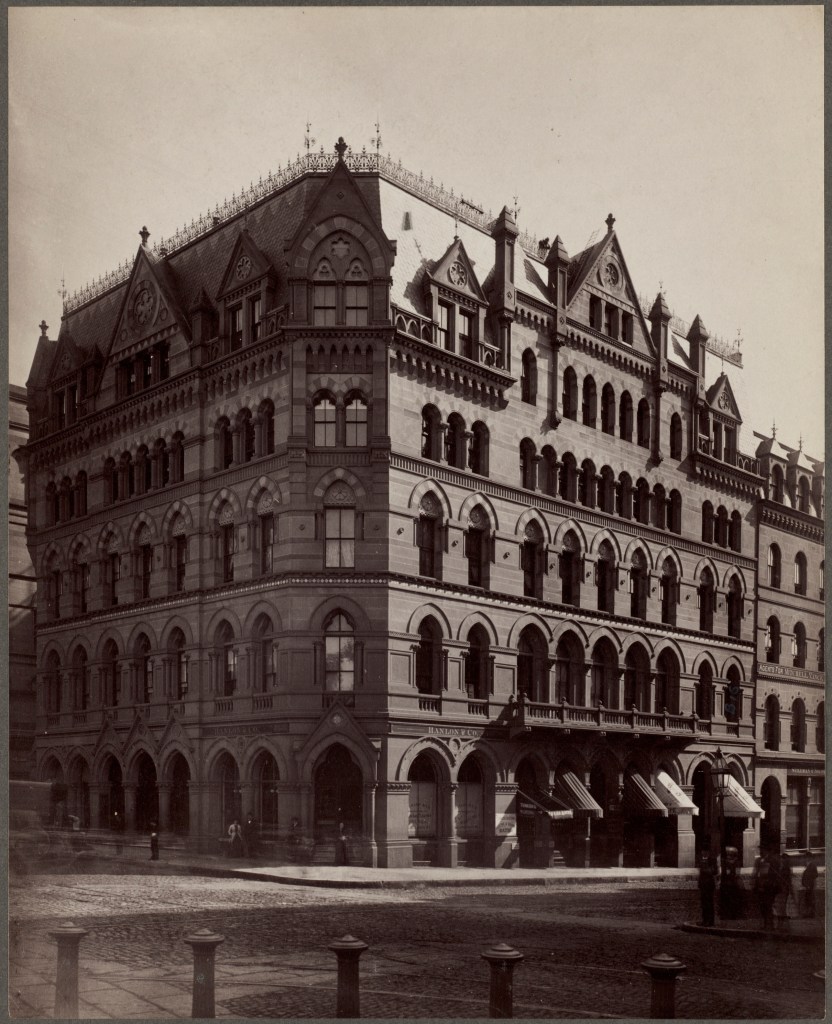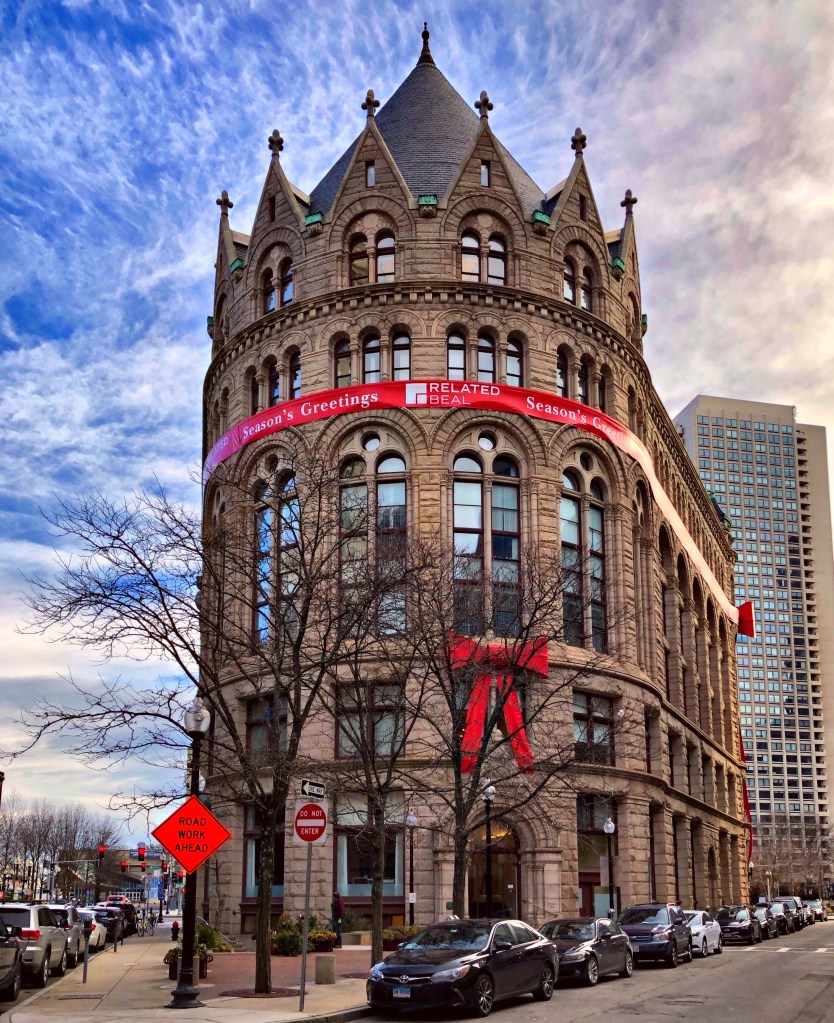
Flour and Grain Exchange Building // 1892

One of my favorite buildings in Boston (and always dressed up with a big red ribbon for the holidays) is the Flour and Grain Exchange Building in Downtown Boston. The third Boston Chamber of Commerce was incorporated in 1884 to promote just and equitable principles of trade, solve disputes between members and acquire and disseminate information related to mercantile interests. There was, however, a feeling among the members that the organization could not attain its full stature until it had a building of its own, one that would be both an ornament to the city and a credit to itself. In 1889, a triangular site was donated to the organization by members, who then hired prominent Boston architectural firm, Shepley, Rutan and Coolidge, the successor to Henry Hobson Richardson‘s practice. It appears the firm was inspired by H.H. Richardson’s F. L. Ames Wholesale Store which was built nearby just years before. The steel-frame building is constructed of rough hewn Milford granite pierced with engaged columns and arched openings, both common in Richardsonian Romanesque buildings. The prominent corner at Milk and India Streets features a rounded corner tower with conical roof, surrounded by a crown of dormers. The building was restored by owners Beal Properties in the late 1980s who own it to this day.
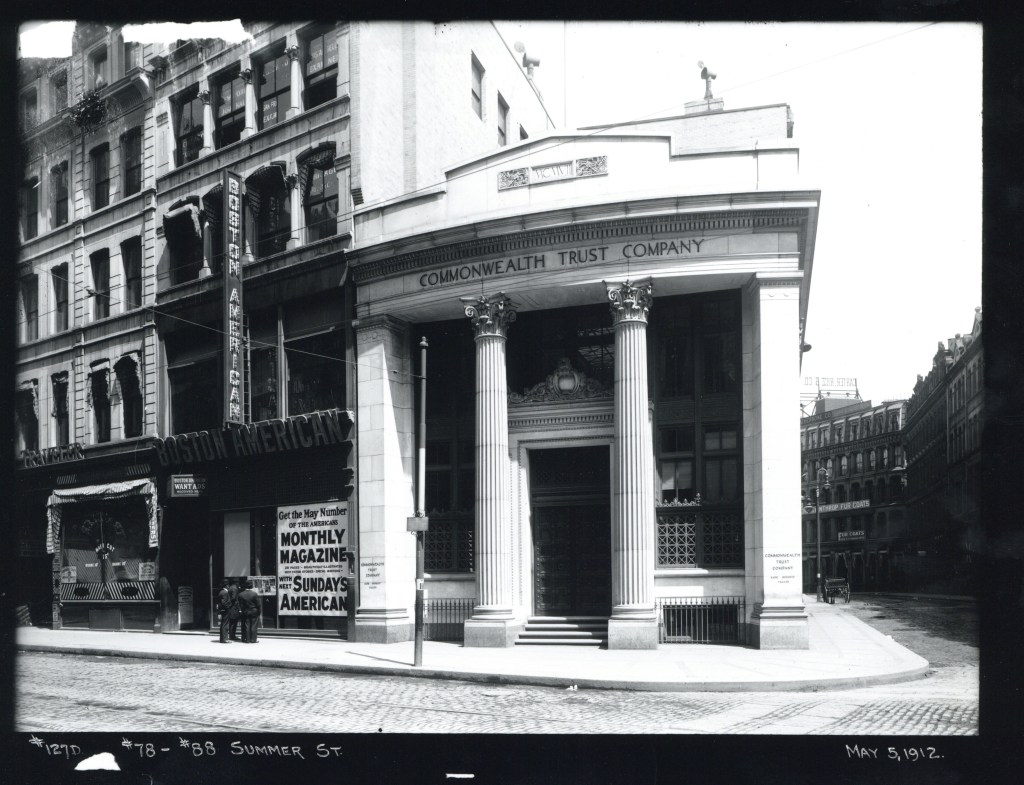
Commonwealth Trust Company // 1908-c.1974

Ca. 1910 image courtesy of Boston Public Archives.

Located at the corner of Summer and Devonshire Streets in Downtown Boston, the Commonwealth Trust Company’s two-story marble banking house commanded the corner, despite its short stature. The building, completed in 1908, was constructed with Lee marble and decorated with ornate wrought and cast-iron grilles over windows. The building was designed by the architectural firm of Parker, Thomas & Rice in the Classical mode with large, fluted Corinthian columns and boxed corner pilasters framing the recessed center entrance, Corinthian pilasters ran along the side facade. At the inside, the building was coated with Cararra and Blanco marble with paneled oak offices. At the ground floor, offices and banking stations framed the outer walls, with the safety deposit boxes located on the second floor. The building was demolished by the 1970s and replaced with a one-story minimalist Modern building (I could not figure out why the former building was razed). The new building was demolished after a few decades with a larger building, better fitting the commercial district.

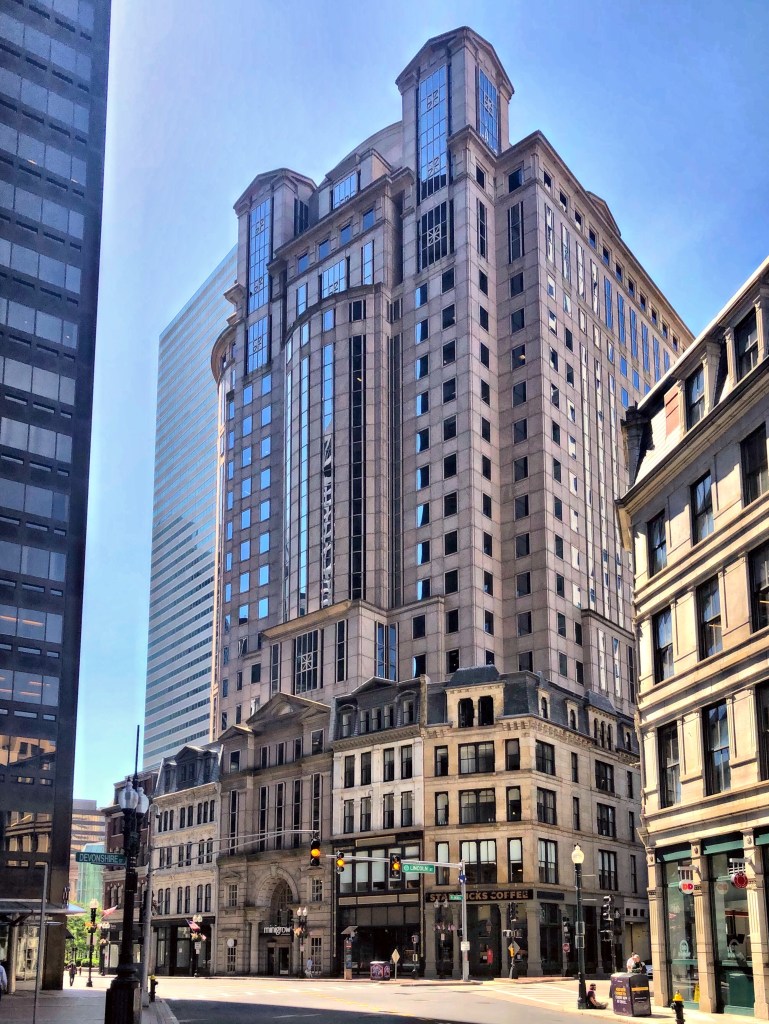
125 Summer Street // 1989

The late 1980s were a time of financial success for developers and banking companies all over the country. It seems that more skyscrapers were constructed in Boston this decade than any other of the 20th century, but working within the confines of the historic downtown of the city, left architects and developers to come up with creative ways to build here. The architectural firm of Kohn Pederson Fox was hired to construct a 20+ story office tower at the southern edge of the Financial District in Boston, while preserving the small-scale commercial buildings there. A row of four-story commercial blocks constructed after the Great Boston Fire of 1872 were retained with the tower seemingly growing out of them. The process here is known as “facadism” which is a valuable preservation tool to balance preservation with density in historic downtowns, though not always done right. This KPF design with its Post-Modern tower in concrete and granite fits well within the streetscape and maintains a walkable block downtown.

What do you think of this design?

Boylston Building // 1887

2019 image courtesy of Brandon Bartoszek.

Built by the Boylston Market Association, replacing the former Boylston Market (1810-1887) in Downtown Boston, the Boylston Building is a great example of late 19th-century commercial design in Boston. The Association hired German-born architect Carl Fehmer (who also designed the amazing Beaconsfield Terrace housing in Brookline) to design a structure that would stand up to the architectural landmarks along Boylston and Washington Streets nearby. Fehmer’s design exhibits many features of the emerging Commercial style (also known as Chicago school style) of architecture which promoted new technologies of steel-frame construction in commercial buildings with masonry cladding, while clearly showcasing the Romanesque round arch windows. In the mid-20th century, this area of Downtown Boston became known as the ‘Combat Zone‘, Boston’s Red Light District, flooded with prostitution, drugs, and adult video stores. The Boylston Building was occupied by an adult video store and dive pizza shop. The building and area surrounding are different today, but you can always find some characters nearby!

Boylston Market // 1810-1887

One of the biggest architectural losses in Boston has to be the demolition of the Boylston Market formerly at the corner of Boylston and Washington Streets. A new market house in Boston was desired by many of the city’s elite, and when John Quincy Adams (who lived on Boylston Street and was elected President of the United States 15 years later) gathered capital for the new structure it was so built. The group hired Charles Bulfinch, who at the time was THE architect of Boston, to design the new brick market. When opened to the public in 1810, the market was considered far out of town, but the neighborhood quickly developed around it with new Federal and Greek Revival homes popping up all around it, with commercial buildings soon after. The market featured stalls for the “sale of provisions” on the first and second floors, and Boylston Hall on the third floor, which featured musical and theatrical productions. The market building was sadly demolished in 1887 for a larger and more modern market of the same name. The belfry atop the former market was disassembled and given to a church in Arlington, MA, who now displays it on their own church building.

Richards Building // 1859

One of my favorite buildings in Downtown Boston is the Richards Building on State Street for its rare and lavish cast-iron facade. Built in about 1859, the building was developed by Quincy A. Shaw and Gardiner H. Shaw (uncles of Robert Gould Shaw, who led the famed African American regiment that is the subject of St. Gaudens’ and Charles McKim’s Boston Common monument), merchants who then leased out commercial space in the building. The architect of the building is unknown; however, the sheet metal was supplied by E.B. Badger & Sons. The original design was a five-story, eight-bay cast iron front structure, in the Northern Italian mode of the Renaissance Revival style. The facade is only a screen attached to the front of the building. It is made of pieces of cast iron that were fabricated in Italy and bolted together in Boston. In 1889, the building was sold to Calvin A. Richards, a wealthy street railway tycoon and it is presumed that the two upper stories and corner oriels were added at that time. The building features one of a handful of extant cast-iron facades in Boston, which was restored in the 1980s.

Yankee Publishing Building // 1874

One of my favorite commercial buildings in Downtown Boston is the former Yankee Publishing Building on Union Street, for its architecture and the fact its surrounded by some great pubs! The building was constructed in 1874 for Cyrus Carpenter (1821-1893), a prominent manufacturer and dealer of furnaces and stoves in Boston. He owned the building, but ended up leasing the space to a competing furnace company, Walker & Pratt Manufacturing Company. Carpenter owned the building until his unexpected death in 1893 when he was run over by a Back Bay horse car, when it was conveyed to his wife until her death. The building was later purchased by the long-time tenants who continued to sell furnaces and other goods out of the store with offices above.

The business by which the building is currently known is Yankee Publishing. It is an independent family-owned business that was founded in 1935 and based out of Dublin, New Hampshire. It publishes Yankee Magazine ten times a year (the magazine has a paid circulation of 500,000; subscribers primarily residing in the Northeast) as numerous travel guides and other publications in print and online to guide locals and tourists of New England alike.

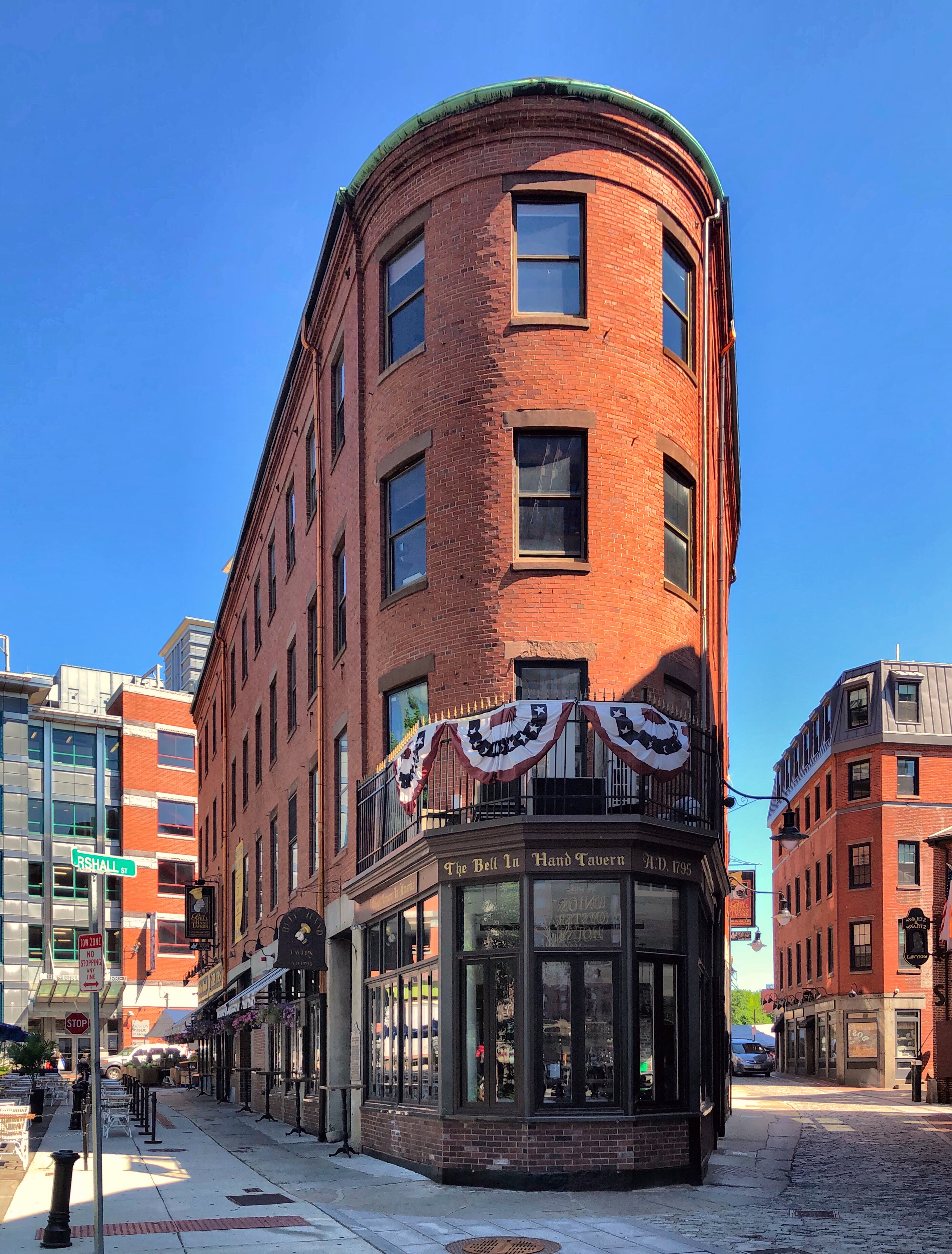
Union Block // c.1842

Located in the Blackstone Block of Downtown Boston, this flatiron building encloses Marshall Street on the Freedom Trail, creating a tight, pedestrian-oriented street that once covered old Boston. The Union Block (c.1842) is a Greek Revival commercial block which typifies this network of short, narrow streets which somehow survived Urban Renewal and the coming of the highway in Boston. The longest running occupant of the building was Ward & Waldron Paper Hangings, which from my understanding, made wallpaper for the estates of Beacon Hill which were being built on the other side of town. After successive ownership, atlas maps show the ownership of the building in 1888 conveyed to Massachusetts General Hospital, which still held title to it past 1938. The building is now home to Bell in Hand, an iconic local pub that was founded in 1795 at another location.

Hotel Boylston // 1870-1894

C.1875 image of Hotel Boylston, BPL image.

Standing just 24 years, the Hotel Boylston at the corner of Boylston and Tremont Streets, evoked the Victorian-era grandeur of Boston. Built in 1870, the Victorian Gothic hotel (what we consider apartment building today) was designed by the architectural team of Cummings and Sears, who were very busy at the time in Boston and beyond. The 5 1/2-story building was constructed of sandstone and featured Gothic arches, dormers of varied sizes and shapes, and a mansard roof with iron cresting. The building (and the three others on Tremont Street) was razed in 1894 and replaced with the Hotel Touraine a few years later.

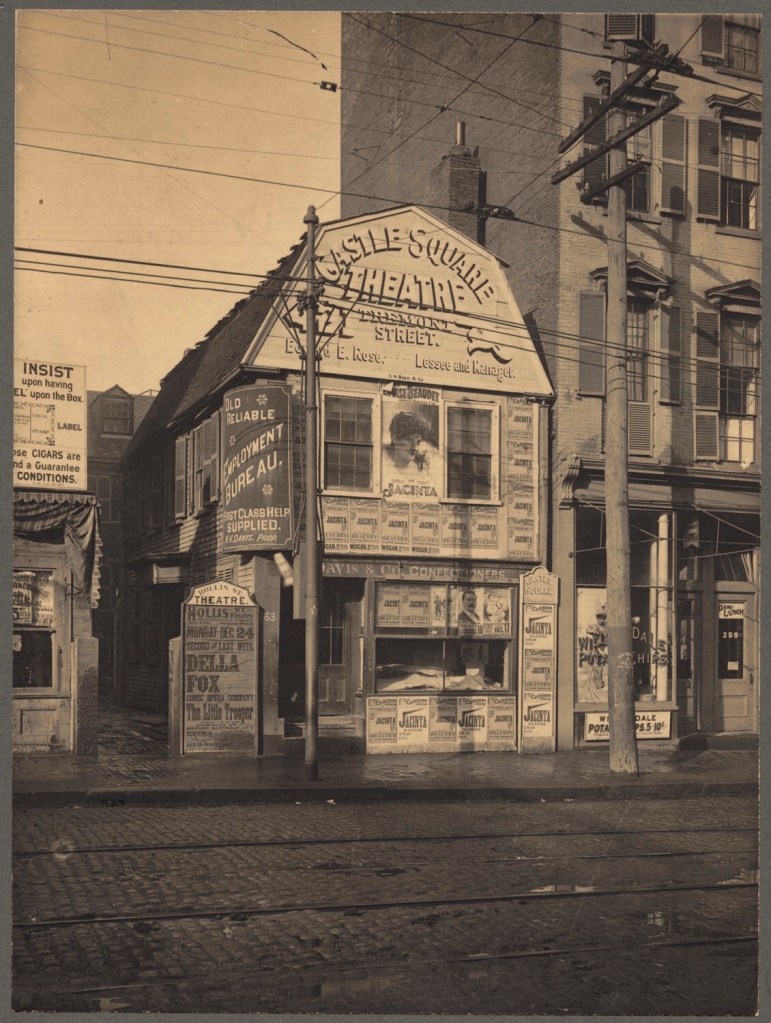
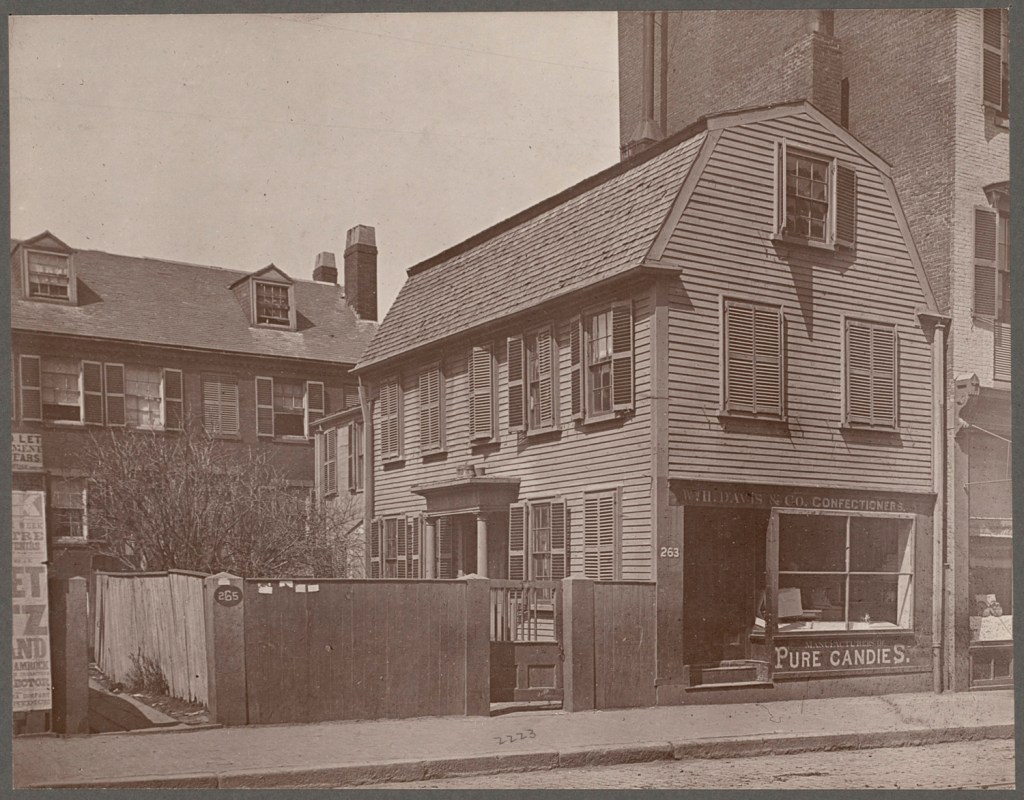
General Crane House // c.1670-1908

Crane House c.1900, courtesy of BPL.

Formerly located on Tremont Street in Downtown Boston, this ca.1670 Georgian gambrel home went from residence to candy shop to billboard in its lifetime. The home was constructed by John Crane (1744-1805), who was a housewright by trade but a patriot and soldier most importantly. At the tender age of 12, he had an early military experience when he substituted for his father in the French and Indian War when his father received the draft. Records state that Crane was an active member the Sons of Liberty, a secret revolutionary organization that was founded by Samuel Adams to fight taxation from the British government. Hours before the Boston Tea Party, Crane and the other participants met at his shop at his home to disguise themselves as American Indians as disguises for the events that would take place that night. He was in the hold of one ship when he was knocked unconscious by a falling crate of tea. His fellow patriots thought him dead and hid him under a pile of wood shavings in a carpenter’s shop off the harbor, only for Crane to recover later. Less than a year later, Crane and his family moved to Providence, Rhode Island where he would later serve under a militia there in the Revolutionary War. After serving, and seeing battle, he was awarded land in Whiting, Maine (Maine was part of Massachusetts at the time) where he built a home and spent his last days.

Crane House, c.1880s, courtesy of BPL.

His former house on Tremont Street in Boston was occupied as a home until the late 19th century until it was occupied by a confectionary shop, with a storefront added on the street. Due to the shifting demand for theater-oriented development and lodging, the candy shop began struggling. The owner, James Grace, then allowed for the home to be covered with signage and notices advertising various theaters nearby. Ironically, the home was demolished by 1908 for the Shubert Theater, which remains today.