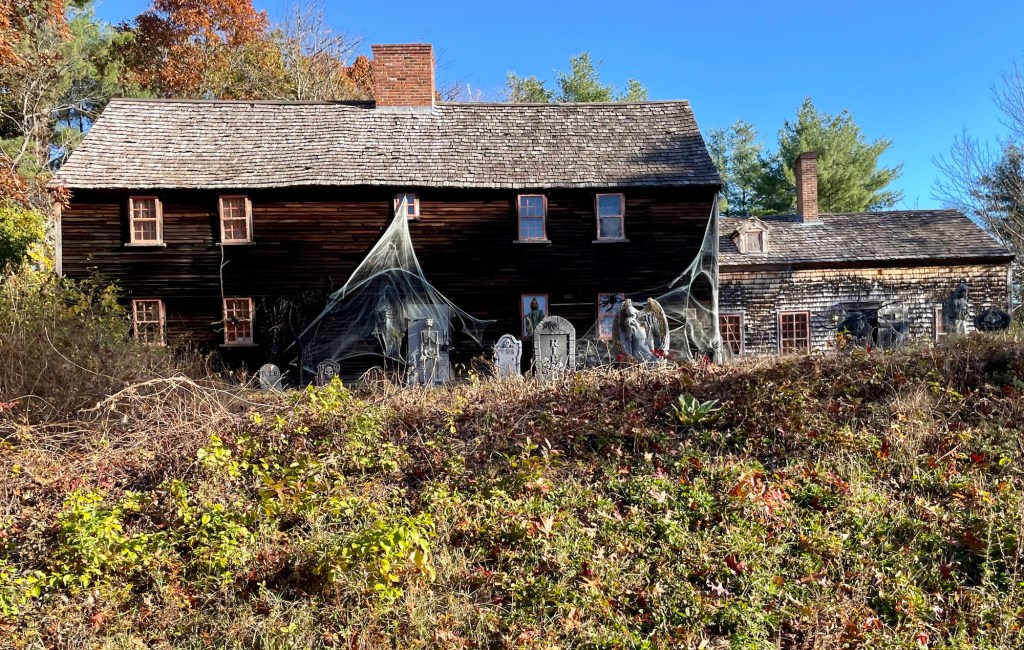
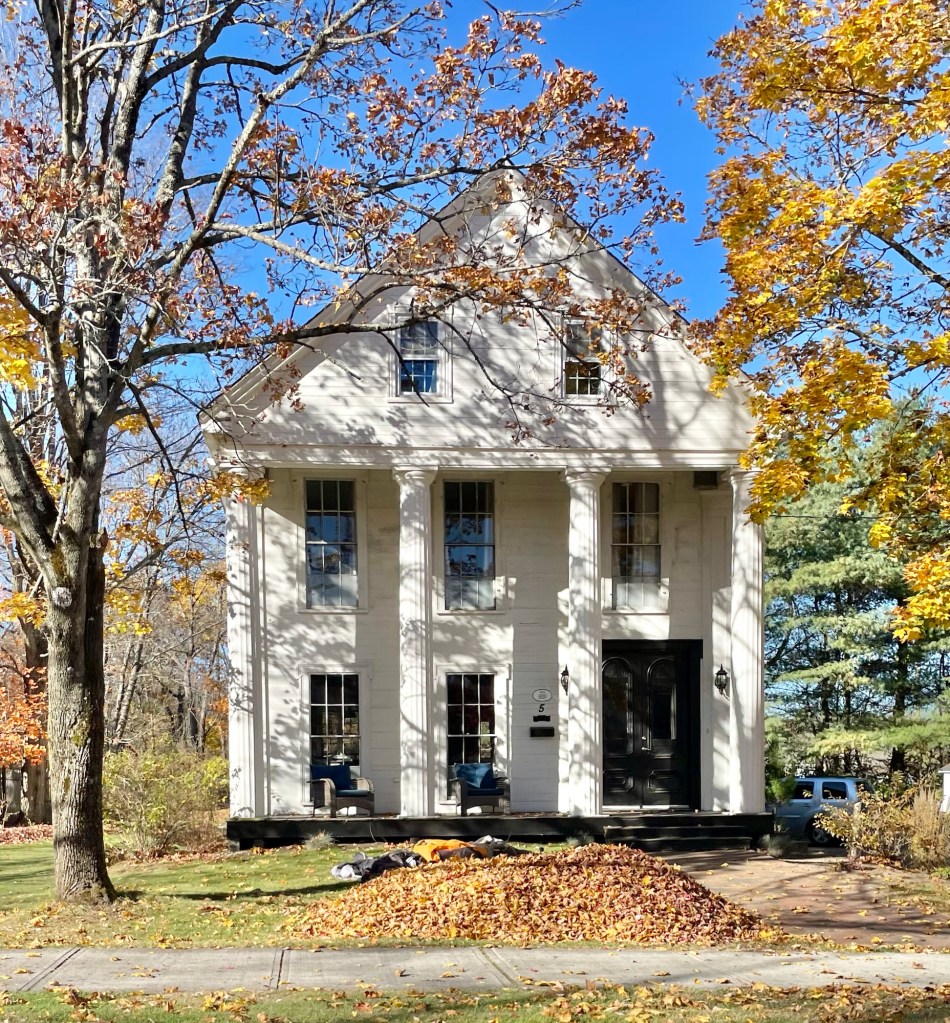
Georgetown Engine House No.5 // c.1860

Following a devastating fire in Georgetown in 1874, local residents of the town petitioned at a town meeting to purchase a fire engine and a lot to erect a new engine house to prevent such a loss again. Within a year, voters approved not only the construction of a new engine house on Middle Street, near the commercial center of town, but also to move this charming single-engine firehouse at to a site to “the south part the town”. This structure was deemed inadequate for the dense commercial village and instead of demolishing it, town voters decided it could be relocated to another area and put to use. A volunteer company was formed for the new engine house and the small structure remained as a firehouse until the early 20th century when modern fire apparatus would no longer fit in the building. The building was sold by the town and has remained in private ownership since the 1920s, and its use is unknown to me, but the owners are doing a great job maintaining this significant structure.

Nelson House // 1797

This residence sits on the historic Elm Street in Georgetown, Massachusetts, and is one of the best late-Georgian style dwellings in the town. The house was built in 1797 for Nathaniel Nelson (1767-1853), a banker who worked in Newburyport, just years after his marriage to Sally Chaplin. Nathaniel descended from Thomas Nelson (1615-1648), who was among the twenty families who had come to the New World in the winter of 1638 with the Puritan cleric Ezekiel Rogers (1590-1660). With Rogers most of these families settled at Rowley, incorporated in 1639 with Georgetown later setting off from Rowley, creating their own town in 1838. Nathaniel and many of his family worked as tanners, preparing the skins of animals into leather, and had shops in the area. Mr. Nelson was such an esteemed member of society, that when the War of 1812 broke out, he was asked to store money and gold from Newburyport in his basement, away from the coast, hiding it from the British forces. After successive ownership, the residence was purchased in 1936 by Everett A. and Mary A. Spaulding. A Georgetown native, Everett Augustus Spaulding made colonial revival furniture under the corporate name Spaulding Colonial Reproductions. The residence remains in spectacular condition, with its large central chimney, symmetrical façade, portico, and hipped roof punctuated by pedimented dormers.

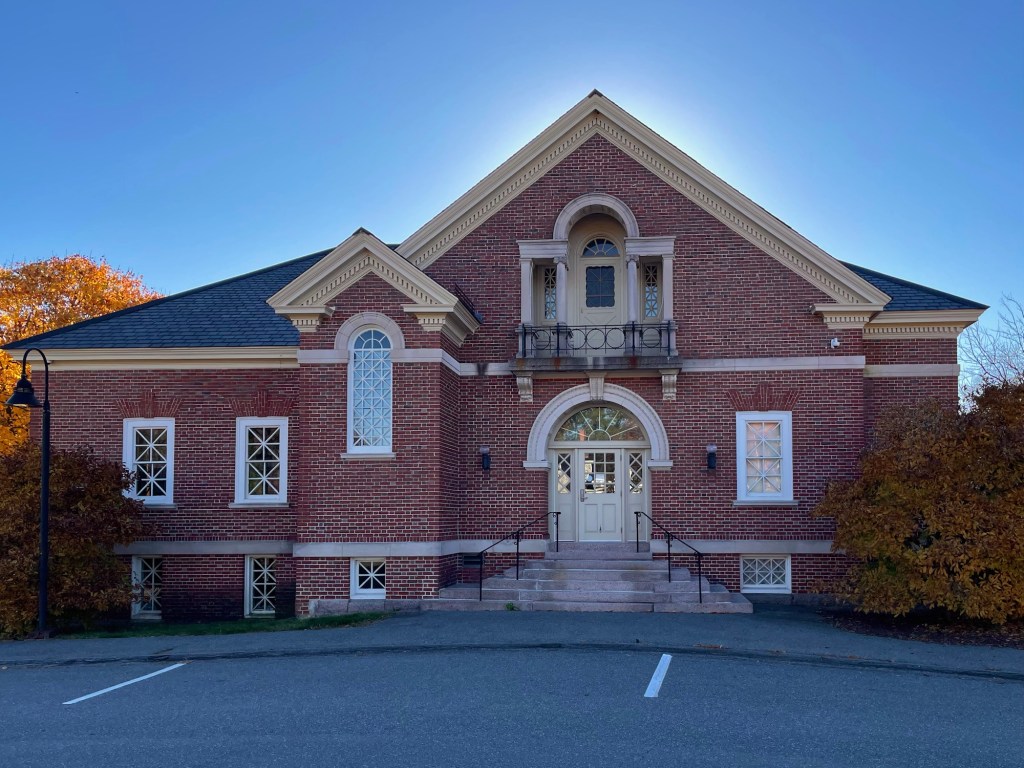
Georgetown Peabody Library // 1907

The Georgetown Peabody Library began on September 19, 1866, following a generous gift from George Peabody (1795-1869), a great man who is considered the father of modern philanthropy. George Peabody’s interest in the town was due to the fact that it was the birthplace of his mother, Judith (Dodge) Peabody, and for many years the home of his sister, Mrs. Judith Peabody Russell. Mr. Peabody decided to donate funds for the town’s first public library and also had 2400 books brought from London for its initial book collection. The wooden library building was designed by the Boston architectural firm of Bryant & Gilman and opened in 1869. After a few decades, the first library proved inadequate for the town’s needs and the present building was built with invested Peabody funds. In 1904, construction began on the new, present library building, a robust, brick structure in the Romanesque style with the firm of Cooper & Bailey furnishing the plans. The building has since been added onto as the town grew, but it retains its significance architecturally and historically for ties to Mr. George Peabody.

Dickinson–Pillsbury House // c.1700

The Dickinson-Pillsbury House is believed to be over 320 years old and is significant as a well-preserved example of a First Period house in good condition. Located on Jewett Street in Georgetown, Massachusetts, the house was seemingly built before 1700 by James Dickinson Sr. or James Dickinson Jr. and was inherited by Samuel Dickinson (1754-1841). The house is notable for being the home of War of 1812 veteran and inventor Paul Pillsbury, who purchased the property about 1801. His inventions included devices for pegging shoes, milling bark off tree sections, and stripping kernels from ears of corn. Paul Pillsbury and his wife Elisabeth Frink had a family of seven sons and one daughter. Paul Pillsbury was also the uncle of abolitionist Parker Pillsbury and the great-uncle of attorney Albert E. Pillsbury who drafted the bylaws of the NAACP. What an incredible family! The house is well-preserved and a great example of a First Period residence from the 17th century.

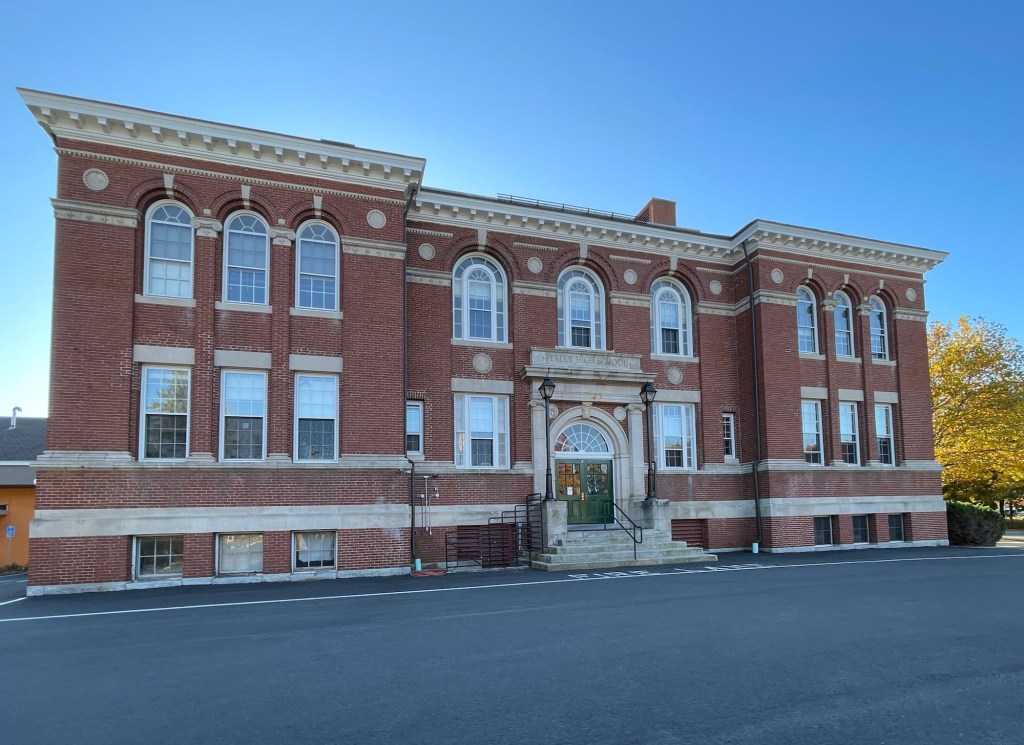
Perley School // 1898

The Perley School, formerly known as the “The Perley Free School” is an architecturally and historically significant school building in Georgetown, Massachusetts, constructed in 1898 as a result of the former high school being lost to fire. The original funding for the Perley School was made possible by donations from the estate of John Perley. John Perley (1782-1860) was born in town and operated grocery stores, later getting involved in land speculation. He never married nor had children and lived frugally despite having a small fortune, that would end up being distributed to extended family and as gifts to the town, including funding this building and in the local Congregational church. He died in 1860 and was buried in a local cemetery, marked by the town’s most ornate memorial. The Colonial Revival style school would suffer a catastrophic fire in 1935, but was largely rebuilt and added onto, showing the community’s resolve and determination. It remains today as the town’s elementary school.

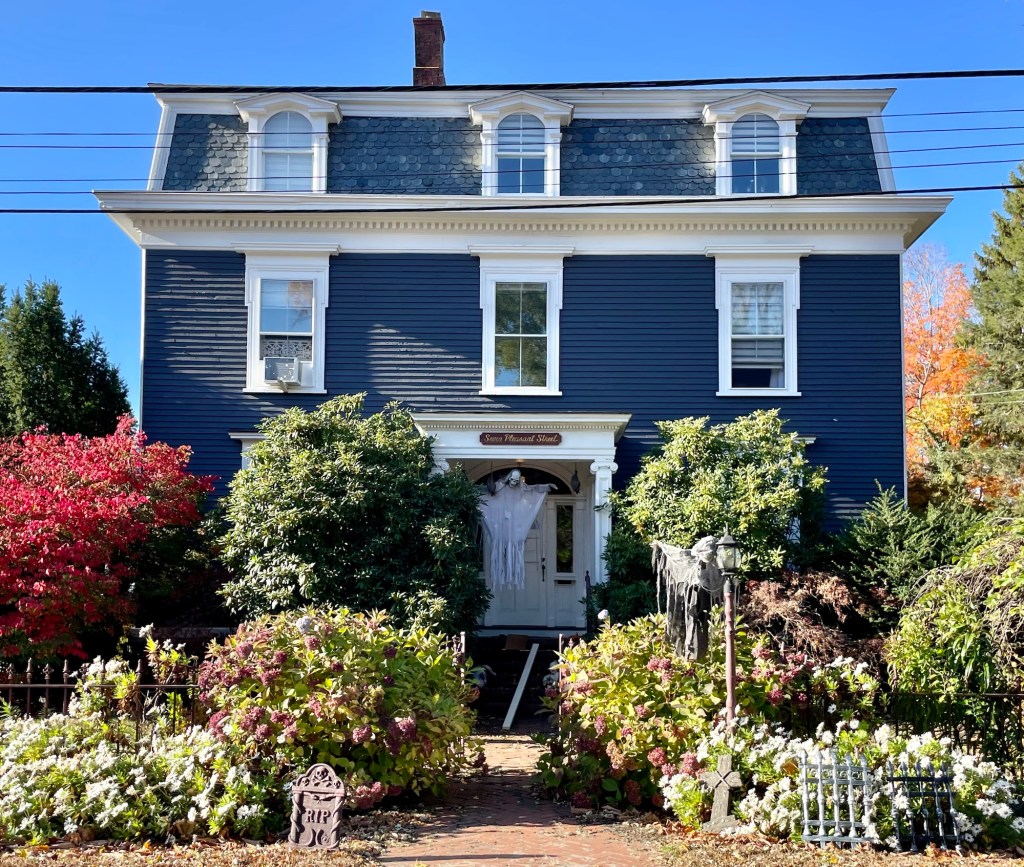
Tenney-Root House // c.1865

This house in Georgetown Center, Massachusetts dates to the 1860s and appears to have been built for Milton G. Tenney, a shoe manufacturer. By the early 20th century, the home was owned by the third member of the Root family to practice medicine in Georgetown. The first, Dr. Martin Root, established a practice in 1827, serving the community for more than 50 years. His son, Dr. Richmond B. Root, owner of 24 North Street (featured previously), was in turn the father of Dr. Raymond Root (1882-1958), owner of this fancy Second Empire style dwelling. In addition to his private practice, Dr. Raymond Root was a school physician for many years, and served as Town Clerk from 1937 to 1944. The house is Second Empire in style with a mansard roof, window mouldings and two-over-two windows, but features a Colonial Revival portico with what may possibly be a Federal-period entry of fanlight with sidelights, salvaged from his father’s home when that house was renovated.

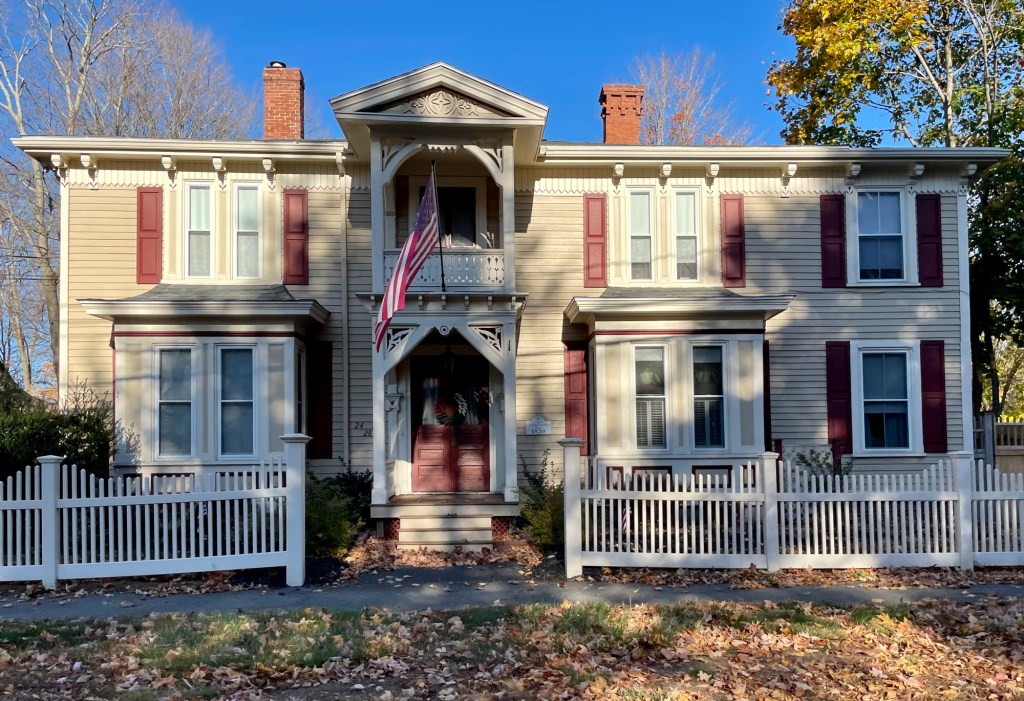
Spofford-Root House // c.1830

The Spofford Family was one of the earliest to settle in present-day Georgetown, with the earliest enclave of homes built along Andover Road in the western part of town. A few generations later, subsequent family members would built in the town center, taking advantage of the growing commercial and business community. This Federal period home (with later alterations) was built around 1830 for Greenleaf Spofford (1801-1887) the same year as his marriage to Emily Willmarth. The couple would move out of town and sold the home to Dr. Richmond Barbour Root (1846-1930),  the second of a highly respected, three generation family to practice medicine in Georgetown. The overlay of machine-sawn Stick Style decorative porch, bracketed cornice and bay windows were likely added by Root sometime after the Civil War. Unlike most owners of Federal and Greek Revival-style dwellings, Dr. Root may have held a valid professional interest in appearing as up-to-date as possible with a “modernized” home that also served as the site of his office and consulting rooms.

Adams Hall // c.1828

According to local histories, this significant Greek Revival style property on Elm Street in Georgetown, Massachusetts, was owned by Josiah Adams (1757-1852), a farmer, a Revolutionary War veteran, and a fourth-generation descendant of the immigrant Robert Adams, who arrived here from Devonshire, England by about 1629. In March 1849, the town’s Congregational Society purchased Adams Hall for eight hundred dollars to house the church vestry, which remained in the building for forty-one months until a new building was built for that purpose next door. Later, Adams Hall was owned by Moses Tenney (1808-1903), operator of a prosperous saw mill in Georgetown, and served at one time in the state senate. The structure retains its significant temple-front with four, two-story Doric columns supporting the portico. Also special on this residence is the use of flush-board siding and the oversized first floor windows.

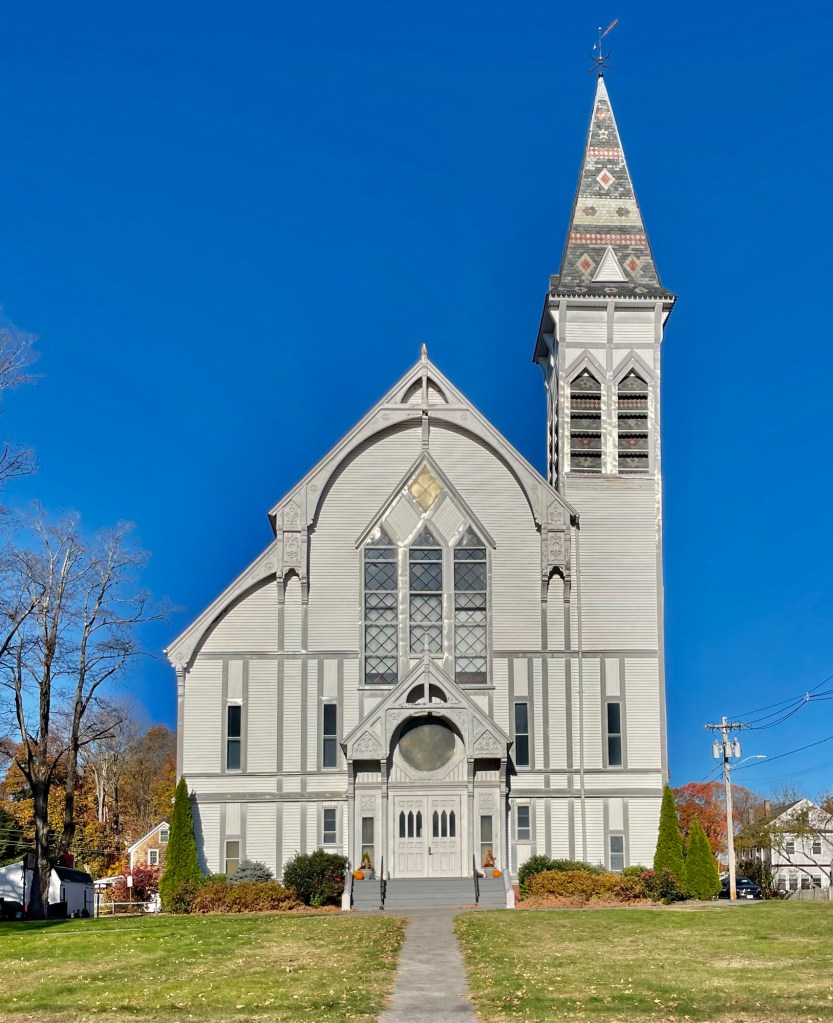
First Congregational Church of Georgetown // 1874

The First Congregational Church of Georgetown, Massachusetts, is significant both architecturally as a Victorian Gothic/Stick style church designed by a prominent architectural firm, and historically as an important gathering place for the town’s members for 150 years. The congregation however is much older than 1874, as when Georgetown was then a part of Rowley, Massachusetts, members here in 1731 petitioned to create their own parish in Rowley to travel a shorter distance to services. The church, then known as the Second Church of Christ in Rowley, was organized in 1732 with services held in a rustic Meeting House. A second meetinghouse was built in 1769, which was both outgrown and in much need of repairs by the time the congregation decided to build a new building on a new site in the new commercial center of town. The congregation hired the esteemed firm of Peabody & Stearns to design the church which today, is the most high-style and architecturally grand building in the suburban town.

Moody-Hall House // 1830

Transitional Federal/Greek Revival style houses are among my favorite. You can see the emergence of Classical architecture blending with American architecture with features of both styles, which work well together. This example can be found on Elm Street in Georgetown, Massachusetts. The dwelling appears to have been built for Dr. George Moody, one of four physicians in Georgetown in 1840, who began his practice in town in 1830. In his first years there, he oversaw patients during Typhus and Dysentery outbreaks and was credited with having determined that a high sulphur content in the local water supply accounted for the increased cases. Dr. Moody died in 1866, and his widow continued to live in the house until her death in 1880, after which it was sold to Mrs. Charlotte Sawyer Hall, the widow of local shoemaker Seth Hall.