Emerson House // 1744

The oldest extant building in the village center of Hollis, New Hampshire is the Emerson House, which overlooks the town green. The home was constructed in 1744 for Reverend Daniel Emerson, the first settled minister in Hollis. The home stands on land that was part of the 40-acre ministerial parcel set aside when the town was planned that year. Over the next 21 years, Reverend Emerson and his wife had 13 children (seven sons and six daughters) which caused them to expand the home numerous times until his death in 1801. The home remained in the Emerson family for some years until it was sold at some point in the 20th century when the home was modified with the storefront windows. It now houses apartment units.

Universalist Church of Strafford // 1833

The Universalist Society of Strafford, founded in 1798, is the second oldest in Vermont and fourth oldest in the nation. In the early years, Universalists met in Strafford’s Town House, sharing the building with other denominations. Eventually the Universalists, Baptists, and Congregationalists all built their own churches, with the Universalists building a structure in 1833 in South Strafford Village. The white clapboarded church sits high on a hill with a gorgeous belfry and large stained glass windows.

Strafford Municipal Building // 1883

Designed and built by Senator Justin Morrill in 1883, this building was donated to the town of Strafford by Morrill in memory of his mentor Jedidiah Harris. It was given to the town as a public library in part to house the Harris Library, which in turn had been created by a bequest from Harris. This structure remained a library until the Morrill Memorial Library building was completed in 1928 and its collection was joined with Morrill’s. It is currently used as the Town Office building providing space for the Town Clerk/Treasurer and Town Records, and town boards. The white clapboarded building has Victorian detailing with the spindled posts at the porch with a prominent gambrel roof covered in slate. Cute!

Farist House // 1894

Joel Farist (1832-1904) emigrated to America with his family by the way of Sheffield, England, working originally as a laborer as a child. By his thirties, he formed the Farist Steel Company in Springfield, MA, later relocating to Bridgeport, CT in 1872. Due to his prestigious role and success, he became well-connected in Bridgeport, later becoming the first President of the Bridgeport Electric Light Company and Vice President of Bridgeport Hospital. He built this massive home in nearby Fairfield, CT, likely to get away from the polluted Bridgeport air, for a more bucolic area. The massive Queen Anne home he had built (likely as a second home) features prominent towers, a full-length porch, and a porte-cochere off the side. The home has been restored a few times recently, and a new (hopefully not final) paint scheme in yellow was recently painted on the front facade.

Howard Lee House // c.1928

Fairfield in the early 20th century began to shift as a suburban town with neighborhoods of large homes in planned districts. The proliferation of the personal automobile led to the “suburbanization” past streetcar suburbs closer to downtowns. Howard Greeley Lee (1893-1965) worked as Vice President of the Lee Brothers Furniture Co. based out of nearby Bridgeport. The company clearly did well as Howard had this large home built in the fairly uncommon (in New England) Spanish Revival style. It features a red tile roof, stuccoed siding, metal casement windows, and arched windows and front door, all commonly found in the style.

First Church Congregational of Fairfield // 1892

The First Church Congregational in Fairfield, Connecticut is the sixth church to occupy this site! The first structure was built in 1640, and the current building was constructed in 1892. The third version of the church was burned by the British in 1779, while the fourth “meeting house” took nearly 42 years to finish and was partially funded by the sales of properties which formerly belonged to Tory sympathizers. The Romanesque Revival church was designed by architect J. Cleaveland Cady, who is best known for his design of the south entrance of the American Museum of Natural History on the Upper West Side of Manhattan.
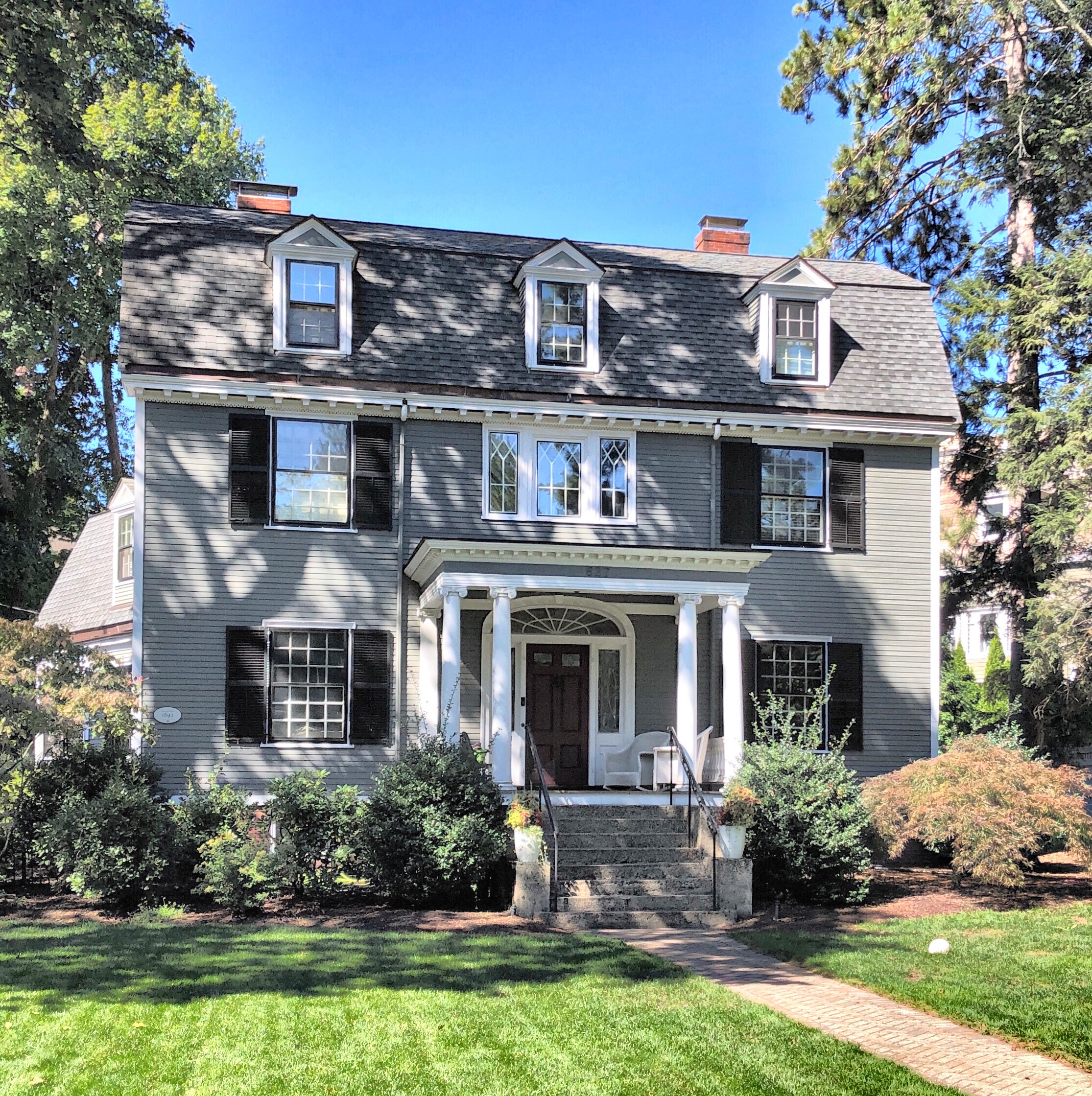
Lewis H. Bacon House // 1892

Another architect-designed home for their own use in Waban Village in Newton, is this house on Chestnut Street. Built in 1892, the Colonial Revival home is set far off the street with a commanding presence and symmetrical facade. The home was designed and occupied by Lewis Howard Bacon (1857-1941), a former chairman of the Newton board of appeals and a member of the school committee and the board of aldermen in Newton, also a practicing architect. He studied architecture in the office of Samuel Lane, architect of Cleveland, 1877-80, when he moved to Boston as a draughtsman and supervisor of construction for the firm of Sturgis & Brigham, 1880-1886. For four years he was a member of the firm of Morrison & Bacon (1888-1892), before embarking on his own practice in an office in Downtown Boston. He resided in this home until his health failed and he moved to a nursing home where he died.

First Church of Christ, Suffield // 1869

Located adjacent to the Town Common, the First Church of Christ in Suffield showcases the grandiose architecture seen in many churches after the Civil War in New England. This brick edifice is the fifth in the history of the church which dates back to around 1680. The church was designed by local architect John C. Mead, who designed many churches in the region. The church is a blending of Italianate and Romanesque Revival styles and originally featured a tall spire and secondary tower. In 1938, the New England Hurricane destroyed the tall spire (a similar event occurred to many New England Churches, including Old North in Boston). Even without the steeple, the church remains as a great architectural treasure in town.

Hills-Claflin House // 1871

This grand home was built in 1871 for George Hills, one of the original investors in the Oak Bluffs Land & Wharf Company development, a development to the east of Wesleyan Grove. The home was designed by Samuel Freeman Pratt, a Boston carpenter turned premier architect of Oak Bluffs, who likely designed the home in his distinct Stick Style with intricate wood carvings and posts. In 1877, the home was purchased by Governor William Claflin after his time in office as a summer retreat from his home in Newton, MA. The governor was an ardent Methodist who was involved with liberal causes such as abolition and Native American and female enfranchisement. Within 10 years of his purchasing of the home, he modified and enlarged it with Colonial Revival motifs including the gambrel roof, Tuscan columned porch, and simplified dormers.

Union Chapel // 1870

One of the most unique buildings I have ever seen is the Union Chapel in Oak Bluffs on Martha’s Vineyard. The chapel, built in 1870 in the American Stick Style, is in the form of an Octagon, very unique for churches. Built as an inter-denominational house of worship, it is significant as the first non-sectarian religious building to be erected in a community that until 1870, was noted primarily for its strong association with the Methodist Church and its summer camp meeting (Wesleyan Grove) assemblies. The Chapel offered islanders and seasonal visitors regardless of religious affiliation
not only an opportunity to worship but a gathering place for cultural activities. According to historic images, the chapel once had more elaborate stick work and finials, since removed, likely due to storms and general maintenance concerns. The chapel was designed by island resident Samuel Freeman Pratt (1824-1920) who had no known architectural training besides working as a wood carver in Boston, yet his work is characterized as having a dynamic and festive style. Pratt’s other major contribution to Oak Bluffs’ architecture, the Sea View Hotel, was erected at the head of the wharf in 1872, but burned down in 1892.

Davis House-Aunt Felicia’s Folly // 1805

If you stroll down Maine Street in Kennebunkport, you cant help but notice the most charming saltbox house. Constructed in 1805 by Samuel Davis, a master builder in Kennebunkport, the Federal home likely had a saltbox roof originally which would have housed the kitchen. After the Civil War, the home was owned by Silas Perkins, who then sold the home to his daughter, Felicia (Perkins) Cleaves and her husband, Albert, a teacher. By the 1870s, Felicia had the Colonial home completely renovated, turning into a Gothic Revival showpiece. Mrs. Cleaves added a new wing to the right of the original house, for she desired the high ceilings that were common during the Victorian era. The building became known in town as “Aunt Felicia’s Folly” and alternately, “the Witch House.” In 1966, owners restored the home back to what it likely looked like before the 1870s renovation, adding a saltbox roof.

Undated image showing “Aunt Felicia’s Folly” with Gothic alterations.

St. Martha’s Catholic Church // 1903

A happy blending of Mission, Colonial Revival and Shingle Styles for the Maine coastal community of Kennebunkport, the St. Martha’s Catholic Church exemplifies the charm of this town. The church is sited on a corner lot with a belfry at its corner. The nave features a central entry with Colonial pilasters and pediment above the second floor windows. The roofline is shaped with Mission style parapet walls and arched openings at the tower, showcasing the Spanish influence in the design. The entire building is wrapped with cedar shingles, as a nod to the coastal summer resort it resides. The church operated here until the mid-late 20th century when it was converted to an art gallery, and now is home to condos.

Eastham Public Library // 1897

Built in 1897, the ever-charming Eastham Public Library has served the town for over 100 years, constantly adapting and growing to meet the needs of the community. Originally constructed as a one-room hipped-roof shingled library building, the tiny space was appropriate for the town of just 500 people in 1900. By the 1960s, the rear ell was replaced with a large addition, effectively quadrupling the square footage of the library, but keeping the original structure intact. The 1960s addition was eventually deemed insufficient and was replaced in 2016 with the gorgeous modern addition by Oudens-Ello Architecture of Boston. The addition compliments the quaint one-room original structure with the use of materials, yet clearly distinguishes itself as 21st century design.

Hotel Touraine // 1897

The Hotel Touraine at the corner of Boylston and Tremont Streets in Boston was built in 1897 as one of the most luxurious hotels in the city. Designed by the local firm of Winslow and Wetherell, the Jacobean Revival style building commands the well-trafficked corner opposite the Boston Common. Early articles described the hotel as “a large and sumptuously equipped house, with internal decorations in the style of the Chateau de Blois (a French chateau). Winslow and Wetherell appeared to have been inspired by the Louis XII wing of the Chateau, as many design elements of the hotel closely resemble it. The hotel was advertised as having 350 rooms valued at $2 a night up to $3 a night for a room with a private bath. Separate men and women’s parlors, a library, and elevator service made the hotel desirable for the upper-class Bostonians and visitors to the bustling Downtown area. The hotel’s rich clientele eventually began frequenting the larger hotels near Copley Square and the stature of the Touraine slipped with a changing Downtown character. By the 1960s, the hotel closed and was converted to apartments.