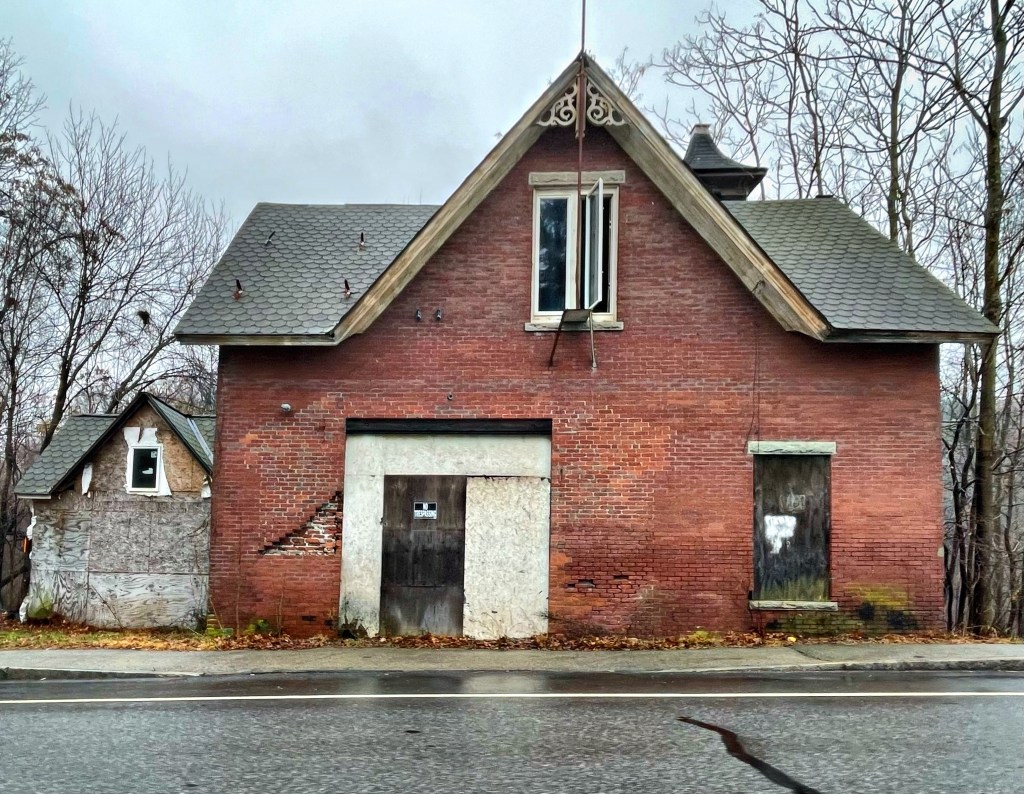
A short distance to the Lapham Woolen Mill, this historic fire station can be found right on the street in Bramanville, an industrial village in Millbury, MA. The fire station was built in 1883 by the Lapham Woolen Mill owners as an insurance protection from fire and complete loss of their lucrative business. After Lapham’s death in 1893, the company sold the mill, worker’s housing, store and fire station to the Mayo Woolen Company which began production almost immediately. Sadly, like many former industrial buildings nearby, the future is unclear for this amazing old building. What would you repurpose the Bramanville Fire Station into?
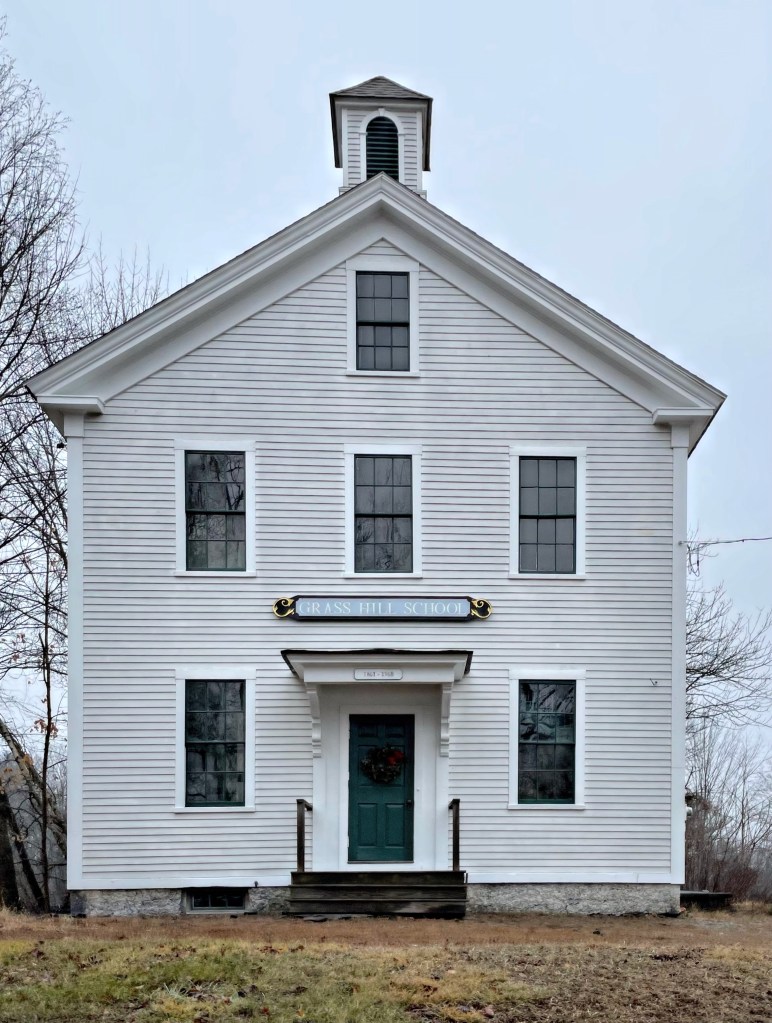
In western Millbury, the Grass Hill school was constructed to provide a place of learning for children in the agricultural section of town. The district school, a remnant of the system of autonomous school districts that characterized the educational system of Massachusetts in the 19th century, this is a larger example of many of them. West Millbury had many wealthy farmers and they financed a district school here as far back as 1814. After two earlier, smaller school buildings, this two-story school was erected and was one of the most substantial. At one time, students in eight grades taught there, all at the same time, with grades 1-4 downstairs and 5-8 upstairs. As there weren’t many students, each grade only took up one or two rows. The building remained as a school for the town until 1968, and the building was leased to the Millbury Historical Society long term. They just completed a massive restoration project for the building, it looks great!
I have gotten a lot of requests recently to feature an old New England mill town, and I wanted to highlight a lesser-known one, so here is Millbury, Massachusetts! This gorgeous mill building was constructed between 1879-1919, impacted by over forty years of growth and design. The Lapham Woolen Mill is the largest and most intact 19th century industrial building in Millbury and sits in the middle of Bramanville, an industrial village in the town, off Singletary Brook, a branch of the Blackstone River. The Lapham Woolen Mill was built on the location of the former Burbank paper mills, which were in operation in Bramanville between 1775-1836. The Lapham Woolen Mill was started in the mid-1870s by Mowry A. Lapham, who oversaw the company’s growth after the Civil War, manufacturing clothing and other woolen goods. After Mowry’s death, the company’s pollution into the brook got the best of them and they disbanded, selling it. The mill was then purchased by Josiah and Edward Mayo, and their business partner Thomas Curtis. The group renamed the existing business the Mayo Woolen Company. The complex was occupied by Steelcraft Inc., a manufacturer of medical supplies, until recently. The building’s future was threatened until 2020, when a proposal to restore the old mill, and add new housing on the site was proposed. Fingers and toes are crossed to see this gorgeous building restored!
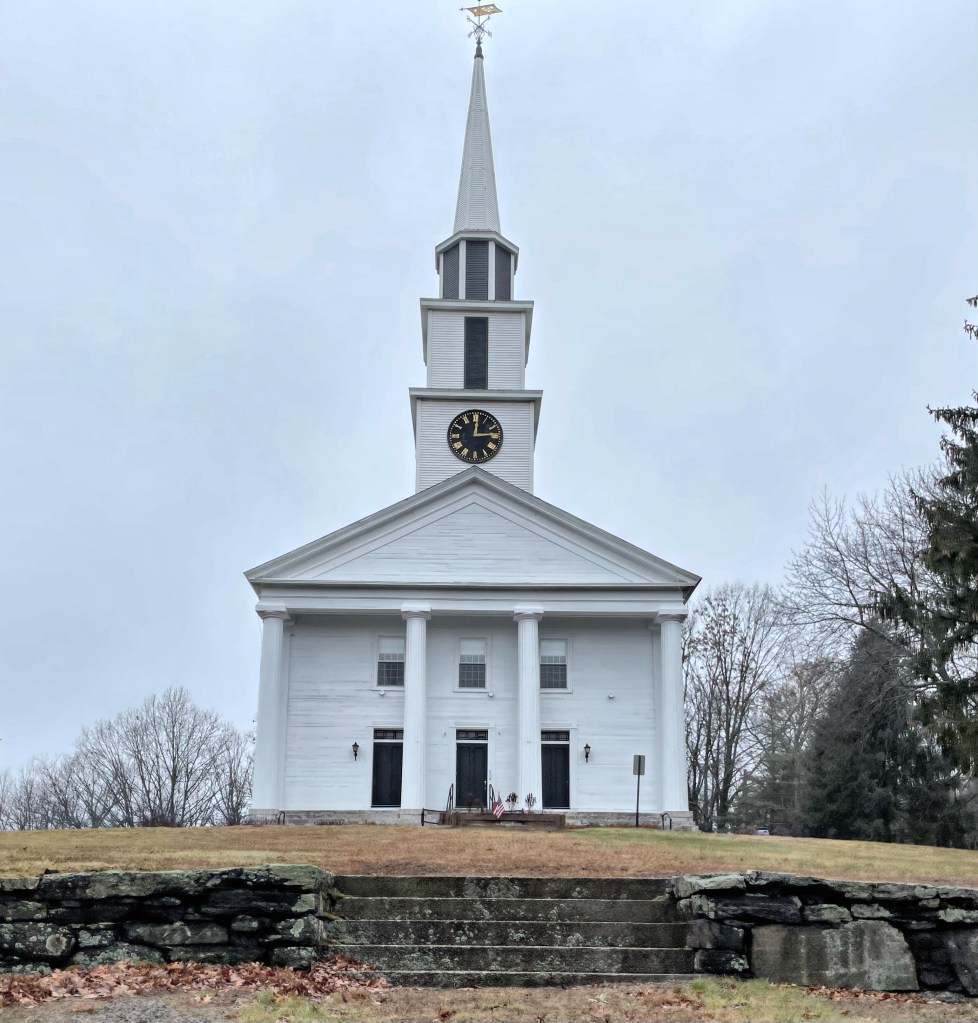
Not just your typical white New England church here… this one was moved! This church was built in 1804 in the north parish of Sutton (present day Millbury, Massachusetts). In the 1700s, the members of the northern part of Sutton petitioned to have a parish church of their own, rather than trekking across the large town to gather for town meetings and religious purposes. They were permitted to erect a parish church inn 1743, and built a church. The building was replaced in 1804, thanks to the wealth and new members of town moving there for manufacturing. Years later, the parish petitioned the Commonwealth of Massachusetts to have the North Parish of Sutton become the town of Millbury, due to the difference in needs being a mill town compared to Sutton’s more pastoral living, and they were designated as a town in 1813. The first town meeting of Millbury was held at First Congregational Church of Millbury that year on the town common. As industry along the Blackstone River picked up, so came waves of workers, many of whom were recent immigrants to New England. It was soon decided that the town church should relocate to provide a new center for town. In 1835, this church was moved about a mile away and erected high on a hill, in Bramanville village, a bustling industrial village. The church has remained in its location in Bramanville, even after the town center again moved, this time eastward to its present location. The Greek Revival style church elegantly reflects the significance of ecclesiastical buildings in early New England towns.
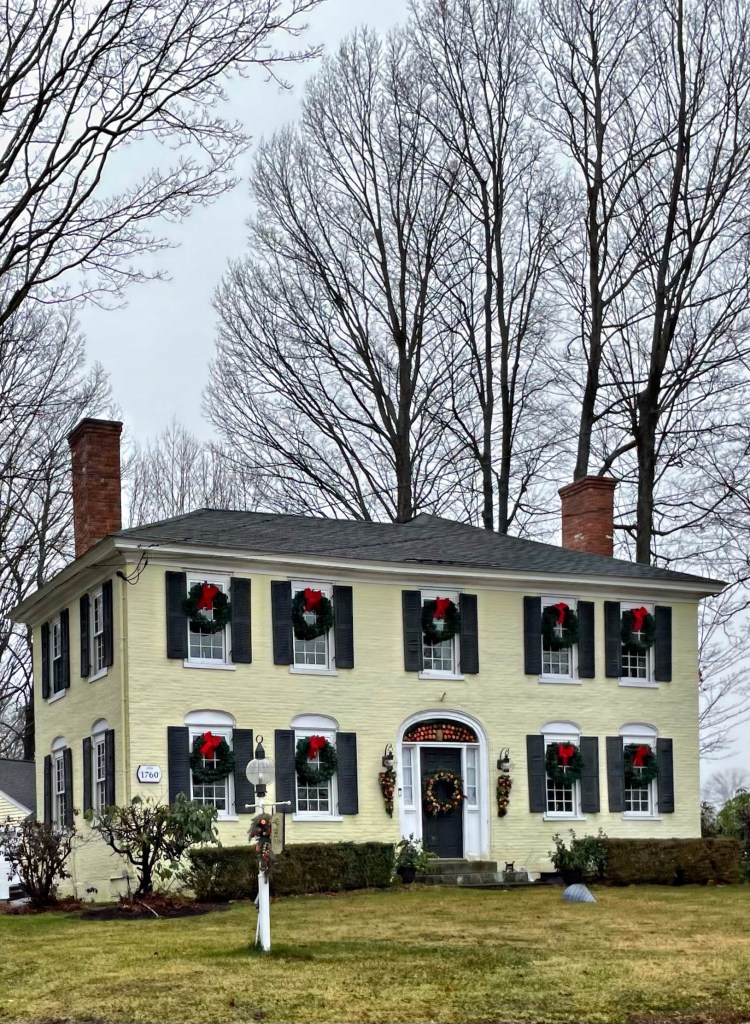
This historic house in West Millbury, Massachusetts, began in the end of the 18th century as a one-and-a-half-story wood-frame farmhouse. By 1810, the home was rotated 90 degrees and a more substantial, two-story brick house was constructed facing the street. The Federal style home was owned by Thaddeus Hall (1779-1855), and after his death, it was owned by his son, Orson Eddy Hall, who possibly rented the property for income while he resided in New Orleans and ran the iconic St. Charles Hotel there. The property was later acquired by Willard Balcom and remained in the family. Oh what I wouldn’t do to see the paint come off this old brick house!!
This farmhouse is unreal… Located on a rural back road in Millbury, I came across this rambling old Cape house with a stone wall and everything! The home appears to have been built in the late 18th or early 19th century, possibly as a half-cape (with the door and two windows to the right) for Emery Bond, or possibly his father, Oliver Bond. The home (like many Cape houses) was added onto as the family grew and finances could necessitate a more substantial house. It likely added the two bays to the left of the front door next, then bumping out the sides by the 20th century to give it the present, elongated appearance. It’s not often that a once-modest Cape house stops me in my tracks!
Backroads in New England are just amazing! When driving through Millbury on my way to visit one of the finest examples of Federal style architecture in the state, I stumbled upon this gorgeous rural Federal style farmhouse, and had to snap a picture! Millbury is best-known as a mill town (hence the name), but you can find dozens of rural farms dispersed between the mill villages in the township. The Blackstone River cuts through the town, and during the Industrial Revolution, it provided much of the water power to the town’s many textile mills and factories. Like many former mill towns, the shifting of the economy away from manufacturing towards the service sector, harmed the economy of Millbury in the 20th century. Many mills were abandoned and demolished, others adaptively reused. Before we get to some industrial history, I wanted to share this charming farmhouse. This home was built for Nymphas Longley upon the time of his 1819 marriage to the love of his life, Nancy Bond. They ran a farm on over 80 acres, with Nymphas also serving as a town selectman, an overseer of the poor, and led recruitment efforts in town at the start of the Civil War. Like many farms, this one saw suburban development take some of the former land, but this home still sits on over 9 acres, not bad for being so close to Worcester!
Built at the tail-end of the Gilded Age in Newport, this turn-of-the-century mansion evokes feelings of country estates in England. “Clarendon Court” was built in 1904 for Edward Collings Knight, Jr. (1863-1936) and his first wife, Clara W. Dwight (1862-1910). Edward C. Knight was a railroad executive and amateur artist who “exhibited more talent at spending money than making it”, which was evident from his architectural taste and timing for building such an expensive home in Newport, which was beginning to wane in popularity at the time. Clarendon Court was actually designed in the 18th century by Colen Campbell, a renowned Scottish architect. The country estate was never built, but Gilded Age architect Horace Trumbauer, found the design in one of Campbell’s old books, and except for removing the cupolas over the wings either side of the central block, he reproduced a perfect copy. Trumbauer had just a year before designed a townhouse for the couple in Philadelphia. Edward Knight originally named the mansion “Claradon Court” after his wife Clara. In 1930, Claradon Court was purchased by Maisie Caldwell (1878-1956) and her third husband, Colonel William Hayward (1877-1944), legendary commander of the “Harlem Hellfighters” during World War One. Maisie had inherited a fortune of $50 million from her second husband, Morton Freeman Plant, a railroad and steamship magnate. The couple renamed the mansion Clarendon Court, a more traditional name.
Clarendon Court was later purchased by Claus von Bülow and Martha Sharp Crawford, who was known as “Sunny von Bülow”. Sunny was worth over $75 million and updated the mansion and grounds to exceptionally elegant conditions. It was known that Sunny and Claus had a rough marriage, but it came to a head when on December 26, 1979, after the family had come together for Christmas at their mansion, she was found unresponsive and was rushed to the hospital where she slipped into coma but was revived. After days of testing, doctors determined the coma was the result of low blood sugar and diagnosed her as hypoglycemic, warning her against overindulging on sweets or going too long without eating. No foul play was suspected at the time. One year later, on the evening of December 21, 1980, while celebrating Christmas with her family at their mansion, she again displayed confusion. She was put to bed by her family, but in the morning she was discovered unconscious on the bathroom floor. She was taken to the hospital where it became clear that this time she had suffered severe enough brain injury to produce a persistent vegetative state. A hypodermic needle was found in a black bag in Bulow’s study and coupled with their maid’s testimony he was subsequently charged with her murder, accused of injecting his wife with insulin so he could live at Clarendon on her money with his mistress. His mistress was the actress Alexandra (Moltke) Isles, better known as “Victoria Winters” in Dark Shadows. In 1982, in a sensational case that gripped the country, Bülow was convicted. But, he appealed in 1985 and was acquitted. His stepchildren then filed a $56 million law suit against him, which was dropped two years later: Bülow agreed to divorce his comatose wife, relinquish all rights to her fortune, leave the country and never to profit from the story. Bülow moved to London where he kept a low profile for the rest of his life while Sunny remained in a vegetative state in New York until she eventually passed away in 2008.
Completed in 1880, the Newport Casino building is one of the best examples of Shingle style architecture in the world, and despite its name, it was never a gambling facility. Planning for the casino began a year earlier in August, 1879. Per legend, James Gordon Bennett, Jr., the influential publisher of the New York Herald and a summer resident of Newport, bet his polo partner, Captain Henry Augustus Candy, a retired officer of the Queen’s 9th Royal Lancers and skillful British polo player, to ride his horse onto the front porch of the exclusive gentlemen’s-only club, the Newport Reading Room. Candy took the dare one step further and rode straight through the clubrooms, which disturbed the members. After Candy’s guest membership was revoked, Bennett purchased the land across the street from his home, on Bellevue Avenue, and sought to build his own social club. Within a year, Bennett hired the newly formed architectural firm of McKim, Mead & White, who designed the U-shaped building for the new club. The Newport Casino was the firm’s first major commission and helped to establish MMW’s national reputation. The building included tennis courts, facilities for other games such as squash and lawn bowling, club rooms for reading, socializing, cards, and billiards, shops, and a convertible theater and ballroom. In the 20th century, the casino was threatened with demolition as Newport began to fall out of fashion as a summer resort. Saviors Candy and Jimmy Van Alen took over operating the club, and by 1954, had established the International Tennis Hall of Fame in the Newport Casino. The combination of prominent headliners at the tennis matches and the museum allowed the building to be saved. The building remains a National Landmark for its connections with gilded age society and possibly the first commission by McKim, Mead and White, who became one of the most prominent architectural firms in American history.
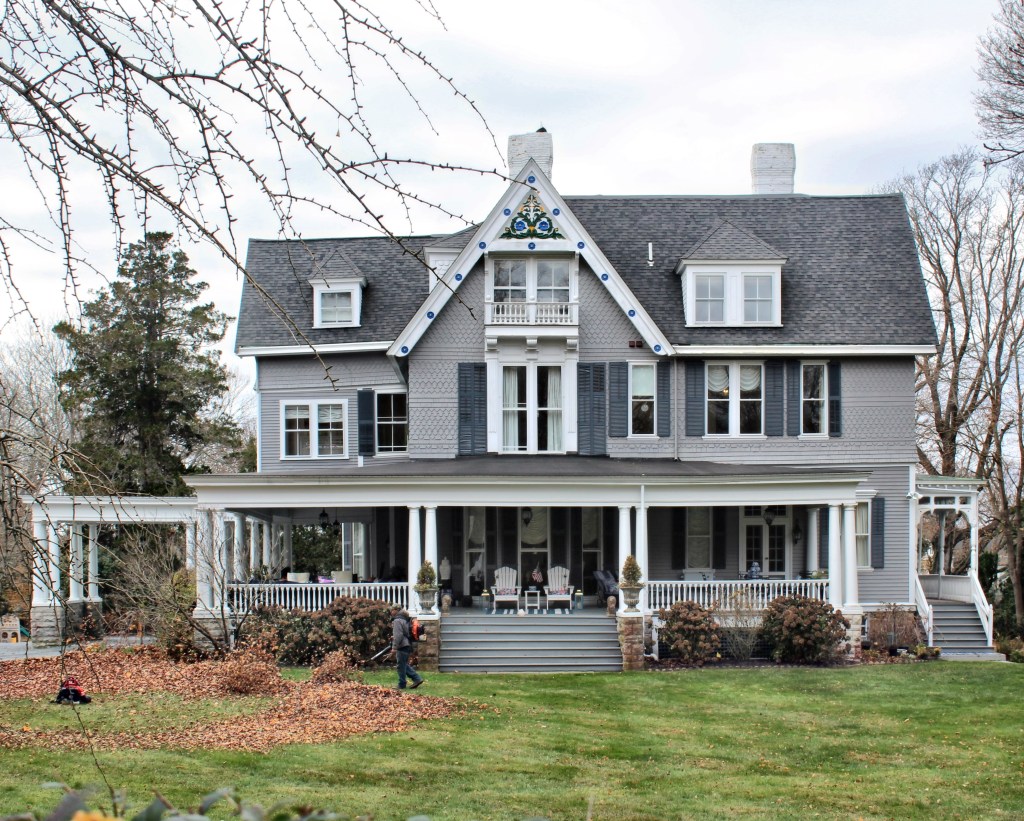
One of the best Queen Anne style summer cottages in Newport is this gem, named Sunnylea. The house was built in 1881 for Charles F. Chickering, who ran the Chickering & Sons Piano Company in Boston. Chickering hired local architect Dudley Newton, who had previously apprenticed under George Champlin Mason, a builder of many Newport summer houses. Sunnylea was the first independent commission that Newton designed with his own firm. The house was later owned by Luther Kountze, a New York banker and his wife Annie. After WWII, the home was converted away from single-family use, and was occupied as a prep school, before being converted to condos late in the 20th century. It recently sold, and wow, the interior is just as beautiful as the exterior!



 Buildings of New England