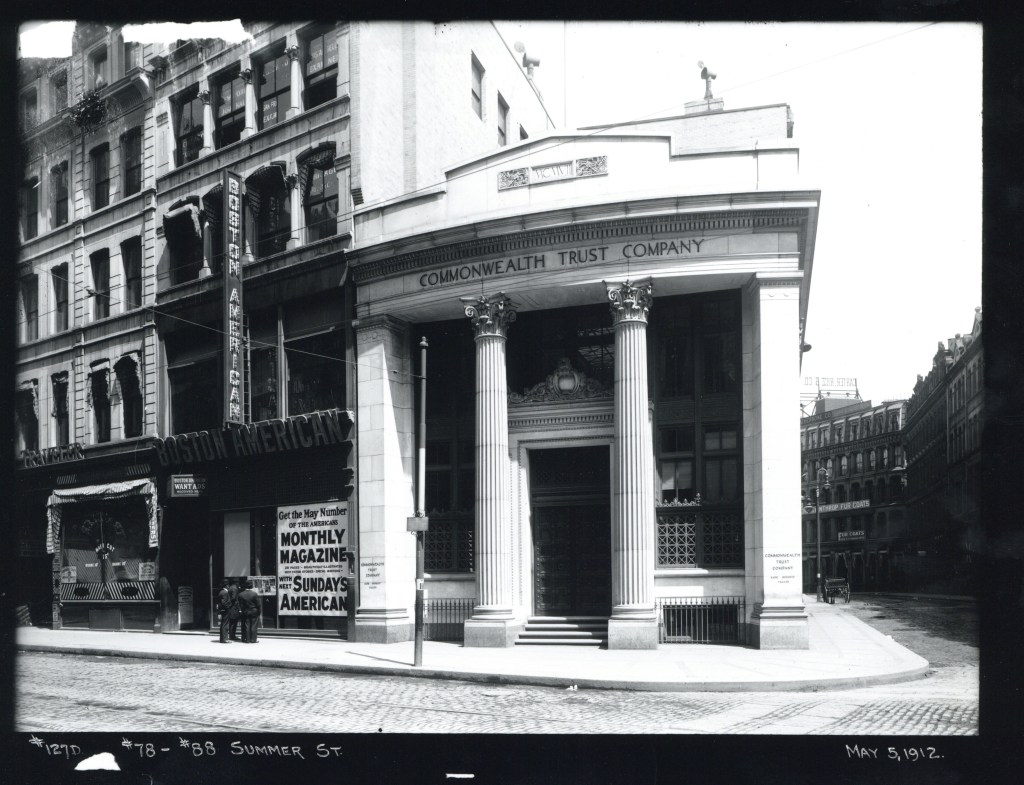
Commonwealth Trust Company // 1908-c.1974

Ca. 1910 image courtesy of Boston Public Archives.

Located at the corner of Summer and Devonshire Streets in Downtown Boston, the Commonwealth Trust Company’s two-story marble banking house commanded the corner, despite its short stature. The building, completed in 1908, was constructed with Lee marble and decorated with ornate wrought and cast-iron grilles over windows. The building was designed by the architectural firm of Parker, Thomas & Rice in the Classical mode with large, fluted Corinthian columns and boxed corner pilasters framing the recessed center entrance, Corinthian pilasters ran along the side facade. At the inside, the building was coated with Cararra and Blanco marble with paneled oak offices. At the ground floor, offices and banking stations framed the outer walls, with the safety deposit boxes located on the second floor. The building was demolished by the 1970s and replaced with a one-story minimalist Modern building (I could not figure out why the former building was razed). The new building was demolished after a few decades with a larger building, better fitting the commercial district.
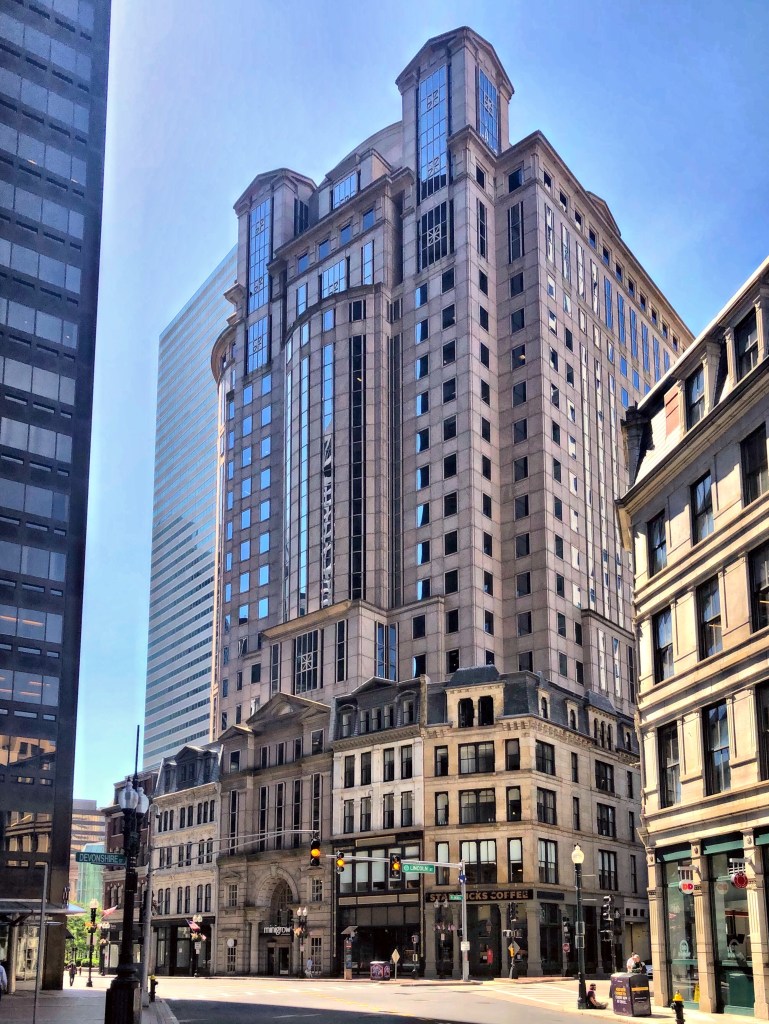
125 Summer Street // 1989

The late 1980s were a time of financial success for developers and banking companies all over the country. It seems that more skyscrapers were constructed in Boston this decade than any other of the 20th century, but working within the confines of the historic downtown of the city, left architects and developers to come up with creative ways to build here. The architectural firm of Kohn Pederson Fox was hired to construct a 20+ story office tower at the southern edge of the Financial District in Boston, while preserving the small-scale commercial buildings there. A row of four-story commercial blocks constructed after the Great Boston Fire of 1872 were retained with the tower seemingly growing out of them. The process here is known as “facadism” which is a valuable preservation tool to balance preservation with density in historic downtowns, though not always done right. This KPF design with its Post-Modern tower in concrete and granite fits well within the streetscape and maintains a walkable block downtown.

What do you think of this design?

Forest Hills Administration Building & Chapel // 1884

Located adjacent to the Entrance Gate at Forest Hills Cemetery in Boston, the Administration Building and Chapel perfectly compliments the Gothic Revival collection of structures welcoming all visitors to the cemetery. Designed by the firm of Van Brunt & Howe, the building was completed in 1884, when the cemetery’s popularity with visitors (alive and deceased) was at a high. The building is in the Gothic Revival style and is constructed of
Roxbury puddingstone, with sandstone trim on the original parts of the building and yellow freestone trim on the 1921 addition. The building remains as a perfect partner to the entrance gate, serving as a physical portal between metaphorical life and death.

Forest Hills Cemetery Bell Tower // 1876

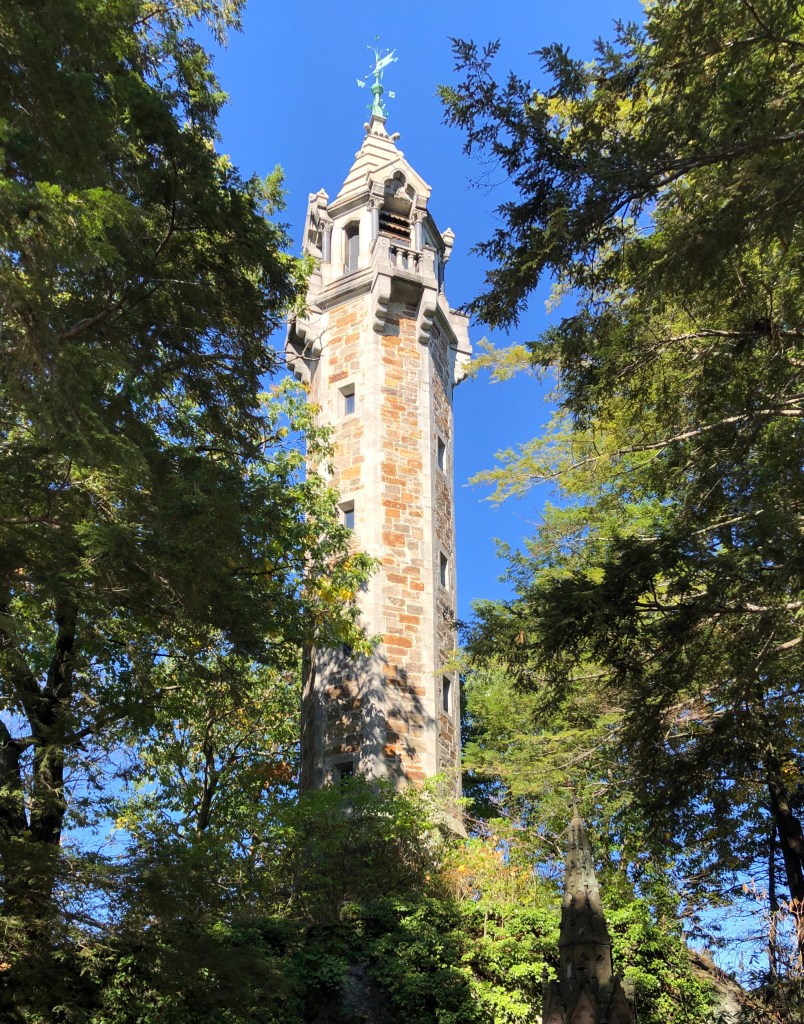
The bell tower at Forest Hills Cemetery is an octagonal Gothic revival structure located on Snowflake Hill just past the entrance gate and administration building and was completed in 1876. The 100-foot tower is constructed of Roxbury puddingstone and trimmed with granite. The roof is clad with granite tiles and topped with an ornate copper weathervane. Originally its swinging bell tolled, but it has since been replaced with an electronic carillon. The bell tower rises dramatically from massive
outcrop of Roxbury puddingstone known as Snowflake Hill which is offset by smooth lawns and Victorian planting beds. While the large trees surrounding partly obscure the tower, it truly is a stunning building.

Lewis H. Bacon House // 1892

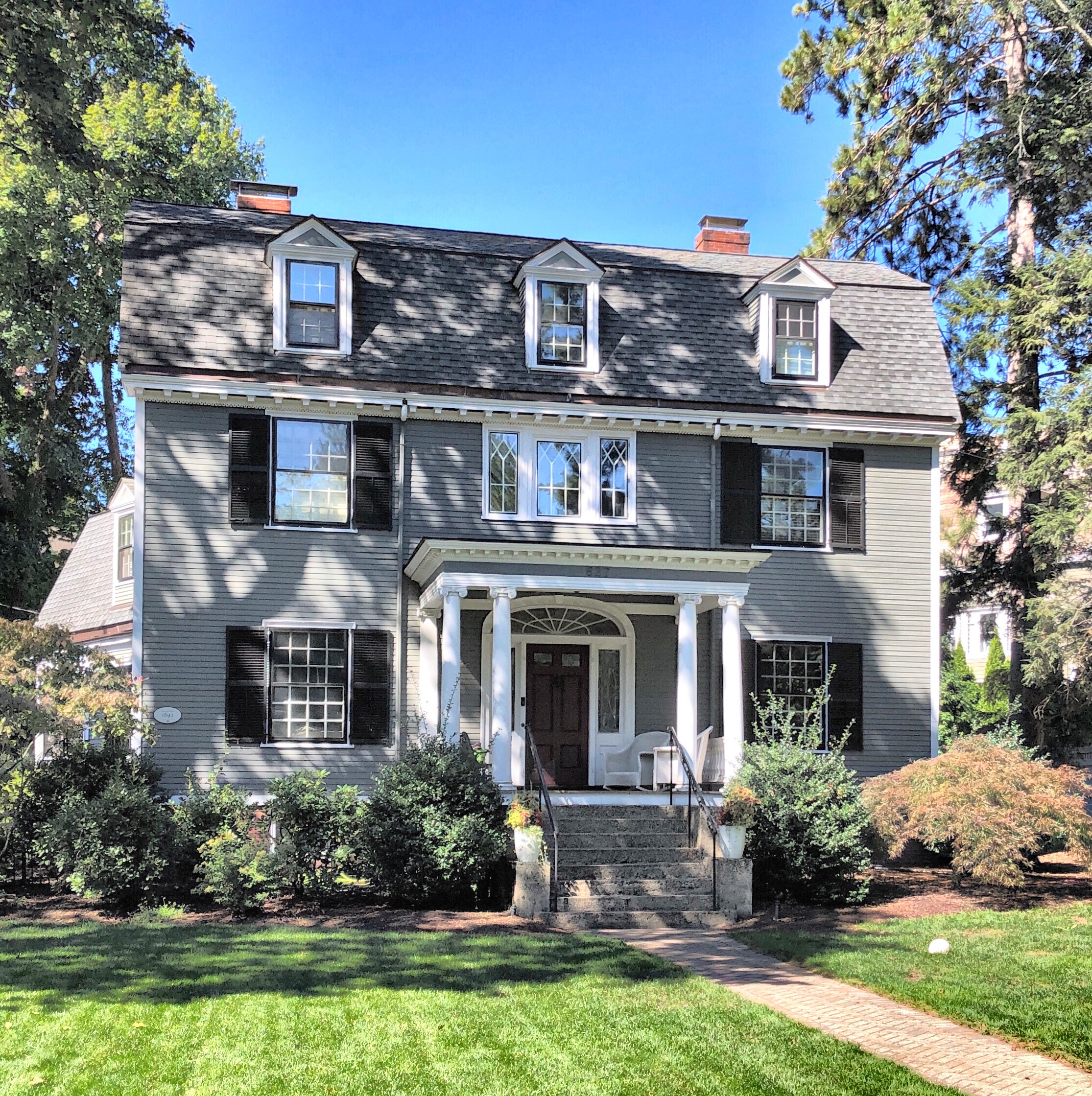
Another architect-designed home for their own use in Waban Village in Newton, is this house on Chestnut Street. Built in 1892, the Colonial Revival home is set far off the street with a commanding presence and symmetrical facade. The home was designed and occupied by Lewis Howard Bacon (1857-1941), a former chairman of the Newton board of appeals and a member of the school committee and the board of aldermen in Newton, also a practicing architect. He studied architecture in the office of Samuel Lane, architect of Cleveland, 1877-80, when he moved to Boston as a draughtsman and supervisor of construction for the firm of Sturgis & Brigham, 1880-1886. For four years he was a member of the firm of Morrison & Bacon (1888-1892), before embarking on his own practice in an office in Downtown Boston. He resided in this home until his health failed and he moved to a nursing home where he died.

William F. Goodwin House // 1888

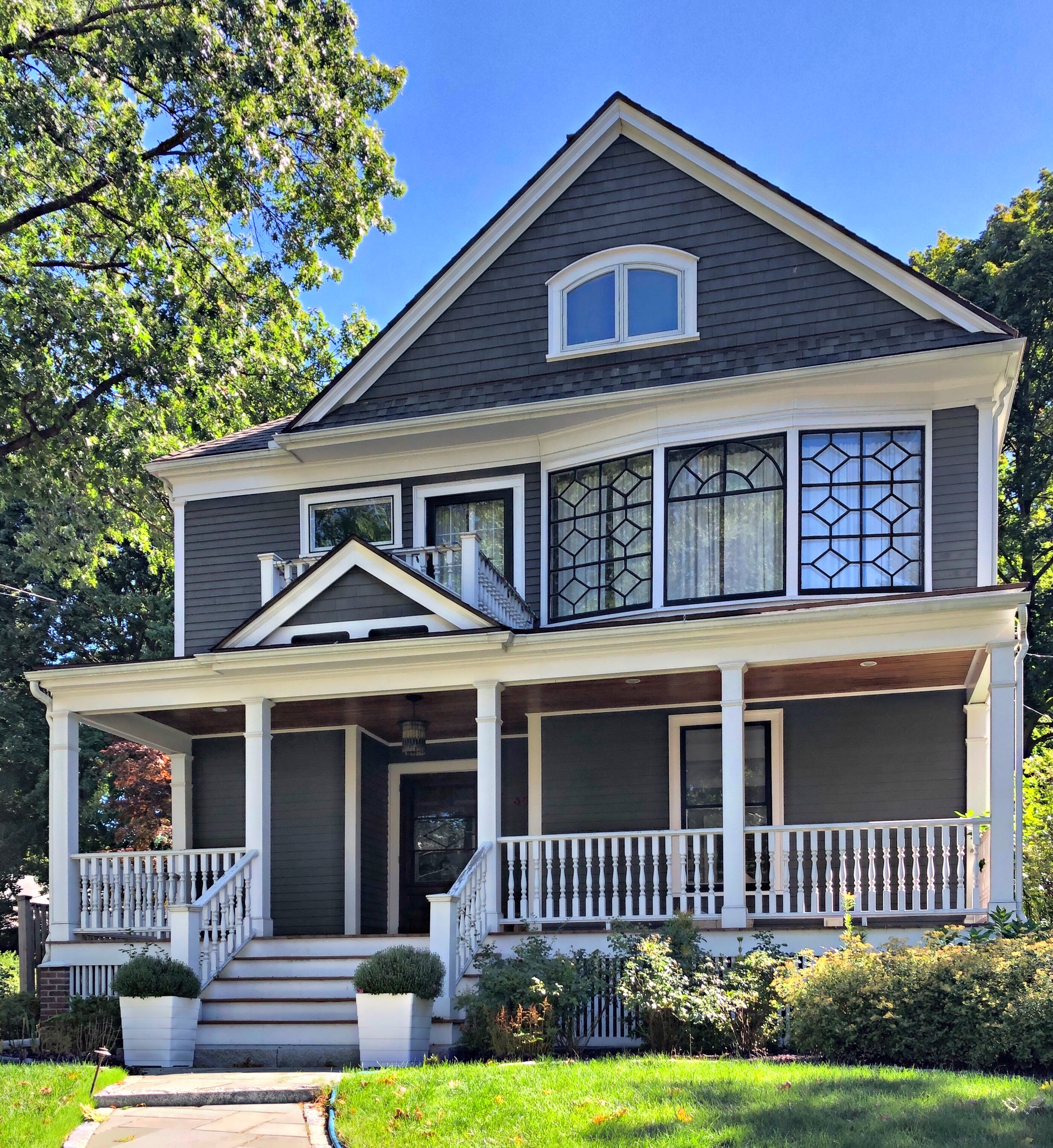
When an architect designs their own home, they typically focus on the minute details which can make such a difference, often because they know what works and what doesn’t! This home was designed and built for William F. Goodwin, an architect with an office in Downtown Boston. After the Waban Station was built in 1886, he sought open space and a large home in suburban Boston, to get away from the hustle-and-bustle of daily life. Years after he moved into his home, he gifted his services to design the neighborhood’s first church, the Church of the Good Shepherd.

Church of the Good Shepherd, Waban // 1896

For the small population living in the farming village of Waban in Newton, MA, every Sunday, they had to take a horse and carriage or walk to church in a nearby village. The Waban Christian Union was the first religious organization to be established in Waban, 1894-1895 after seeing a suburbanization of the village. The church was to be for services of the Protestant Episcopal Faith, though the group claimed no allegiance to the Diocese, nor was it organized according to the laws of the church. It was independently owned by a corporation that felt the need for a religious association in the community. This church structure was constructed in the
summer of 1896 at a cost of $5000 with William F. Goodwin, a charter member of the group (and resident nearby), donating his services as the architect. The organization leased the space to a pastor for $200 a year, later selling it to the congregation, known now as the Church of the Good Shepherd.

Hampshire House // 1911

Built in 1911 as a single-family home for Bayard and Ruth Thayer, this building on Beacon Street is one of the most visited in the city (I will get to that later). The four-story home replaced two large townhomes across from the Public Garden and was designed by New York based architect, Ogden Codman, Jr., who was born in Boston into the esteemed Codman family. Bayard Thayer died within five years of the completion of the house, and his widow, Ruth, and their children continued to occupy the massive residence into the 1930s. By 1944, the home was being used as a lodging house, a violation, and it was sold two years later to a realty company who operated apartment houses. From this time the house functioned as a residential hotel known as the Hampshire House. In 1969, Thomas Kershaw acquired the property and kept its name, which it retains today. In the same year they opened the Bull & Finch Pub in the basement, which in 1982 became famous world-wide as the locale for the bar in the television sitcom Cheers, one of the most-watched programs in television history. Pictures of the exterior of the building were used in the show’s credits and scene changes, and the interior was faithfully replicated in a set used in Hollywood. The building is now habitually swarmed by locals trying to get to drink in a piece of cultural history.

Boylston Market // 1810-1887

One of the biggest architectural losses in Boston has to be the demolition of the Boylston Market formerly at the corner of Boylston and Washington Streets. A new market house in Boston was desired by many of the city’s elite, and when John Quincy Adams (who lived on Boylston Street and was elected President of the United States 15 years later) gathered capital for the new structure it was so built. The group hired Charles Bulfinch, who at the time was THE architect of Boston, to design the new brick market. When opened to the public in 1810, the market was considered far out of town, but the neighborhood quickly developed around it with new Federal and Greek Revival homes popping up all around it, with commercial buildings soon after. The market featured stalls for the “sale of provisions” on the first and second floors, and Boylston Hall on the third floor, which featured musical and theatrical productions. The market building was sadly demolished in 1887 for a larger and more modern market of the same name. The belfry atop the former market was disassembled and given to a church in Arlington, MA, who now displays it on their own church building.

Hull Street Medical Mission // 1901

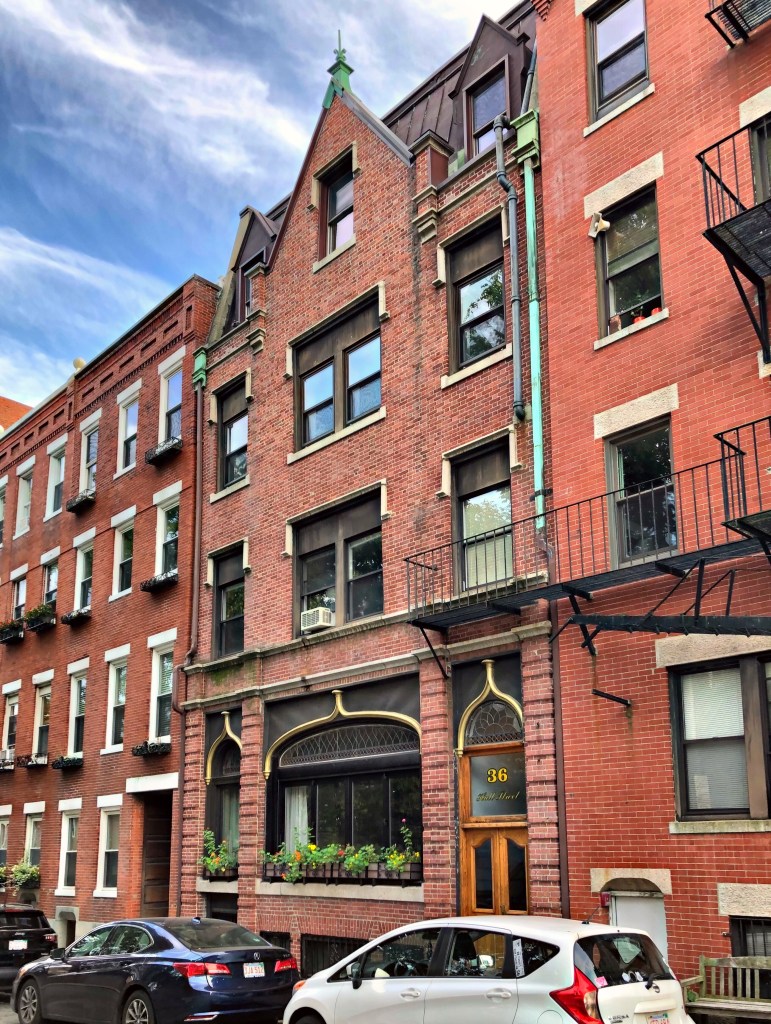
Constructed for the Woman’s Home Missionary Society of the Methodist Church of New England, this building was associated with the Hull Street Medical Mission from the time of its construction, in 1901, to about 1950. The mission was one of a number of church-related social service programs established in the North End in the late 19th and early 20th centuries to address the needs of recent immigrants, namely the Russian Jews, Italians, and Portuguese residing in this area of the neighborhood. In 1909-1910 alone, 14,574 treatments were given in the clinic, providing a huge medical service to the widely low-income immigrant community of the North End [29th Annual Report, 154]. The Medical Mission closed in the early 1950s and the property was later sold and converted to apartments. It was designed by architect Walter Forbush, who utilized ogee arches and leaded glass windows, adding much flair to the building’s design.