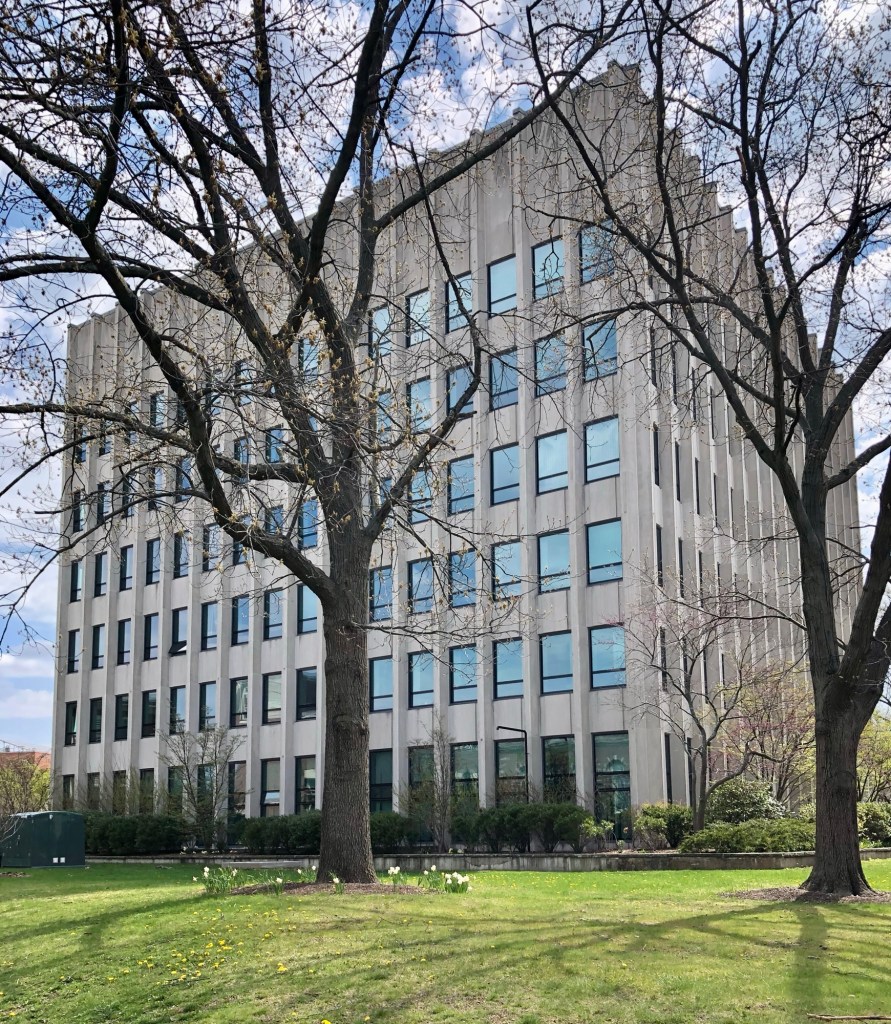
Brookline Town Hall // 1965

The modernist Brookline Town Hall building stands in stark contrast to the many historic buildings in Brookline Village, and even more-so from the town’s third Town Hall, a Victorian Gothic design by architect Samuel J. F. Thayer. Completed in 1965 as a six-story municipal “skyscraper”, the structure was designed by Anderson, Beckwith, and Haible, architects who specialized in sleek, clean, Modernist designs, primarily in office parks and college campuses. The unadorned box is broken up only by the rows of identical windows and slightly projecting fins, which break up the bays in their own monotony. Like many such municipal and office buildings of the time, the structure is set back from the street and surrounded by landscaping, with surface parking behind. While the building was lauded when it opened in 1965, tastes shifted and like in many communities, a majority of the public (and likely the employees who work here) would have preferred its predecessor.
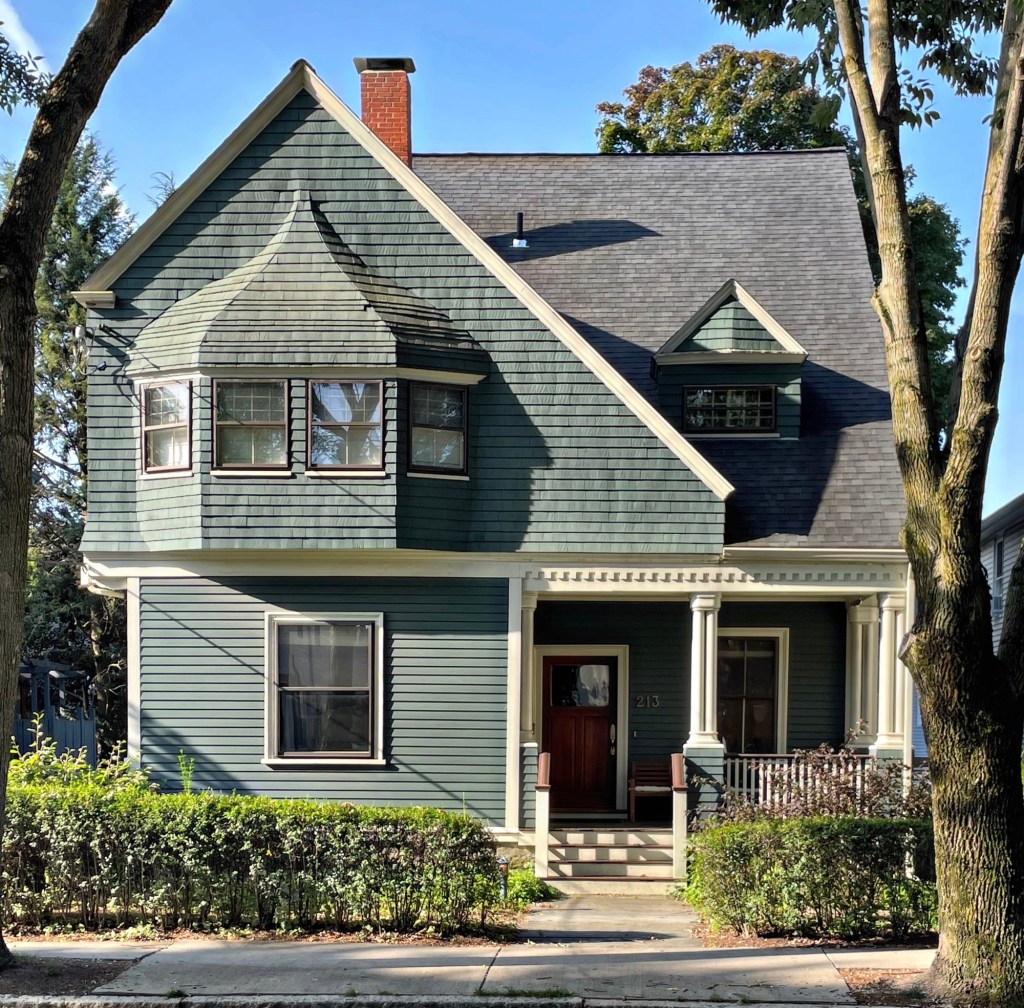
Frederick & Arabella Holden House // 1893

The Frederick & Arabella Holden House sits on Aspinwall Avenue in the Brookline Village neighborhood of Brookline, Massachusetts. Built in 1893, the excellently designed Shingle style dwelling was actually built on speculation by developers, and sold upon completion to the couple. Fred G. Holden (1858-1927) was a marble dealer who managed the Boston Marble Company and had connections in his home state, Vermont for the highest quality marble to sell around Boston, largely for building products and grave memorials. Arabella Proctor Holden (1859-1905) was born in Cavendish, Vermont, as the eldest daughter of Redfield Proctor, 37th Governor of Vermont and the founder of the Vermont Marble Company, the largest such company in the world. I could not find the architect of the house, so any more information, let me know. I’d love to solve the mystery!

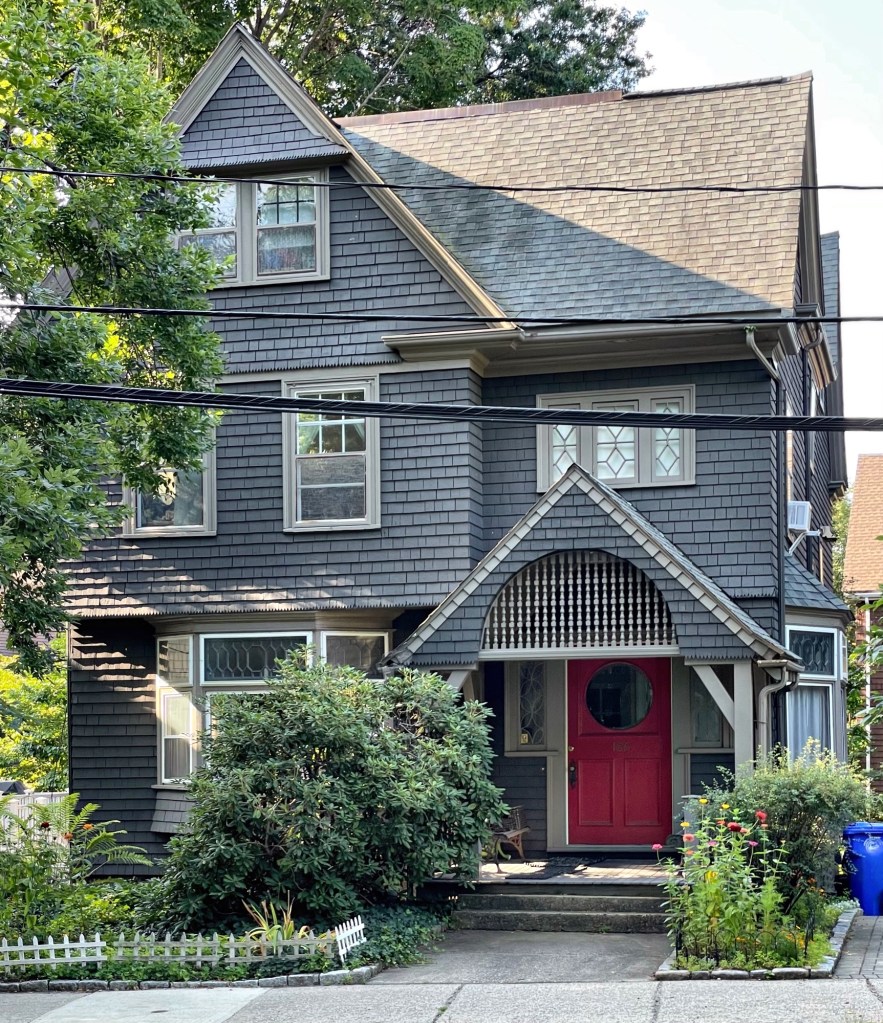
Dr. Thomas J. Shanahan House // 1892

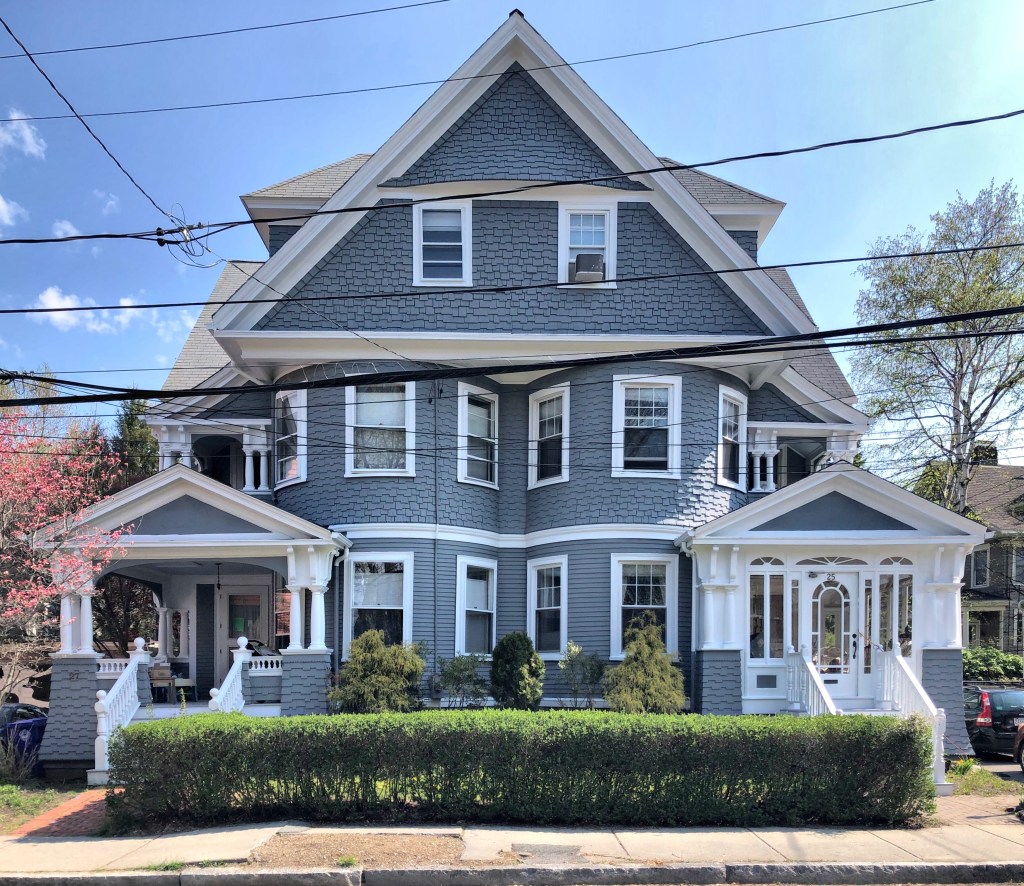
Dr. Thomas Joseph Shanahan (1873-1929) was born in Lawrence and graduated from Harvard Medical School in 1896. He practiced medicine in Brookline and Boston and was engaged in local organizations. He purchased this 1892 house on Aspinwall Avenue in Brookline in 1911, which had previously been rented to families. Two generations of Shanahans would own the house until the 1970s. After Dr. Shanahan’s death in 1929, the widowed Margaret Shanahan remained in this house with their daughter, Mary Margaret Shanahan, who was employed in 1940 as a medical secretary for a hospital. Mrs. Shanahan transferred title to the property in 1947 to her daughter, who converted the house to a two-family dwelling in 1953 for supplemental income. Architecturally, the house is Queen Anne and Shingle styles with continuous shingle siding, complex form with bays and oriels, and a unique arched opening in the gable over the entrance filled with a spindle screen. Architects were William Langley Morrison and Peter J. McEwen.

St. Paul’s Church Rectory // 1886

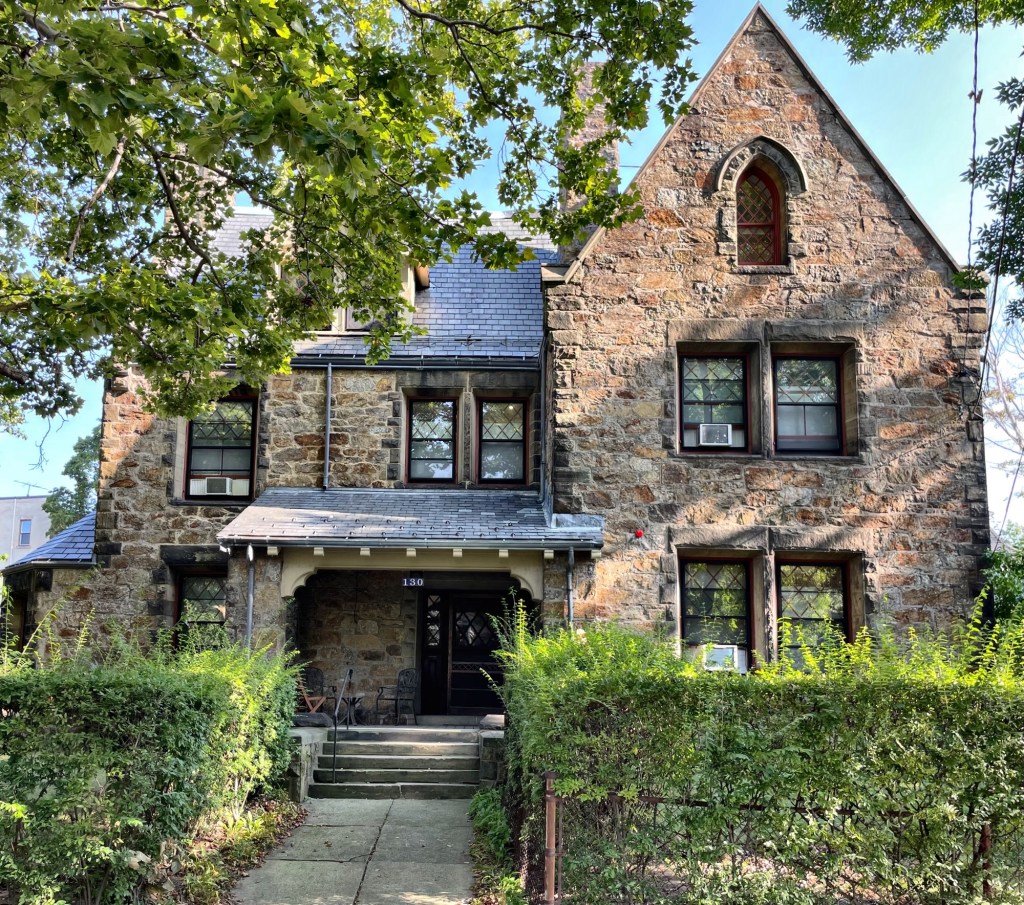
Located next door to the St. Paul’s Episcopal Church in Brookline, Massachusetts, the church’s rectory is equally stunning and compliments the 1850s Gothic church. The Rectory was built in 1886 from plans by Boston architects, Peabody & Stearns, in harmony with the architecture of the Church, with masonry walls of Brighton puddingstone with Nova Scotia freestone trimmings. The Rectory’s architectural style, is somewhat Jacobethan/Tudor due to the pitch of the roof, elbows on the parapet wall, diamond panes in the sashes of the windows, and projecting bay window on the second floor.

Levi T. Lyon Two-Family House // 1895

When Brookline Village filled in with multi-family housing in the late 19th and early 20th centuries, many speculative real estate developments sprouted up from larger residential estates. As so many were built on speculation, high-quality designs and construction were a necessity to bring in picky buyers. This two-family house was built on the corner of Brook and Toxeth streets by Levi T. Lyon, a builder and developer, who lived on Brook Street. This house was designed by F. Manton Wakefield, a relatively unknown architect who apprenticed under Shingle-style maestro William Ralph Emerson, before opening his own firm. Buildings like this are great as they provide much-needed housing, while being built of a good scale that allows residents to know their neighbors, not as easy in a high-rise.

Old Pierce School // 1855

Located in the heart of Brookline Village, the old Pierce School sits tucked away behind the Brookline Town Hall and other municipal and institutional buildings. The school was built in 1855 at a cost of $15,000 and later expanded in 1904 from plans by Julius Adolphe Schweinfurth, a prominent local architect. Julius had two brothers who also were architects:  A. C. Schweinfurth, who worked out of California and Charles F. Schweinfurth, out of Ohio. The Pierce School was named after Reverend John Pierce, noted pastor of the Walnut Street church during the mid 19th century. He and his wife, Lucy Tappan Pierce, were active leaders in the abolition movement in Brookline. The school was expanded a number of times until the 1970s, when the present Pierce Elementary School was built, in an unsympathetic Modern design that does little to enhance the busy street. As expected, the 1970s school will soon be demolished and replaced by a new, $212 million school. The old Pierce School will be incorporated into the new development.

Clements Apartment Building // c.1885

Brookline is pretty great as you can find unique and well-preserved examples of nearly every type of building in almost every architectural style! Staying in Brookline Village, this apartment building stands out as one of the best panel-brick apartments I have seen. The property was developed in the mid-1880s by Thomas W. Clements, who served in the Army during the American Civil War and later settled in the Boston area working as a dentist. Thomas married Lydia R. Clements, who is much more interesting than her husband! She was a graduate of the Boston University School of Medicine and worked locally for years, but wanted more. In the spring of 1898, she set out with a party of men and women, determined to make their fortune in the gold fields of the Klondike. During the months long trek, all of the other women and some of the men in her party left the expedition before reaching their goal, but Lydia Clements persevered and became one of the first white women — possibly the first from the East — to cross the Chilkoot Pass into the Klondike region. She never made a fortune, but upon returning, she was more spiritual, and got involved in the occult philosophy of Prof. Charles H. Mackay and his West Gate School of Philosophy in Boston. She used her new learnings to go back to Alaska to make her fortune, but there is no indication that Clements ever did make her fortune. She did however, remain in Nome and elsewhere in Alaska for more than a decade, hiring men and mining tin and gold. She retained her Brookline residence here on Davis Avenue and travelled back and forth across the continent many times before returning to Brookline, before dying there in February 1927.

Arthur Jones Double House // 1896

As Brookline Village developed in the mid-late 19th century, house lots were scarce. Demand for housing saw the demolition of a number of older 1840s Greek and Gothic Revival style cottages for multi-unit dwellings as duplexes and three-deckers which surged in popularity in the Village from the late 1890s to the 1910s when three-deckers were effectively banned in Brookline. In 1896-1897, Arthur R. Jones had large double houses built here and nextdoor, which were rented out to families. Newton architect Henry McLean designed these double houses as pairs of attached single-family dwellings separated by a brick party wall blending both Queen Anne and Colonial Revival styles under one roof. The homes show what housing was available to middle-class residents of the Boston area, a price-point that is unattainable to most in the area today. Though, it is great to see these old homes lovingly preserved so well by their owners!

Elijah Emerson Double House // 1884

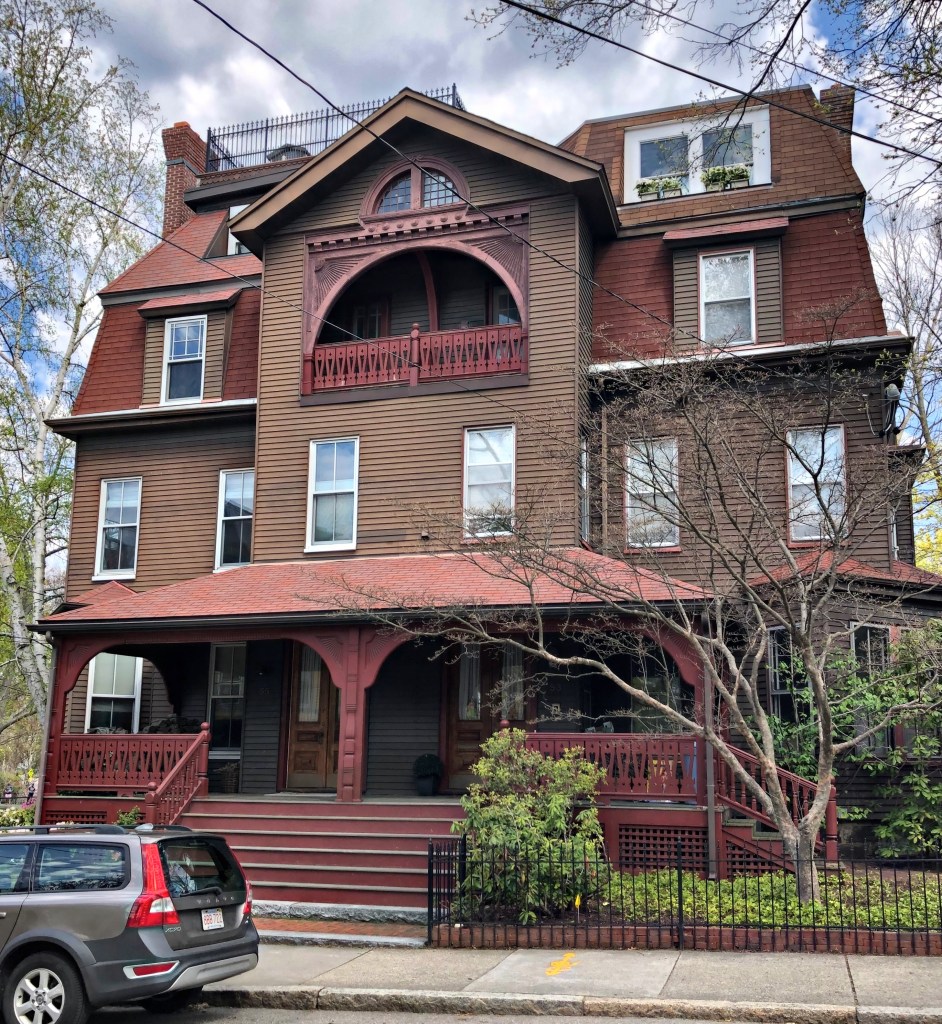
Brookline Village is full of amazing double houses (or duplexes) built in the late 19th century. Many feature Queen Anne detailing and are architecturally striking with porches, complex rooflines, and trim details. This example was built in 1884 by Elijah Emerson, who had an estate nearby. His house was originally located where the park, Emerson Garden is located, but it was moved across the street. He had this double house built and rented it out to middle-class families who flocked to the neighborhood for the ease of access to Downtown Boston, while maintaining a bucolic feel (why many still today move to Brookline). Even though it is covered in aluminum siding today, the original wood clapboards and trim likely are waiting underneath to be revealed someday. But for today, we can gawk at the original details that are visible, including the semi-circular window, recessed porch with decorative balustrade, and porch with original entry doors.

Putterham School // 1768

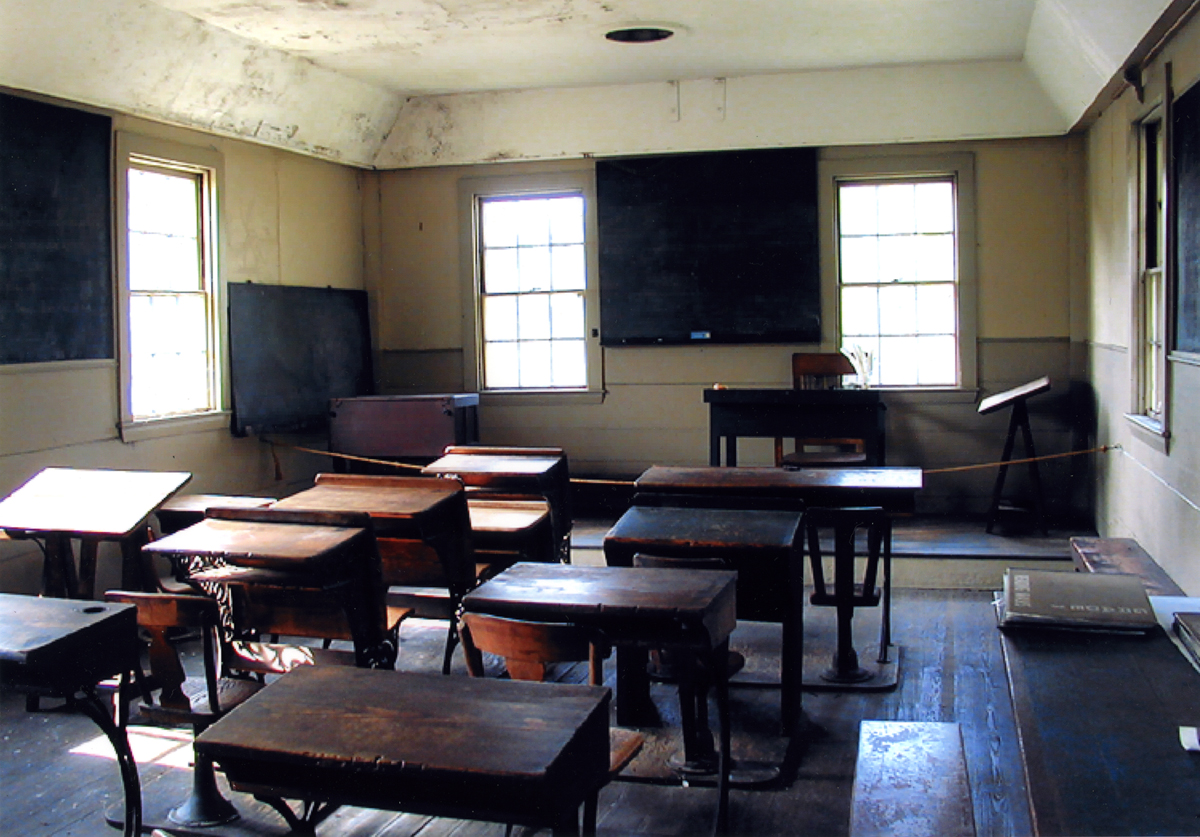
Colonial-era one-room schoolhouses once dominated the landscape of New England, providing a learning space for young children. The number of these structures have plummeted due to changing development patterns and limited funding to preserve or adaptively reuse such buildings. In the town of Brookline, this c.1768 schoolhouse has been altered frequently, showing various styles and techniques in construction used during the eighteenth, nineteenth, and twentieth centuries. The original one-room school house was enlarged in 1840 by an addition to the rear to fit additional pupils. In 1847 a shed was built for storing coal or wood and providing an entry vestibule. According to town records, in 1855 the ceiling in the schoolroom was raised, the windows enlarged, and the desks and chairs repaired. The double privy was built around 1898, probably replacing an earlier single privy. There is some evidence that in 1938 the school was used temporarily as a Catholic church and at some time following World War II as a synagogue. In 1966, the school was moved from its original site on Grove Street to its present location at Larz Anderson Park for the future preservation of the building by the town and local historical society. The schoolhouse is normally open for tours at various points during the year or by appointment.