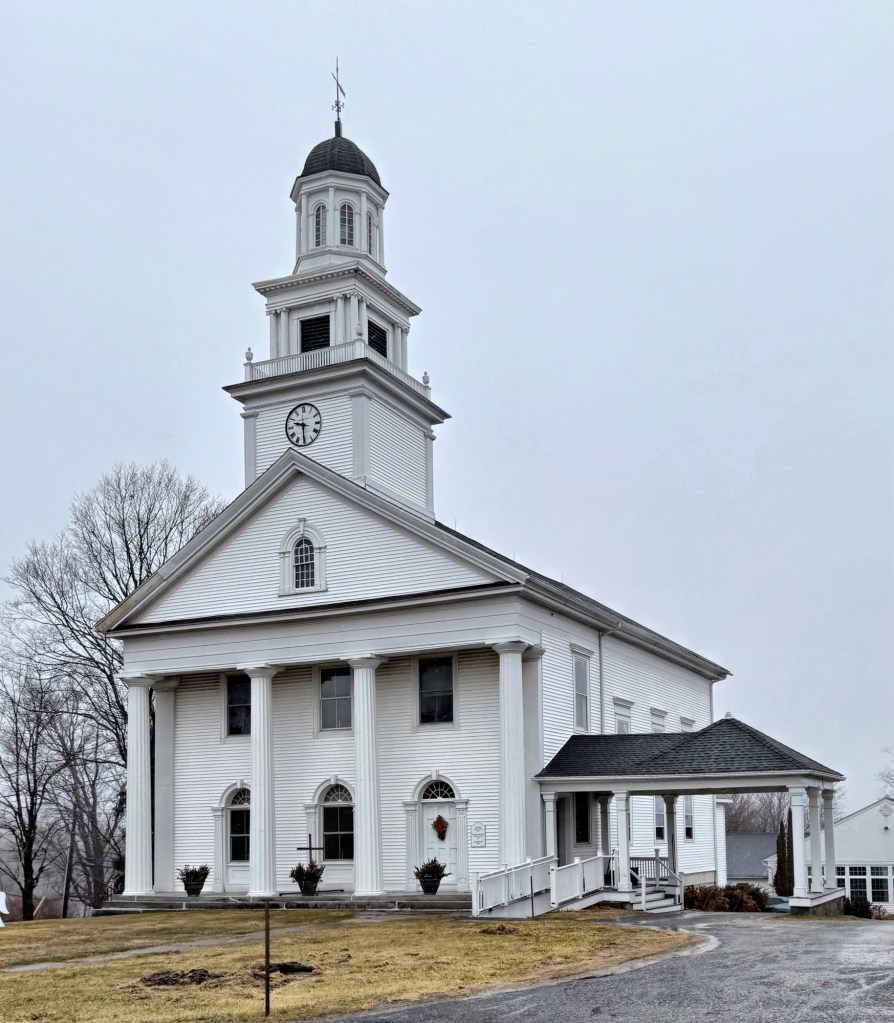
First Parish Church of Ashby // 1809

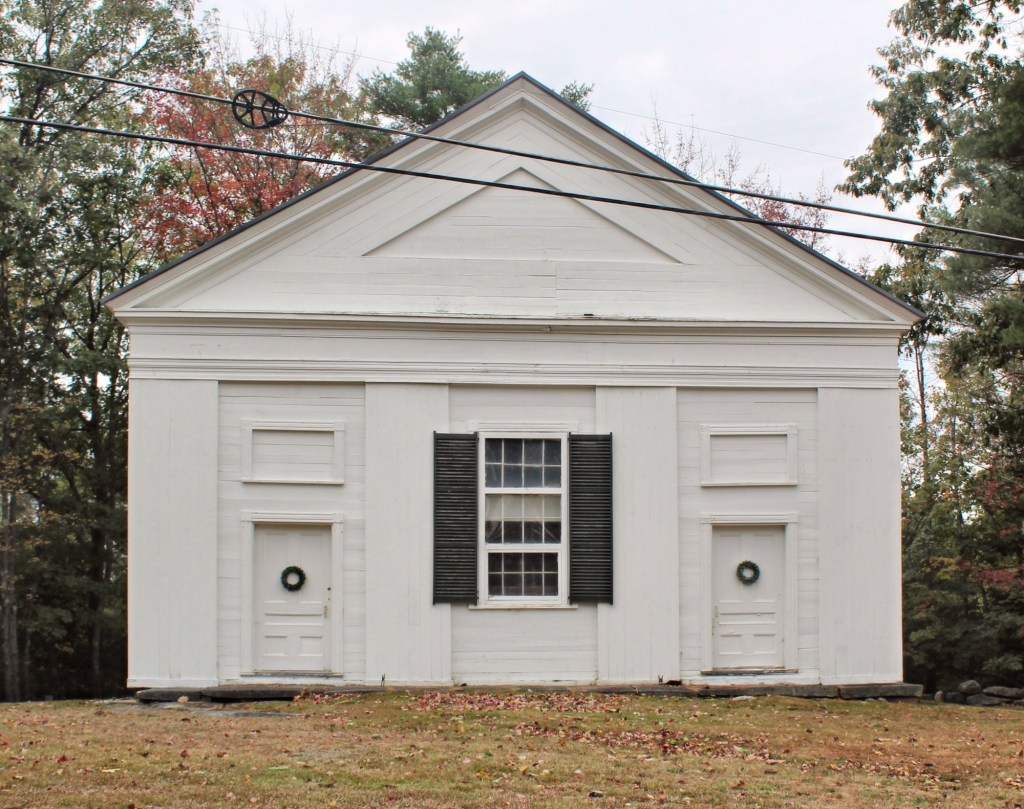
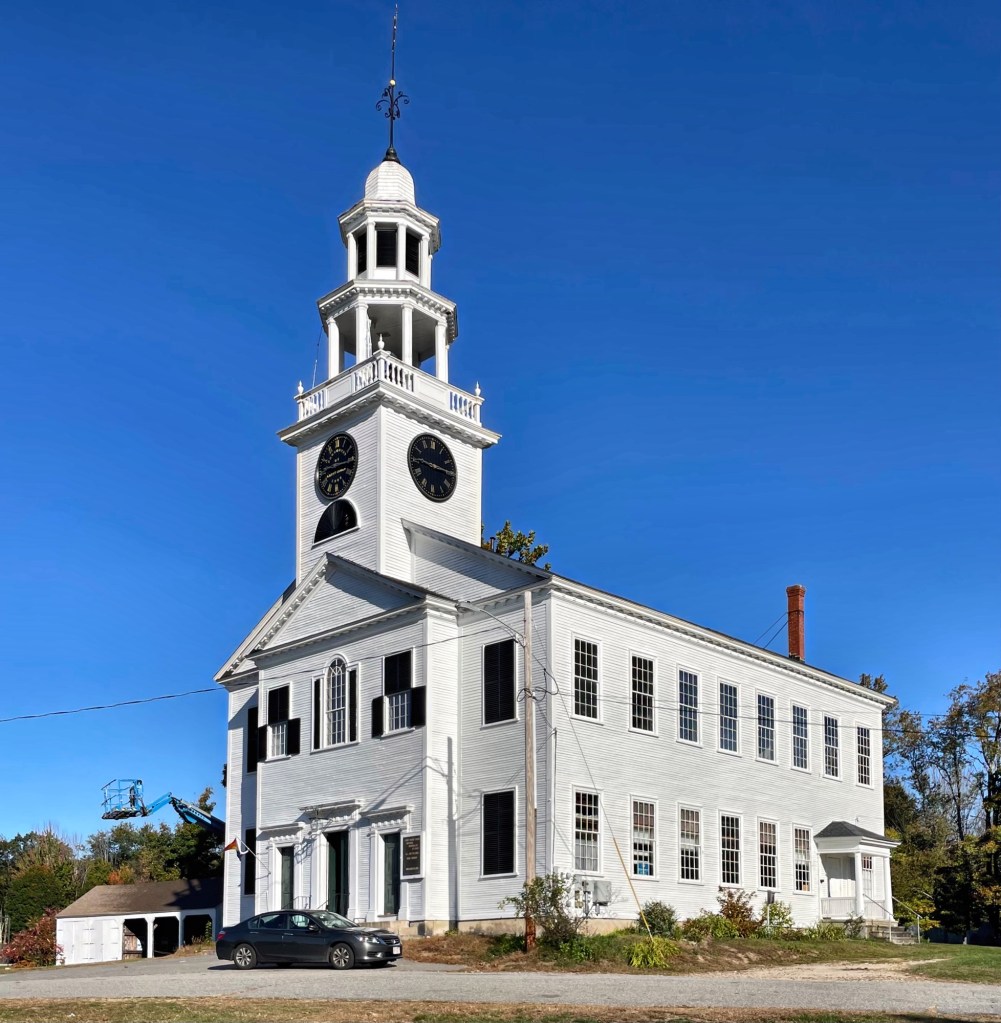
Welcome to Ashby, Massachusetts; a rural and historic town that was first settled in 1676 but due to the continued threat of native hostilities, permanent European settlement in the town did not occur until about 1750. The town incorporated in 1767 and was reputedly named for the abundance and quality of white ash trees found in the area by early settlers. Today, the town has just over 3,000 residents. At the center of the town village, the First Parish Church of Ashby stands as a significant Federal-period meetinghouse, and an integral piece of the town’s history. The present building was constructed in 1809, replacing an earlier structure from 1771. Carpenters for the building were Joseph Kendall and Darius Wellington of Ashby, who utilized plans from Asher Benjamin’s American architectural pattern book of 1797. Facing the town common, the church is a two-story gable front building with a three-stage tower including an octagonal open belfry rising from the pedimented front pavilion.

United Church of Norwood // 1886

Located across from the church-like Norwood Town Hall, the United Church of Norwood is a landmark example of the Victorian Gothic architecture style and an important historical landmark for the town. The cornerstone of this present church was laid in 1885 and was completed and consecrated by December of 1886. Boston architect J. Williams Beal, got his start at the firm of McKim, Mead & White, designed the church here for the local Universalists, who lost their previous church to fire in 1884. In 1934, the town’s Universalist and Methodist congregations merged and they joined together in this, as a Union Church. Built of Milford granite and pressed brick, the United Church of Norwood features a side chapel and clock in its steeple which are unique and add charm to the historic church.

Highgate Springs Union Church // 1877

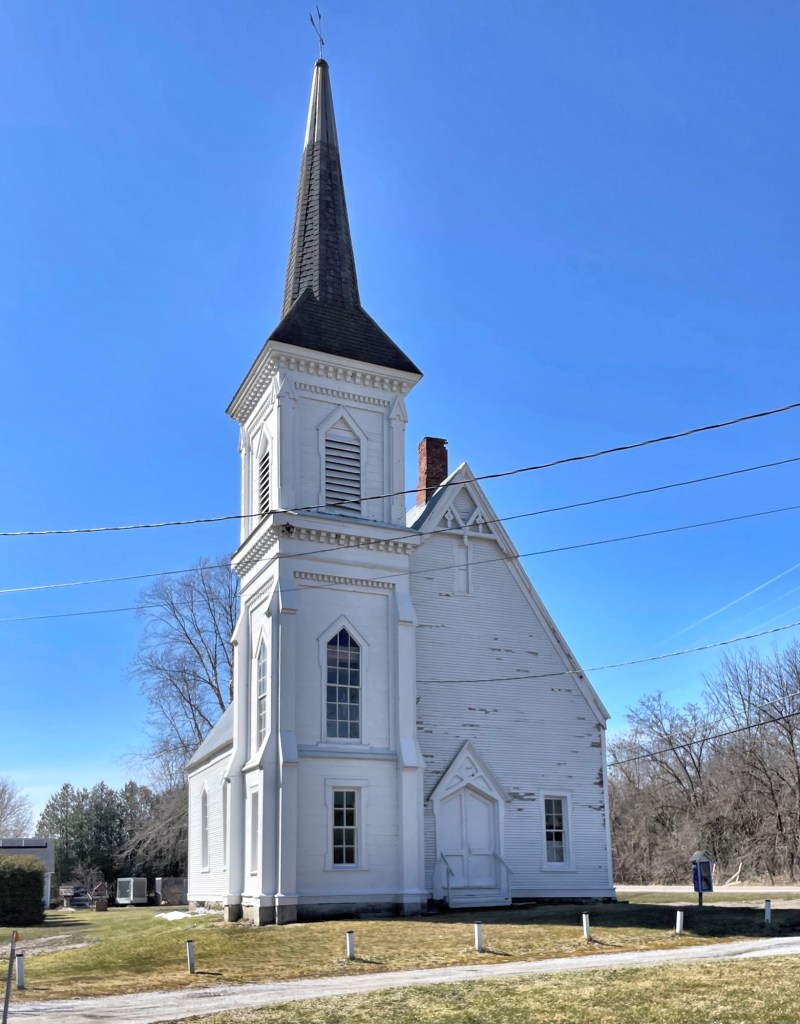
Rural parts of Vermont always surprises me with amazing old buildings. This white wood-frame church is known as the Highgate Springs Union Church, an 1877 edifice which effortlessly blends Victorian Gothic and Stick style details. The building became the village’s union church, providing a worship space for members of all denominations who on their own, could not afford the cost of building and maintaining a building. The small congregations eventually moved out and the church appears to now be largely unused beyond small events or weddings/funerals. I am glad to see it is kept up well at least!

Sacred Heart Church, Newton // 1899

Built in the Italian Renaissance Revival style by architects Rand & Taylor, the Sacred Heart Church in Newton Centre of 1899 reflects much of the lesser-known history of the affluent suburb of Boston. As Newton’s population nearly doubled between 1870 (12,800) and 1890 (24,000), many Irish Catholic residents who worked in the mills and factories of the Upper and Lower Falls areas of town began to move to the suburbs, taking jobs at households of the affluent class in Newton Centre, as cooks, maids, gardeners and more. Residents of Newton Centre wanted a Catholic Church closer to their homes and work, so they established their own congregation in 1890. As the congregation grew, it was obvious that a new church in Newton Centre would be needed to provide services there. Ground broke on the church by 1891, but it took nearly 10 years until the building was completed. Architect Bertram Taylor of the firm Rand & Taylor, and resident of Newton Centre, is credited with designing the large edifice, which is dominated by twin hipped-roof bell towers. The interior of the church has some of the most elaborate plaster work in the Boston area and stained glass windows lining the walls. Early Pastors of Sacred Heart included two who went on to important posts: Francis C. Spellman (1933-39) became Archbishop of New York; and Richard J. Cushing (1939-44) became Archbishop of Boston.

Head Tide Church // 1838

In the early 19th century, Head Tide was a bustling village within the Town of Alna, Maine, supported by mills at the dam, agriculture and apple orchards, boat building, fishing and forestry. As Head Tide grew in population, village leaders determined to build their own Congregational church so they would not have to travel the three miles to the 1789 Meeting House in Alna Center. The Head Tide Church in Alna, Maine was dedicated in November 1838 and sits on a hill overlooking the village. The Head Tide Church is a handsome rural Maine house of worship which exhibits a combination of Federal style, Greek Revival, and Gothic Revival elements in its design. The facade displays the outline of a Grecian temple front with its six pilasters and strongly accented triangular pediment. The Federal fan motif appears above the two facade windows as well as in the center of the pediment and the Gothic Revival influence is felt in the two pointed arch windows on either side of the church and in the simple pinnacle at the top of each corner of the belfry. The church is a high-style building for the rural Maine village and is kept very well by the community. The congregation disbanded, but the church remains an important part of the town and is rented for memorial services, events, weddings.

Newport Congregational Church // 1857

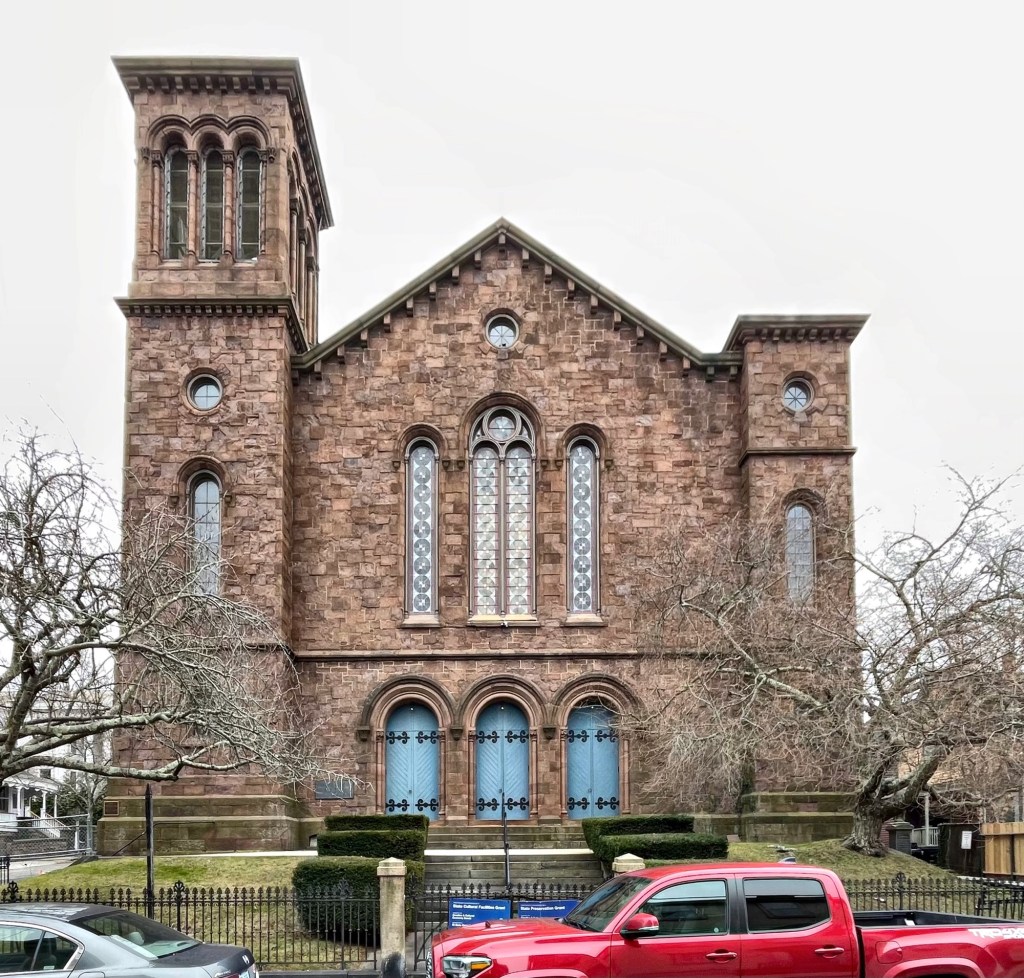
The Newport Congregational Church on Spring Street was built between 1855-1857 and serves the United First and Second Congregational parishes of Newport whose history began in the late 17th century. The building, designed by Joseph C. Wells a New York City architect, and redecorated on the interior in 1880 by John LaFarge, is an interesting and well-preserved example of the Romanesque Revival, brownstone churches of the mid 19th century. LaFarge had recently completed work on H. H. Richardson’s landmark Trinity Church, Boston, and sought to provide a more elaborate interior than he was able to in Boston. He produced twenty stained glass windows and a series of murals, which today, represent the only fully integrated ecclesiastical interior he produced. The congregation has shrunk in recent years and moved to nearby Middletown, but it’s vestry was committed to the preservation of La Farge’s work. The LaFarge Restoration Fund was established and since the 1990s, the nonprofit has spent $3 million on glass and mural restoration, architectural stabilization and systems upgrades for their former building. The building is used occasionally as an arts center.

Notre Dame Roman Catholic Church // 1875

Built in 1875, this large Gothic Revival church was built specifically to serve as a place of worship for the French Roman Catholic immigrants from Canada who began moving northern Berkshire County, Massachusetts, who were arriving to work in North Adams’ brickyards and textile factories. Before 1875, the Catholic community in the region had to make due with only occasional visits from a Vermont missionary. In 1871, Father Charles Crevier arrived in North Adams to take charge of the French flock and officially form the parish of Notre Dame du Sacre Coeur, with 750 new parishioners. Funding was acquired to purchase a property in town and erect a suitable church for the large (and growing) congregation. Architect James Murphy, a relatively unknown architect who specialized in ecclesiastical designs, furnished the plans for the church. After loss of industry and a declining population, the church closed in 2005, and the property was sold to the city of North Adams in 2008. The city faced repairing the church building as recently as 2016 with about half of the $100,000 budget coming from the city directly. Its future is unknown, but the town hoped to sell it for a renovation into a hotel or other use to activate the downtown area.

Middlebury Congregational Church // 1935

Located next door to the Middlebury Town Hall, the Middlebury Congregational Church has a very similar history to its Classically inspired counterpart. The congregational church here was established in 1791, less than a year after a separate Middlebury ecclesiastical society was granted and the first church here was erected in 1794. Decades later, a more traditional and larger church was desired by the congregation, so they had a Greek Revival style church built in 1839. Nearly 100 years later, the church (and adjacent original town hall building) burned in a large fire in April 1935. Undeterred, the congregation hired architect Elbert G. Richmond, AIA (1886-1965), who as a young man worked in the New Haven office of J. Frederick Kelly, Connecticut’s first and most famous restoration architect. The present building is a near-replica of the mid-19th century church building, and even has a bell that was recast from pieces of the old bell that crashed through the building during the earlier fire. Talk about rebirth!

First Baptist Church of Stoneham // 1892

In 1891, the Baptist Society of Stoneham, Massachusetts unveiled that it had acquired funding and approved the plans for its first purpose-built church building in town. The organization met in a shared chapel in town since its founding in 1870. The new church would be unique in the Boston suburb as the only in town to be of the Queen Anne/Shingle style. A prominent site on South Main Street was acquired and work began in 1892 to erect the new house of worship. The design of the church is credited to the firm of L.B. Volk & Sons, a firm who specialized in church buildings with commissions all over the country. The church is complex in plan and combines brick and shingle siding in its construction with a prominent two-story tower with rounded corners and stained glass rondels (round windows).

Beth Eden Chapel // 1900

Almost at the southern, most remote tip of the Blue Hill Peninsula in Brooklin, Maine, I was stunned to come across this enchanting chapel. Completed in 1900, the Beth Eden Chapel is a small wooden frame building that appears to have been the first religious facility erected in the Naskeag area of Brooklin. Although it was erected by the Methodist Episcopal Church of Brooklin, the building was dedicated to the use of all Christian sects who wished to worship in the more remote section of town. Interestingly, the vernacular church employs some late 19th-century detail including the shingled flared siding and triangular motif. The chapel appears to remain open for summer months.