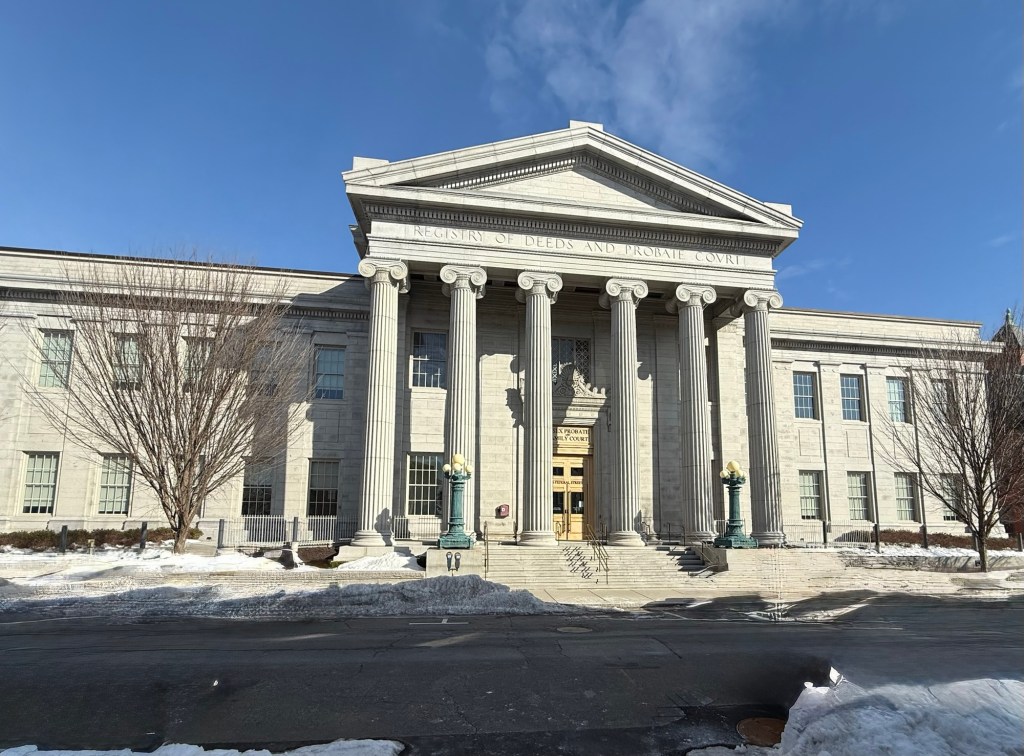
Essex County Registry of Deeds // 1909

The Essex County Registry of Deeds and Probate Courthouse on Federal Street in Salem, Massachusetts, was built in 1909 from plans by Boston architect, Clarence Blackall. The Neo-Classical courthouse adds to the rich tapestry of Civic buildings there, showcasing the ever-evolving tastes in architecture as the buildings become more contemporary as you move westward down the street. The two-story granite and cast-stone faced brick masonry building is cross-shaped in plan, consisting of a three-bay wide gable-end entrance with Ionic porch of six fluted columns supporting a dentilled entablature and pediment. The central bay within the entry porch contains a large double-door entrance with elaborate architrave and a scrolling pediment incorporating Classical motifs and a Greek god bust. The building underwent a massive restoration in 2017, and was renamed the Thaddeus Buczko Building after retired First Justice Thaddeus M. Buczko.

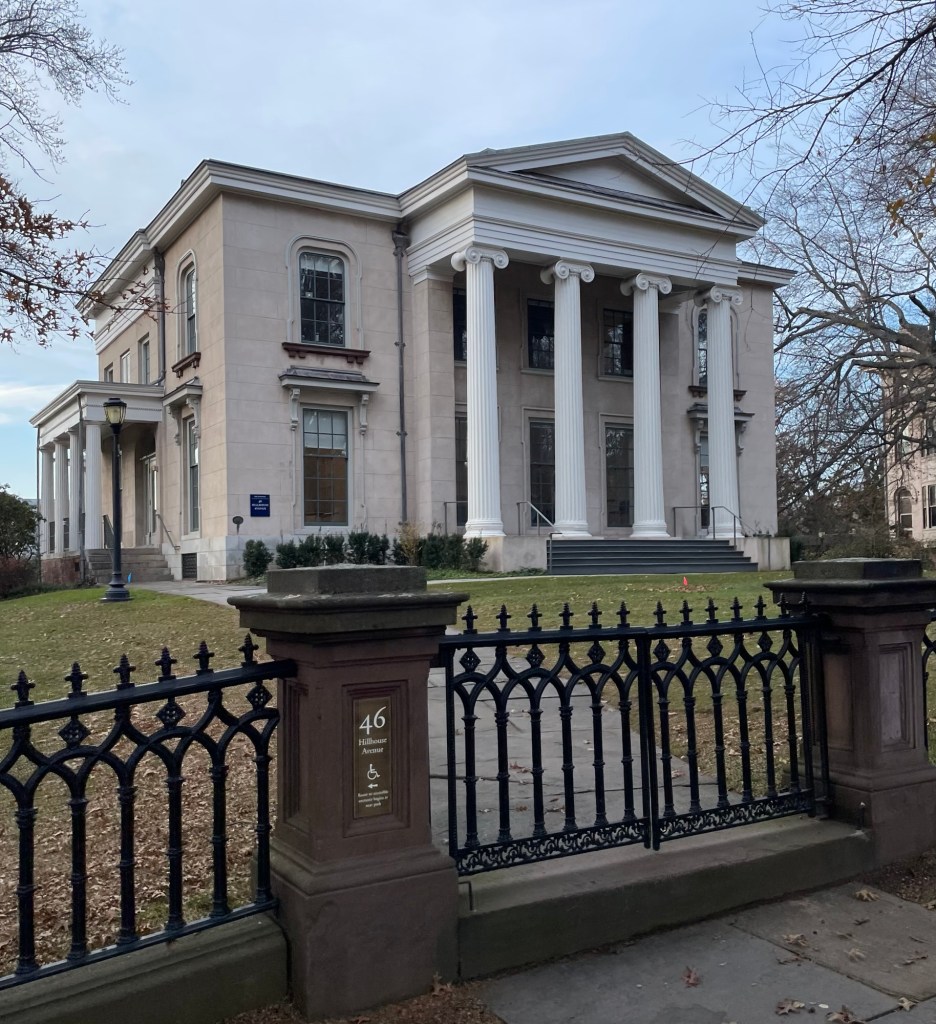
Skinner-Boardman Mansion // 1832

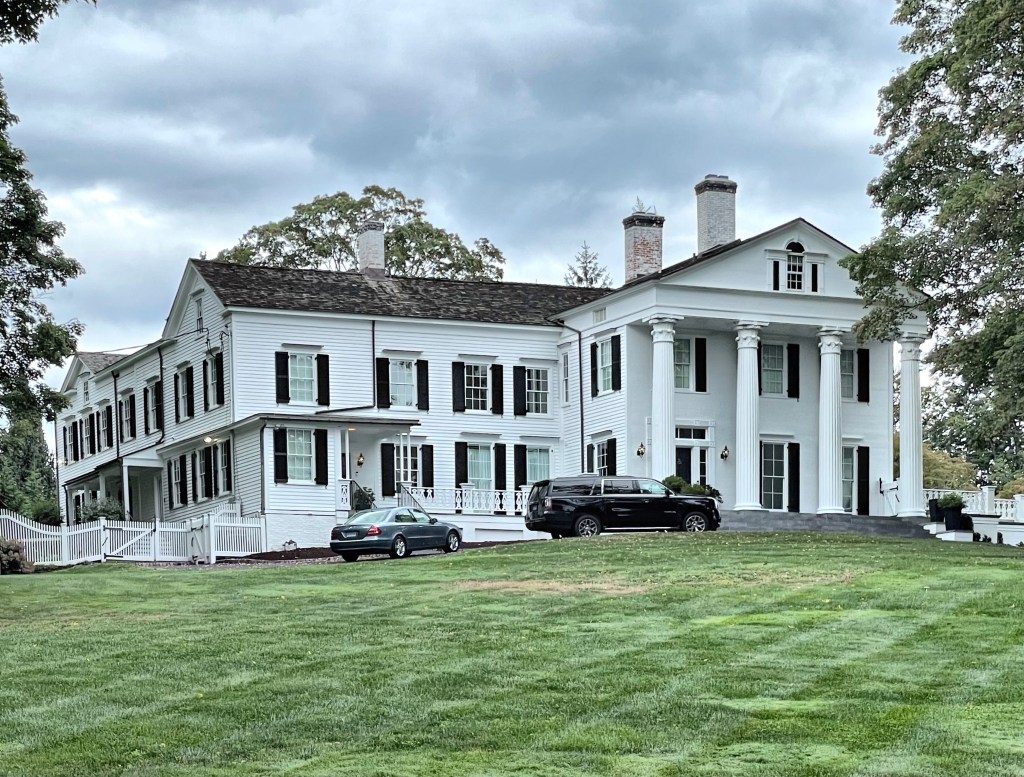
One of the finest houses in New Haven is this stately residence, the Aaron Skinner Mansion on Hillhouse Avenue. The mansion was built in 1832 for Aaron Nichols Skinner (1800-1858) from plans by architect Alexander Jackson Davis. Skinner was a Mayor of New Haven (1850-1854), and for a short time, ran a boy’s boarding school out of this house. Skinner was also a CT State Representative, serving two terms. The house was originally built as a three-bay, two-story house with one-story side wings and a rear ell. After his death, the house was purchased by Judge William W. Boardman, who in 1859, modernized the property hiring architect, Henry Austin, who filled in the side wings and added Italianate window mouldings. The monumental portico supported by fluted, Ionic columns, creates such a stately presence for the early house on the street. In the early 20th century, the mansion was owned by Rutherford Trowbridge, who renovated the house for his own use. The house remained in the Trowbridge family until the death of his last daughter, Miss C. Rachel Trowbridge, when the estate became the property of Yale University.

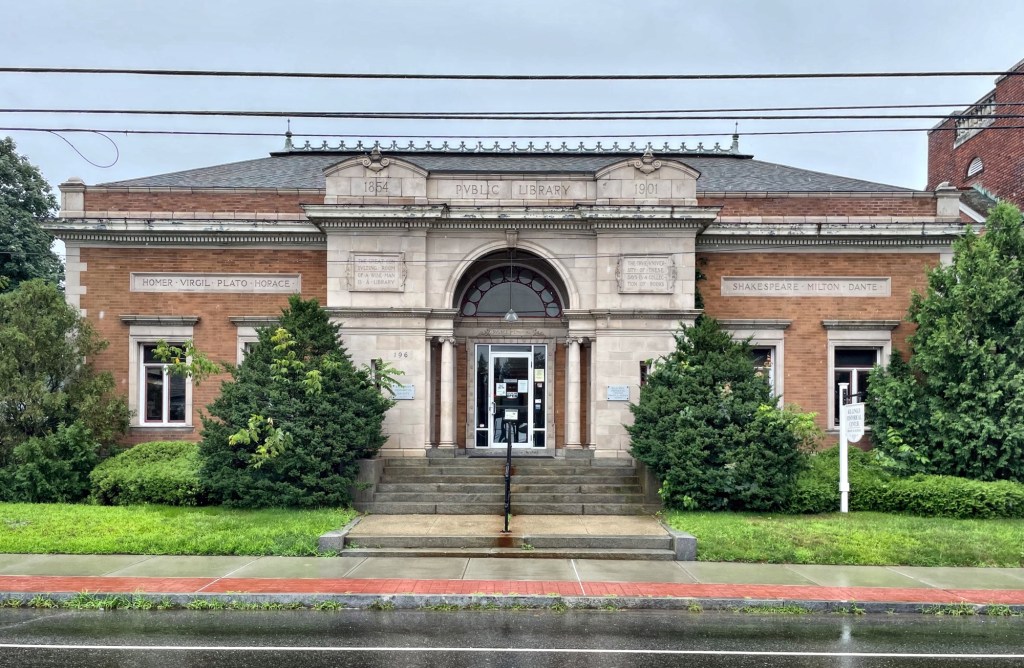
Bugbee Memorial Library // 1901

The Bugbee Memorial Library sits on Main Street in Danielson, the main village in the town of Killingly, Connecticut. The library was built in 1901 and financed by a bequest from Edwin Holmes Bugbee, who made his fortune at local mills. When Bugbee died in 1900, his estate left his entire collection of books along with funds for a new library for Danielson. Boston architect Walter Jefferson Paine designed the library building in the Classical Revival style with buff brick and stone construction. The names of Homer, Virgil, Plato and Horace, along with Shakespeare, Milton and Dante, are boldly emblazoned across the facade denoting the building as a house of learning. The library was outgrown, and a new library was built nearby in 1994. The old Bugbee Memorial Library has since been occupied by the Killingly Historical Society.

Dillingham House // c.1845

This perfect Greek Revival cape house sits on Pascal Avenue, the main street that cuts through the center of Rockport, Maine. The house dates to the 1840s or early 1850s and was owned by the Dillingham Family for a few generations. The original owner may have been Josiah Dillingham (1796-1861), a mariner and sea captain. Josiah died in 1861, and the property was inherited by his eldest son, Josiah Winslow Dillingham (1829-1895) who went by Winslow, seemingly to differentiate himself from his father of the same name and same profession. The Dillingham family home is a quintessential Greek Revival cape with central portico with Ionic columns and corner pilasters with full length entablature at the facade. In true Maine fashion, the side elevations are covered in weathered shingle siding.

Warren Industrial Trust Building // 1906

This monumental Georgian Revival bank building sits on Main Street in Warren, Rhode Island, and is one of the finest buildings of the style in the entire state. The Warren Industrial Trust in 1906 hired Edmund R. Willson of the Providence architectural firm of Stone, Carpenter & Willson to design the bank for the town after it had absorbed the town’s multiple banks, under one roof. Four Corinthian columns support a robust pediment over the entrance with the red brick elevations enlivened with arched windows, oversized keystones, and pilasters with contrasting capitals and bases. The building shows that Colonial Revival architecture, while often seen as a refined, classical style, can be festive and ornate.

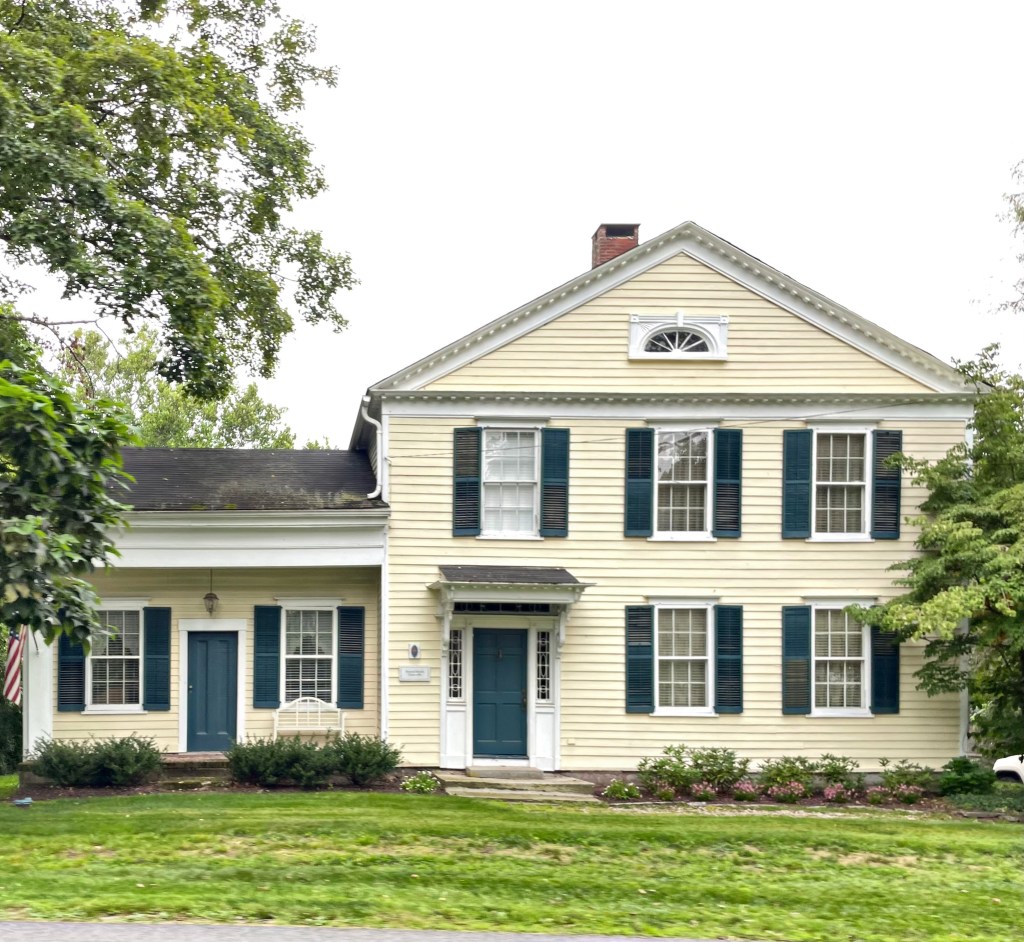
Smith-Pierce House // c.1829

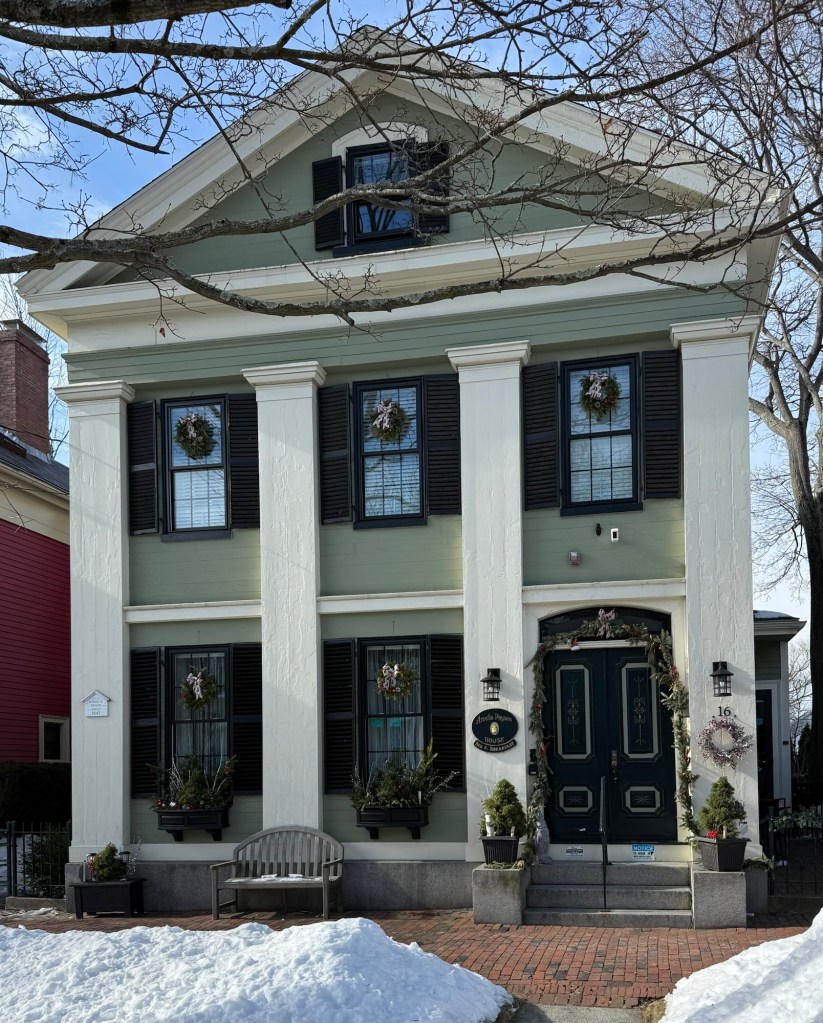
This transitional Federal-Greek Revival style house sits on the main street in South Britain, Southbury, Connecticut. The based on the style, the house was likely built around 1829 for Samuel Smith (1804-1856) who married Caroline Curtiss that year. Federal elements include the entry at the gable end, a pedimented facade embellished with modillions, and a doorway with sidelights and a leaded transom. Some moldings, the six-over-six windows and the simplicity of design are Greek Revival. It is one of the best preserved old houses in this part of Southbury.

William W. Wakeman Mansion // c.1833

William Webb Wakeman was born in Southport, Connecticut on June 19, 1799, the son of Jesup Wakeman, an eminent citizen of the community. As a young man, William worked with his father in his commercial and trade enterprises. He acquired his own vessel early in his career, and gradually accumulated a line of trade vessels, sailing to New York, Savannah, Georgia and Galveston, Texas. By mid-century he was involved in the East Indian and China trade under the firm name of Wakeman, Dimon & Co. He built and owned a line of steamships during the late 50s, and was commissioned by the Federal government during the Civil War to transport troops and equipment. His massive Greek Revival mansion was built around 1833 on one of the largest house lots in the village, perched high on a hill overlooking the harbor. The three-bayed facade is framed by a two-story portico. Supported by four fluted columns, the capitals and entablature are similar to the “composed” order of Minard Lafever and the “composite” order of Asher Benjamin, popularized in the 1830s and 40s in their pattern books for architects and builders. After William died in 1869, it was likely his widow, Mary Catherine (who lived to be 99 years old, outliving all of her six children) who enlarged the home with massive two-story ells.

Litchfield Old Town Hall // 1851

The town of Litchfield, New Hampshire is located at the southern section of the state across the Merrimack River from the town that carries its name. Land which is now known as Litchfield, was once populated by the Abenaki people. The New Hampshire Archaeological Society has located over 30 Native American sites along the shore of the Merrimack River in Litchfield, with artifacts several thousands of years old being uncovered. European influences started in the 1650’s with early records showing that Litchfield was then a part of Dunstable, Massachusetts. Both sides of the Merrimack River were granted in 1656, to William Brenton, colonial governor of Rhode Island. The name was changed to “Brenton’s Farm” in 1729. Chief Passaconaway of the Penacook lived in a Litchfield settlement at least part of the year around this era. In 1728, sixteen proprietors divided up the Brenton Farm Land. In 1749, the land was granted to another group of settlers and named “Litchfield” after George Henry Lee, Earl of Lichfield. The town has historically been comprised of farmland without a true town common or center. A small enclave of buildings did center in town, where the town hall was built. This building, the Old Town Hall of Litchfield, was built in 1851 from parts of an older meetinghouse, which was built across the road from where the building now stands. A shift in the course of the Merrimack River during the early 1800s forced the dismantling of the original Meeting House and a new structure to be built. It is a modest Greek Revival structure with corner pilasters, entablature, and gable end facing the street which reads as a pediment. It is very well maintained to this day as the home to the Litchfield Historical Society.

Robert Palmer Jr. House // 1907

Robert Palmer Jr. (1856-1914) was born in Groton, Connecticut as the son of Robert Sr., a prominent businessman and Deacon in Noank’s seaside village (his house was featured previously). Robert Sr. established the Palmer shipyard, which became the largest business enterprise in Noank. Jr. would later join his father’s business and did well for himself financially, eventually marrying and building this Neo-Classical mansion on Church Street in town. The company, under Sr. and Jr.’s leadership, built many seafaring vessels that were internationally renowned until the company closed in 1914 after the death of Robert Jr. This house is unique in town for the monumental two-story portico, Palladian windows at the first floor, and a projecting entry vestibule.

First Church of Christ Scientist, Providence // 1906

One of the most stunning and monumental buildings in Providence is this building, a church which pretty closely resembles the Rhode Island State House! Christian Scientists in Providence began to hold informal services in 1889 and received a charter from the state legislature in 1895. Construction started on this church, the First Church of Christ, Scientist in 1906 from plans by local architect Howard Hoppin who roughly modeled the building after the congregation’s Mother Church in Boston. The Classical Revival building is capped by a copper hemispherical dome supported by a colonnade of Corinthian columns. The main block of the structure at the street is fairly modest, possibly due to the residential character of its surroundings.