William G. Low House // 1887-1962

One of the many significant losses to American architecture is the demolition of the Low House, a perfect encapsulation of the Shingle style of architecture by one of the most prolific designers in American history. The William G. Low House was constructed at the southern tip of Bristol, Rhode Island by esteemed architect Charles Follen McKim (my personal favorite) of the firm McKim, Mead & White. The Shingle style, which took off in the Northeast United States, primarily in seaside communities in the late 20th century, the homes of the style often had a strong horizontal emphasis. The style contrasts the other Victorian-era styles, de-emphasizing applied decoration and detailing in favor of complex shapes wrapped in cedar shingles. The Low House, formerly located on Low Lane, stood out for its 140-foot long gable which appeared to protrude right from the hilly outlook. The home was demolished in 1962, but was documented by the Historic American Buildings Survey program, which documented the home inside and out before it was a pile of rubble. Architectural historian Leland Roth later wrote, “Although little known in its own time, the Low House has come to represent the high mark of the Shingle Style”.

“Hey Bonnie Hall” // 1808-1944

Formerly located on the Poppasquash Peninsula in Bristol, Rhode Island, the William DeWolfe House, also known as Hey Bonnie Hall, was constructed in 1808 for William DeWolf (1762-1829) and his wife Charlotte Finney (1764-1829). William DeWolf was a member of the infamous DeWolf Family of Rhode Island, which is believed to have transported tens of thousands of enslaved people to the United States and Caribbean before the African slave trade was banned in Rhode Island. The Ocean State played a leading role in the transatlantic slave trade. Not only did Rhode Islanders have slaves—they had more per capita than any other New England state. The beauty of Hey Bonnie Hall, and its melodic name hid the dirty money with which it was built. With his extreme wealth, William hired Providence architect Russell Warren to construct the home in a high form of the Federal style. Eventually, the home was willed to Anna DeWolf, who married Nathaniel Russell Middleton, from a slave-owning family in Charleston, South Carolina (birds of a feather…). It was Anna Middleton who gave the house its curious name of “Hey Bonnie Hall”. When she was younger, she used to sing an old Scottish song called “Hey The Bonny Breast Knots” over and over again to delight her grandfather, William, the first owner of this home. After Anna’s death, the home was willed to her two unmarried daughters. The Great Atlantic Hurricane of 1944 proved fatal for the grand estate, when the front portico was ripped off the home and flew away. The damage was deemed too expensive to repair and the home was demolished that year.

Goddard Mansion // 1859-1981

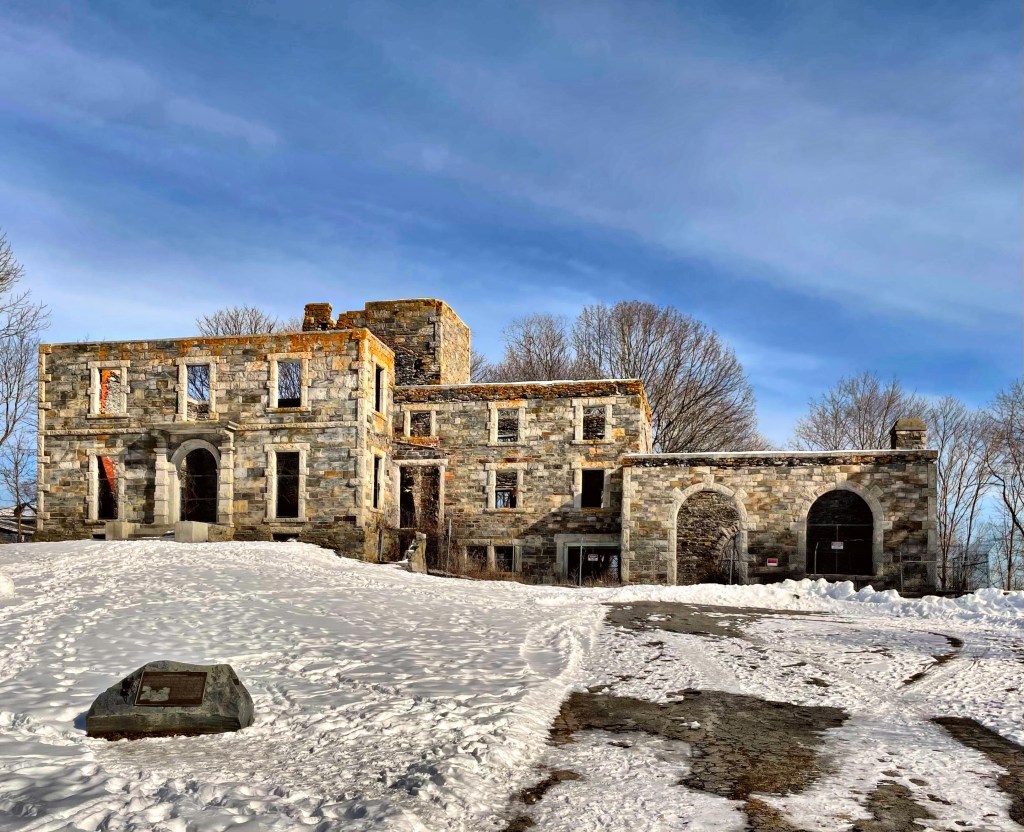
This shell of a former mansion was built in 1859 for Colonel John Goddard (1811-1870), a Civil War Union Army Officer. Goddard was a “lumberman” who amassed substantial wealth before the outbreak of the Civil War, and he hired architect Charles A. Alexander, to design an estate house for him and his family. The home appears to have been constructed of local stone with white granite trim and featured a prominent tower, emulating an Italian Villa. The home was purchased in 1898 by Judge Joseph W. Symonds, who presided over the Maine Supreme Judicial Court. Just two years later in 1900, during the expansion of Fort Williams, the estate was acquired by the Federal government. The home was used for housing married enlisted men and their families while stationed at Fort Williams. The basement was converted into the fort’s Non-Commissioned Officers’ Club. At the time of the town’s purchase of the Fort in 1964, the mansion was already in serious disrepair and its future was uncertain. People routinely broke in and damaged the interior, which suffered numerous small fires over the years, until the town decided in 1981 to hold a controlled burn of the home, leaving the shell. The shell remains a significant architectural landmark and a massive opportunity for the town.

Paragon Park // 1905-1984

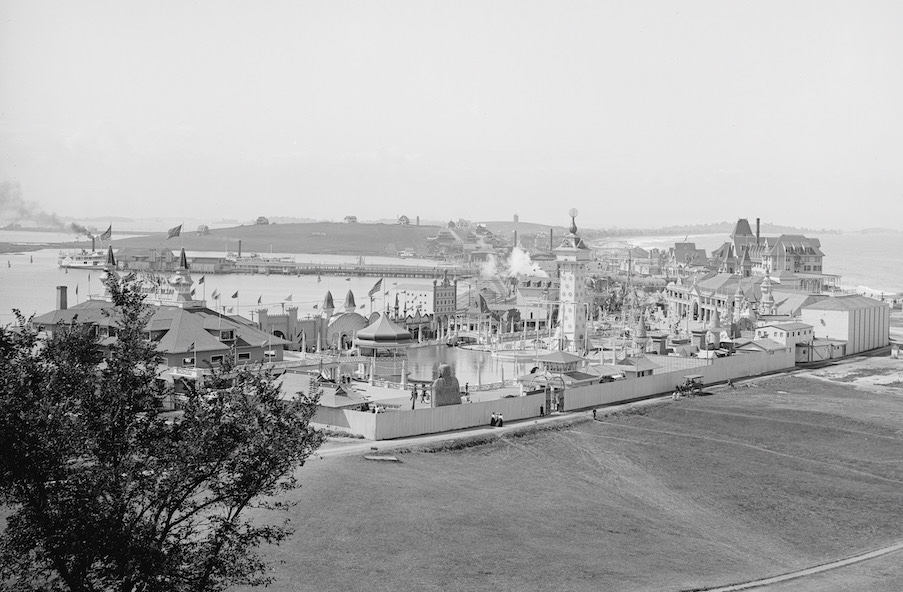
The Nantasket area of Hull on Boston’s south shore had been a popular summer destination since the middle of the 19th century, when resort hotels were developed there to take advantage of the ocean breezes and sweeping vistas. Paragon Park, an amusement park developed at the turn of the century was a great addition to provide activities for the summer visitors and resident alike. Convenient transportation in the form of steamship service and an electric railroad from Boston added to the appeal of the area. The park developed rapidly over the early 20th century and featured rides, activities and shows. The park was thought to be a mini World’s Fair, featuring a lagoon at the center with small boats to ride, and new expositions and features added every summer. The park struggled in the second half of the 20th century as the land value was more expensive and the park was only open a couple months a year. It sold in 1984 to developers who sold off many features and demolished almost all of the structures. The Giant Coaster, built in 1917 was one time, the largest roller coaster in New England. When the park was purchased, the roller coaster was sold to Six Flags America near Washington D.C. and is now The Wild One.

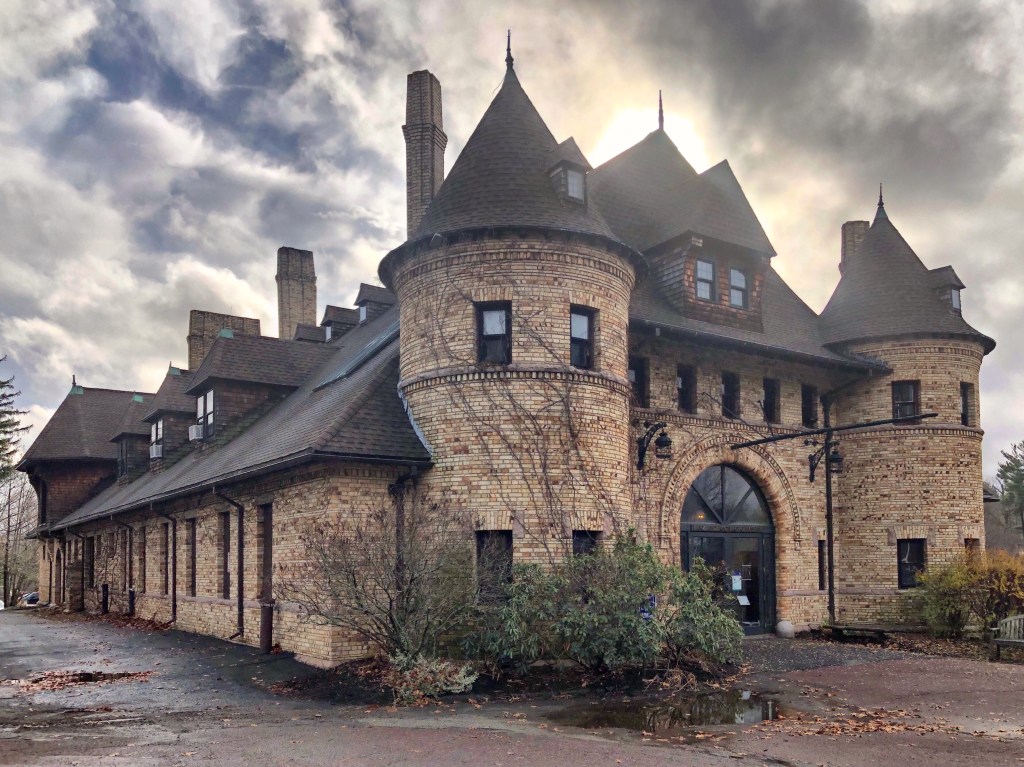
Larz Anderson Carriage House // 1889

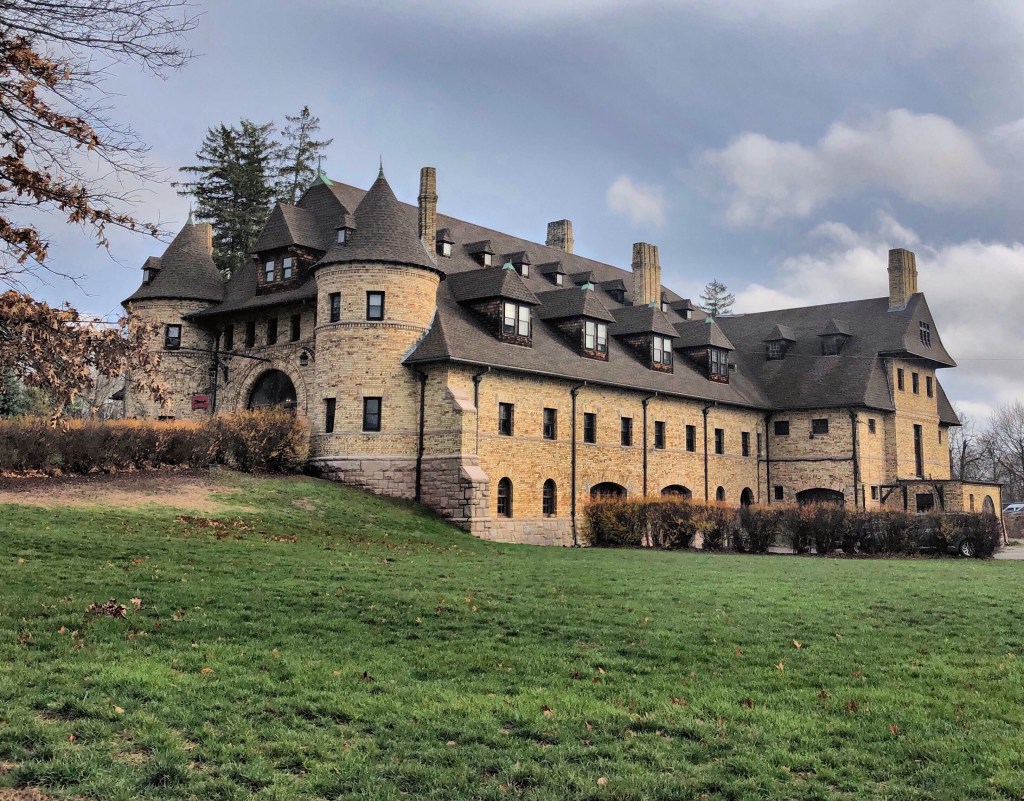
This large and imposing brick and stone structure, located in Larz Anderson Park in Brookline, was once the carriage house of “Weld”, the estate owned by Larz and Isabel Weld Anderson. Constructed in 1888, it was inspired by the Chateau de Chaumont-Sur-Loire in France and designed by Edmund M. Wheelwright, the city architect of Boston. First constructed to house a working stable, it later served to house and maintain the Andersons’ growing automobile collection. After Isabel Anderson’s passing in 1948, the collection was entrusted, at Isabel’s bequest, to the Veteran Motor Car Club of America. The VMCCA then established the nonprofit organization that is now known as the Larz Anderson Auto Museum. The former mansion suffered from vandalism in the 1950s and caught fire, later demolished by the Town, who could not afford to rebuild the home.

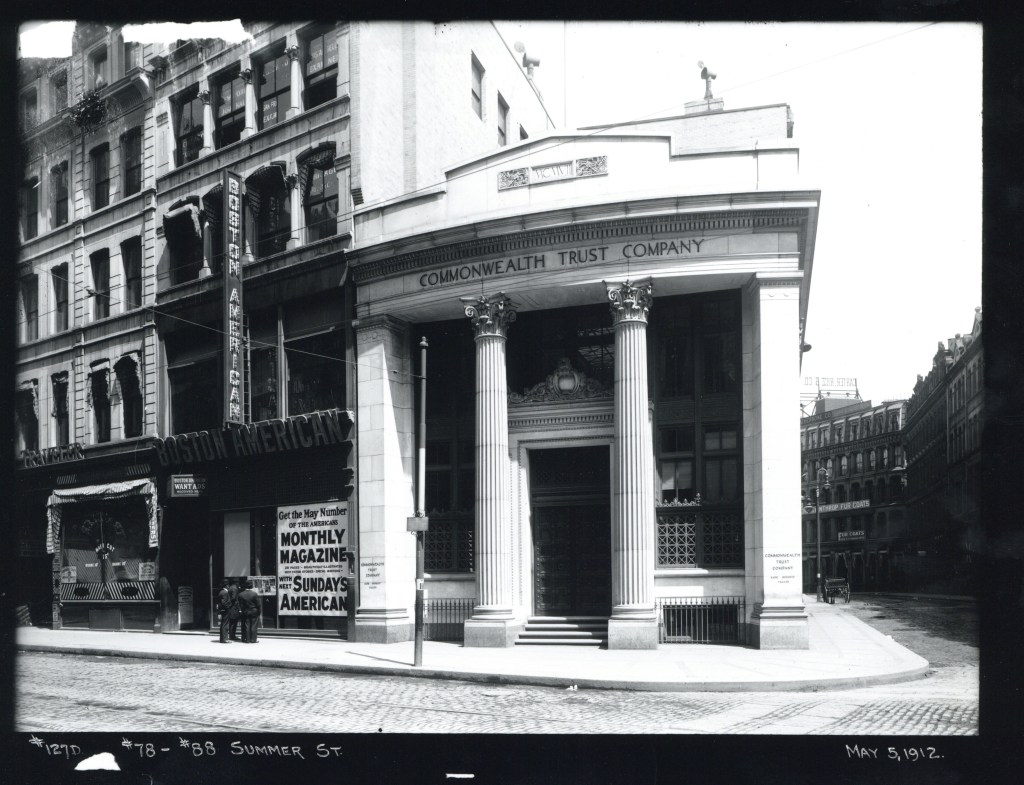
Commonwealth Trust Company // 1908-c.1974

Ca. 1910 image courtesy of Boston Public Archives.

Located at the corner of Summer and Devonshire Streets in Downtown Boston, the Commonwealth Trust Company’s two-story marble banking house commanded the corner, despite its short stature. The building, completed in 1908, was constructed with Lee marble and decorated with ornate wrought and cast-iron grilles over windows. The building was designed by the architectural firm of Parker, Thomas & Rice in the Classical mode with large, fluted Corinthian columns and boxed corner pilasters framing the recessed center entrance, Corinthian pilasters ran along the side facade. At the inside, the building was coated with Cararra and Blanco marble with paneled oak offices. At the ground floor, offices and banking stations framed the outer walls, with the safety deposit boxes located on the second floor. The building was demolished by the 1970s and replaced with a one-story minimalist Modern building (I could not figure out why the former building was razed). The new building was demolished after a few decades with a larger building, better fitting the commercial district.

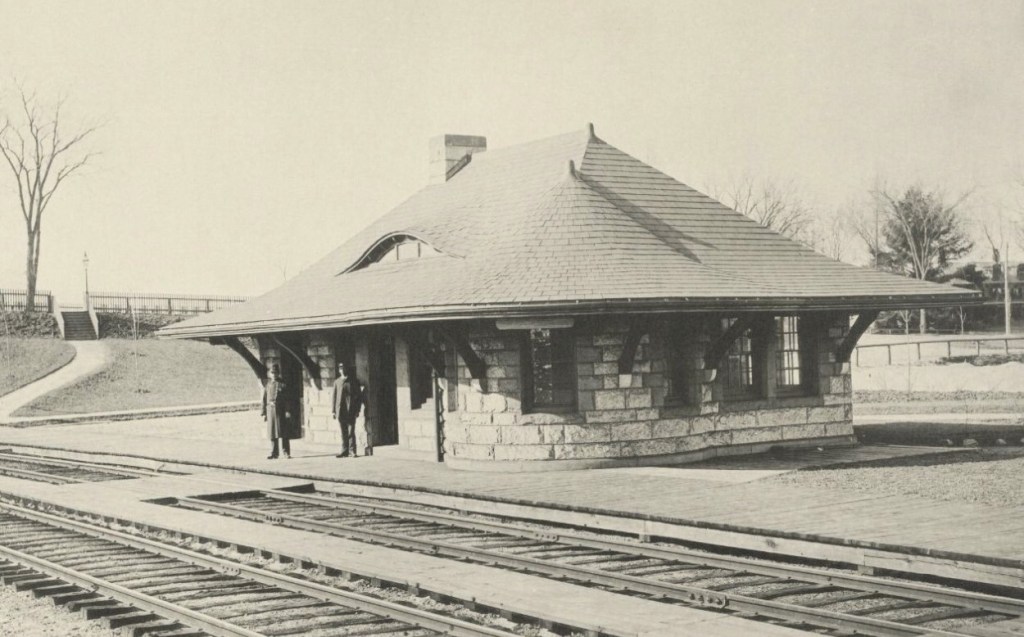
Waban Station // 1886-1958

Image from Harvard Archives.

The village of Waban in Newton, Massachusetts, was named after a Massachusett Chief who had previously resided atop Nonantum Hill on the Newton-Brighton line. This location is believed to have been a favorite hunting ground for Waban (the Wind) and his people. Throughout much of the 19th century, Waban remained a quiet agricultural region. As late as 1874, fewer than 20 families held title to all of its land. In the mid-1880s, however, interest in suburban developments near the Boston and Albany Railroad became increasingly widespread. Seeing suburbanization in the late 19th century and into the early 20th century.

The station that allowed all the development in the early days of Waban was built in 1886. The Boston & Albany Railroad hired renowned architect Henry Hobson Richardson to design the station, and many others on branches of the various lines radiating out from Boston. The Highland Branch (which this station was on) was later acquired by the MBTA in Boston, which operated it as a Commuter line. Waban Station closed along with the rest of the Highland Branch commuter rail line in 1958 and reopened a year later in 1959 as part of the Green Line’s D Branch. The gorgeous H.H. Richardson-designed station was demolished in order to build a 74-space parking lot. They literally paved paradise, and put up a parking lot

Massachusetts Normal Arts School // 1886-1967

The Massachusetts Normal Art School was one of the many Richardsonian Romanesque buildings constructed in the Back Bay, but it did not survive like so many others did. The building’s history goes back to the 1860s, when wealthy Bostonians petitioned for the Commonwealth of Massachusetts (State Government) to assist with the founding of new institutions to enhance the quality of life in the state. Due to this, the legislature funded three major institutions including the Massachusetts Institute of Technology (1860) and the Museum of Fine Arts (1870), and founded in 1873, the Massachusetts Normal Art School. The Normal Arts School was tasked with training future teachers for public schools and budding professional artists in the arts, with courses ranging from drawing to architecture. The Commonwealth of Massachusetts rented space in various buildings in Downtown Boston before they appropriated $85,000 and hired the firm of Hartwell & Richardson to design and oversee construction of the new school at the corner of Newbury and Exeter Streets. The Richardsonian Romanesque building was constructed of red brick and brown freestone, featured entrances on both street facades, and held gallery spaces inside for members of the public to view the work created at the school. The school outgrew the original building, which could comfortably fit just 100 students, and in 1929, a new building was constructed at Brookline and Longwood Avenues. Before moving one more time to its current location in 1983, the school was renamed to the Massachusetts College of Art and is best known as MassArt today. The original school in Back Bay was demolished in 1967 and was home to a surface parking lot before the existing building was constructed.