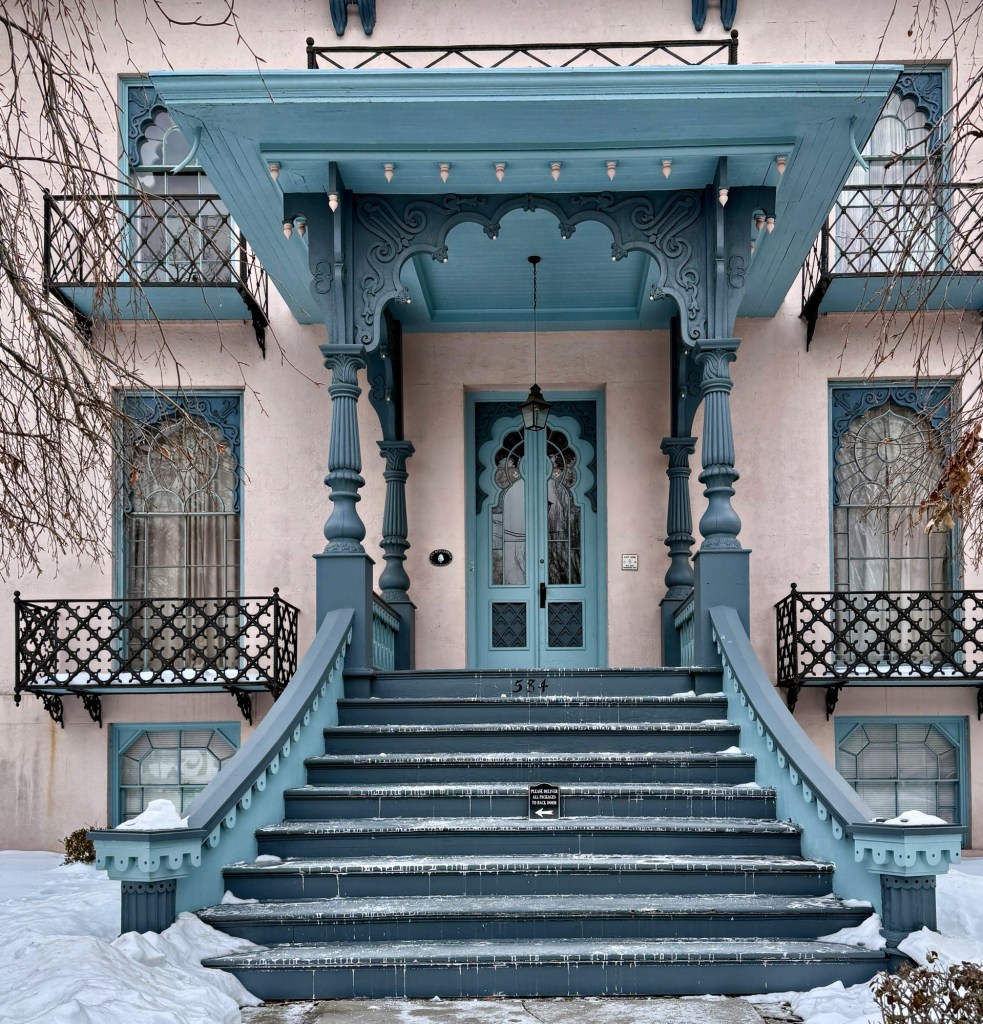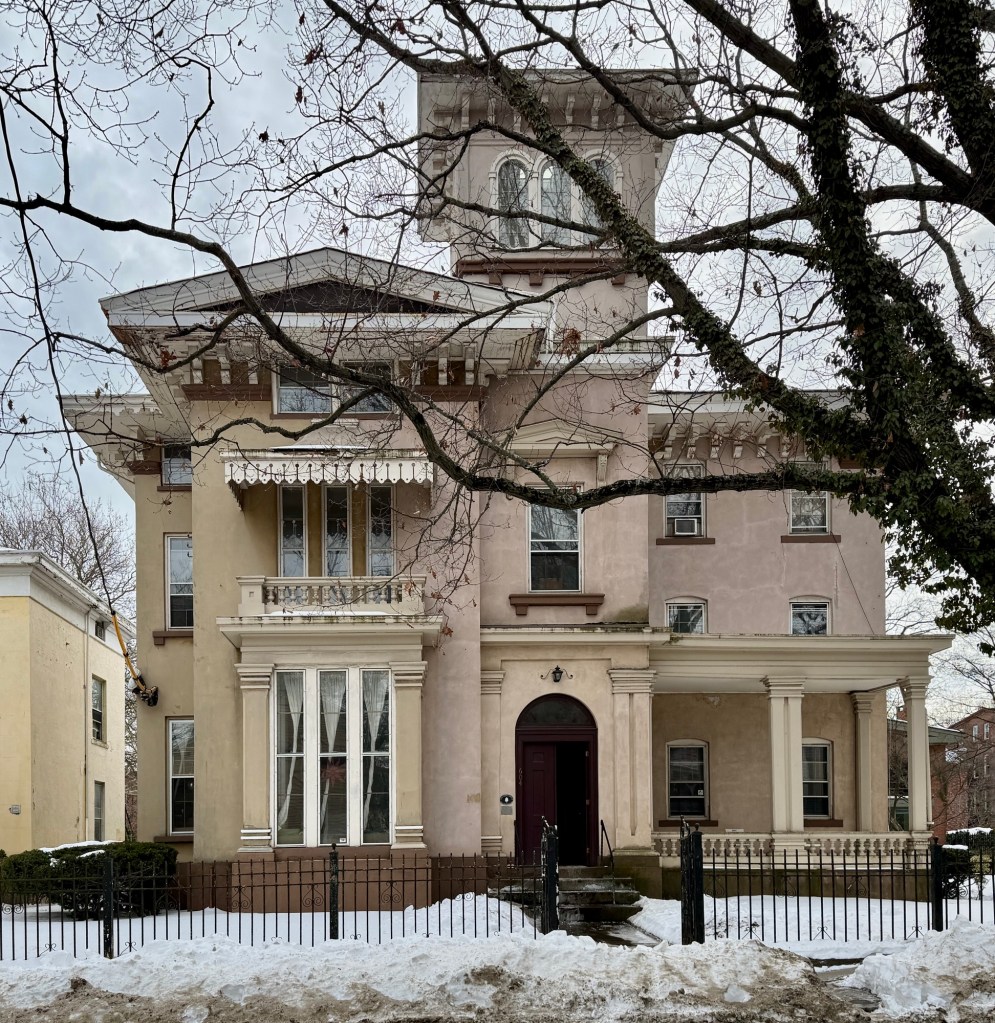
Norton Mansion – Steinbach Hall // 1849

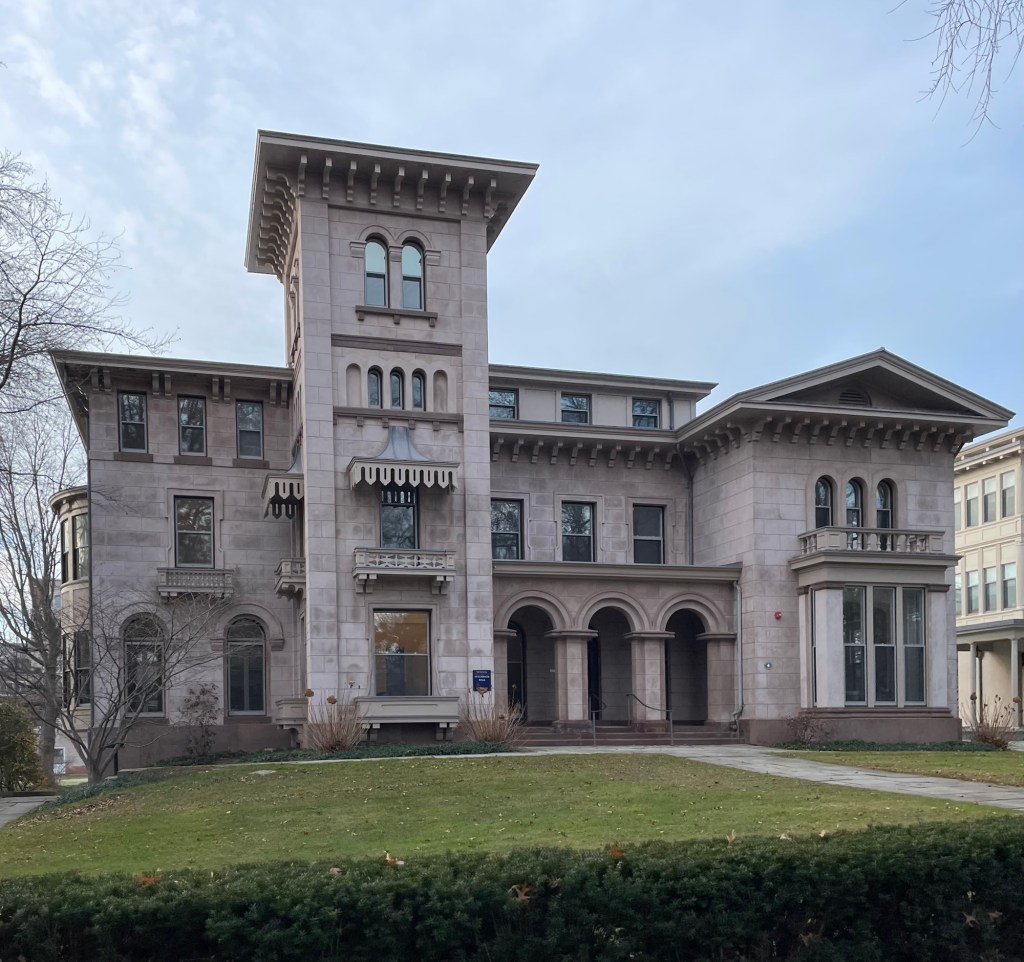
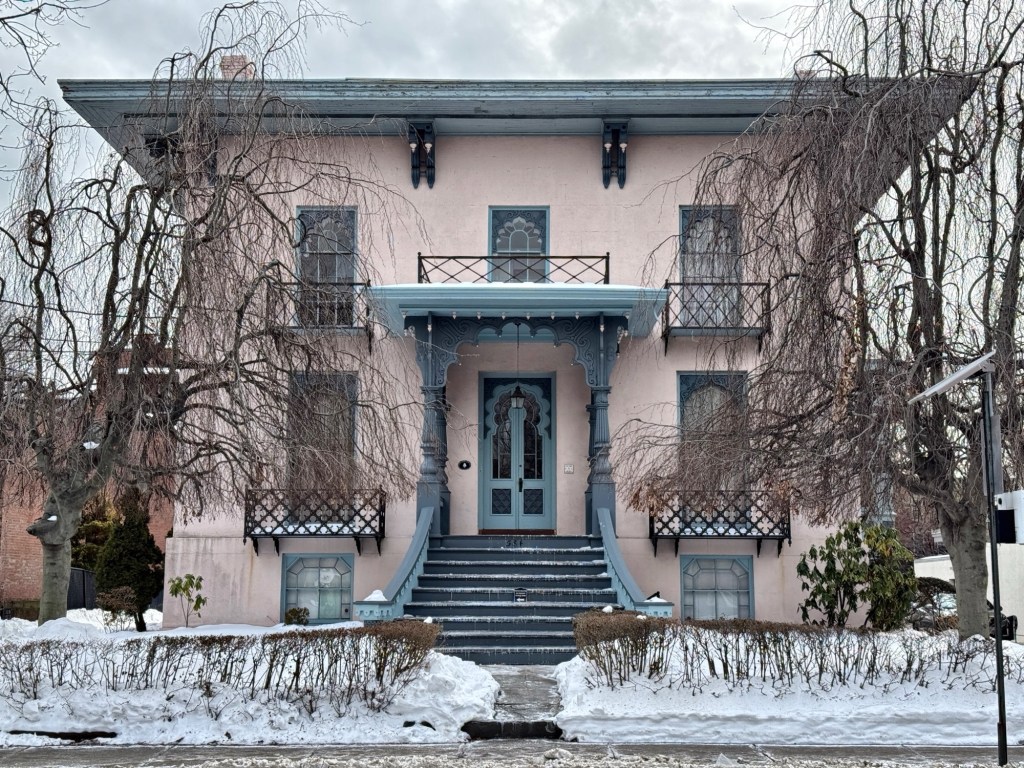
John Pitkin Norton (1822-1852) was a successful educator, chemist, and author, who at just 27-years-old, built this stately mansion on Hillhouse Avenue in New Haven, Connecticut, for his young family. John P. Norton studied chemistry under Benjamin Silliman at Yale College, and was eventually appointed Professor of Agricultural Chemistry at Yale in 1846. He helped to found the Department of Philosophy and the Arts at Yale College and authored many scientific papers, dealing with the chemistry of crops. Coming from an established family and beginning a successful career himself, John hired New Haven-based architect, Henry Austin, to design this large, Italianate villa. The window surrounds, canopies, and flamboyant Moorish entryway are typical of Austin, with the general form and detailing taking cues from architect Alexander Jackson Davis‘ work. The Norton Mansion was purchased by Yale University in 1923 and was long the home to the Yale School of Management and is now occupied by the Jackson School of Global Affairs.

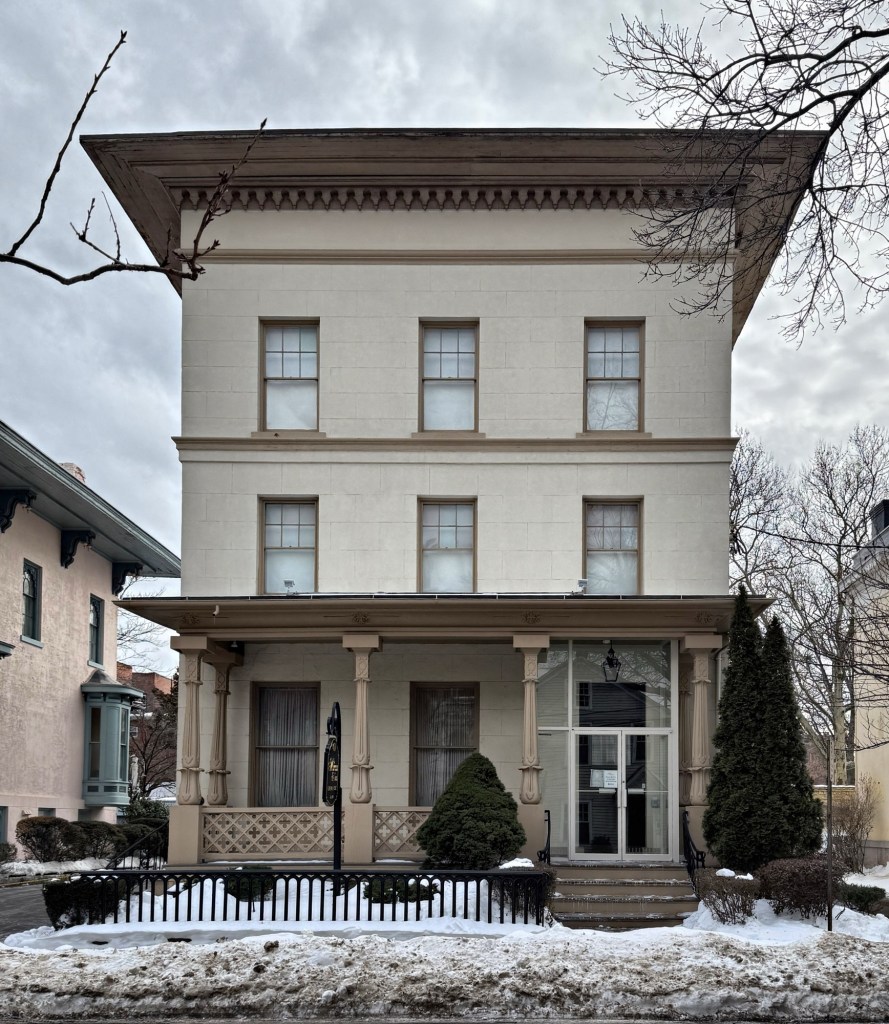
Skinner-Boardman Mansion // 1832

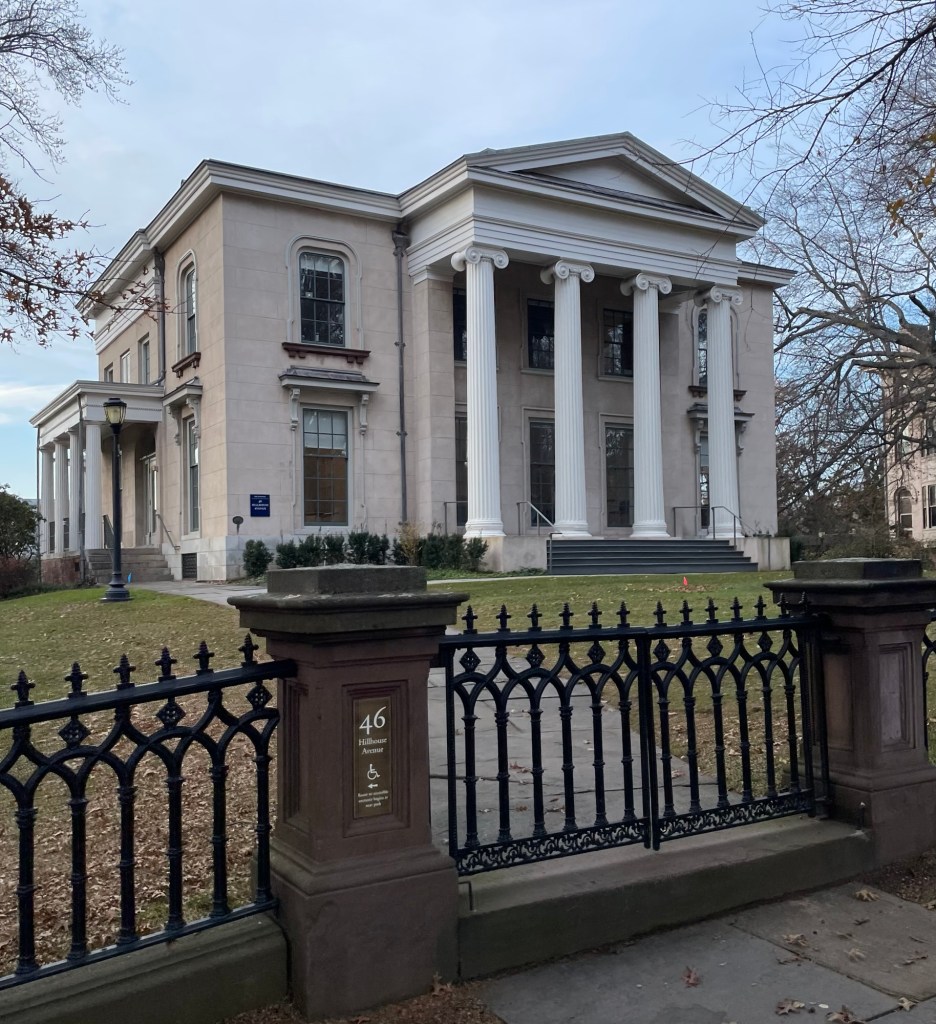
One of the finest houses in New Haven is this stately residence, the Aaron Skinner Mansion on Hillhouse Avenue. The mansion was built in 1832 for Aaron Nichols Skinner (1800-1858) from plans by architect Alexander Jackson Davis. Skinner was a Mayor of New Haven (1850-1854), and for a short time, ran a boy’s boarding school out of this house. Skinner was also a CT State Representative, serving two terms. The house was originally built as a three-bay, two-story house with one-story side wings and a rear ell. After his death, the house was purchased by Judge William W. Boardman, who in 1859, modernized the property hiring architect, Henry Austin, who filled in the side wings and added Italianate window mouldings. The monumental portico supported by fluted, Ionic columns, creates such a stately presence for the early house on the street. In the early 20th century, the mansion was owned by Rutherford Trowbridge, who renovated the house for his own use. The house remained in the Trowbridge family until the death of his last daughter, Miss C. Rachel Trowbridge, when the estate became the property of Yale University.

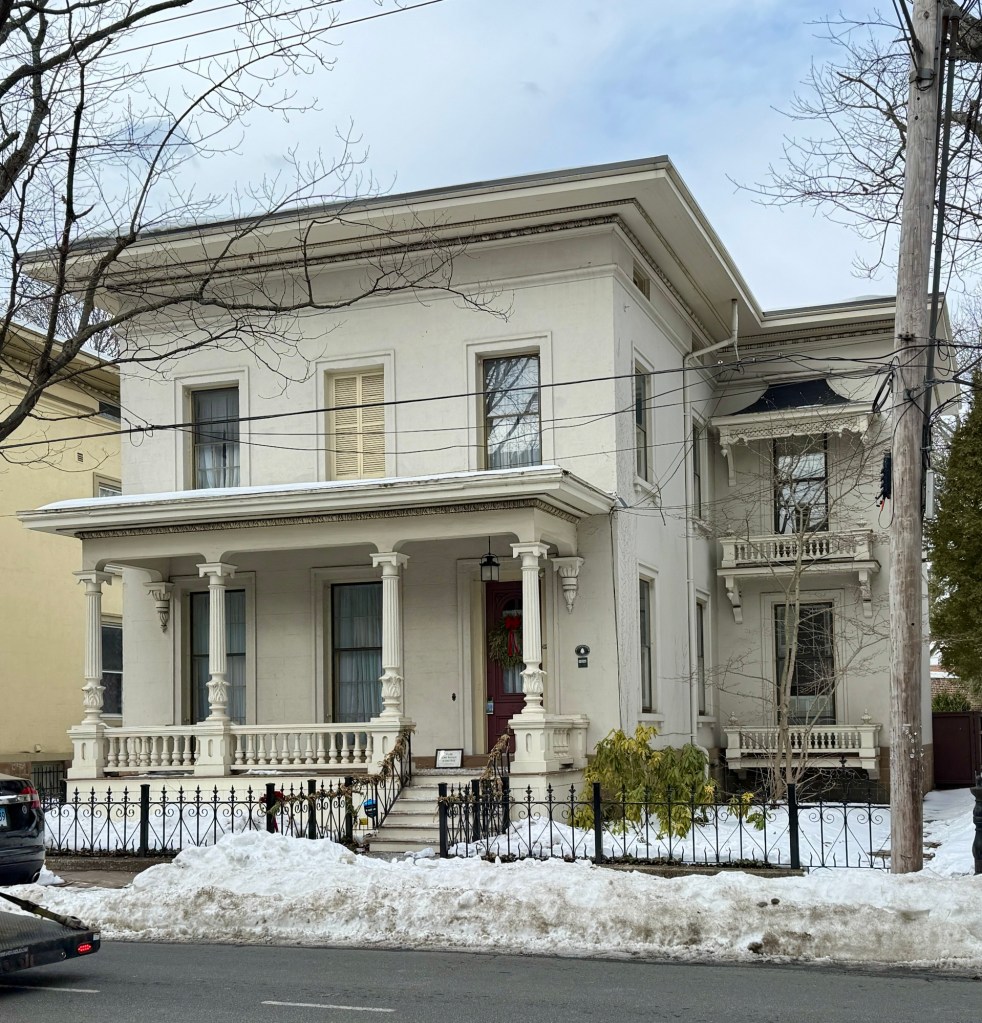
Abigail Whelpley House // c.1826

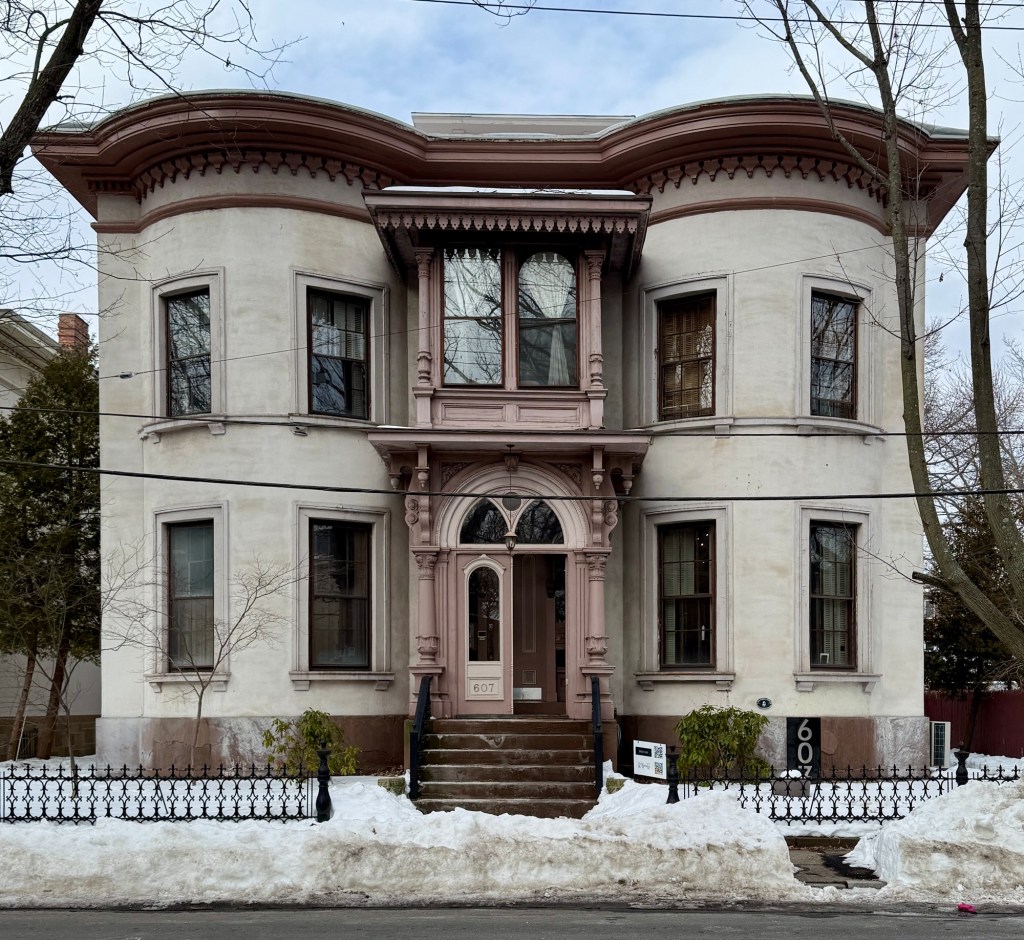
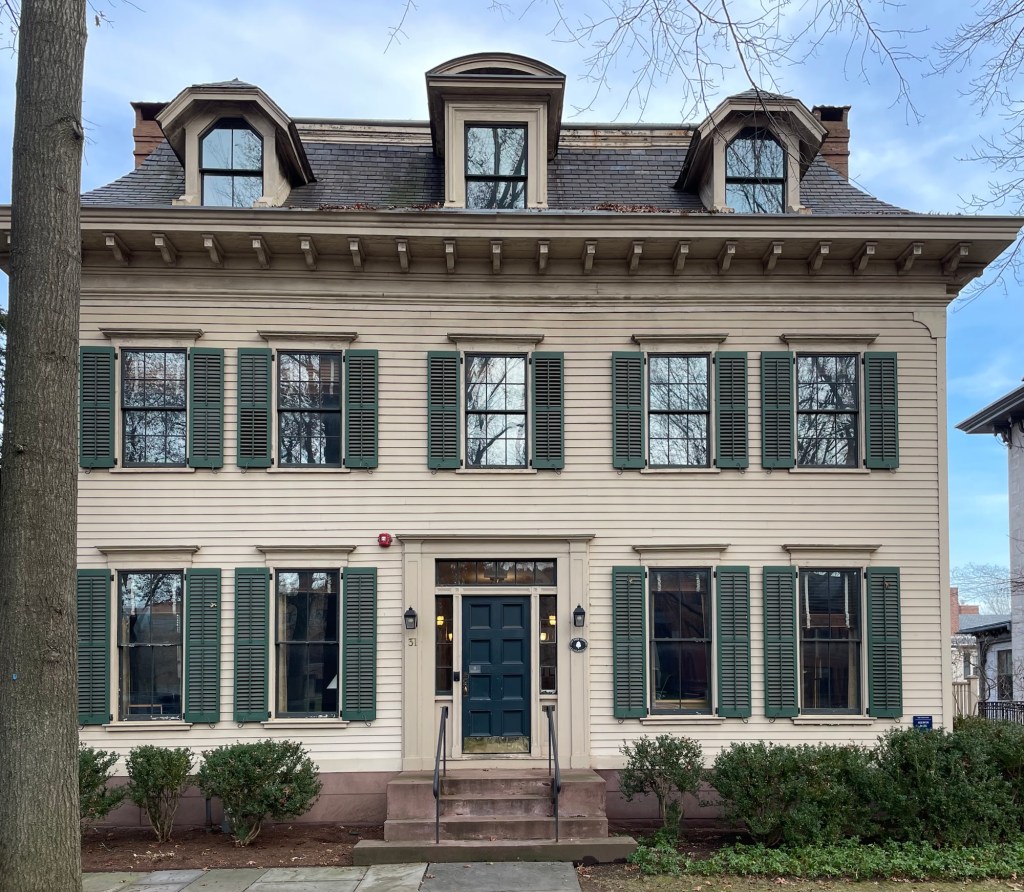
The oldest extant building on Hillhouse Avenue in New Haven is this Federal-period house with later Victorian-era modifications. The Abigail Whelpley House was built by 1826 (with some estimates as early as 1800 and moved to the site) and was a traditional, five-bay, two-story Federal style residence. It is said that the house was built by James Abraham Hillhouse (1789-1841) for his widowed family member, Ms. Whelpley, and her two sons. As of 1849, the property was owned by Noah Porter, later President of Yale, who would alter the house in the 1860s with the addition of a mansard roof and trim, all designed by architect, Henry Austin. The house, now known as Allwin Hall, is maintained by Yale University and contains offices for the program on Ethics, Politics & Economics.

Town-Sheffield Mansion // c.1836-1957

One of the biggest architectural losses in New Haven was the 1957 demolition of the Town-Sheffield Mansion, formerly on Hillhouse Avenue. The mansion was built around 1836 by esteemed American architect and civil engineer Ithiel Town (1784-1844) as his own home on Hillhouse Avenue in the Greek Revival style; here he kept what was then an extraordinary architectural library, which was said to have been larger than any other personal collection anywhere at the time, including that of Sir John Soane in London. After Town’s death, the house was bought by Joseph Earl Sheffield in 1859, benefactor of the Sheffield Scientific School at Yale, and modified by local architect, Henry Austin in the Italianate Villa style. Alterations included two large asymmetrical towers, a new porch, and symmetrical side wings with large bay windows. After Sheffield’s death in 1889, the building was used for laboratory space for the school. Although the house was one of Austin’s most important works, it was demolished in 1957 by Yale to make way for Dunham Laboratory.

Yale University – Dwight Hall // 1842

One of the most architecturally significant college buildings in the United States, Dwight Hall was designed to house the growing book collection of Yale College as its library. The former Yale College Library, now Dwight Hall, represents a significant shift in Yale’s campus architecture from Georgian and Federal brick buildings to the Gothic mode which the campus is largely known for today. Dwight Hall was designed by local architect Henry Austin with the guidance of esteemed architects Ithiel Town and Alexander Jackson Davis, both experts in early high-style Gothic buildings in America. The design, to me, resembles the 1443 King’s College Chapel in Cambridge, England. The structure is constructed of brownstone from Portland, Connecticut, and it is composed of a central block with two smaller flanking wings on either side connected by smaller linking spaces. At the yard facade, two octagonal towers with domed copper roofs rise, flanking a large, pointed lancet arch window that extends above the doorway. The library was outgrown fairly quickly, necessitating an annex next door and eventually collections were transferred to Sterling Memorial Library in 1930, the Old Library was converted to a chapel and community service building and is known as Dwight Hall.

New Haven City Hall // 1861

Less than four centuries ago the area which is now New Haven, Connecticut, was the home of a small tribe of Native Americans, the Quinnipiac. White settlers arrived by 1638 and made a deal with the local sachem (leader) to protect the native Quinnipiac from raiding bands of Pequots and Mohawks in return of purchasing some of the tribe’s land by the Puritans. By 1640 a complete government had been established and the settlement, originally called Quinnipiac, was renamed Newhaven (later New Haven). The town plan was based on a grid of nine squares. In accordance with old English custom, the central square, now the Green, was designated a public common. By 1718, in response to a large donation from East India Company merchant Elihu Yale, an early college relocated from Old Saybrook to New Haven, and its name was changed to Yale College. The city grew exponentially with industry, education, and commerce, becoming one of the wealthiest and diverse cities in the state. As the city grew after the Civil War, a new City Hall was built. The New Haven City Hall was constructed in 1861-2 and was designed by local architect Henry Austin. To the left of City Hall and set back further from the street was the old Courthouse (1871-3) designed by David R. Brown (1831-1910). Together the buildings provide a united facade marking the first phase of the High Victorian Gothic Style in America. By the 1980s, plans for a new Government Center were discussed following decades of deferred maintenance and a decaying building. Luckily, cooler heads prevailed, and the facades of the building were preserved with a modern structure constructed behind to house city offices, from plans by local architect Herbert S. Newman. The Victorian Gothic and Post-Modern building stands proudly today, anchoring the east end of the Town Green.