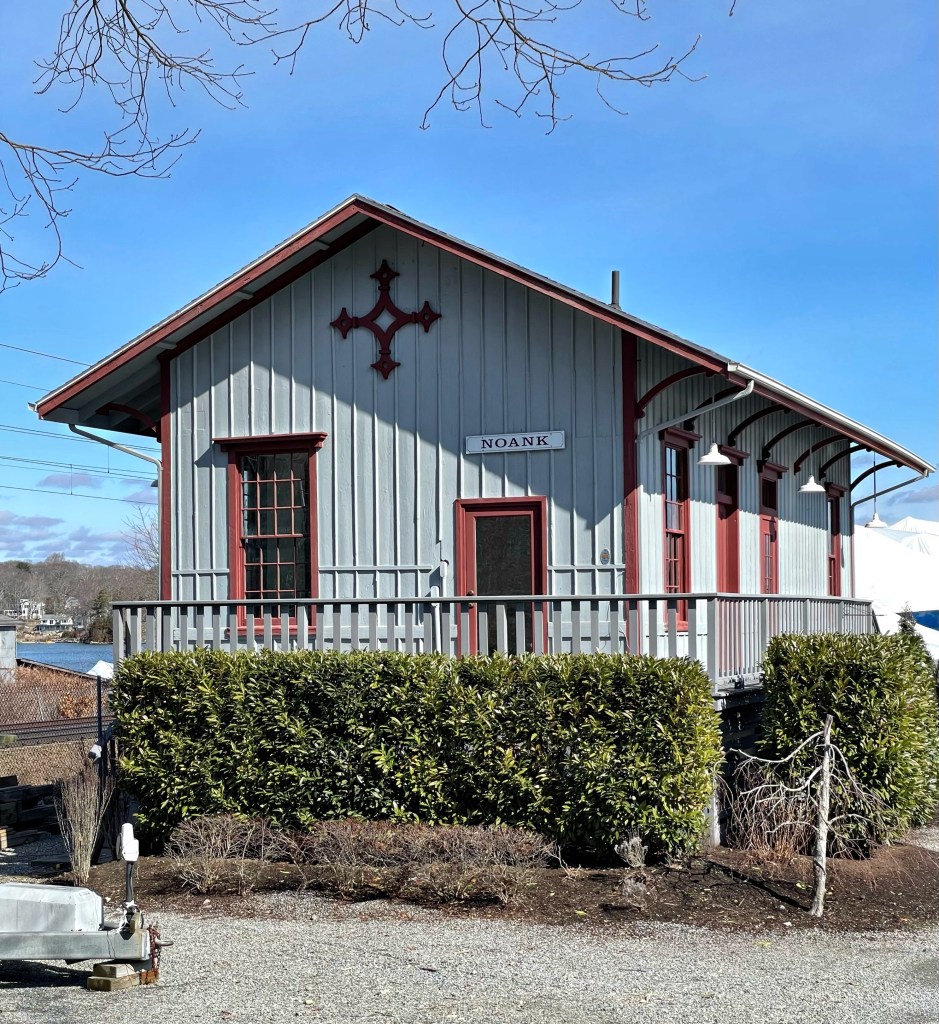
Noank Train Depot // 1858

Starting in 1848, rail service connecting New Haven and New London, Connecticut commenced to provide transit between two of the state’s economic centers. The New Haven and New London Railroad was completed in 1852 and almost immediately, work commenced on extending the line eastward as the New London and Stonington Railroad. This completed the “Shore Line” route between New York City and Boston through other lines and the span became re-organized and named the Shore Line Railway. One of the many village stops along the route was in Noank, in this 1858 rail depot. The small train station is covered in board-and-batten siding with an overhanging gable roof supported by brackets. In 1976, much of the shoreline track was purchased by Amtrak, which is now known as the Northeast Corridor. The Noank station was cancelled as a stop, and the building was sold from the holdings, it is now office space, seemingly for the Noank Village Boatyard.

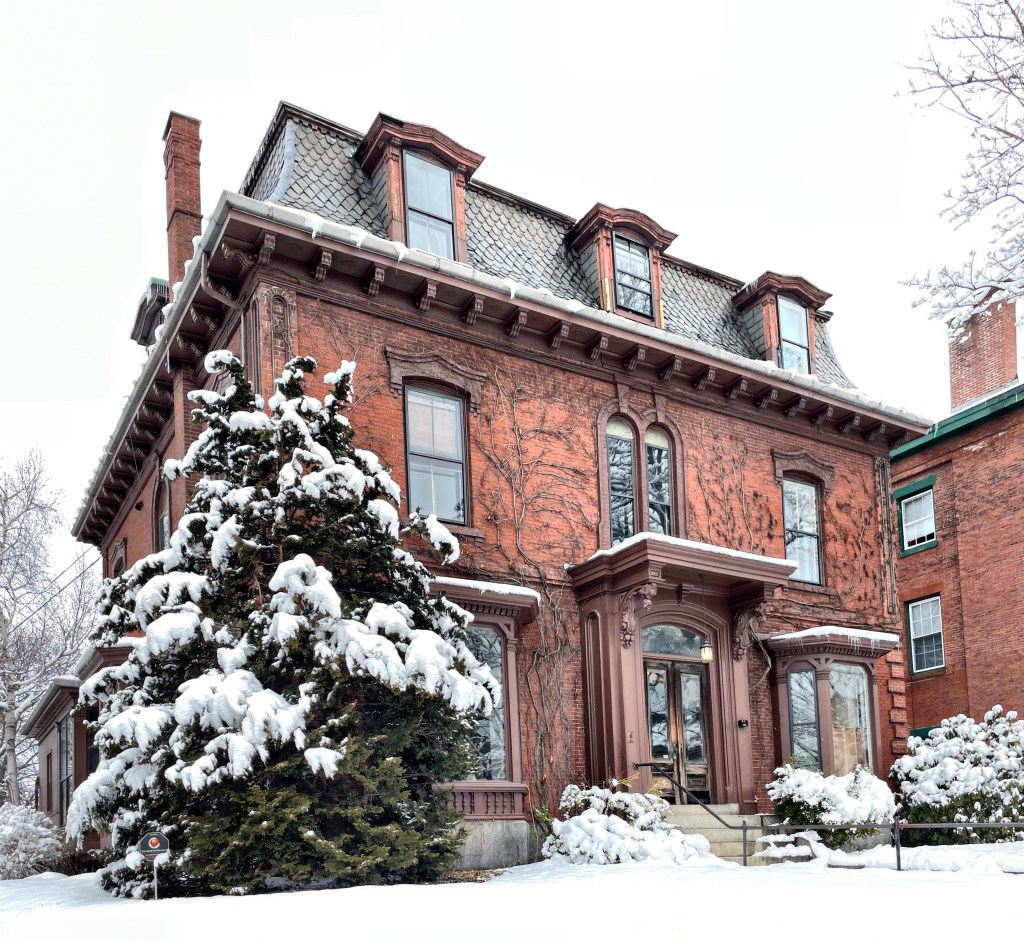
Woods-Gerry House // 1860

There are always those houses that just stop you in your tracks… For my last post (for the time being) on Providence, I wanted to share this significant property, known as the Woods-Gerry House, perched atop College Hill. Owner Marshall Woods, who married into the Brown family and was active in the affairs of Brown University. Locally he was also involved on the building committee for St. Stephen’s Church where he was a factor in selecting renowned architect Richard Upjohn to design the church. He must have liked Upjohn so much (or got a good deal) that he hired Richard Upjohn to design his new home on Prospect Street. The exterior of the three-story brick building stands out amongst the other Italianate mansions built in the same decade nearby, but is elevated design-wise with a bowed centerpiece on its east elevation with the handsome new front entrance renovated in 1931 by then-owner, Senator Peter Gerry, who was a great-grandson of Elbridge Gerry, the fifth Vice President of the United States (who had given his name to the term gerrymandering). Today, this significant building is owned by the Rhode Island School of Design and houses the Woods Gerry Gallery. The grounds are also very well designed.

Henry A. Thomas House // 1870

People don’t explore Roxbury enough! The neighborhood is full of amazing architecture with buildings in a great state of preservation and some waiting for the overlapping vinyl siding to be removed. This restored beauty sits perched above the road and is one of the best examples of a Second Empire merchant’s home in Roxbury. The house was built around 1870, within a year of owner Henry A. Thomas purchasing the lot here for $4,800. Mr. Thomas owned a boot and shoe retail store in Downtown Boston for years. The lot was later subdivided and stucco apartments were built to the side, notable at the time when Roxbury began to really densify with housing construction in the early 1900s.

William Allen Jr. House // 1866

Italianate style houses dominate the Deering Street area of Portland architecturally, but there are definitely some great Second Empire residences and other styles seen here. This house (like seemingly every building in Portland in the 1860s) was designed by architect George M. Harding for William Allen Jr. The house would soon be Harding’s neighbor, so he made an effort to site and design this residence with care. The brick building is capped by a slate mansard roof and it has a beautiful projecting door hood with pendants carved of grapes. Sadly, like some others on the street, the belvedere was removed in the mid-20th century.

Academy of the Holy Family // 1914

Built adjacent to and just a few years after the St. Mary of the Immaculate Conception Church in Baltic (last post), the Academy of the Holy Family stands as a high-style Colonial Revival building in the town. The building stands four full floors with a raised basement and attic story, and is symmetrical in its design. A large fan-light transom and stone trimmings add much depth to the buildings large massing. The structure was built in 1914, and has housed the Academy of the Holy Family, a private, Roman-Catholic all-girls prep school, which is still active today.

Sprague Former Town Hall and Fire Station // 1911

At the turn of the 20th century, the town of Sprague (including Baltic Village), had 1,300 residents. Just ten years later, in 1910, the population doubled, largely due to Frederick Sayles‘ purchase of the Sprague Mill and re-investment in the village’s housing and buildings. The need for new town offices and a fire station was evident, and this building in the village was constructed in 1911 to serve both needs. The old Town Hall and Fire Station is a late example of Romanesque Revival style architecture with the arched windows at the second floor and in the dormer. The space was outgrown again and the town offices relocated to a Modern building down the street after WWII.

Giddings Homestead // c.1800

This old gambrel-roofed home sits on the beginning of Pautipaug Hill Road just outside the industrial village of Baltic, in Sprague, Connecticut. The house’s history is a little unclear, but it shows up on historic maps as being owned by W. Giddings. This appears to have been Walter Giddings (1788-1854). Walter may have built or inherited this property from his father Nathaniel, who died in 1809. Walter married Laura Lucretia Fillmore in 1811 and they had four children. Laura died in 1827 at just 37 years old and Walter remarried within a year to Lydia Lathrop Ladd. The property remained in the Giddings Family at least into the second half of the 19th century. It was later “Victorianized” with two-over-two windows, side and front porches, and a octagonal bay window. The home has been suffering from deferred maintenance for over 15 years (as far back as Google maps goes) and was listed for sale, so here’s to hoping this old beauty survives!

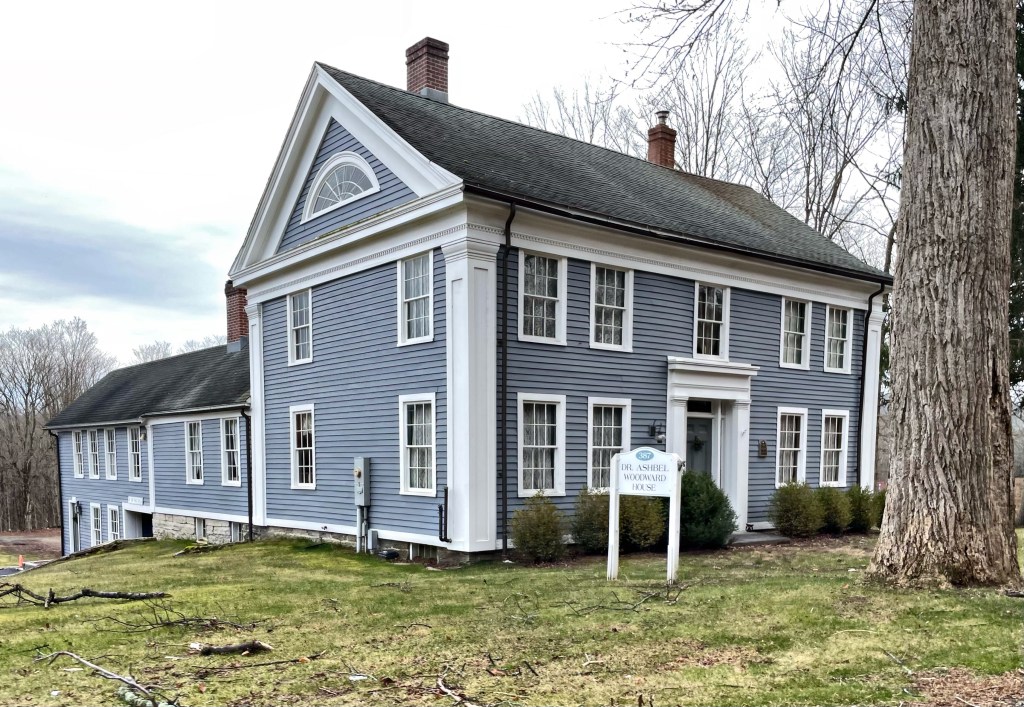
Dr. Ashbel Woodward House // 1835

The Ashbel Woodward House in Franklin, Connecticut was built in 1835, on land purchased by Doctor Ashbel Woodward, a prominent local physician, a year prior. Woodward, was a graduate of Bowdoin College, and he began practice in Franklin in 1829, serving as the town’s primary medical practitioner until his death in 1885. Though in his 60s at the outbreak of the Civil War, Woodward perhaps lent his greatest service to his country when he served as a battlefield surgeon and medical facilities inspector for the Union army. Besides his work in medicine, Woodward collected literature and numerous artifacts pertaining to Franklin’s past and eventually wrote a book detailing the town’s history. The Ashbel Woodward House is an excellent example of the Greek Revival architectural style in a five-bay form. Interestingly, there are semi-elliptical windows in the pediment gable ends on the side elevations, seemingly a nod to the Federal style that was waning out of style at the time. The property is in use today as a museum, documenting the life of Dr. Woodward and the people of Franklin, Connecticut.

The Elms – Mrs. Berwind’s Bedroom // 1899

On the second floor of The Elms mansion in Newport, you will find two separate bedrooms for the owners Edward and Sarah Berwind, a husband and wife of high society. The larger of the two bedrooms was for Mrs. Berwind as you know what they say, “happy wife, happy life”. Mrs. Berwind’s bedroom has cream-colored woodwork covered with custom-woven celadon green damask with borders of coordinated green, gold, and cream material. She had an adjoining bathroom and her chambers had access to her husband’s chamber along with a shared fireplace.

Belair Gate Lodge // 1870

Located at the historic entry to Belair (last post), one of the largest estates in Newport, you would be greeted by this charming stone building, the Belair Gate Lodge. The building is symmetrically massed, 1½-story and built of rough-face-granite-ashlar, similar to the main house. This building can be classified as French Eclectic in style and was designed by Newport architect Dudley Newton, who also designed the 1870 Second Empire renovations to the main house at the same time for owner George Henry Norman. When the Belair estate was subdivided, the gate lodge was sold off as a separate unit, and is now a single family home, aka my dream home. There is something so enchanting about gatehouses!