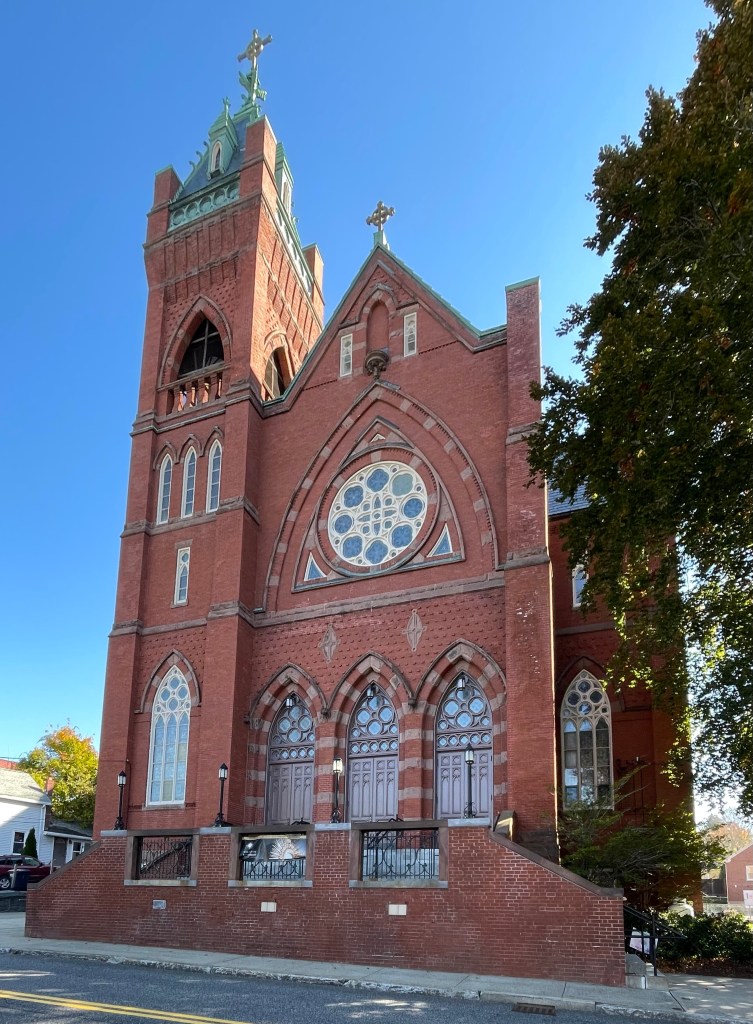
All Saints’ Church in Ware Massachusetts was originally known as St. William’s parish, and was the oldest Roman Catholic Church in the town. Beginning in 1850, regular Catholic services were held in the new industrial village, as large a population of French Canadians moved there for work in the textile mills. A small frame church was built on West Street and a cemetery laid out around it for members of the congregation. As the congregation grew, a larger building was needed. In 1888, work began on the present structure which was to be located in a more central location. The Archdiocese worked with Patrick W. Ford, an architect who designed many Roman Catholic churches built in the eastern part of United States through the latter half of the 19th century. The Victorian Gothic church building remains one of the best examples of the style in central Massachusetts.
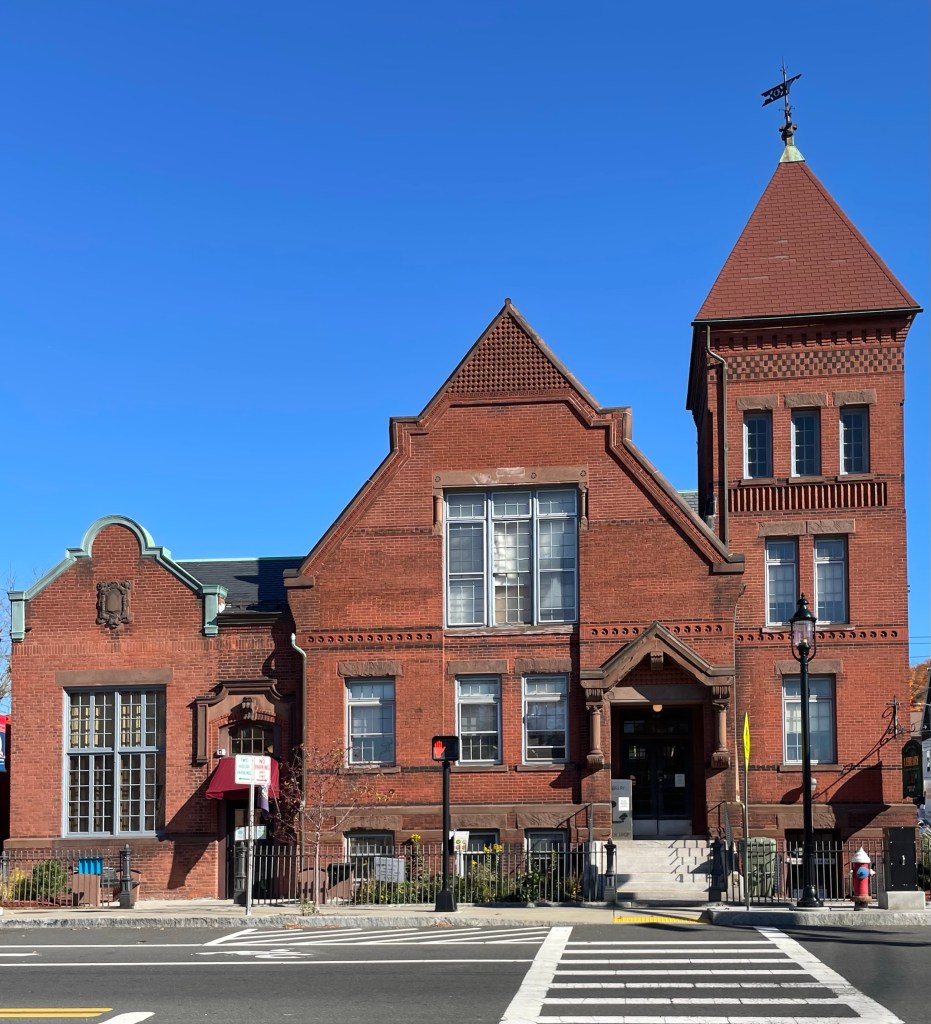
The first library in Ware, Massachusetts was organized in 1796. Operating on a subscribers system, books were lent out to those who paid the most at the time. The Society flourished for 26 years until it abruptly disbanded. In 1824, a second library was organized, called the Mechanics and Manufacturers’ Library, which was loosely managed by the manufacturing companies in town. In 1872, an act providing for the formation of library corporations was passed in Massachusetts. The Ware Young Men’s Library Association was the first to incorporate under the new law. They established a location in a commercial space in town until it was outgrown. In 1879, the present lot at the corner of Main and Church streets was donated by a local businessman. Funding was acquired and Springfield-based architect Eugene C. Gardner was hired to design the building. In 1923, an addition was built onto the side by architects Gay & Proctor in the Jacobethan Revival style, which blends well with the original Queen Anne building. The building remains home to the library and is the town’s public library.
I love exploring old industrial towns. In Ware, Massachusetts, the urban decay of some buildings provides opportunity and potential, but also so much negative thoughts for long-time residents as it reminds some of the town’s once thriving past. Just off Ware’s Main Street, I spotted this former chapel and had to learn more. This structure was built in 1881 as the second East Congregational Church chapel. The congregation was largely made up of immigrant laborers who worked in the town’s mills. This chapel replaced a Greek Revival building erected in 1857 on Water (Pulaski) Street that was later remodeled by the town into a fire station. That building was destroyed during the Hurricane of 1938. This Victorian Gothic chapel was designed by architect Eugene C. Gardner of Springfield, who was very busy in central/western Massachusetts. The chapel long was used by church members for spillover events and social gatherings. Later, the building became the office of the Ware River News.
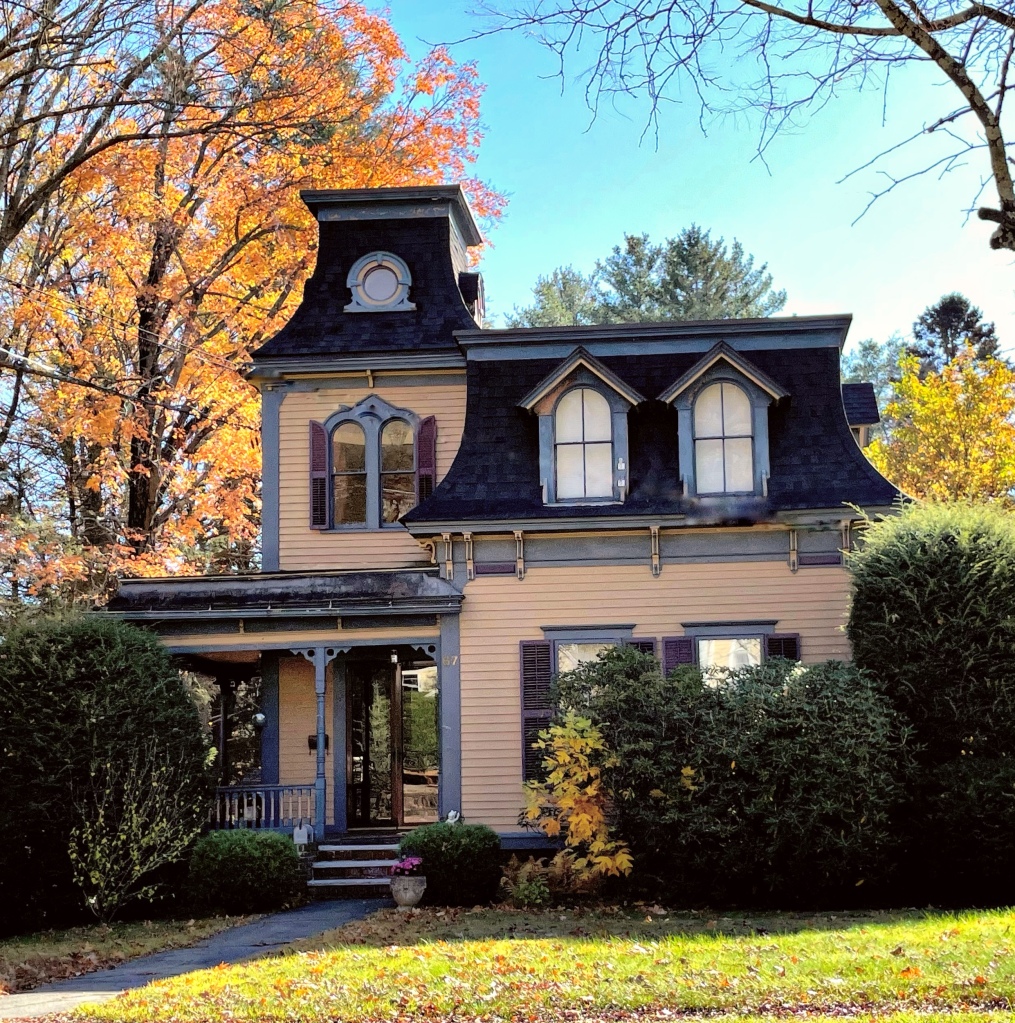
Located on Church Street, the best architectural stretch of buildings in Ware, Massachusetts, you’ll find this absolutely charming mini-Mansard house. The property was built after the Civil War and historic maps show it was owned by a J. Coney. Upon further research, it seems J. Coney is John Coney (1809-1884), a farmer who retired in 1870 and was later referred to as a carpenter in census’. It is likely that Mr. Coney built this mansard cottage around his retirement and relocation to Ware’s industrial village, building it himself. The home features gabled dormers with round-headed sash projecting from the mansard roof. A two-story tower has paired, round-headed windows with oculus windows. Perfection.
This house in Ware, Massachusetts was built after the Civil War by the Otis Company, the major employer in town, for use as an agent’s house. Crazy I know! Historically, it was a common practice for New England textile companies to provide housing for employees (though agents got the nicest dwellings). Many of the agents were brought from Boston and a comfortable residence was a benefit of the job. The first agent to reside in this house was Sylvester Bowen Bond, agent of the company between 1870 and 1877. Mr. Bond sadly would die in the dwelling of typhoid fever, aged 36. The Italianate style property on a large lot continued to be used as an agent’s residence until the Otis Company left Ware. The property was acquired by the nearby St. Mary’s Church as a convent.
One of the later mill buildings constructed in the mid-19th century for the Otis Companyis this brick building which contributes to the rich industrial heritage of the town. Built in at least three stages, this long industrial building probably grew from a middle section dating 1856, expanded in both directions over the next several decades and but was largely completed by 1869. The building was a major manufacturer, supplying thousands of jobs for the town until it closed after WWII. In 1945, the top two stories of this building along with their towers were removed in 1945, which echoes the history of many similar mills all over New England (but hey, at least this one is occupied today!)
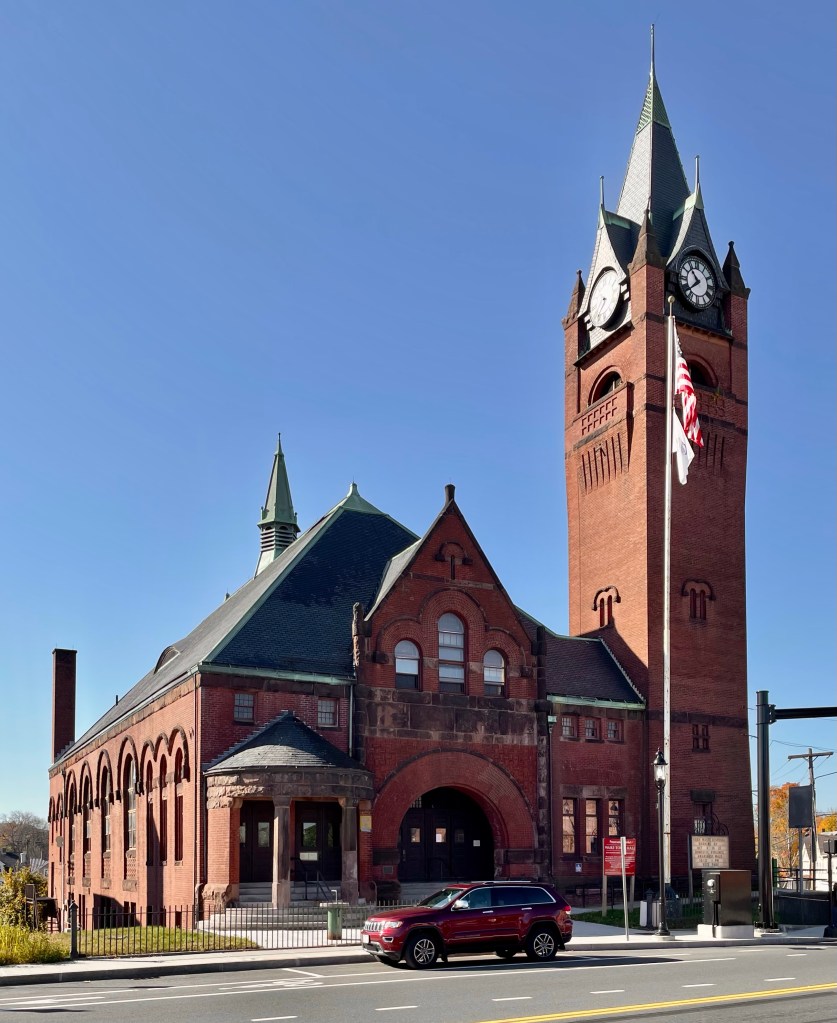
After learning a little about some of the buildings in Dorset, Vermont, which were saved and relocated to the town from land flooded for the Quabbin Reservoir, I wanted to visit one of the surviving towns there to see it for myself. I found myself in Ware, Massachusetts, a town with a history that parallels many in central and northern Massachusetts. The town was first settled by white European colonists by 1717, and incorporated in 1775. The town was named after the English town of Ware in Hertfordshire. The Town of Ware began as a sleepy farming town with inns and taverns dotting the landscape until industrial sites were developed on the banks of the Weir River. The post Civil War era (1860s–1900s) brought a new prosperity to the now established textile mill town. “Ware Factory Village” sprang up overnight and formed the basis for new growth and development, to the east of the former town center. From this, a new Town Hall was needed, and where better to locate it, than the economic and population center of town?! The Ware Town Hall was built in 1885-1886 from plans by the prominent Boston firm of Hartwell & Richardson. Sadly, a fire gutted much of the building in 1935, but the shell remains (though needing much repair). The town, like many former industrial centers, has struggled to re-invent itself, but a growing population is a great indicator of good things to come!
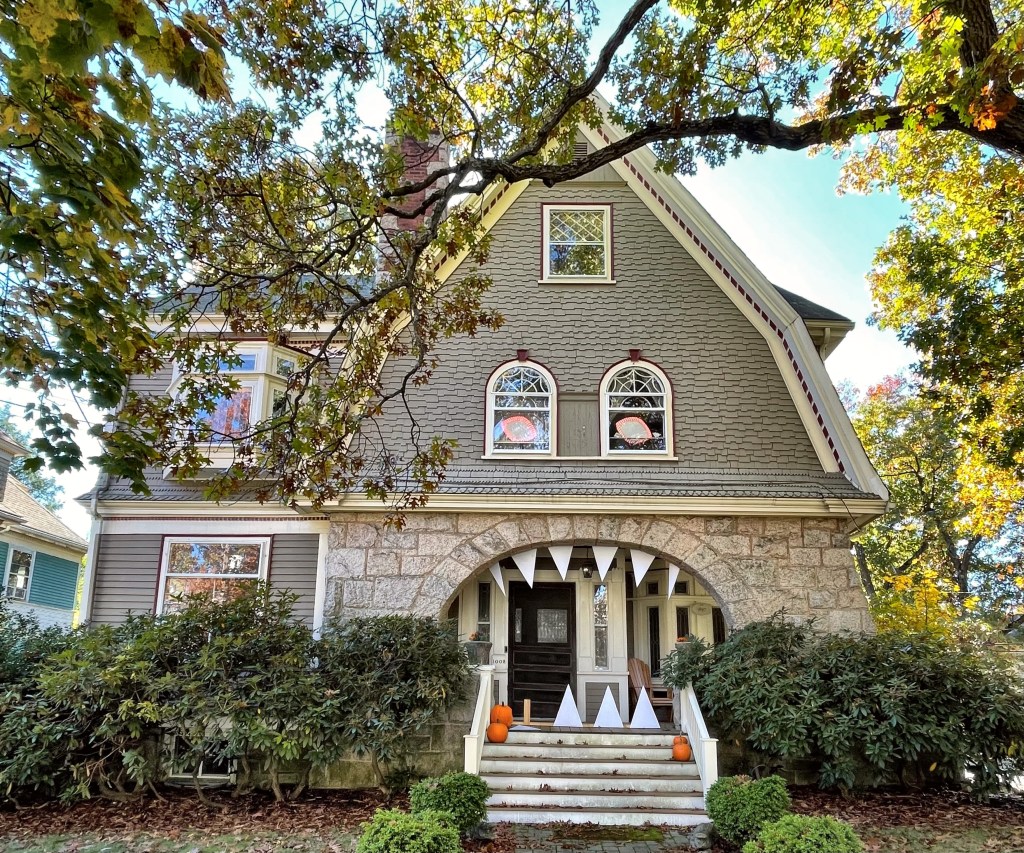
Happy Halloween! To celebrate I wanted to feature one of the more creatively decorated houses in the Boston area, which blends spookiness with architecture! This is the Barrows-Goddard House, so named after its first two owners. The house is located in Newton and was built in 1898 as an eclectic Queen Anne/Shingle style home. The original owner was Joseph Barrows, who developed the property and sold it within a year, relocating to a new home on a less busy street. The property was owned next by Christopher Goddard, an insurance agent with offices in Boston. Architecturally, the gable roof of the main block is intersected by an over-scaled gambrel cross-gable clad in patterned cut wood shingles. The focal point of the design is the Syrian-arched entrance porch of coursed, dressed fieldstone which this time of year, eats trick-o-treaters!
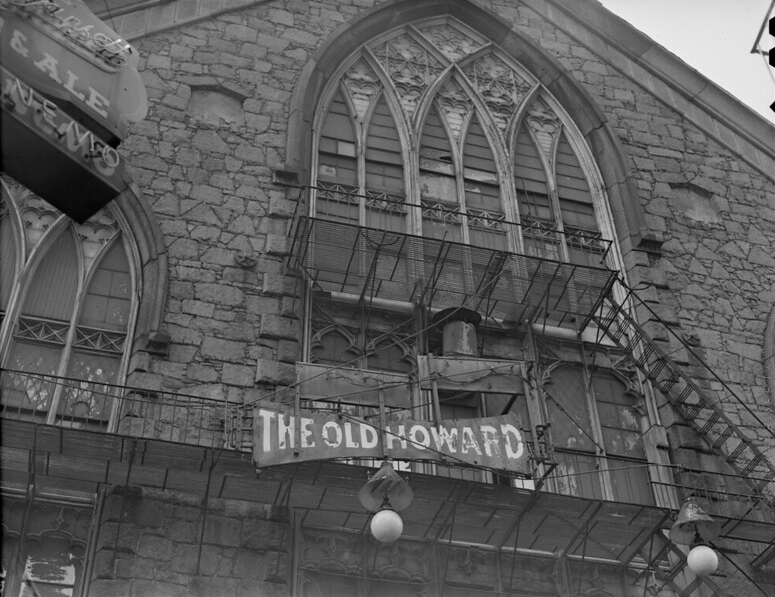
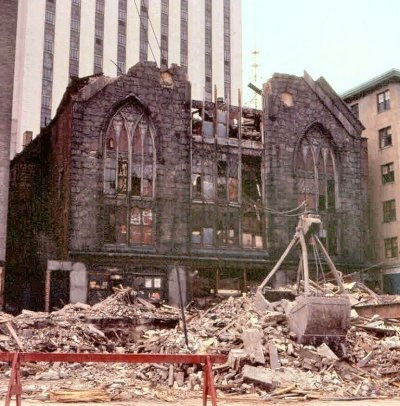
One of the more iconic theater buildings to ever stand in Boston was the Howard Athenaeum, later the Old Howard, which stood on the former Howard Street in Downtown Boston. The origins of the building begin in 1843, when a flimsy, tent was built to serve as a church for the small Millerite sect. The small but loyal congregation eventually abandoned the site following disappointment with the minister’s promise that the world would end in 1844. After Armageddon failed to materialize, the founder of the sect, William Miller, an ex-Deputy Sheriff from Poultney, Vermont, was discredited and the Millerites moved on. After running their former minister out of town, several church members (who had given up all their worldly possessions in preparation for their trip to heaven,) decided to recoup some of their losses by selling the property to Messers Boyd and Beard, who opened a theater here in 1845. A fire destroyed the structure, and it was replaced by a larger, fireproof building that same year. The new building was constructed in 1845 and was designed by architect Isaiah Rogers in the Gothic Revival style with massive granite blocks from Quincy.
The Howard Athenaeum saw many iconic performers and historical events in its 100 years. A young John Wilkes Booth, played Hamlet at the Howard before becoming famous for a more nefarious deed in Washington in 1865. Also, Sarah Parker Remond, a Black anti-slavery activist and lecturer with the American Anti-Slavery Society (and later a medical doctor), had bought a ticket through the mail for the Donizetti opera, Don Pasquale, but, upon arriving, refused to sit in a segregated section for the show. She was forcibly removed and pushed down a flight of stairs. She eventually won a desegregation lawsuit against the managers of the Howard Athenaeum and received $500 in a settlement.
The theater was quickly deemed obsolete and second-tier compared to more modern theatres built nearby. By the mid-20th century, the Old Howard was largely featuring burlesque shows. To keep bringing in audiences, the burlesque performances got more risqué with each year. As a result, the Boston vice squad made the Old Howard the object of their attention. The Boston Vice squad made a 16 mm film during one of their raids in 1953 and captured on film the performance by “Irma the Body”. This film footage resulted in an indecency hearing which eventually led to the closing of the Old Howard in 1953. A fire a few years later along with Urban Renewal led to the demolition of the Old Howard by 1962. Like the former Suffolk Savings Bank (featured previously), the present Center Plaza Building is on the site.
In 1748, Alexander Watts, a merchant and sea captain purchased land in Marblehead, building a dwelling house, shop, and barn. This home was likely built in the 1750s, not long after he purchased the lot from David LeGallais, a merchant and prominent landowner in town. The gambrel-roofed Georgian house with its elaborate entry stands out on the street for its large frontage, with many other period homes sited on narrow lots, with the side of the house facing the street. He likely lived in the shop nextdoor until he had enough money to build this separate, more elaborate dwelling. Captain Watts died in 1772, and the property was willed to his “wife Rachel for her widowhood, and at her decease, one-half was to descend to her heirs, and the other half to his kinsman, Alexander Watts of London, England”. By the 1780s, the property was noted as “much decayed” with his widow likely struggling to maintain the property, renting the shop to others for income. On April 13, 1795, the estate was divided, meaning Rachel, Alexander’s widow, likely died at the home.




 Buildings of New England