William Mason House // c.1812

This oversized brick Federal style house in Providence looks like it belongs more on the iconic Benefit Street rather than a quieter side street like Transit Street, but its history informs us as to why. Located at 136 Transit Street, the Benjamin Mason House stands as one of the finest (and largest) brick houses in the Fox Point neighborhood of Providence. The residence was built around 1812 by William Mason, who appropriately worked as a bricklayer and builder in 19th century that put his talents to work to build his own home seen here. The large brick residence was not only a family home, but marketed his abilities as a mason to area residents who were in need of his services. Benjamin Mason lived here until he moved to a new house down the street with his wife, Ann. Benjamin died by 1828 and the brick residence was purchased at auction and later sold to Reverend William Phillips. The house retains much of its original fabric, and even includes a stunning courtyard garden bounded by – you guessed it – a brick wall. 

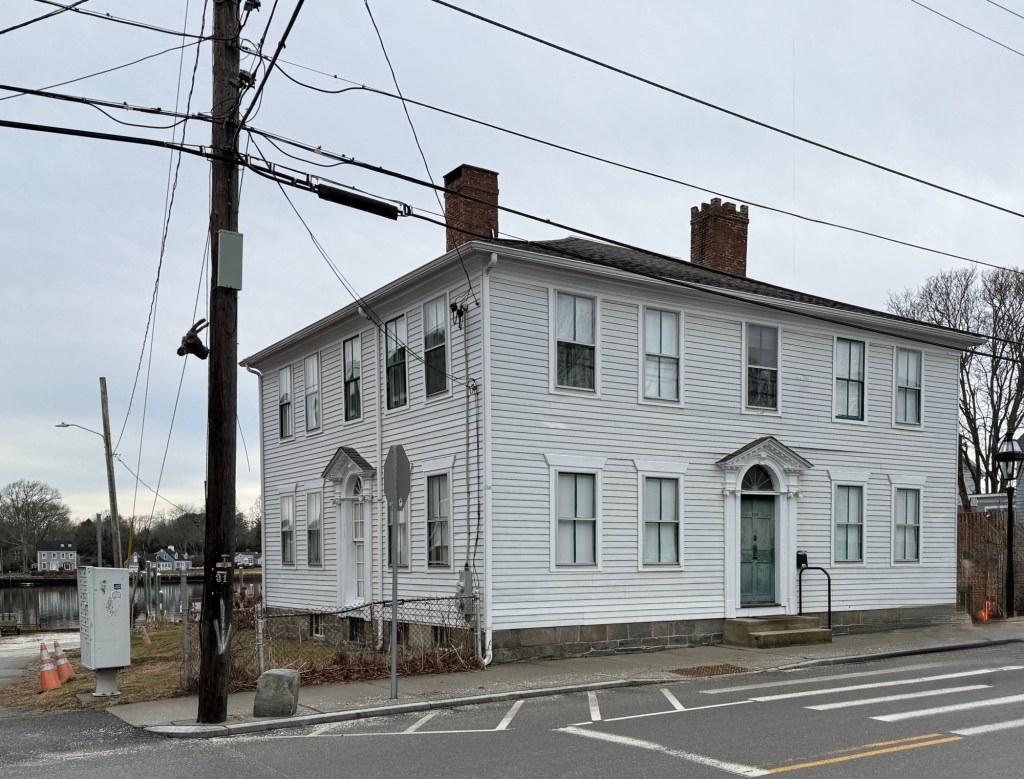
Simeon Ingraham House // 1795

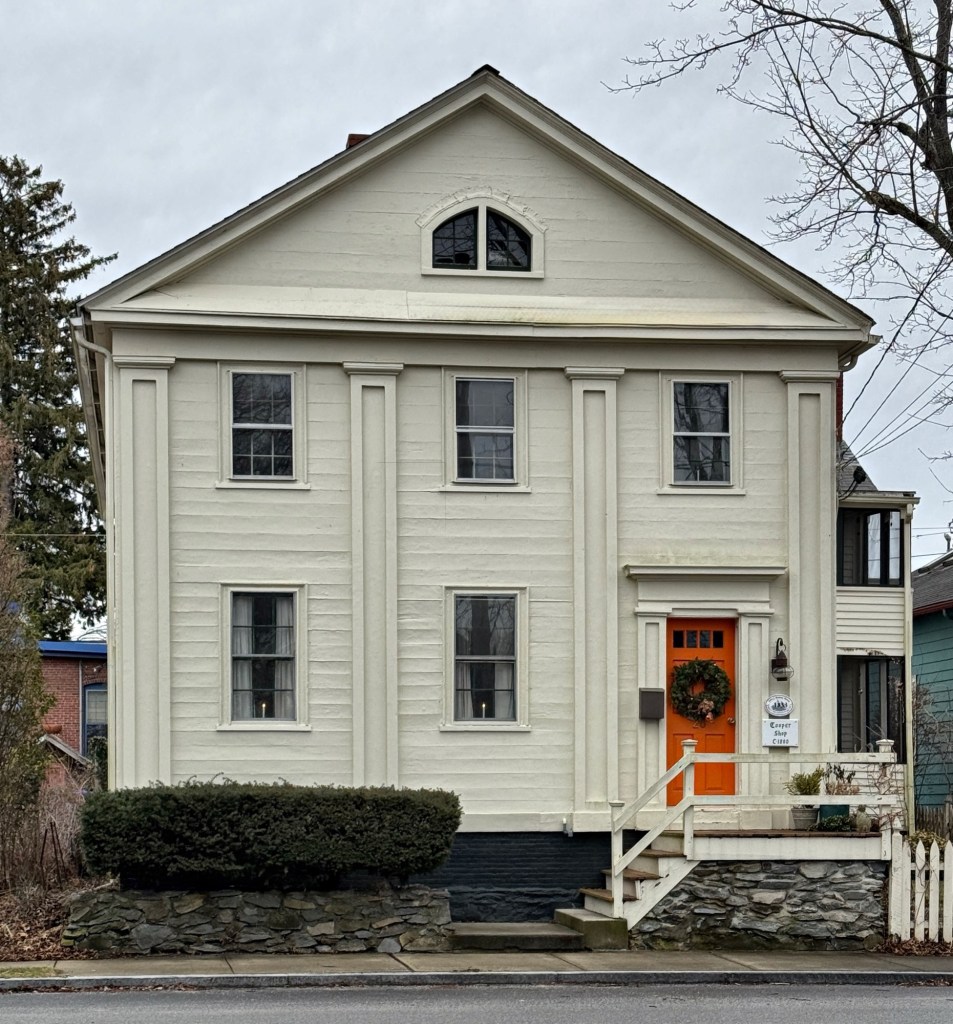
Simeon Ingraham (1749-1840), a housewright (house builder) purchased a corner lot on Wickenden Street in the Fox Point area of Providence in 1795, and constructed this absolutely stunning late-Georgian home that has survived centuries of commercialization and Urban Renewal of the surrounding area. In the early decades, Simeon purchased lots nearby and built houses, selling them for profit, and repeating this until his death in 1840. Simeon left no will, and the property was eventually purchased by his eldest son, Solomon, who bought out all of his other heirs for their shares of the property. Solomon allowed his widowed stepmother to reside in the home until her death in 1851. Solomon operated a store nearby, and it was likely he who jacked up the house, adding the brick ground floor for commercial purposes in the 1850s, coinciding with the increased commercialization of Wickenden Street. When the house was raised, the former center entry (now on the second floor) was turned into a window, with the doorway placed in the new brick level. Changes like these showcase how buildings are vessels of history, informing later generations of the layers of history that our cities and towns experience over time.

Cheapside Block // 1880

The Cheapside Block on N. Main Street in the East Side district of Providence, Rhode Island, is significant as a remaining Victorian-era commercial block that retains much of its original architectural detailing. Built in 1880 and designed by local architects Stone & Carpenter, the Cheapside Block was named after the early nineteenth century name given to the commercial district running along the west side of Main Street, north from the eighteenth century Market House, after the London commercial district of the same name. The word “cheapside” is derived from the Anglo-Saxon word “to barter.” The block here is an excellent example of the High Victorian Gothic architecture style, with intricate brick and stonework, pointed gables with inlaid tile, quatrefoil motif in the parapet, and the original cast iron storefronts. The building was acquired by the Rhode Island School of Design and renovated in the 1980s. Today, the Cheapside Block is home to the RISD Design Center

Joseph Brown House // 1774

Constructed in 1774 by architect Joseph Brown (1733-1785) of the Brown family of Rhode Island as his personal residence, the John Brown House of Providence, stands as one of the oldest (if not the oldest) house built by an American architect for his own use. Joseph Brown, while a member of the Brown Family, was not as much in the shipping business as others in his family, instead turning his attention to scientific matters, becoming an expert in astronomy, electrification, and architecture. He was an architect in the Thomas Jefferson-gentleman mode, owning English architectural books from which he selected motifs for inclusion in his designs. It is believed that the eccentric curved ogee gable that caps the façade was adapted from the roof design of a garden house published in William Salman’s Palladio Londinensis, owned by Joseph Brown’s builder, Martin Seamans. The same ogee gable was later replicated in the Colonial Revival period in Providence. The residence’s entrance was originally raised above ground and accessed via symmetrical flights of stairs; in the late 18th century, the entrance was moved to street level in the brownstone basement level. Over a decade after Joseph’s death in 1785, the structure was acquired by the Providence Bank, an enterprise founded by Brown’s brothers John and Moses, and used as an office. The bank occupied the structure until 1929, and the Joseph Brown House was subsequently owned by the Counting House Corporation, and still appears to be owned by descendants of the Brown Family.

Pawtucket Hair Cloth Mill //1864

Despite its name, this handsome mill structure, known as the Pawtucket Hair Cloth Mill, is actually located in Central Falls, Rhode Island. The building, located on Roosevelt Avenue on the banks of the Blackstone River, is a great example of a Civil War-era mill, built for one of the many wool and cloth companies in New England. Begun in a small factory across the street in 1856, this business became successful after the acquisition of patents for weaving haircloth (most of the raw material for which originally came from Russian horse markets) for upholstery, crinolines, and inner linings. The company is said to have once been the largest producer of haircloth in the world. The Italianate style mill stands pretty much as built, besides the tower that has lost its low pyramidal cap. The building was one of the first commissions by great Rhode Island architect, William Walker, who was just 34 at the time of designing this large, and complicated structure.

Kennedy-Stafford Mill // 1825

One of the oldest mills in Central Falls, Rhode Island, is this four-story brick building constructed in 1825 is important as one of the earliest extant brick mills in Rhode Island, at a time when such buildings were shifting from wood construction to fire-proof brick or stone construction. Built on one of the first industrial sites in the city, along the Blackstone River, the mill was originally constructed for a John Kennedy as a cotton manufactory. The complex was purchased and expanded in the 1860s by the Stafford Manufacturing Company, who built a new dam on the river and extension to the 1825 building. The structure features a five-story square end tower with freight doors, and a monitor roof which runs the span of the original 1825 building, terminating where the Stafford Company addition begins. Originally, canals flowed directly under the building, powering the building and three mills downstream, but they were filled in by 1965. Elizabeth Webbing started in the Kennedy/Stafford mill buildings in 1933. After over 70 years of making cloth straps used for seat belts, dog collars, luggage straps and more, it ceased operations in March of 2001. The complex, which included 19 nearby mill buildings, was split up and sold off. In 2007 work began on converting the former mill to residential use with the first phase of the project opening to tenants in 2009. It’s another great example of adaptive reuse into housing, the best type of project!

George M. Thornton House // c.1870

One of the finest homes in Central Falls, Rhode Island, is this eclectic Victorian residence on Clay Street. The home was seemingly built around 1870 and modified by the end of the 19th century by later owner, George Mumford Thornton (1850-1916). Mr. Thornton was an industrialist who was elected as one of the first aldermen when Central Falls incorporated in 1895. The well-preserved house features varied siding, a rounded corner tower with spiral-columned porch and conical roof, and original multi-light sash windows. What a spectacular home.

Samuel B. Conant House // 1895

Built in 1895 for Samuel Conant, president of a Pawtucket printing firm, this stately residence is one of the finest Colonial Revival houses in Central Falls, Rhode Island. Designed by the Providence architectural firm of Stone, Carpenter & Willson, the house is brick on the first floor with clapboard siding above. The Contant house has a gambrel roof punctuated by several gable dormers. The main facade has two symmetrical round bays, which rise to the roof and are topped by low balustrades. A single-story porch extends between the center points of these bays, and is also topped by a low balustrade. Recognized for its architectural grandeur (inside and out), the house was individually listed on the National Register of Historic Places. The Conant House is now used as a nursing home and while the transition to this new use has required a number of interior alterations, these changes have been made with sympathy for the character of the house and many of them are reversible.

Benjamin F. Greene House // 1868

Built for Benjamin Franklin Greene, a second-generation mill owner of the Greene and Daniels Thread Company in Central Falls, Rhode Island, this large, Second Empire style house is one of the finest of its style in the entire state. The house is one of only a few high-style residences left from the mid-nineteenth century in Central Falls, when industrialization’s full expansion provided manufacturers such as Greene with fortunes to be expended on their houses. Designed by Providence architect Clifton A. Hall, the ornamentation of the Greene House is extraordinary for its elaboration, relieving the severity of the simple, block-like shape of the house. The central door is set under a flat-roofed porch which is supported by trios of Corinthian columns. Above the porch a trio of round-head windows is set under a “sunbonnet” gabled dormer which caps the central pavilion, is supported by brackets, and encloses a round-head window with a small balcony. What a spectacular home!

David G. Fales House // c.1858

The David G. Fales House of Central Falls, Rhode Island, is an excellent example of the Second Empire architecture style in a high-end residence. The home was built around 1858 and belonged to David Gilmore Fales (1806-1875), one of the partners of the nearby Fales and Jenks machine works. Mr. Fales either built or purchased the home which was then a flat-roofed Italianate style home, and hired architect Clifton A. Hall, to modernize the residence, adding trim and the mansard roof. Its broad eaves are supported by brackets with pendants; segmental-head dormers are set in the mansard and a square belvedere with round-head windows tops the roof. A major fire gutted much of the house in the 1960s, and its future was uncertain. It was preserved and is now a multi-family apartment building.