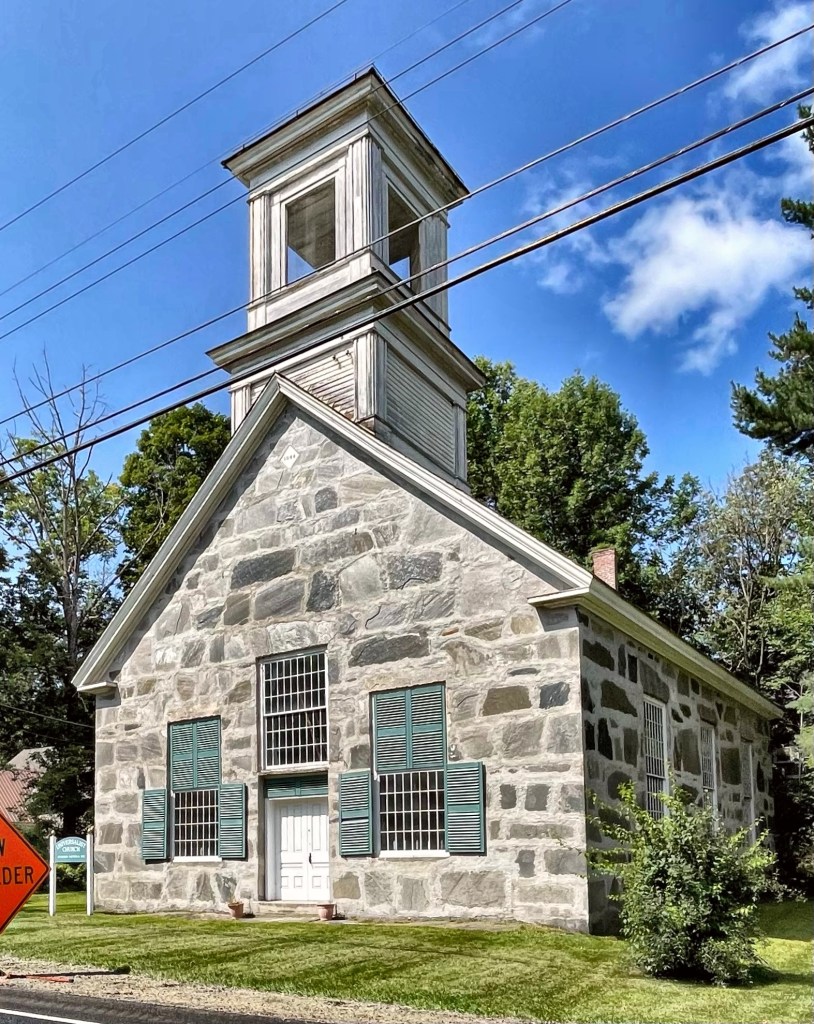
Oh Snecked Ashlar… the iconic vernacular building style that was seen in south-central Vermont in the middle of the 19th century. The Cavendish Universalist Church was built in 1844 by Scottish immigrant stonemasons who had moved to the area ten years earlier from Canada. These builders constructed houses, schools, and churches in Windsor County and nearby, using traditional building techniques they likely brought to North America from Scotland. This church in Cavendish was built under the leadership of Rev. Warren Skinner, an avid abolitionist and was part of the “above ground” railroad in Vermont. The church was decommissioned in the 1960’s from a shrinking congregation and was leased to the Cavendish Historical Society in the 1970’s. While work has been done to maintain the building, it is in need of repairs. In recent years, the Universalist Unitarian Convention of Vermont and Quebec has agreed to deed the building to the town of Cavendish on May 11, 2013. The structure has been restored, and apparently houses exhibition space inside.
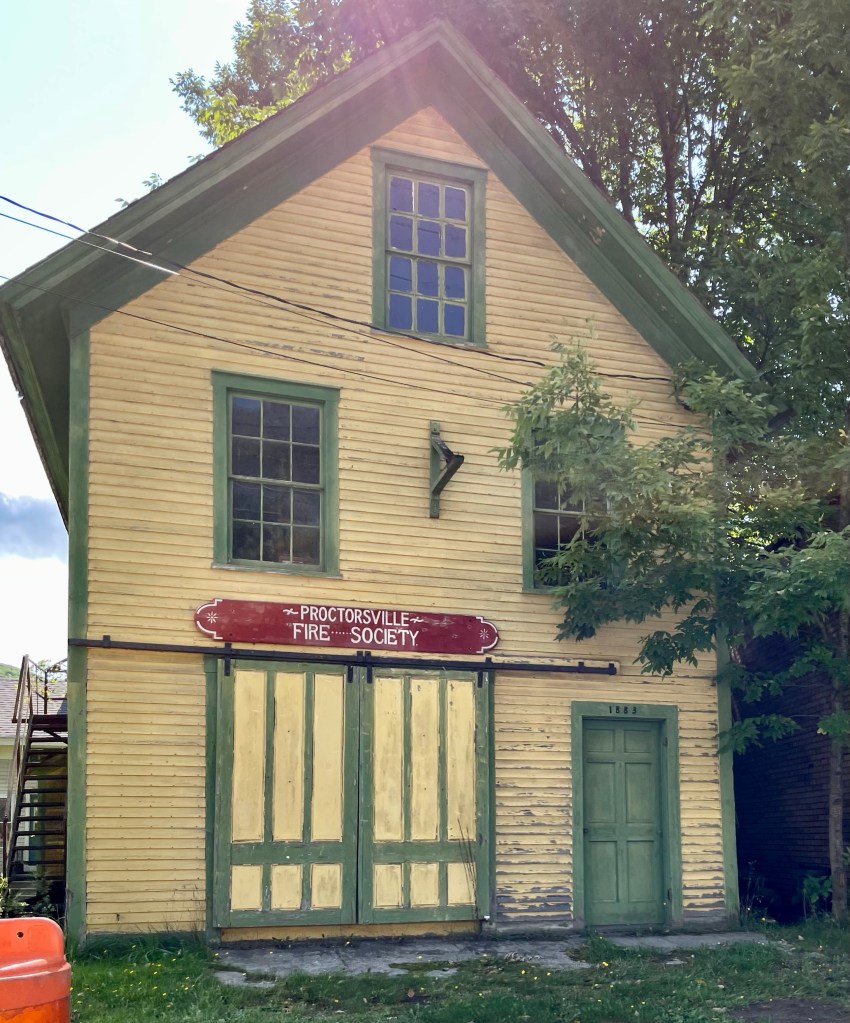
Industrial villages like Proctorsville in Cavendish, Vermont, have always been susceptible to fire and complete destruction. As a result, many such villages erected firehouses or barns where apparatus (and sometimes horses) would be kept in case of emergency. The Proctorsville Volunteer Fire Department was formed in 1883, and this structure was built to house the fire apparatus and possibly a small apartment or living quarters above. Today, the building appears to be home to the Fire Society.
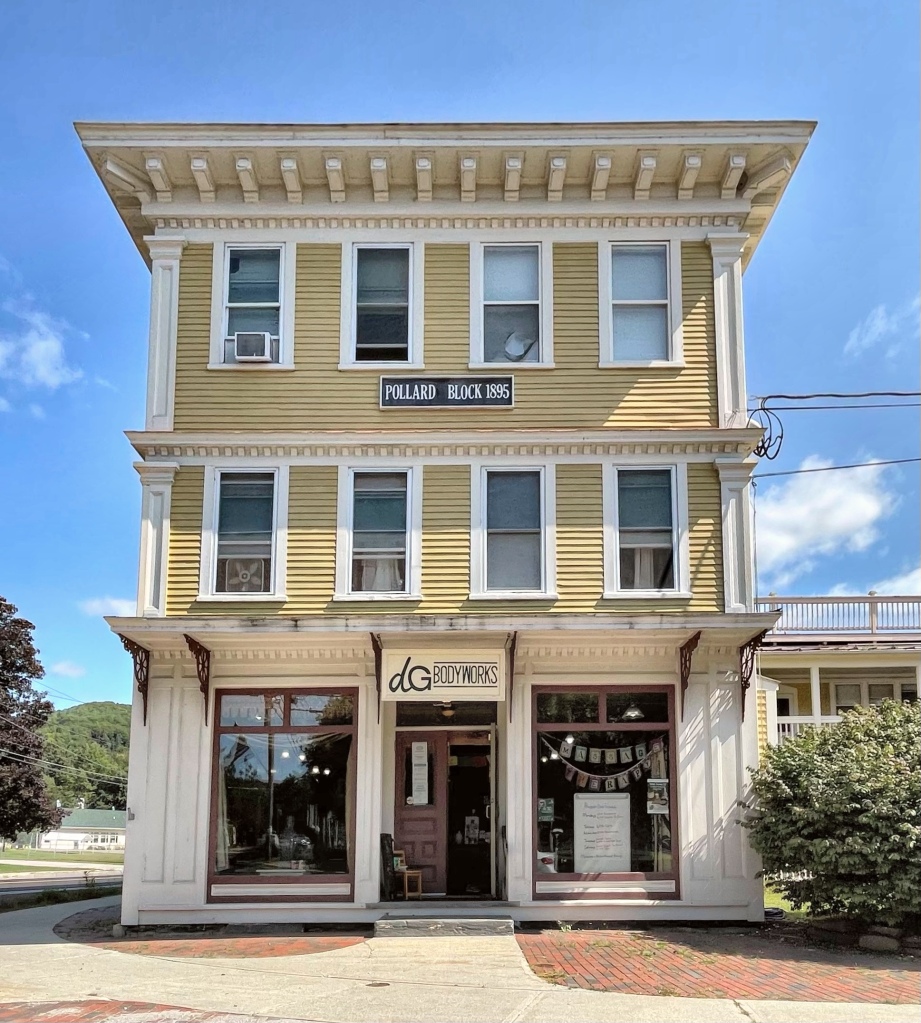
Proctorsville Village (in present-day Cavendish, Vermont) was established in last decades of the 18th century along the Black River, where the slope allowed for suitable locations for small water-powered mills. The community grew slowly for the early part of the 19th century as farmers, craftsman and merchants established enterprises around the handful of small mills built along the river. The establishment of the Central Vermont Railroad through the village aided manufacturing expansion, and by the late 1800s, Proctorsville was home to many large mills. As employment in the mills grew, the local economy shifted from the barter economy of a farming community to a cash-based economy generated by wage employment. The general store was essential to this transition supplied the townspeople with essential goods via the railroad, and the major store in Proctorsville was the Pollard General Store. Don Carlos Pollard (1840-1921) was born in Plymouth, Vermont and opened his first store there under his father’s name. He moved to Proctorsville in 1860 and opened a general store in the village. The store was an immediate hit, and later managed by Don’s two eldest sons, Fred and Park out of a brick building. A fire destroyed the brick building in 1895, but construction began of a new building immediately that same year. The present wood-frame building exhibits the retail presence and early commerce in many small villages in New England. It blends Italianate and Classical Revival details with the bracketed eaves and one-story corner pilasters and dentils. Swoon!
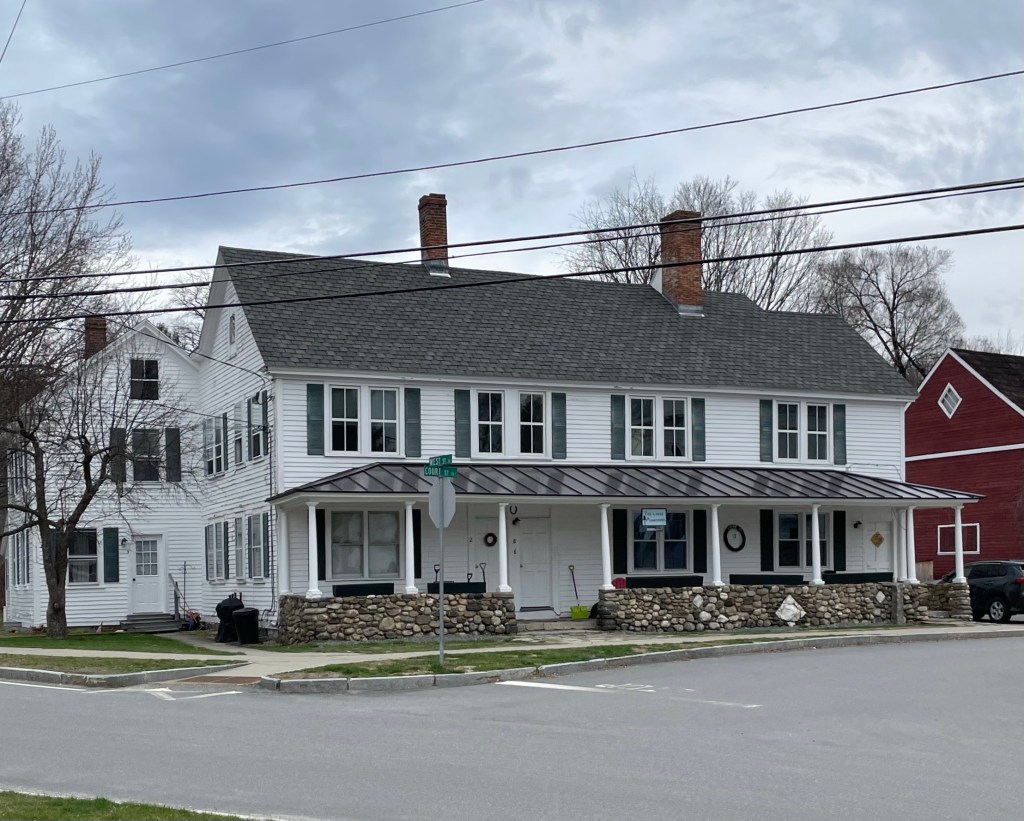
Constructed circa 1830 for Anthony Jones, this clapboard building in Newfane, Vermont originally contained tenements and was called the “long building” during the nineteenth century. Around the turn of the 20th century, a federal judge acquired the building and some of its rooms were used as offices during sessions of the county courthouse across the street. Subsequently, the local Odd Fellows Group (I.O.O.F.) occupied a hall on the second story, and for a half century after 1910, part of the first story served as Newfane’s telephone exchange. In 1971, the building was converted to apartments and has remained so since that time.
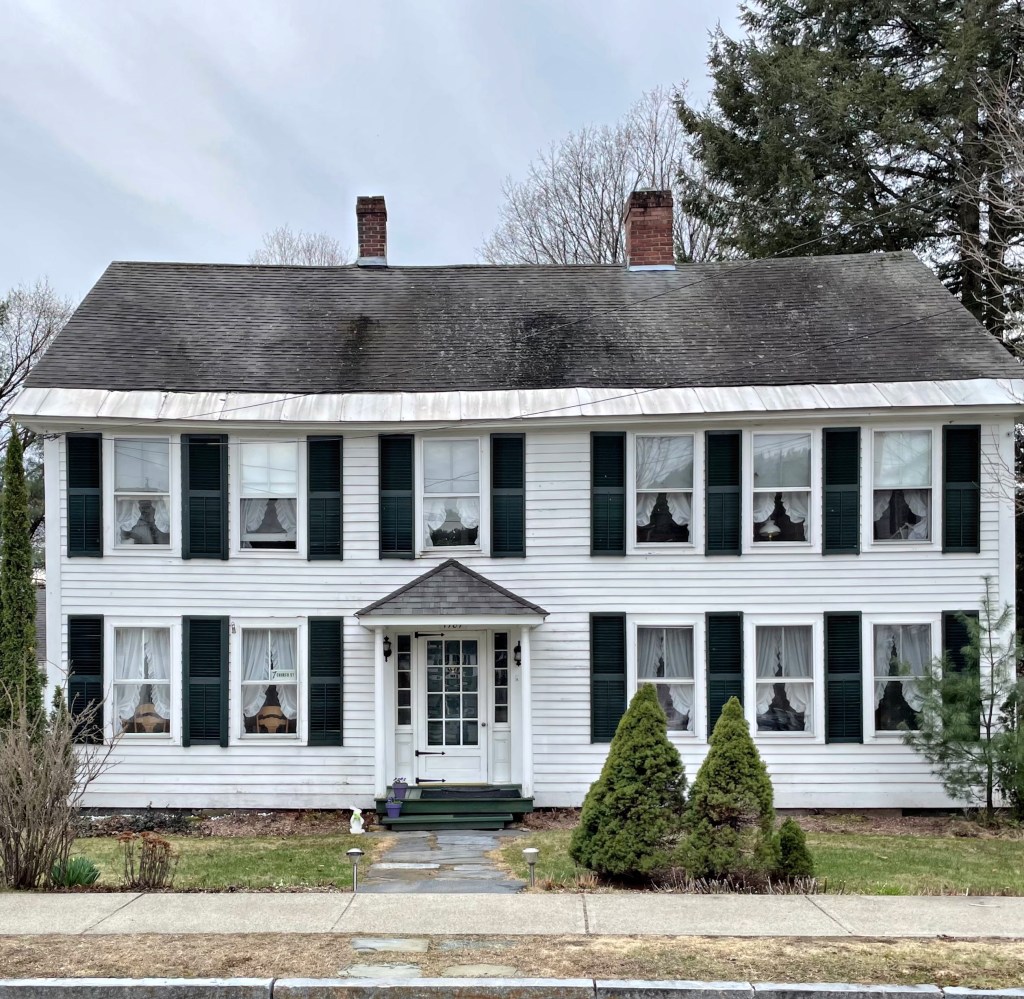
Among the earliest buildings in Newfane, this plain two-and-a-half-story, wood-framed and clapboarded gable-roofed house was constructed on its original site on Newfane Hill in 1787 to serve as the county jail. When the residents in town found that living on a hill in winter was less than ideal, much of the town relocated to the flat of town. In 1825, this building was dismantled and moved to its present site. With a new jail being built already, this building was reconstructed as the residence of Anthony Jones, an early resident and businessman. During the middle decades of the century (c.1840-1880), the house served as the Congregational Parsonage for the adjacent church.
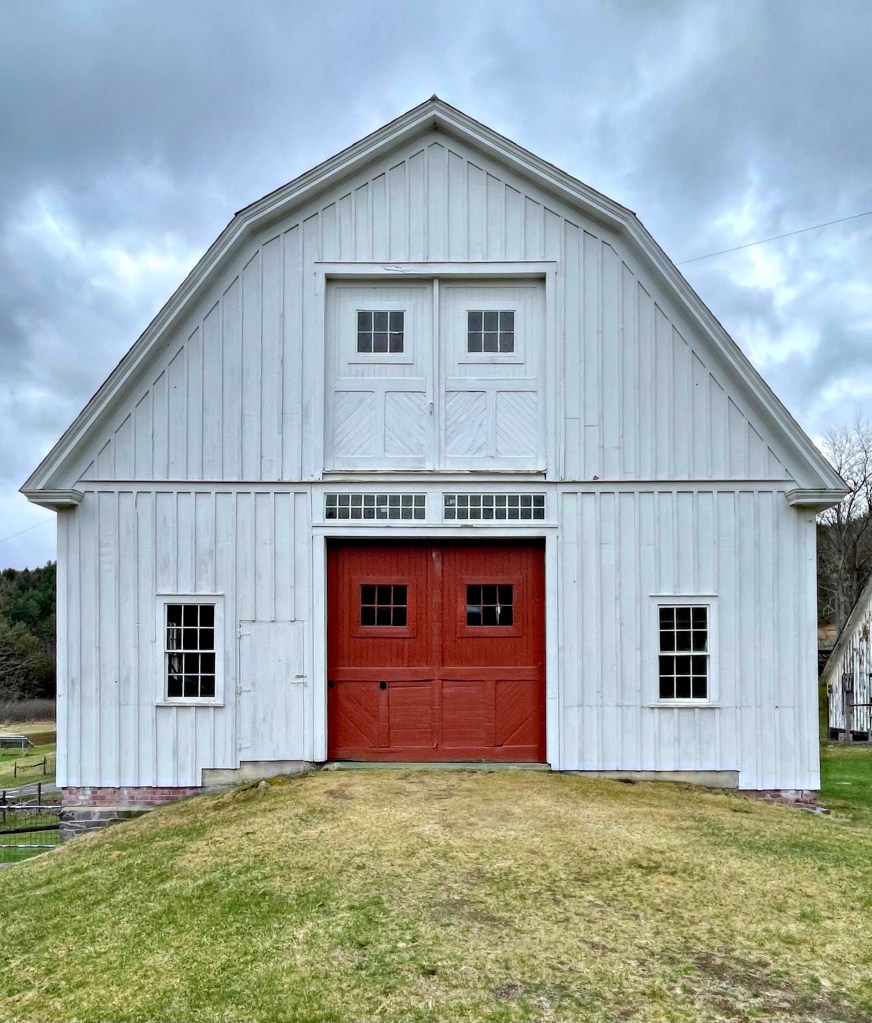
You saw the cow barn at Scott Farm, now you can see where the horses lived! The Horse Barn at Scott Farm in Dummerston, Vermont is a very photogenic building with its symmetrical facade and bright colors. The barn was built not long after Frederick Holbrook II of Boston acquired most of the farm to add to Naulakha, where he lived. Holbrook used the farm as a gentleman’s farm where he would have laborers managing the grounds and supplying him with the freshest produce and dairy products. Inside, there is a ramp down to the basement which still retains the horse stalls, it’s so charming!
Scott Farm, established as a working farm in the late 18th century and as a commercial apple orchard in 1911, is an excellent example of the vernacular architecture that Vermont is known for. The sprawling 571-acre farm was established in Dummerston in 1791 and purchased by Rufus Scott in the mid-1800s. In the 1840s, he built this farmhouse and many of the barn buildings soon after. The five bay Greek Revival house is in a Cape form and retains its historic slate roof and detailing. The property has been owned since 1995 by The Landmark Trust USA, a non-profit organization whose mission is to preserve historic properties through creative sustainable uses for public enjoyment and education. The farm sits a short drive to Naulakha and the Dutton Farmhouse (both featured previously) which are also managed by the Landmark Trust USA.
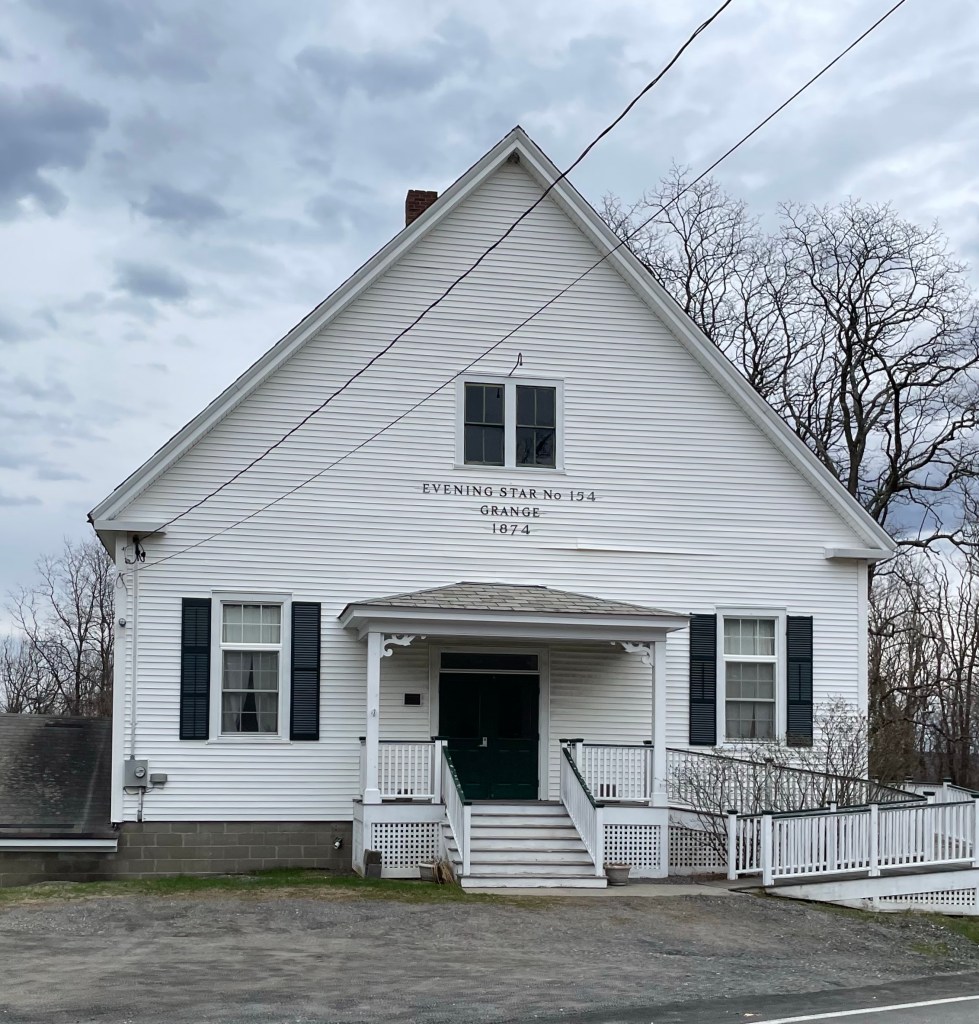
Rural New England towns like Dummerston, Vermont long relied on agriculture as a means of life. From this, local farmers and their families would organize in regional Grange Halls through the The National Grange of the Order of Patrons of Husbandry, an agricultural advocacy group. Many rural communities in the United States still have a Grange Hall and local Granges still serve as a center of rural life for many farming communities. The local Evening Star Grange was organized in Dummerston Center in 1874 with 32 members, growing by the end of the 19th century. This building would have held meetings where farmers could share trade secrets, make deals, and “talk shop” regarding farm life. Such buildings are significant as community centers for agricultural communities and should be preserved for future generations.
Another one of the Landmark Trust USA properties in Dummerston, Vermont is the Dutton Farmhouse, a meticulously restored Greek Revival farmhouse from around 1840. The gable-roof farmhouse was possibly an addition to an earlier dwelling built decades earlier as a one-and-a-half-story center-chimney home, seen at the rear today. The first known owner of the farmhouse was Asa Dutton who farmed off the large orchards. Generations later, the farmhouse served as a dormitory for migrant laborers who worked nearby, with the interior being altered. The property was eventually gifted to the Landmark Trust USA, who began a massive restoration project on the home, uncovering original detailing and even historic wallpaper! The house has since been meticulously restored and preserved and is available for short-term rentals! The charming interiors and near silence outside is a perfect getaway from city life.
Located on a hillside in rural Dummerston, Vermont, you will find Naulakha, one of the most significant properties in the region. Naulakha (pronounced now-LAH-kuh) was built in 1893 for Rudyard Kipling an english journalist and author born in British India, an upbringing which inspired much of his professional work. In 1892, Kipling married Caroline Balestier, who was born into a prominent New England family. The couple honeymooned in Vermont near Carrie’s family home. The couple would settle in Vermont in a cottage which was soon outgrown, leading the couple to buy 10 acres of land from Carrie’s brother Beatty Balestier and built their own house. The new Shingle-style home they had built was named Naulakha after a book written by Rudyard and Caroline’s late-brother Wolcott. Kipling wanted a home that merged the distinctive qualities of the Indian bungalow with those of the American Shingle Style and he worked closely with his architect, Henry Rutgers Marshall of New York City, a Balestier family friend to achieve this.
The rectangular mass of the home parallels the contours the hill upon which its sited, and sits atop a raised fieldstone basement salvaged from stone walls on the property. From the home, Kipling wrote some of his most influential work, including the Jungle Books (1894, 1895), Captains Courageous (1896,The Seven Seas (1896), and The Day’s Work (1898). Sadly, the Kipling’s moved out of Naulakha after just a few years, largely from familial disputes with Caroline’s brother, Beatty. The family removed to England where they settled, though Rudyard always mentioned how much he missed his secluded life in Vermont. The property was then purchased by the Holbrook family, who made slight modifications to the property, but all maintaining the original design and feeling. In 1992, the British-based Landmark Trust acquired Naulakha as its first American building, later creating the Landmark Trust USA to maintain the property and more. The Landmark Trust USA rents out Naulakha and the adjacent carriage house for short-term rentals to provide revenue for maintaining these properties.
For more on my stay at the absolutely stunning Kipling Carriage House, check out my later blog post here.



 Buildings of New England