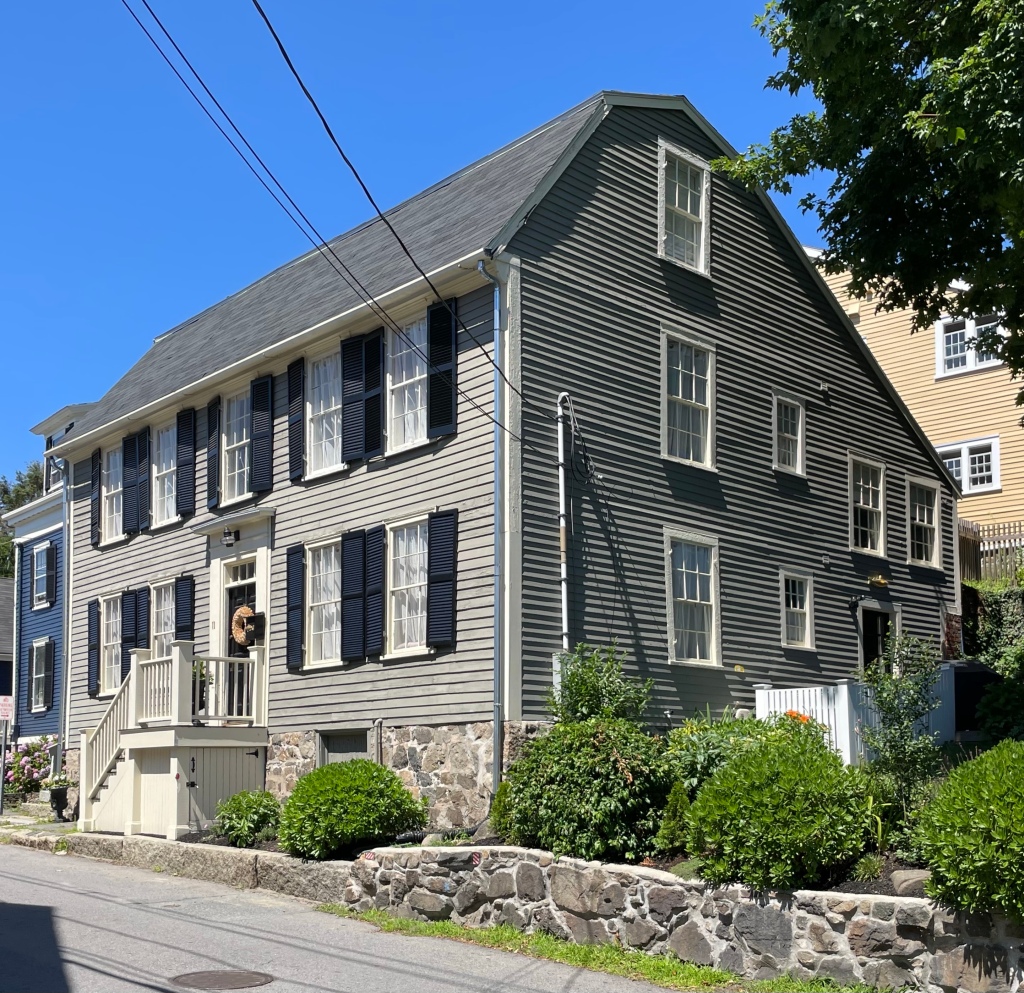
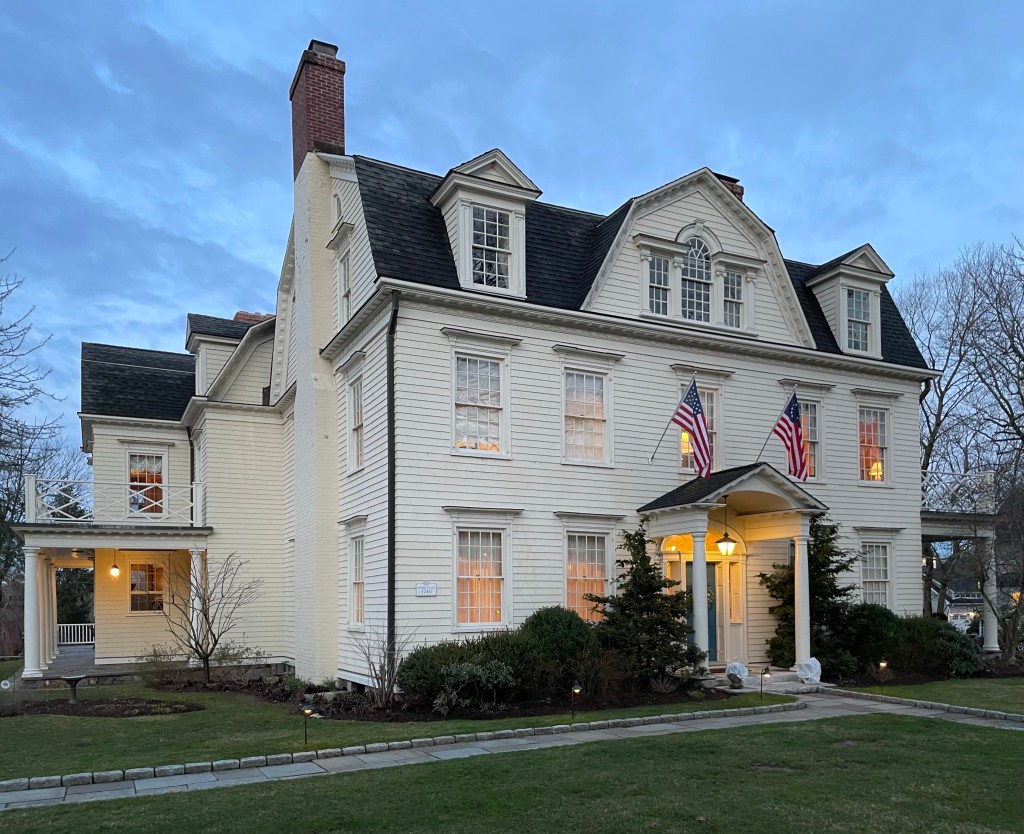
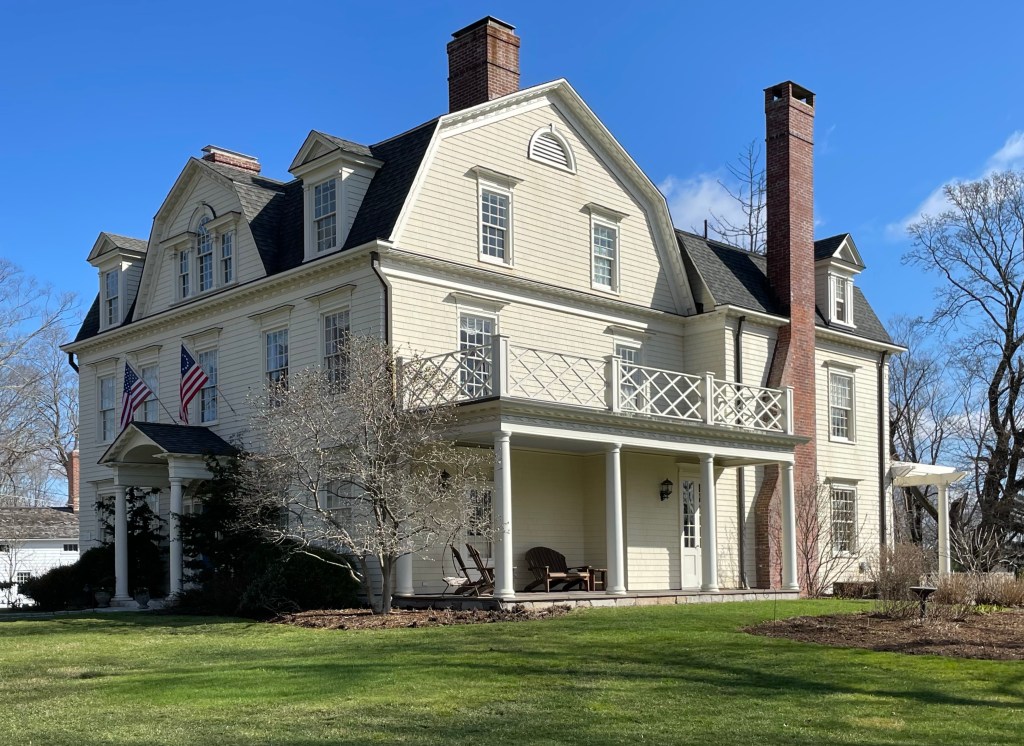
In 1720, James Pearson acquired a house lot on Windmill Hill in Marblehead, and he soon after built a house in the bustling harbor town. He lived in the house until 1734, when it was sold to a Giles Irwin. After Mr. Irwin’s death, it was conveyed to John Patton and John Bailey, both mariners, who likely split up the home inside. From this, fireplaces were punched into the central chimney inside, totaling 10 fireplaces in the home! John Bailey also worked as the Captain of Fort Sewall during the War of 1812. His wife Mary, served as temporary commander of Ft. Sewell after his death until a successor was appointed. The house eventually came under the ownership of siblings Carrie Florence Bessom (1867-1944) and her brother Frank Lewis Bessom (1870-1952). Florence operated an antiques store in town and Frank worked as a welfare commissioner. The home is a great example of a Georgian, Colonial-era home with a gambrel roof and even has the two (what I believe to be) separate coal doors in the raised stone foundation when the home was occupied by two families.
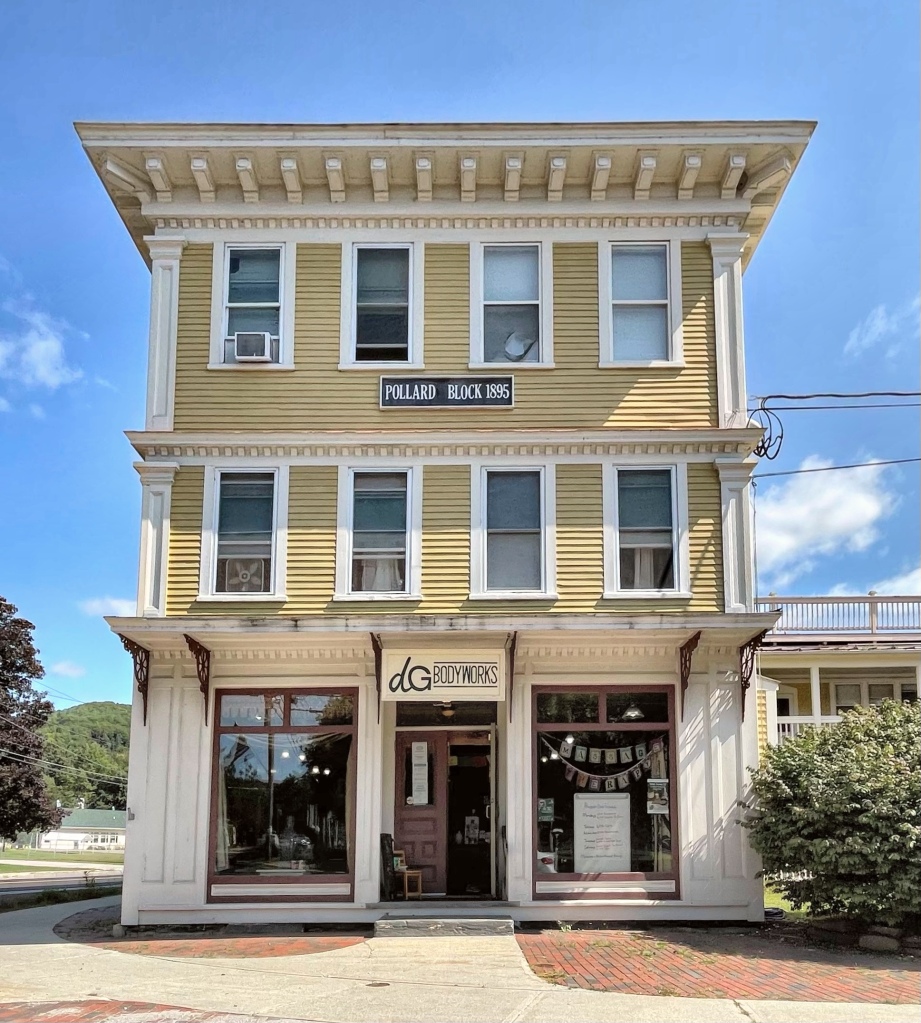
Proctorsville Village (in present-day Cavendish, Vermont) was established in last decades of the 18th century along the Black River, where the slope allowed for suitable locations for small water-powered mills. The community grew slowly for the early part of the 19th century as farmers, craftsman and merchants established enterprises around the handful of small mills built along the river. The establishment of the Central Vermont Railroad through the village aided manufacturing expansion, and by the late 1800s, Proctorsville was home to many large mills. As employment in the mills grew, the local economy shifted from the barter economy of a farming community to a cash-based economy generated by wage employment. The general store was essential to this transition supplied the townspeople with essential goods via the railroad, and the major store in Proctorsville was the Pollard General Store. Don Carlos Pollard (1840-1921) was born in Plymouth, Vermont and opened his first store there under his father’s name. He moved to Proctorsville in 1860 and opened a general store in the village. The store was an immediate hit, and later managed by Don’s two eldest sons, Fred and Park out of a brick building. A fire destroyed the brick building in 1895, but construction began of a new building immediately that same year. The present wood-frame building exhibits the retail presence and early commerce in many small villages in New England. It blends Italianate and Classical Revival details with the bracketed eaves and one-story corner pilasters and dentils. Swoon!
One of the best examples of a temple-front Greek Revival house in the state of Vermont is this stunner, found in Newfane Village. The house was constructed in 1832 for General Pardon T. Kimball (1797-1873), a cattle-broker, general of the state militia and later, a state senator. Kimball made a name for himself locally as he donated much of his money to social causes, from a local almshouse to other charitable organizations. Kimball died in 1873 after falling from his carriage. The house was converted to an inn in 1965-6 and has since been known as the Four Columns Inn, so-named after the four monumental Ionic columns that dominate the house’s facade.
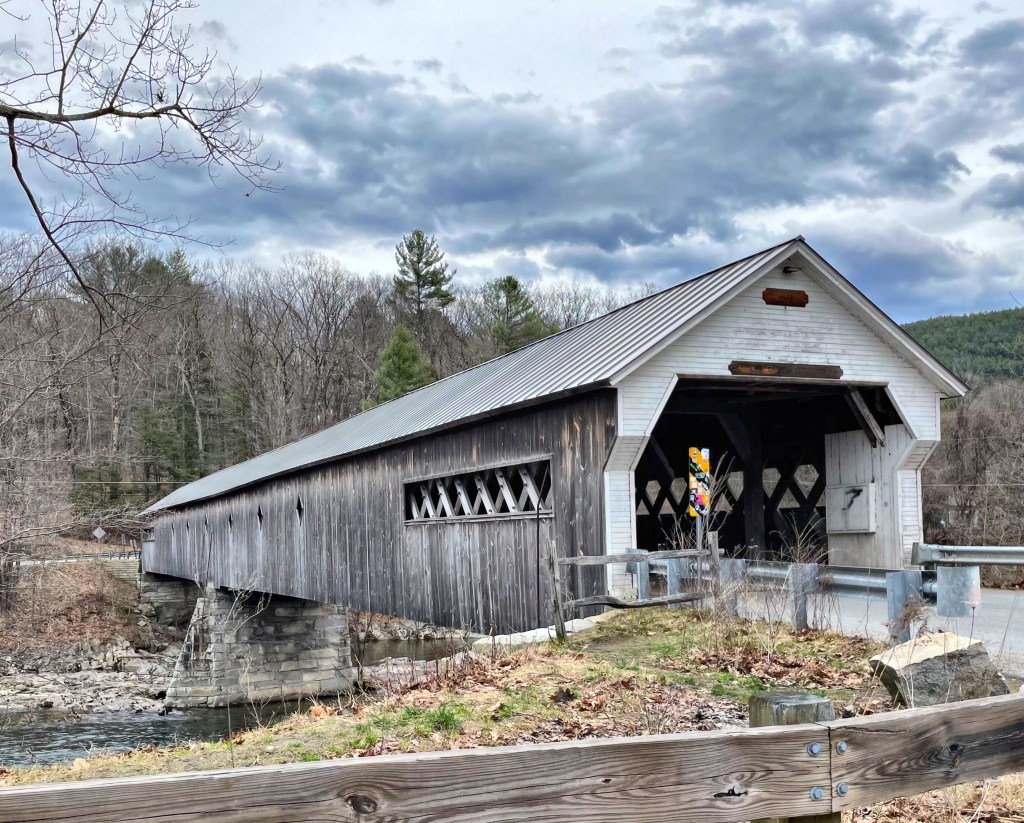
Oh covered bridges, one of the many symbols of New England that always give me joy when I see them! This beauty was constructed in 1872 to span the West River in Dummerston, Vermont and is the longest that is wholly within the State of Vermont. The bridge was designed by Caleb B. Lamson, a master carpenter and the bridge is the only known bridge built by Lamson that survives. Vermont is significant for covered bridges as about one hundred bridges still stand in the state, which is probably the greatest concentration by area of covered bridges in the nation. A reason we have to thank Vermont for this is purely population. With more people living in the state, transportation demands change, and these bridges are often replaced with modern steel structures. Keep doing you Vermont!
Located on a hillside in rural Dummerston, Vermont, you will find Naulakha, one of the most significant properties in the region. Naulakha (pronounced now-LAH-kuh) was built in 1893 for Rudyard Kipling an english journalist and author born in British India, an upbringing which inspired much of his professional work. In 1892, Kipling married Caroline Balestier, who was born into a prominent New England family. The couple honeymooned in Vermont near Carrie’s family home. The couple would settle in Vermont in a cottage which was soon outgrown, leading the couple to buy 10 acres of land from Carrie’s brother Beatty Balestier and built their own house. The new Shingle-style home they had built was named Naulakha after a book written by Rudyard and Caroline’s late-brother Wolcott. Kipling wanted a home that merged the distinctive qualities of the Indian bungalow with those of the American Shingle Style and he worked closely with his architect, Henry Rutgers Marshall of New York City, a Balestier family friend to achieve this.
The rectangular mass of the home parallels the contours the hill upon which its sited, and sits atop a raised fieldstone basement salvaged from stone walls on the property. From the home, Kipling wrote some of his most influential work, including the Jungle Books (1894, 1895), Captains Courageous (1896,The Seven Seas (1896), and The Day’s Work (1898). Sadly, the Kipling’s moved out of Naulakha after just a few years, largely from familial disputes with Caroline’s brother, Beatty. The family removed to England where they settled, though Rudyard always mentioned how much he missed his secluded life in Vermont. The property was then purchased by the Holbrook family, who made slight modifications to the property, but all maintaining the original design and feeling. In 1992, the British-based Landmark Trust acquired Naulakha as its first American building, later creating the Landmark Trust USA to maintain the property and more. The Landmark Trust USA rents out Naulakha and the adjacent carriage house for short-term rentals to provide revenue for maintaining these properties.
For more on my stay at the absolutely stunning Kipling Carriage House, check out my later blog post here.
Located on Main Street in idyllic Ridgefield, in Fairfield County, Connecticut, The Fountain Inn provides one of the most welcoming and historical bed and breakfast experiences in New England! The Fountain Inn was built in 1740 as a “city home in the country” for David Hoyt, who showed off his wealth and stature in the young town by having such a high-style home built at the time. Decades later during the Revolutionary War, David Hoyt’s house became a part of the Battle of Ridgefield. After defeating the Colonial militia elsewhere on Main Street, British Gen. William Tryon‘s troops turned their attention to nearby Keeler Tavern, the local militia’s headquarters, which just happened to be neighbors with the mansion owned by David Hoyt, a known Loyalist. General Tryon’s troops practiced their artillery-firing skills on the building pummeling it with cannonballs, sending a message to the head of the local militia. David Hoyt formally demanded a cease-fire, as he was concerned about wayward cannonballs damaging his home. By 1790, with Ridgefield’s British influence diminishing by the day, David Hoyt finally left his Connecticut home and sailed back to England. The home was expanded and modernized over the next two hundred years until the present owners purchased the property and underwent a massive restoration of the Colonial house inside and out as their family residence. In the past year, the inn opened as the Fountain Inn so-named after a Cass Gilbert-designed fountain across the street.
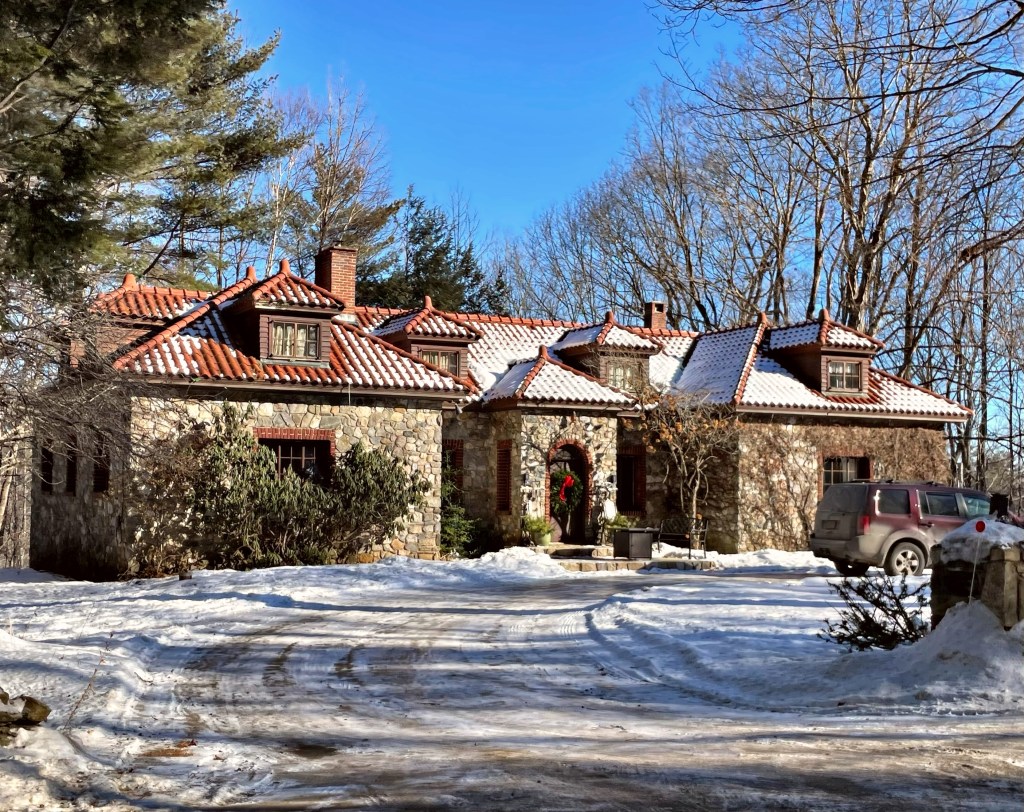
In the early 20th century, Norway, Maine and the surrounding towns were sought-after for their natural beauty with large lakes and rivers with untouched expanses of forest. Upper-middle class residents of Portland, Boston and other larger cities in New England built more rustic summer homes, compared to the elaborate “White Elephants” in Newport, Rhode Island. This home in Norway was named Wrightstone and was built in 1925 for the Wright Family. The U-shaped home is constructed from rubblestone, likely gathered from the land on which it sits. The house blends the Arts and Crafts movement with the uncommon (in Maine) Spanish Colonial Revival style, with the terracotta roof! I bet the interior is so cozy!
The Daniel Glazier Tavern is located at the west end of the Willington Green, an area showcasing great vernacular examples of Federal and Greek Revival architecture. The tavern was apparently built by Daniel Glazier as a stop along the route connecting Norwich, CT to Springfield, MA, where visitors could grab a bite to eat and/or stay the night to rest. Daniel’s son Isaac was the first tavern-keeper, followed by Daniel’s son-in-law Arial Eldridge until his death in 1849. The ballroom of the tavern had long been used in the winter months for town meetings, as he basement of the Town Meetinghouse, used for town meetings, lacked any form of heat. Since 2009, the property has been owned by the Willington Historical Society, who have restored the building.
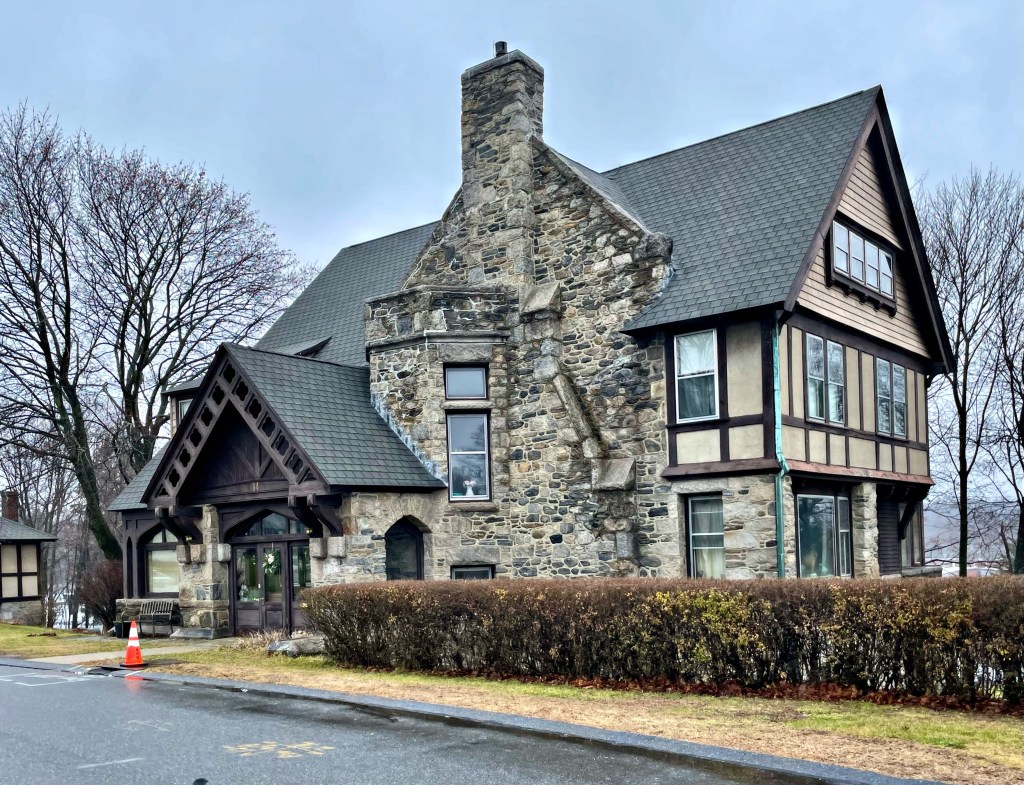
William “Willie” Winfred Windle (yes that is a real name) was born in Millbury at the height of the town’s industrial growth and prosperity. He ran the W.W. Windle Mill just west of downtown and with his wealth, was able to buy a house lot on one of the most fashionable residential streets in town. His home was built in the early 20th century and is a stunning example of Tudor Revival architecture. In 1911, Windle traveled to England to inspect mills there and was likely inspired by some of the residential architecture he viewed on the trip. The house elegantly blends stone walls with half-timbered wood, with a prominent entry. The timber and stone entrance porch which has decorative bargeboard and corbels, has been enclosed. The home remained in the Windle family at least into the 1940s, when it was occupied by William Winfred Windle’s son, Winfred Woodward Windle. By the 1970s, the home was occupied as the Millbury Society of District Nursing.




 Buildings of New England