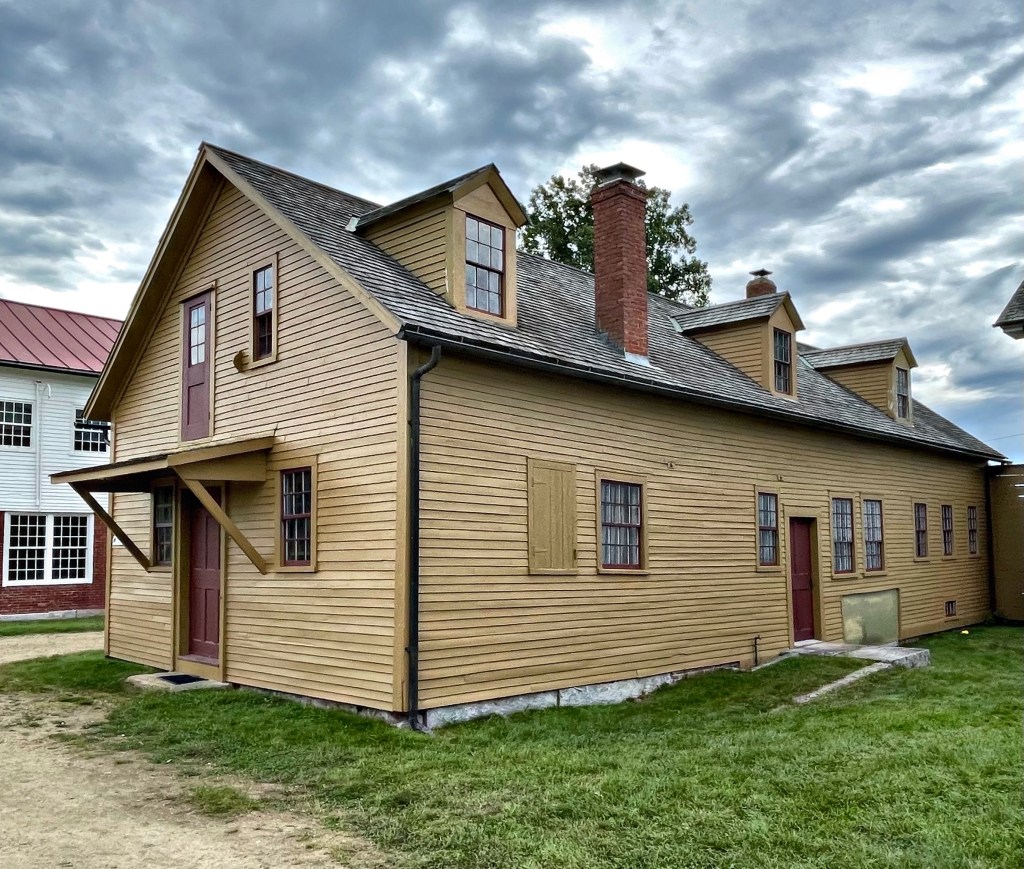
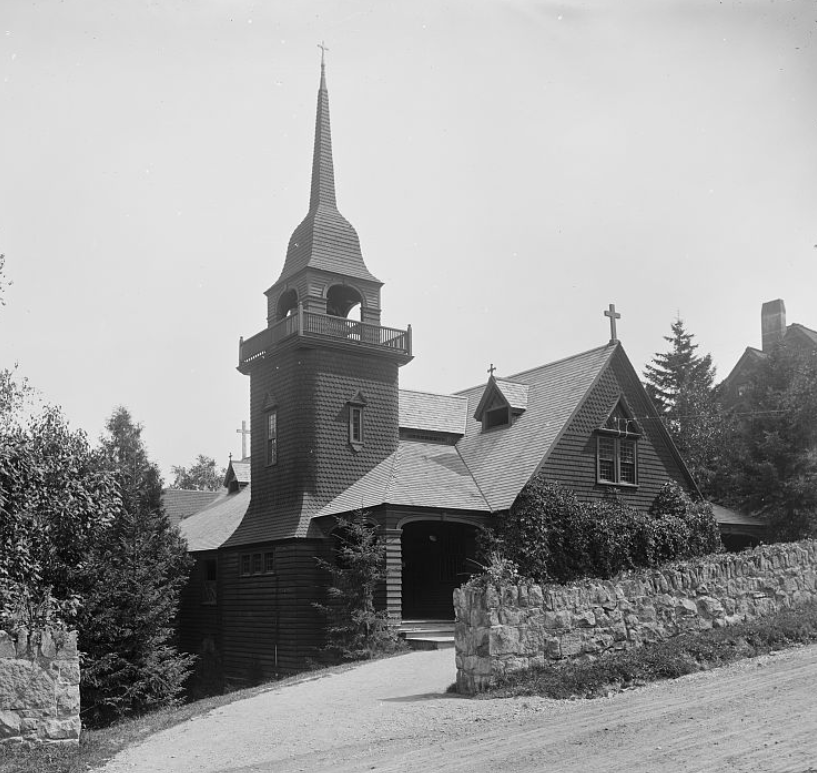
William “Willie” Winfred Windle (yes that is a real name) was born in Millbury at the height of the town’s industrial growth and prosperity. He ran the W.W. Windle Mill just west of downtown and with his wealth, was able to buy a house lot on one of the most fashionable residential streets in town. His home was built in the early 20th century and is a stunning example of Tudor Revival architecture. In 1911, Windle traveled to England to inspect mills there and was likely inspired by some of the residential architecture he viewed on the trip. The house elegantly blends stone walls with half-timbered wood, with a prominent entry. The timber and stone entrance porch which has decorative bargeboard and corbels, has been enclosed. The home remained in the Windle family at least into the 1940s, when it was occupied by William Winfred Windle’s son, Winfred Woodward Windle. By the 1970s, the home was occupied as the Millbury Society of District Nursing.
Completed in 1880, the Newport Casino building is one of the best examples of Shingle style architecture in the world, and despite its name, it was never a gambling facility. Planning for the casino began a year earlier in August, 1879. Per legend, James Gordon Bennett, Jr., the influential publisher of the New York Herald and a summer resident of Newport, bet his polo partner, Captain Henry Augustus Candy, a retired officer of the Queen’s 9th Royal Lancers and skillful British polo player, to ride his horse onto the front porch of the exclusive gentlemen’s-only club, the Newport Reading Room. Candy took the dare one step further and rode straight through the clubrooms, which disturbed the members. After Candy’s guest membership was revoked, Bennett purchased the land across the street from his home, on Bellevue Avenue, and sought to build his own social club. Within a year, Bennett hired the newly formed architectural firm of McKim, Mead & White, who designed the U-shaped building for the new club. The Newport Casino was the firm’s first major commission and helped to establish MMW’s national reputation. The building included tennis courts, facilities for other games such as squash and lawn bowling, club rooms for reading, socializing, cards, and billiards, shops, and a convertible theater and ballroom. In the 20th century, the casino was threatened with demolition as Newport began to fall out of fashion as a summer resort. Saviors Candy and Jimmy Van Alen took over operating the club, and by 1954, had established the International Tennis Hall of Fame in the Newport Casino. The combination of prominent headliners at the tennis matches and the museum allowed the building to be saved. The building remains a National Landmark for its connections with gilded age society and possibly the first commission by McKim, Mead and White, who became one of the most prominent architectural firms in American history.
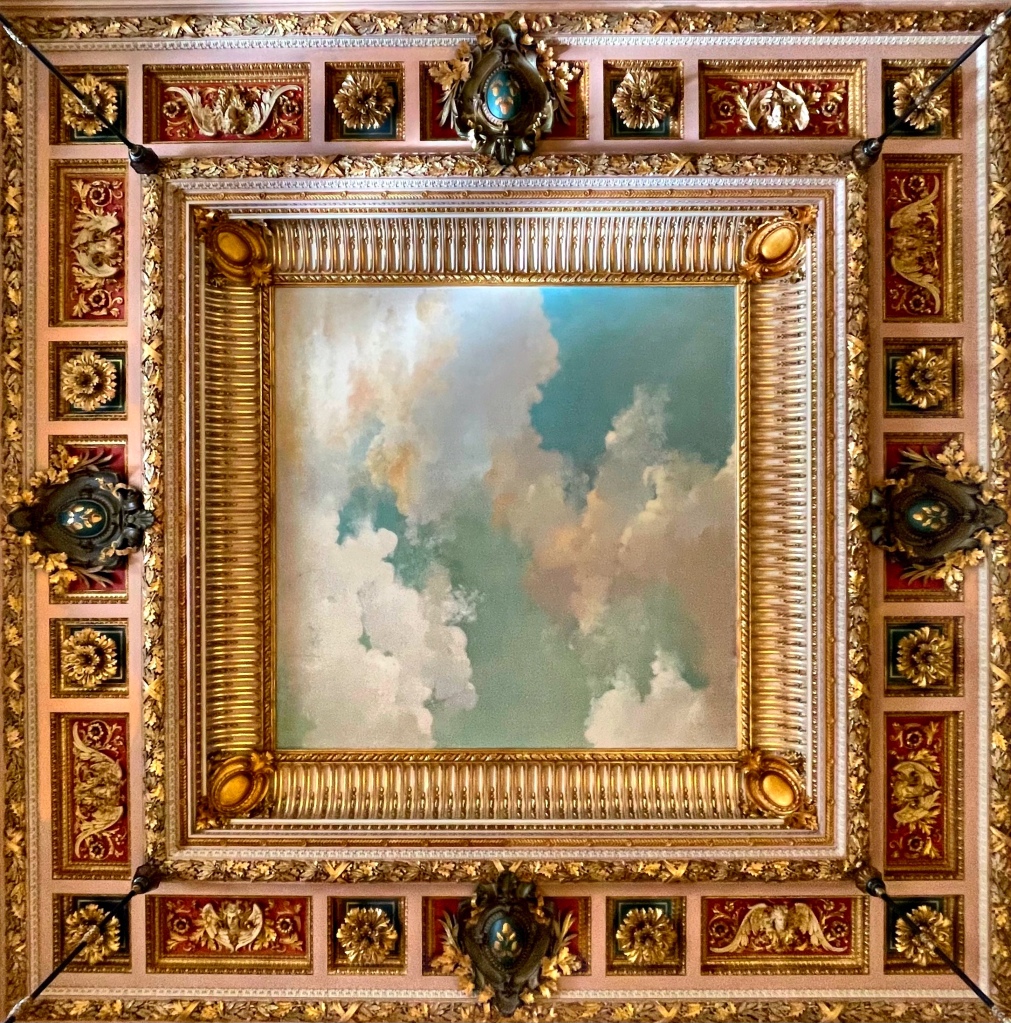
Merry Christmas from The Breakers! This 1895 Gilded Age mansion is the best to explore during December, when the halls are decked and stunning Christmas trees adorn the lavish rooms (learn more about the mansion in my last post) When you walk into The Breakers, you enter the Great Hall. Architect Richard Morris Hunt designed the Great Hall after the open-air courtyards in Italian villas, but enclosed due to the tough New England winters. The palatial space (measuring 50 foot square), even if crowded by tourists trying to get the perfect shot on their smartphones, feels spacious yet somehow welcoming given the art museum-like detailing. The walls are made of carved limestone from Caen on the coast of France and adorned with plaques of rare marbles. Elaborately carved pilasters decorated with acorns and oak leaves support a massive carved and gilt-cornice which surrounds a ceiling painted to depict a windswept sky, further expressing the open-air courtyard feeling envisioned by Hunt, the architect. Four bronze chandeliers dangle from the gilded ceiling, and flood the room with warm light, evoking warm summers in Italy.
Built about 1758, this Georgian house in Newport was the home of John Tillinghast, a representative to the Rhode Island General Assembly in 1744 and 1749, and a wealthy merchant and ship owner. It is not unlikely to assume that Tillinghast was involved in the slave trade and transportation of goods in the Indies, like many other wealthy Rhode Island merchants at the time. During the American Revolution, General Nathanael Greene was quartered in this house. Greene was born to a Quaker family in what is now Warwick, Rhode Island, but because of his military affairs, the pacifist Quakers disowned him. After several decisive victories against the British in the Carolinas, Greene was named Commander of the Southern Army, second in command to George Washington! Also during this time, two of Greene’s aides are said to have visited him while he resided at the house. One was the Lithuanian General Thaddeus Kosciuszko, an engineer who designed fortifications along Delaware River and West Point. Another was the Inspector-General of the Continental Army, German-born Friedrich von Steuben. This house is significant and shows the international nature of the War for Independence, which saw American forces joined by French forces and German mercenaries to fight the British. In the early 19th century, the home was occupied by William C. Gibbs, Governor of Rhode Island from 1821-1824. The high-style Georgian home has been enlarged over the years, but remains one of the most significant properties in the town!
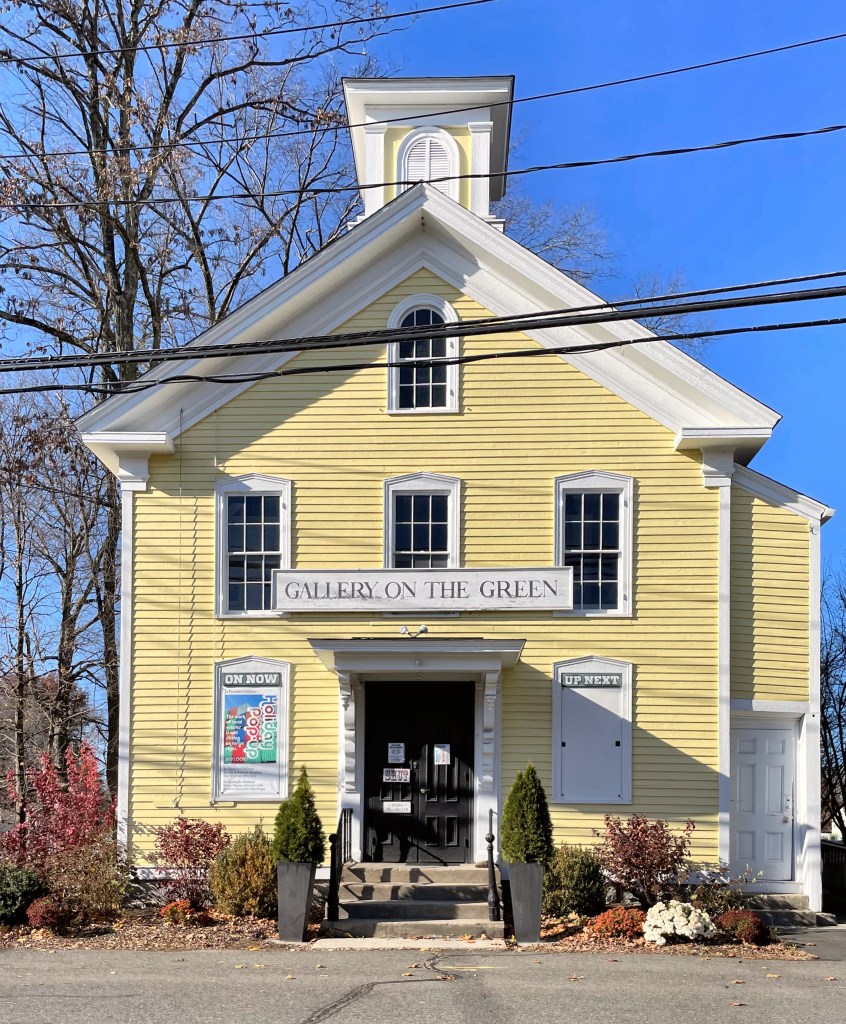
Canton, Connecticut, the only town in the state named after a city in China! The land which we now know as Canton had long been inhabited, specifically by the Wappingers, a group in the larger Algonquin speaking tribes. Canton was incorporated out of Simsbury in 1806, and named after the City of Canton in China (now known as Guangzhou), though I am not sure why. The town quickly developed two main villages. Collinsville sits on the Farmington River and its power was harvested for industry; while the center village grew differently as an agricultural village of farms. At the center of town sat a green for civic and town functions and gatherings. The town constructed a school here as far back as 1759, when the rural village was still a part of Simsbury. This is the fourth building on the green and it was built in 1872, and can be classified as Italianate in style. The building was occupied as a school until 1949, and it was used for other city uses until 1971, when the building was rented to the Canton Artist’s Guild and the building was renamed Gallery on the Green. The building remains community-focused and holds exhibits of local artists! Much of the rest of Canton Center lost all of its bucolic charm when the main road became commercialized, prioritizing speeding cars over a walkable village.
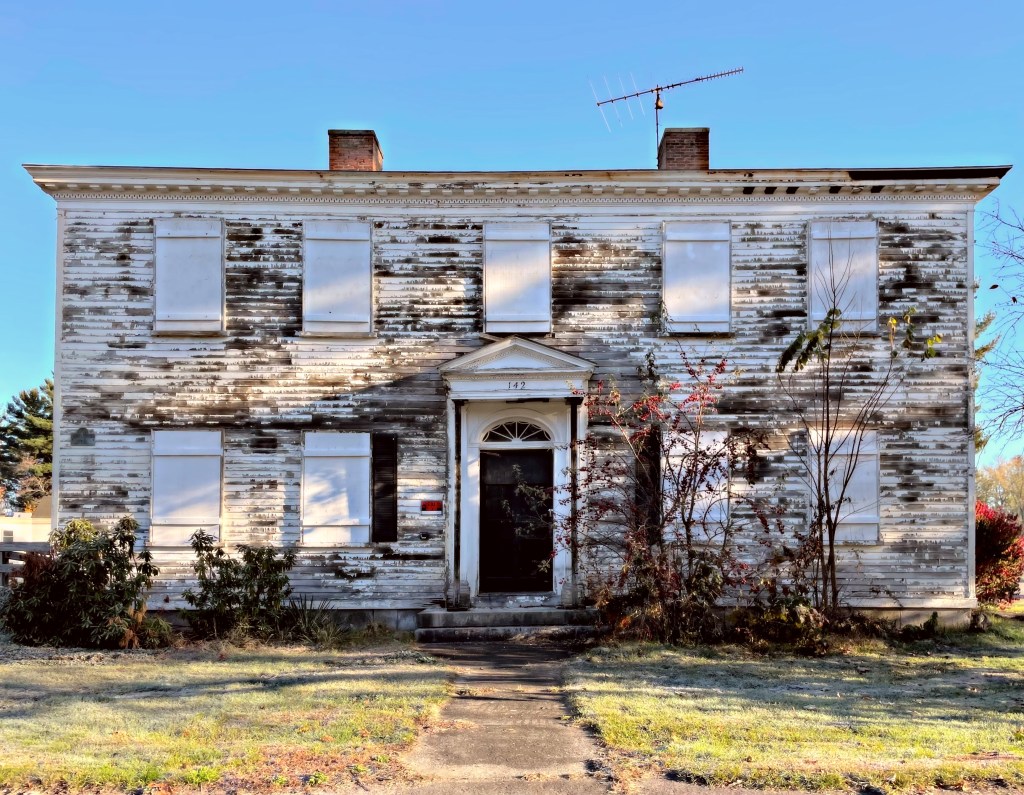
Located in Lancaster, Massachusetts, the Thomas Safford House has stood for over 220 years, but is slowly decaying. Built in 1799 for Thomas Safford, a baker, the house is an excellent example of a Federal-style homestead that appears much like it did when built (besides the neglect). After two subsequent owners, the property was purchased in 1890 by Pauline Revere Thayer, a direct descendant of Founding Father, Paul Revere. Pauline added a large wrap-around porch and balcony to the house, which served as a vacation home for working girls from Boston. She appropriately named the house “Goodrest” where the girls could enjoy their summers, without working in poor conditions. After she died in 1934, the property was acquired by the Commonwealth of Massachusetts as the residence for the head of the Lancaster Industrial School for Girls. The Lancaster Industrial School for Girls was a reform school and the country’s first state reform school for girls, opening in 1856. This school paved the way of social reform, moving away from child imprisonment for “delinquents” towards a correctional paradigm. This was in part achieved because of the observed benefits of environmental change in children, as well as the importance of education. The bucolic, open-air setting was believed to be beneficial for childhood development, compared to a prison setting common before-hand. In 1935, the Safford House was restored to the original appearance, and the porches removed. The State of Massachusetts owns this house and the rest of the severely deteriorating buildings on the campus. It is a shame to see such significant buildings intentionally left to rot.
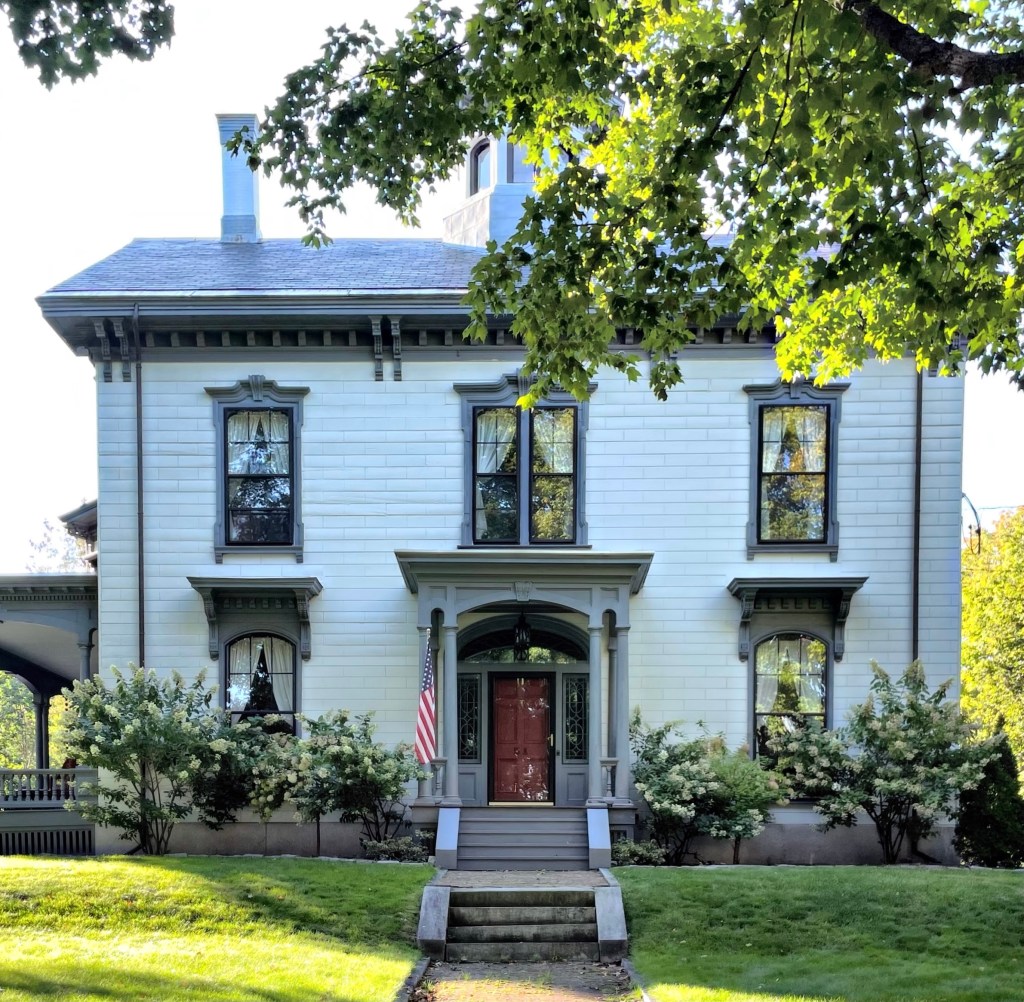
The neighbor to the iconic Thomas Hill Standpipe (last post), this pre-Civil War Italianate mansion predates the water tower and has long been one of the most grand homes in Bangor, Maine. The house was constructed in 1857 for Joseph W. Low, a businessman and trustee of the Bangor Savings Bank. The house he had built is one of eastern Maine’s outstanding Italianate residences, designed by Boston architect Harvey Graves, who was born in Maine. Soon after the Civil War, Graves moved west to California, likely seeking additional wealth from the spurned from the success of the Gold Rush. He appears to have lived out the remainder of his life out west, giving his family in Maine this home. The house exhibits flushboard siding with scored wood to resemble ashlar masonry, gorgeous window hoods and mouldings, and a large belvedere at the roof, which would have provided sweeping views of the Maine frontier when built, atop one of the highest hills in Bangor.
The iconic Witch House in Salem was the home of Judge Jonathan Corwin (1640–1718) and is the only structure you can visit in Salem with direct ties to the Salem witch trials of 1692. The Post Medieval English house was constructed by Nathaniel Davenport, commander of the fort on Castle Island in Boston from 1645-1665. After he left that post, he moved to Salem and began construction on his house. Jonathan Corwin, a merchant and judge, purchased the unfinished home from Davenport in 1675, he soon after finished construction of the large home. When reports of witchcraft began circulating in Essex County, Corwin was one of the magistrates called on to make preliminary inquiries into the reports. He and John Hathorne, another local magistrate, held hearings in early March 1692 in which testimony was gathered from Tituba, Sarah Good, and Sarah Osborne, the first three women accused of being witches. Corwin presided over all the other cases, which ended after thirty individuals were found guilty, nineteen of whom were executed by hanging (fourteen women and five men). One other man, Giles Corey, was pressed to death for refusing to plead, and at least five people died in jail. The lasting legacy of the Salem Witch Trials still draws thousands every year to Salem to learn more as to how such a terrible set of circumstances could happen. Jonathan Corwin’s grandson George, lived in the house until his death in 1746. His widow, Sarah Corwin “modernized” the old house by replacing the iconic pitched roof with a gambrel roof, more in line with Georgian design, popular at the time. The building underwent more changes when George P. Farrington, a druggist, owned altered the home and added an apothecary shop to the east side front in 1856. The Corwin House was moved back 35 feet in 1945 to allow for the widening of North Street, and at that time, a new pitched roof (a recreation of the original) was put on, restoring the building to its former glory. It has since been owned by the City of Salem, who maintain the property and open the doors as a museum.
Ernest Machado, the Cuban-American architect mentioned in the last post is credited with designing this massive Colonial Revival mansion on Beckford Street in Salem. The house was constructed in 1905 for William Jelly, a teller at the Salem Five Cent Savings Bank. William’s family-owned property on the street before he acquired the property, seemingly from his father. Ernest Machado was a locally significant architect who designed stately city mansions and enchanting country estates for some of Boston’s wealthiest families in the late 19th- and early 20th centuries. This home is setback off the street and faces the side, a common practice for larger homes in narrow urban lots. The house has a five bay symmetrical facade facing south, with clapboard sheathing, rusticated quoins, and a modillion cornice. It is topped by a gambrel roof, which has two large interior brick chimneys at the ridge. A Chippendale patterned balustrade stretches between three pedimented dormers which rise above the roof on main facade. Who else loves Colonial Revival houses?!
It’s rare to find a house with so much potential in Salem, a town where seemingly every old house has been purchased and lovingly maintained or restored. This home on Federal Street could use some TLC to restore her to her former glory. In 1808, William Orne Jr., a housewright and his wife Polly acquired a mortgage for the lot here and he built a large, Federal style home with gambrel roof, showcasing his building skills. The property was a little more than the couple could handle financially, which was compounded by the War of 1812, and the Royal British Navy blockading maritime trade, which especially hurt Salem’s port. The Orne House was sold in 1817 to Captain John Derby III, who died just a year later, leaving his widow Sarah (Felton) Derby all his estate. Sarah rented the home to family, but was allowed to live there until her own death in 1857. The stunning home with fanlight at the front door, historic wood windows, and pair of large brick end chimneys all could be saved with a good restoration of the home. Fingers crossed!