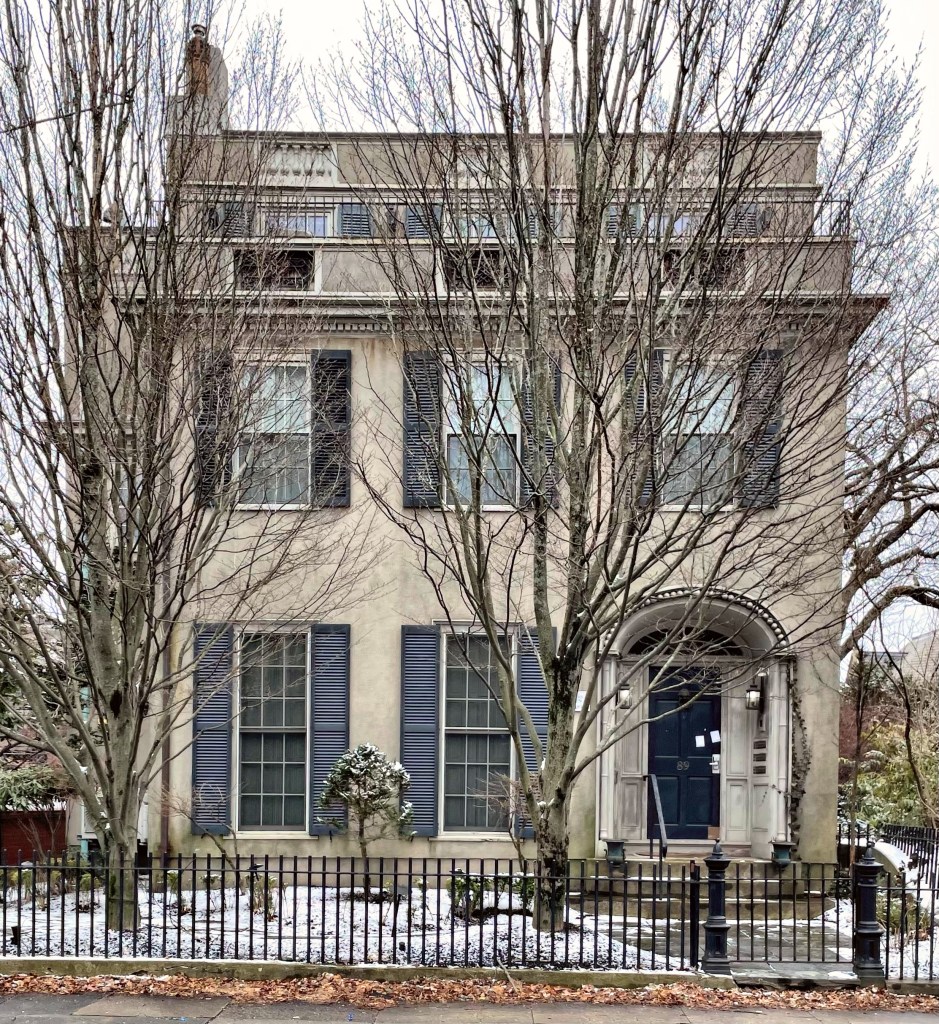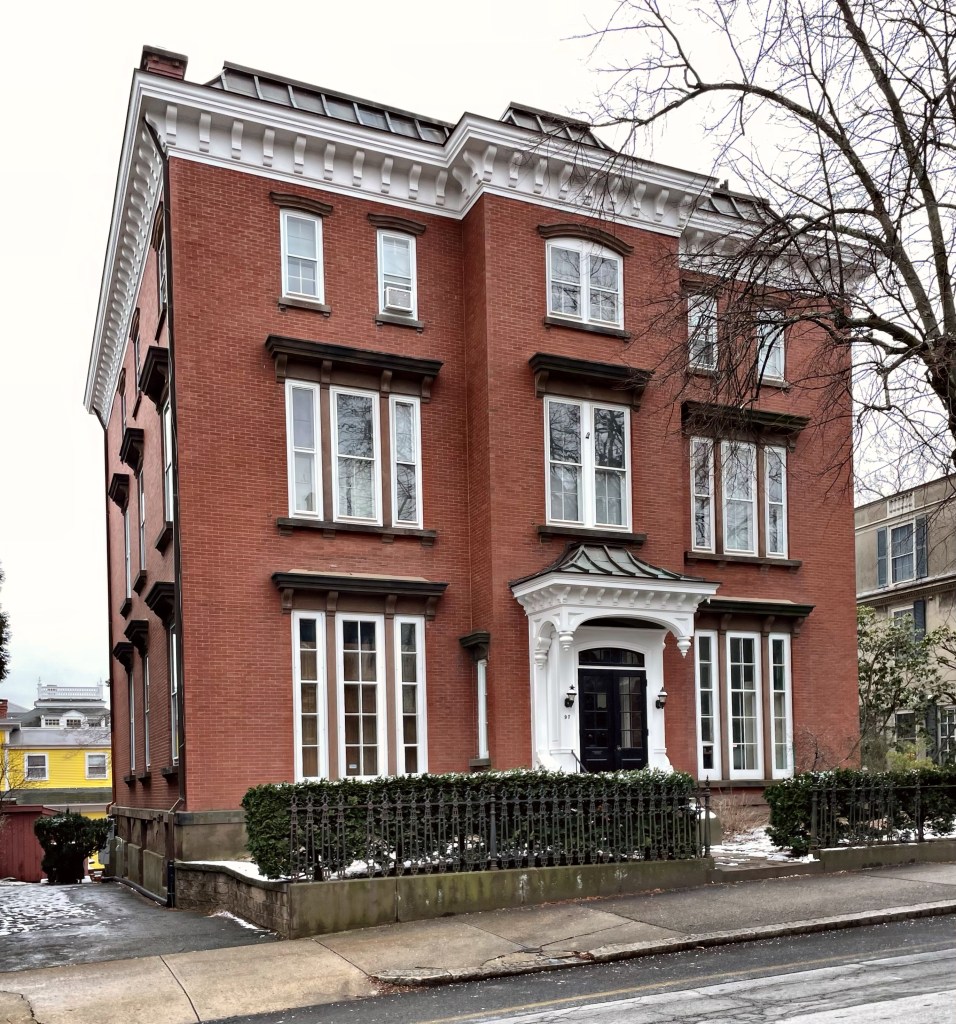
Watson-Knight Mansion // 1854

No town does Italianate architecture quite like Providence! Case in point, the Watson-Knight Mansion, a relatively overlooked example of the style found on Angell Street in College Hill. In 1854, a house lot here was purchased by an elderly Matthew Watson (1786-1857), who possibly lived in half of the house for a few years until his death. Directories also list his son Robert as living in the home in 1854. The three-story brick mansion has a boxy form with symmetrical facade. Brownstone hoods and sills are located at the windows and add depth to the otherwise blank facade. A projecting wooden door hood with hanging pendants covers the large entry. The home remained in the Watson Family until it came under the possession of Robert Brayton Knight (1826-1912) a businessman and mill owner who became the largest individual owner of cotton mills in the world, with upwards of twenty distinct establishments under his personal control. He co-founded what became the Fruit-of-the-Loom brand with his brother in the 1850s. The building has since been divided into apartment/condominiums.

“Snug Harbor” – Charles H. Baldwin Cottage // 1877

One of the finest Queen Anne style residences New England is this 1877 summer cottage, named “Snug Harbor”. The mansion was designed by architects William Appleton Potter and Robert Henderson Robertson for Charles H. Baldwin, a prominent admiral in the United States Navy. The design utilizes a brick first floor with shingle siding above, a high cross-gabled roof, panels and half-timbering, asymmetrical form, and a porte cochere at the entry. Later owner Arakel Bozyan, painted the entire exterior a deep red color and renamed the house “Gamir Doon”, Armenian for “Red House”. The house was restored back to a traditional color scheme and sold in 2020. The interiors are STUNNING!

Berkeley House // 1885

In 1885, a 28-year-old Leroy King (1857-1895) and his wife Ethel Rhinelander King (1857-1925) hired one of the country’s most prominent architects, Stanford White, to design a Newport home for their family. Leroy was the son of Edward King, a prominent local merchant, and upon his fathers death in 1875, inherited some of the $100+million dollar fortune he had amassed in today’s dollars. The corner lot at Bellevue and Berkeley avenues was purchased and work was underway on the new mansion. The house is a really interesting take on the Shingle style, but instead of cedar shingle siding, employs fireproof construction. A central hall, large gabled masses, picturesque window arrangements, and a spectrum of surface textures (here conveyed largely in natural stone and brick with flourishes of shingle and pebble dash work), align this house with McKim, Mead & White’s earlier efforts in this style. The interior has been meticulously preserved and maintained by the owners.

The Elms – Sitting Room // 1899

The formal Sitting Room at the Elms in Newport, Rhode Island is one of the many statement-rooms found in the Gilded Age mansion. This room is located directly above the Ballroom and is the first space seen when ascending the main staircase onto the second floor. The sitting room was used by the Berwind Family and their guests as a gathering and socializing space, a little less formal than the ballroom downstairs for more elegant events. The Preservation Society of Newport County has done an amazing job at restoring the building and purchasing furniture and fixtures that were sold off when much of the inside of the property was sold off at auction in the 1960s. The Preservation Society restored the red silk walls fabric in the 1980s, bringing the space back to its original grandeur. I cannot think of a better place to just “sit”.

The Elms – Dining Room // 1899

The Dining Room of the Elms Mansion in Newport, Rhode Island, is represents the Gilded Age in all the best ways. The room sits just off the ballroom and like all of the other rooms in the summer residence of the Berwinds, it was designed by famed interior designer Jules Allard. The dining room was specifically to display a collection of early18th-century Venetian paintings purchased by Mr. Berwind from the Ca’ Corner estate in Venice (the Berwinds were avid collectors of 18th century French and Venetian paintings). The iconic coffered ceiling is not of wood, but of molded plaster, grained and painted to imitate oak. Each coffer is decorated with the winged lion of Saint Mark, the patron saint of Venice. Pour custom-made crystal chandeliers hang in the four corners of the room. At the end of the room is a stunning green marble, agate and onyx fireplace that is framed by a ceiling-high pediment supported by carved Ionic columns. Could you see yourself entertaining in this dining room?

The Elms – Stair and Gallery Hall // 1899

Stair Hall

Immediately upon entering the main entrance of The Elms, one of the finest Gilded Age mansions in Newport, you are enveloped in the Stair Hall or foyer. The space is stunning, with walls lined in limestone and purple Breccia marble pilasters and columns with bronze capitals and bases. The floors are of white marble bordered in green with stairs in white Italian marble. At the beginning of the stairs, there are two large urns of green marble and pink granite, each with four bronze female figures. The urns bear the name of the decorator, Allard et Fils of Paris, who was responsible for crafting the details of the period rooms for the mansion. At the top of the first set of stairs is the Gallery Hall, a long hall connecting many rooms on the first floor and also serving as a gallery of irreplaceable art including two early 18th-century oil paintings depicting episodes in the history Scipio Africanus, the ancient Roman general who conquered Carthage by Venetian artists Paolo Pagani and Giovanni Antonio Pellegrini. The space is grand, yet cozy and feels more like a home than the larger Breakers mansion.

Gallery Hall

Belair Stable // c.1875

Just past the Belair Gate Lodge (1870), you w5ll find one of the most eclectic and interesting buildings in Newport, Rhode Island. This structure was built around 1875 as the stable to the larger Belair estate, just a stone’s throw away. When it was built, local papers stated the building was “probably one of the most expensive stables in the city.” It was designed by Newport architect Dudley Newton at the same time he redesigned the main mansion and furnished plans for the new gate lodge for owner George H. Norman. Architecturally, there is A LOT going on here. The 1½-story, rough-face-granite-ashlar building is capped by a hexagonal-tile slate mansard roof. On the left is an octagonal tower with an out-of-scale roof pitch and at the other side of the carriage door is a circular-plan tower with battlemented parapet. At the center is a really unique trefoil gable with trefoil window centered within. So cool to stumble upon this!! Oh, and it’s now a single-family home. Swoon.

“Morningside” // 1872

While many of the summer cottages in Newport retain much of their architectural and historical integrity, it is not always the case. This cottage, named “Morningside” barely resembles its original 1873 design. The summer home was built for William Barton Rogers (1804-1882), a scientist, educator, and best-known as founder of the Massachusetts Institute of Technology. He sought a place of rest and leisure, away from the stresses of Boston and running a new college, so he hired the Boston firm of Cabot & Chandler to design a Stick style cottage for him to spend the summer months at. In his diary for October 11, 1872, Mr. Rogers wrote, “Removed [from Cliff House Cottage] to our new home on Gibbs Avenue, at 4.30 o’clock. I have decided to name the place ‘Morningside.'” The house was his respite from stresses and he loved to spend time here with his family. President Rogers died after collapsing during a speech at MIT’s 1882 commencement exercises. His last words were “bituminous coal.” After the property sold out of the Rogers estate, the house was remodeled with stucco siding and much of the original Stick detailing was removed or covered. Morningside is now divided into condominiums.

Morningside c.1880s

Anderson-Muenchinger House // c.1850

One of the most eccentric and over-the-top houses in Newport (a town full of over-the top houses) is this home on Cottage Street. The original house was built around 1850, likely as an Italianate style residence with a flat roof. Early owner Elbert J. Anderson (1800-1888) who was born and raised in New York City. In Manhattan, Anderson was a director of The Manhattan Fire Insurance Company; the Farmers’ Loan & Trust Company; and The Phoenix Bank. He married Martha Maria Ellery, the eldest daughter of the late Abraham Redwood Ellery. In 1847, his wife inherited the Redwood Farm at Portsmouth, six miles from Newport, and they eventually moved there permanently. They maintained this summer cottage in Newport to remain close to high-society. The home was sold to George and Annie Collins, who likely modernized the residence with the bays, porches, and frilly details. By the early 20th century, the property was owned by Gustave and Amanda Muenchinger, who ran a hotel at the corner of Bellevue and Catherine streets.

Captain George Benson House // 1797

One of the finest Federal period mansions in Providence is this well-sited home on College Hill known as the Captain George Benson House. George Benson was a partner of the mercantile firm of Brown, Benson & Ives, who made immense sums of money at the end of the 18th century. The firm did well as the movement to abolish the transatlantic slave trade grew at the time in Rhode Island, many abolitionists placed their faith in so-called “legitimate commerce,” an African trade centered on commodities other than enslaved people. In 1794, the firm run by Nicholas Brown, Jr., and his partners George Benson and Thomas Ives, tried the legitimate trade, and dispatched the ship Charlotte to Freetown Africa, under the command of Benson’s half brother, Martin. George’s half-brother Martin was a slave trader, a job that may have accounted for the unusually explicit tone in a 1794 letter of instructions: “by no means take any Slaves on board the Ship on any terms whatever as we desire to have nothing to do with business.” Three years later, George had this Federal style mansion constructed on the peak of College Hill which remains one of the best in the area over 200 years later.