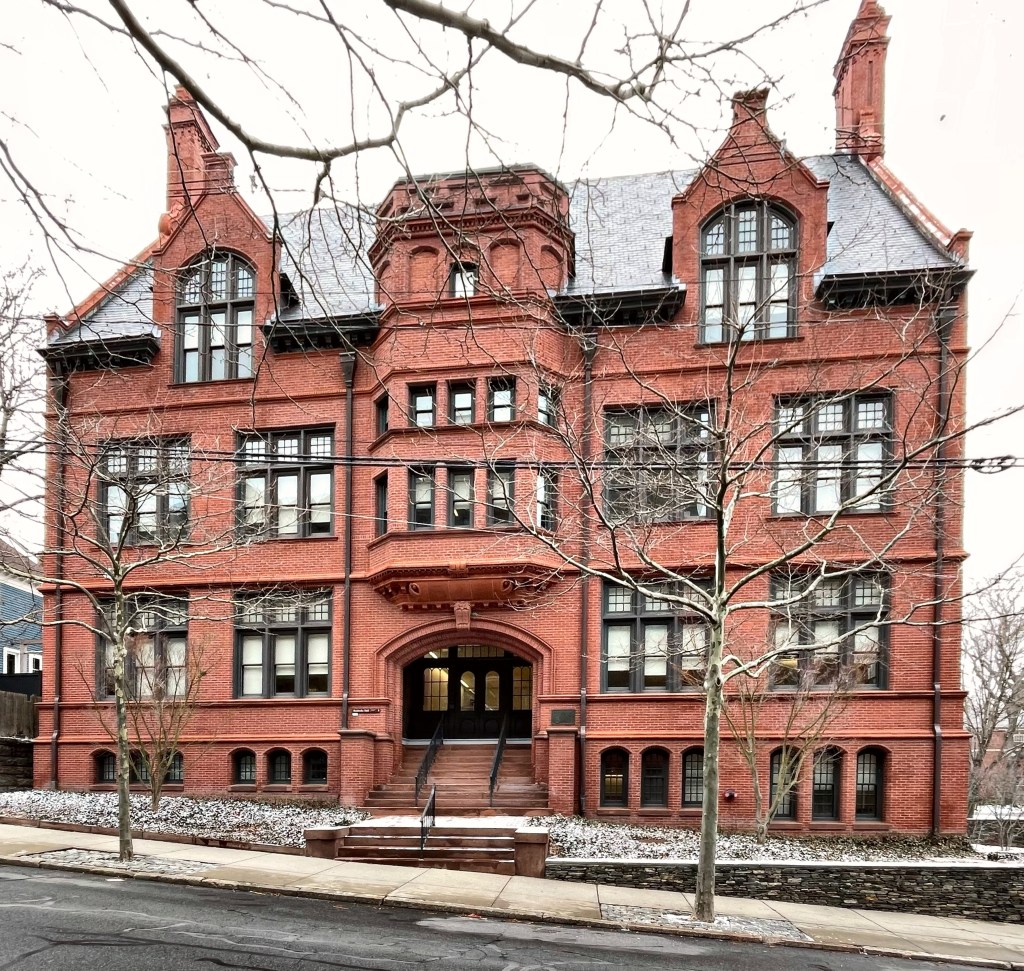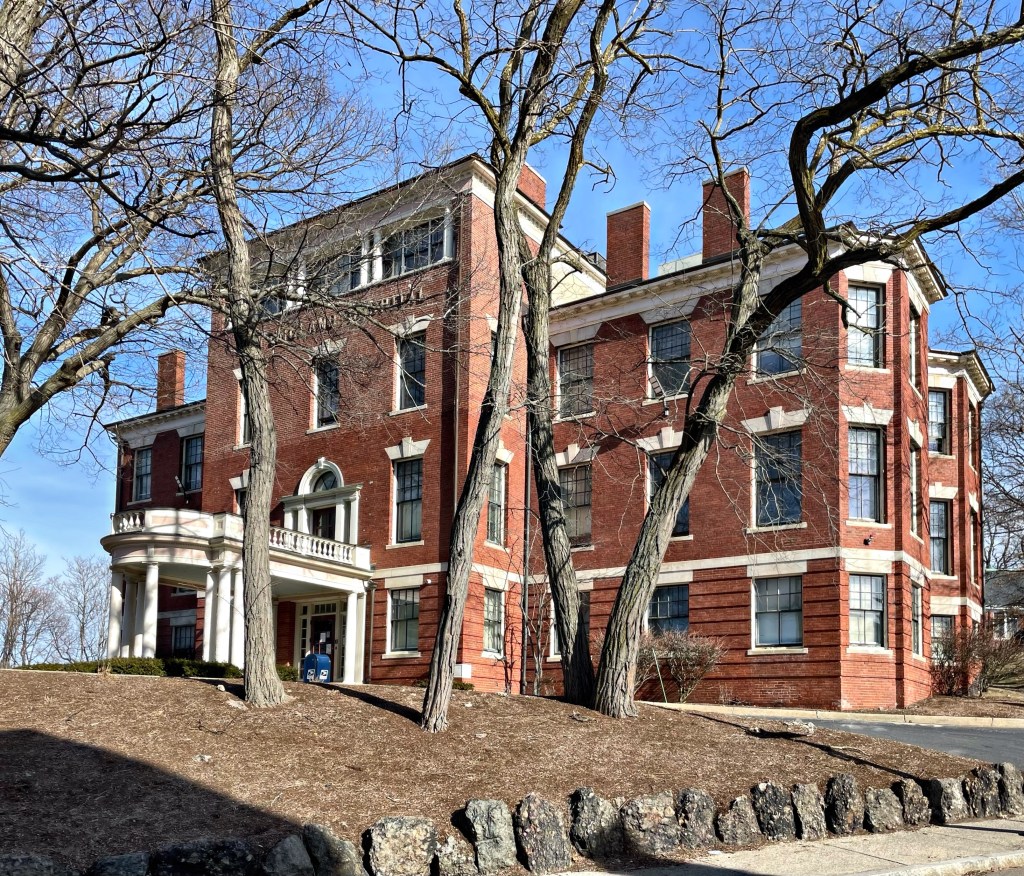
Dimock Center – Cheney Surgical Building // 1899

With funds for expansion at the New England Hospital for Women and Children in Roxbury, the hospital’s board commissioned architect Willard T. Sears (also the architect of the earlier Cary Cottage and Zakrzewska Building) to design a new surgical building at the hospital’s growing campus. Construction began on the new Cheney Surgical building in 1899 on the birthday of its namesake, Edna Dow Cheney an original incorporator of the hospital and then President. The Cheney Surgical Building was designed in the Colonial Revival style in brick, with a four-story central block with three-story wings. The central entranceway is accentuated by a classical porte-cochere topped by a Palladian window, in keeping with the Georgian Revival tradition of symmetry and classical vocabulary. The building is one of the first you see when climbing the hill into the campus.


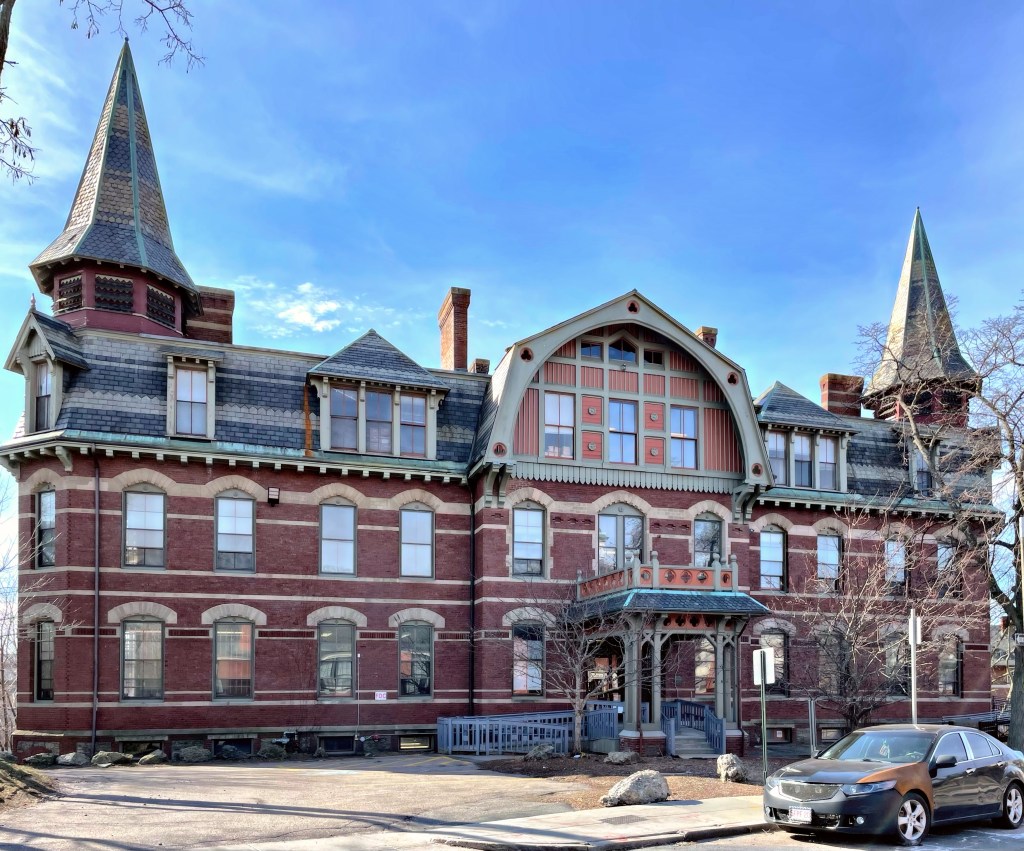
Dimock Center – Zakrzewska Building // 1873

Following the construction of Cary Cottage at the New England Hospital for Women and Children in Roxbury (last post), architects Cummings and Sears turned their attention to designing the most important facility in the complex, the large two-story Zakrzewska Building built in 1873. It is a fine example of polychromatic High Victorian Gothic style with Stick detailing. The building is characterized by its decorative stone and brick string courses, arched window heads, polychrome slate roof, end towers, and a gambrel dormer. The building was named after Dr. Maria Zakrzewska (1829-1902), a Polish-American doctor who moved to the United States in 1853, eventually settling in Boston in 1859, working as a professor of obstetrics at the New England Female Medical College. There, she realized that women in medicine did not have the same opportunity to advance in their field and left, launching her own hospital, the New England Hospital for Women and Children. It was the first in Boston, and the second hospital in America, to be run by women physicians and surgeons. Dr. Zakrzewska knew that the opportunity to work with large numbers of patients was vital if women physicians were to achieve the same levels of training and standards of practice as male physicians. The hospital became a primary training hospital for several generations of women physicians, and also trained nurses. The hospital was extremely successful and remains a medical institution to this day, as the Dimock Health Center.

Laura Richards House // 1810

This stunning Federal style house in Gardiner, Maine, was built about 1810 by Ebenezer Byram, who had purchased the land from Robert Hallowell Gardiner, a descendant of Dr. Sylvester Gardiner, the “founder” of the town. Dr. Gardiner was a resourceful Boston druggist, who was one of the principal owners of the Kennebec Purchase, known as the Plymouth Company, who purchased land on the west side of the Kennebec River in Maine. Dr. Sylvester Gardiner had been attracted to the Gardiner area for a number of reasons, primarily because of the depth of the water of the river to the point of Gardiner as the head of navigation for ships here. This house overlooking that river was purchased in 1878, by Henry and Laura E. Richards. Laura Richards (1850-1943) was the daughter of Samuel Gridley Howe, an abolitionist and the founder of the Perkins Institution and Massachusetts School for the Blind. Her mother, Julia Ward Howe wrote the words to The Battle Hymn of the Republic, a tune that I am sure most of you have heard of, but never knew the name. Henry and Laura moved to Gardiner in 1876 after suffering financial reverses in Boston, where Henry worked at his family’s paper mill, and it was about that time that Laura Richards began her writing career. At this house in Gardiner, Laura wrote more than 90 books including biographies (including one on her mother), poetry, and several children’s books. Even more impressive, Laura was awarded one of the first four ever Pulitzer Prize in 1917 for her biography on her mother, years before women were even afforded the right to vote!

Dr. Gertrude Heath House // c.1850

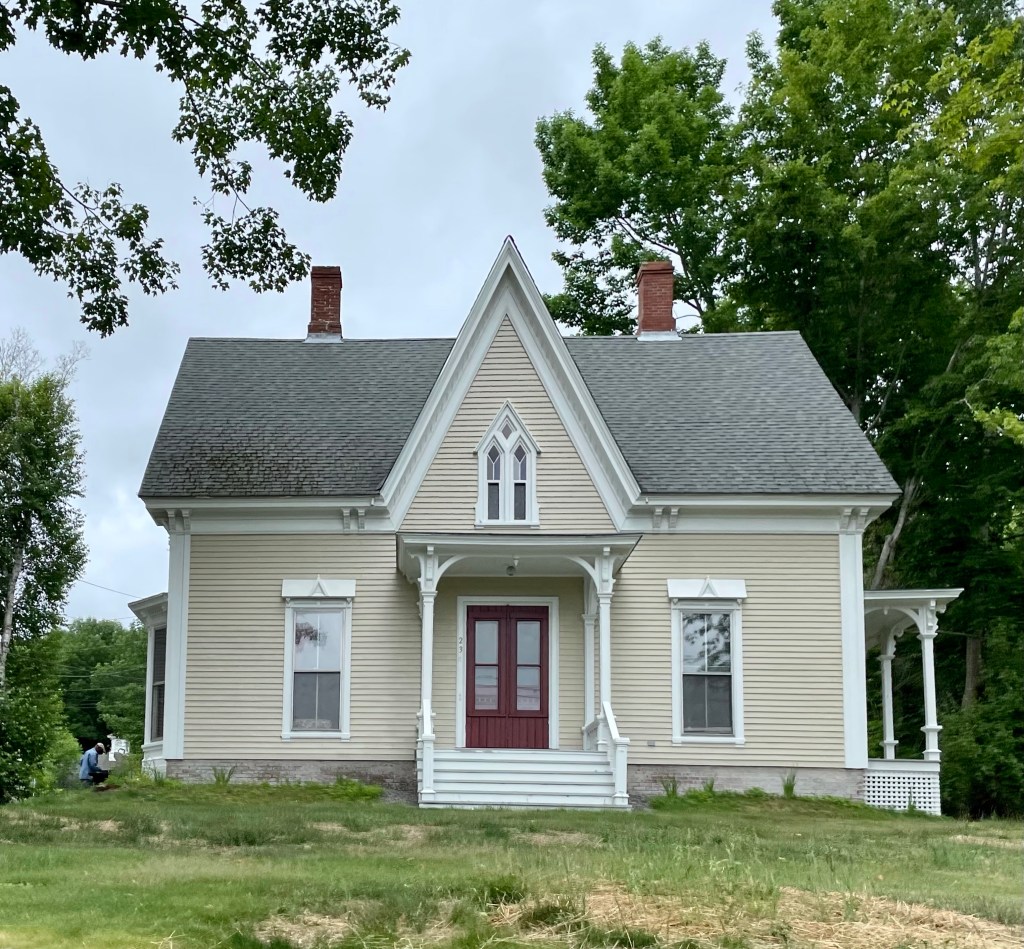
Constructed c. 1850, this Gothic Revival house in Farmingdale, Maine, has many identifying features common in the style: a symmetrical facade, steeply pitched gable, and lancet windows in the front gable. Besides its architectural significance, the home is also historically significant as the home of Dr. Gertrude Heath. Gertrude Emma Heath (1859-1935) was born in Gardiner, Maine in January 1859. When Gertrude was just three years old, after the American Civil War began, her father died in battle at Fredericksburg, leaving his widow Sarah to run the family affairs. She excelled in school and received her early education in the public schools of Gardiner, afterward attending Hahnemann Medical College at Chicago, Illinois, taking special courses. She graduated from this institution in 1883 with the degree of Doctor of Medicine, and began medical practice in Chicago in 1884, moving back home within that year. Soon after returning to Maine, she accepted a position at the Maine State Hospital, at Augusta, where she specialized in eye and ear conditions. It is amazing learning stories about such strong women, when at the time, women medical practitioners were almost unheard of and women were decades away from earning the right to vote.

Susie King Taylor House // c.1874

The rowhouse at 23 Holyoke Street in the South End neighborhood of Boston is an excellent architectural specimen, but is best known for one of its residents, Susie King Taylor. Susie King Taylor (1848-1912) was born into slavery near Savannah, Georgia; and despite Georgia’s harsh laws against the formal education the enslaved, she attended two secret schools taught by black women. She became free at the age of 14 when she escaped onto a Union-owned boat off the coast of the then Confederate occupied Fort Pulaski on the islands off the coast of South Carolina. She soon attached herself to the First South Carolina Volunteers, the first black regiment in the US Army. She served under the Union Army in various capacities: officially as a “laundress” but in reality a nurse, caretaker, educator, and showcased such strength and courage as a young woman. Eventually, Taylor married Sergeant Edward King in 1862, and together they remained with the unit until it was mustered out of service in 1866. It is likely at that time that she met Harriet Tubman, who served as a nurse, scout, and spy for the 1st South Carolina Volunteers. Postwar, the Kings moved to Savannah, Georgia. She hoped to continue her teaching career and opened a private school for the children of freedmen. Unfortunately, her husband died the same year, and a public school opening caused her private school to fail. By 1868, Taylor was forced to find work as a domestic servant. She moved to Boston in 1872 where she married Russell Taylor in 1879. She devoted much of the rest of her life to work with the Woman’s Relief Corps, a national organization for female Civil War veterans. She lived at this home on Holyoke for much of her time in Boston, likely re-connecting with her old friend Harriet Tubman when she lived on the street.

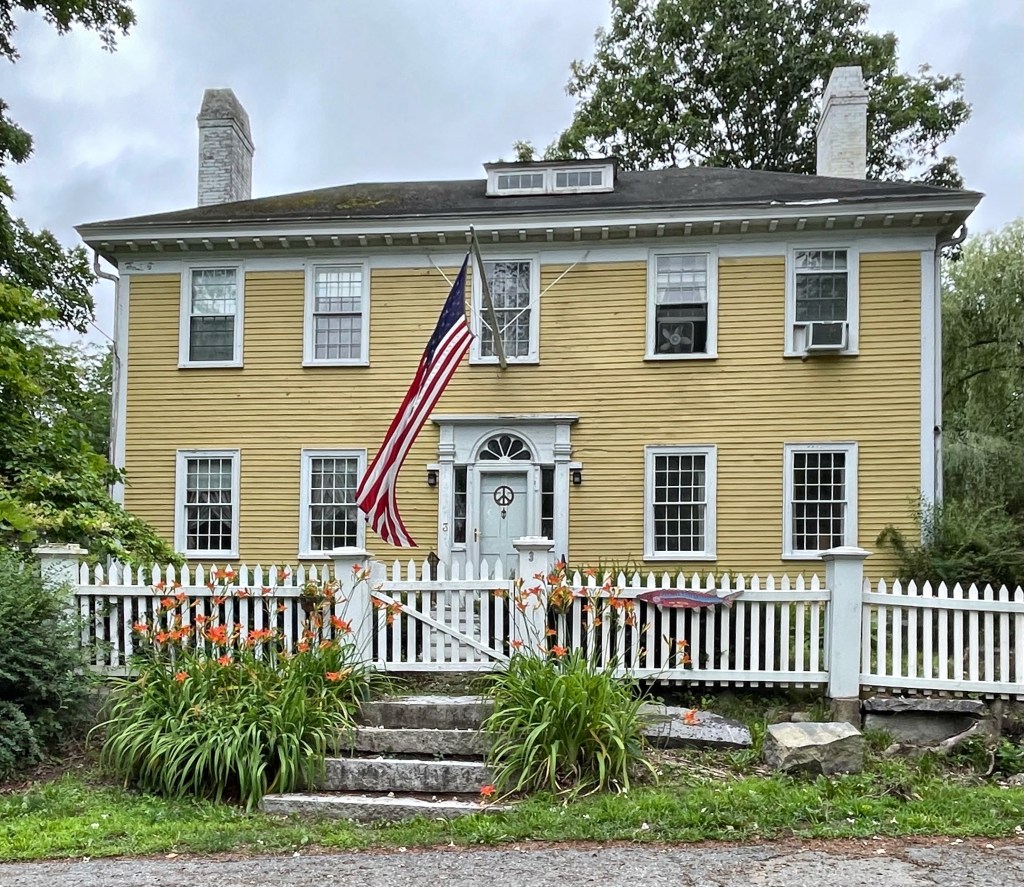
Sedgwick House // 1785

Built in 1785, the Sedgwick House on Main Street in Stockbridge, MA, is the oldest of several Federal mansions built in town after the Revolution. Theodore Sedgwick (1746-1813), one of the early lawyers of Berkshire County, moved to Stockbridge in 1785 and built this house. From 1796 to 1799 he was a Senator in the federal government, and declined a position of Secretary of the Treasury offered by George Washington. Before this, when a House Representative, he was nominated the fourth Speaker of the House. An ardent Federalist, Theodore retired from the national arena upon Thomas Jefferson’s election. Sedgwick was also a member of an early abolitionist society organized in Pennsylvania in 1775 and played a key role in abolishing slavery in Massachusetts by his win in the case of Bett v. Ashley. In this case, Sedgwick served as attorney of Mum Bet (also known as Elizabeth Freeman) an enslaved woman in nearby Sheffield and argued that slavery was inconsistent with the 1780 Massachusetts State Constitution, and won. Bet became the first enslaved African American to file and win a freedom suit in Massachusetts, effectively abolishing slavery in the state. She was later buried in the Sedgwick Family burial plot in Stockbridge. The home was later owned and occupied by Catharine Maria Sedgwick, Theodore’s daughter, who became one of nineteenth-century America’s most prolific women writers. She published six novels, two biographies, eight works for children, novellas, over 100 pieces of short prose and other works.