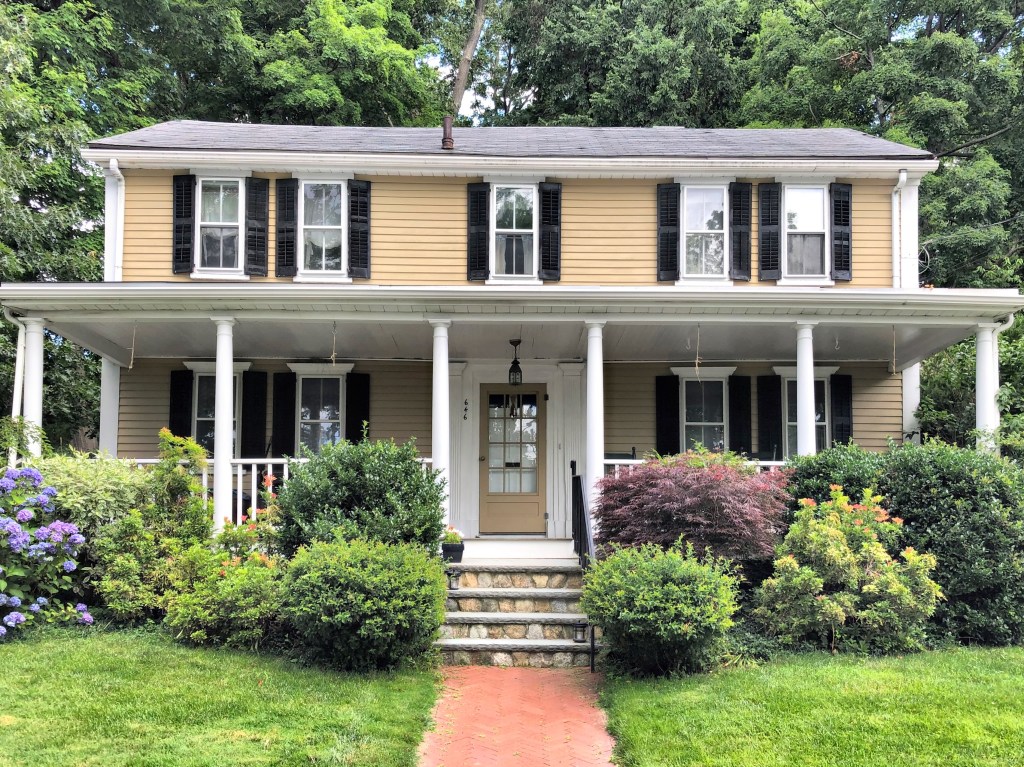
Crehore Mill Worker’s Cottage // c.1848

Toward the middle of the 19th-century, the Newton Lower Falls Village developed into a premier paper-manufacturing center of eastern Massachusetts, largely due to the forests and water power supplied by the Charles River. One of the most successful paper mills in the area was owned by Lemuel Crehore (1791-1868), who with his success, built workers cottages for his employees and their families (imagine if businesses did that today)! This Greek Revival workers cottage was occupied by employees of the mill before it was sold when the mill closed, to a house painter. The modest house stands out for the gorgeous wrap-around porch supported by fluted Doric columns, an off-center entrance with sidelights, and corner pilasters.

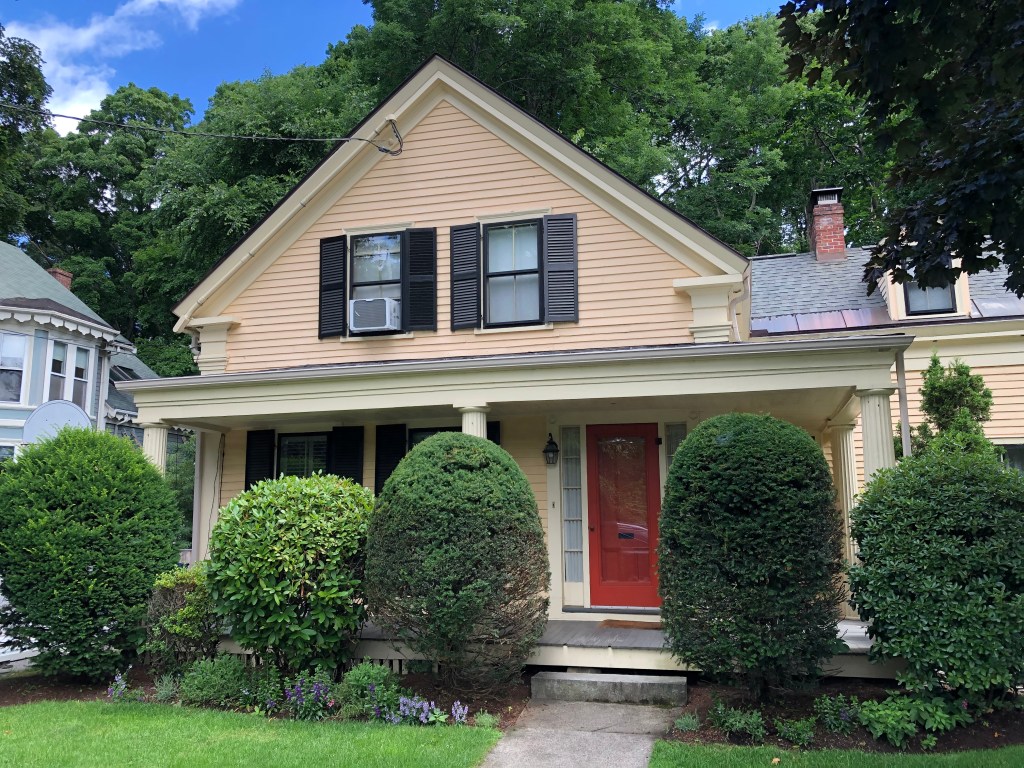
Crehore Mill Worker’s Cottage // c.1848

Toward the middle of the 19th-century, the Newton Lower Falls Village developed into a premier paper-manufacturing center of eastern Massachusetts, largely due water power supplied by the Charles River. One of the most successful paper mills in the area was owned by Lemuel Crehore (1791-1868), who with his success, built workers cottages for his employees and their families (imagine if businesses did that today)! This Greek Revival workers cottage was occupied by employees of the mill, and was sold off after the mill shut down. The house features a deep piazza with three Tuscan columns across the front and scroll-sawn bargeboards at the porch and hanging along the roof, giving it a slight Gothic Revival element.

Dr. Edward Warren House // c.1841

In 1841, Dr. Edward Warren (1805-1878) purchased land, a dwelling house, and outbuildings in the Lower Mills village of Newton for his own property. Edward was the son of Dr. John Warren, a Continental Army surgeon during the American Revolutionary War, founder of the Harvard Medical School, and the younger brother of Dr. Joseph Warren, also a physician and Patriot during the early days of the American Revolution, eventually serving as President of the revolutionary Massachusetts Provincial Congress and dying at the Battle of Bunker Hill. Edward, a much less renowned figure practiced medicine in Boston and Newton and married Caroline Rebecca Ware, the half-sister of Henry Ware, a prominent Harvard professor. The house was likely modernized during Warren’s ownership and is largely Greek Revival in style, but much more modest than one would think given the family connections of the two owners!

United States Hotel, Boston // 1839-1930

On August 18, 1929, the United States Hotel in Downtown Boston closed its doors for good. Once housing and feeding over 700 guests per night, the hotel saw severely declining numbers by the time of the Great Depression. Construction on the hotel commenced in 1837, and it was completed two years later in 1839. The hotel was operated by the Messrs. Holman and Clark, who saw an immediate success due to the hotel’s location central to Boston’s major train stations. The hotel (which first contained 300 rooms) did so well that the building was expanded numerous times with undulating additions to maximize light and air into the many rooms. At the hotel, over 150 employees served the guests at their rooms, the dining halls, bathing facilities or the stables which had drivers ready at a moments notice. The United States Hotel was one of the finest establishments in Boston and was thought to be the largest in the country by the middle of the 19th century. The size and amenities however was the downfall of the iconic hotel as Boston’s train stations saw fewer passengers in the early decades of the 20th century. Owners of the hotel sought to squeeze out every last dollar from the complex before they locked her up for good, hosting an auction on everything from beds to a chair said to have been sat on by Charles Dickens during his stay. The hotel was razed in 1930.

Thomas Snow Shop // 1854

This tiny building next to the John Palmer House featured previously was built in 1854 by Thomas Snow as an income-producing property. According to the sign, Snow was a grocer in town and must have rented the small building, which was developed on a small sliver of land, formerly a side garden. I’d guess that the building was originally 1 1/2-stories with the brick first floor added underneath sometime later. The house is vernacular Greek Revival in style and the scale is exactly what makes Marblehead so charming to get lost walking in!

Haskell House // 1830s

Located next to the John Wright House (last post), this gorgeous 19th century home blends the Federal and Greek Revival styles elegantly under one roof. The house was likely built in the 1830s when the Federal style was waning in popularity and the Greek Revival style was THE style for houses and churches in New England. By 1850, the property was owned by William T. Haskell.

Prentiss House // 1843

This past weekend, I took a little “stay-cation” in Cambridge, and I am so glad I did! I stayed at the Prentiss House, a highly significant Greek Revival house near Porter Square. The Inn is operated by Thatch, a company that offers short-term hotel stays, long-term apartments, and co-living arrangements in the Boston area. They recently acquired and renovated this amazing old house and its a great place to stay!

The home was built in 1843 by William Saunders a well-known housewright for his son, William Augustus Saunders about the same time as his first child, Mary was born. Sadly, Mary died at just six years old and was buried at Mount Auburn Cemetery with her grave guarded by a tiny stone dog. The Saunders Family resided at the home for over 50 years until William and his wife’s death at the end of the 19th century. The original location of the mansion on Massachusetts Avenue necessitated its move to the newly laid out Prentiss Street to save it from commercial development pressure and the wrecking ball. The home was moved to its present site in 1925 for the erection of a one-story block of stores on Mass. Ave. In 1992, the home was purchased by local artist, Charlotte Forsythe and she began the journey of transforming the home into the Mary Prentiss Inn. An addition by Bell/Fandetti added rooms and subterranean parking to the building at that time. The Inn was purchased by Thatch in 2021, who modernized the rooms.

The house reads like a Greek Temple, not with a full portico, but by using colossal applied pilasters and an entablature carried across the gable, suggesting a classical pediment. Ornamental wreaths adorn the full-length porch and interior mouldings.

First Unitarian Church of Wilton // 1860

Wilton, New Hampshire’s original land grant included 240 acres for a church and stipulated that a building must be erected by 1752. From this, settlers built a log church. For the first ten years traveling preachers supplied the pulpit. In 1763, Rev. Jonathan Livermore became the first settled minister. In April 1773, the town voted to provide six barrels of rum, a barrel of brown sugar, half a box of lemons and two loaves of loaf sugar for framing and raising a new meetinghouse. In 1859, a fire destroyed the Revolutionary-era church/meetinghouse, and members immediately began the construction of a new, modern building. The present building blends Greek and Gothic revival styles in a later, vernacular form.

Wilton Old Town Hall // 1860

When Wilton, New Hampshire was settled and incorporated, a log structure was built to serve as a town meeting house. The structure in the center of town was deemed insufficient and was torn down and replaced with a larger meeting house in 1775. The second meeting house served the town for 80 years until it burned down in 1859. The town voted to build a third meeting house (this building) on the same spot, at a cost and the building was completed in 1860. The vernacular Greek Revival building was used as the town hall for just a couple decades, until the 1880s when East Wilton became the population and economic center of town, facilitating the move of the town hall there into a new building. The building would later serve various uses from a community hall to a grange hall, and it is now home to Andy’s Summer Playhouse, a youth theater and cultural hub for the region.

Atherton Farmstead // c.1840

This beautiful farmhouse in Cavendish, Vermont is located along a winding dirt road and has ties to one of the town’s original family’s. A home was built here in 1785 and changed hands numerously over the first few decades of its existence. The farmhouse that was built also served as a tavern for travellers along the newly laid out Wethersfield Turnpike. It is possible that the cheap land and rural character of the new town was appealing to some, but reality away from true commerce may have made many sell the farm after a few years, which could explain why the property was bought and sold so often early on. The property was purchased by Jonathan Atherton, a Revolutionary War veteran, farmer, surveyor and lawyer, who acquired large landholdings in Cavendish. In 1821, Jonathan Atherton was sued in court by his neighbor, Jedediah Tuttle for beating Tuttle’s wife Lydia. In order to finance the bonds, Atherton mortgaged all his real estate in Cavendish to his brother Joseph, and Elihu Ives, Jonathan Atherton Jr.’s father-in-law. Atherton St. lost the case and had to pay a fine. The property was eventually inherited by Stedman Atherton, the youngest son of Jonathan, who seems to have demolished the old homestead and constructed the present home on the site. The original dwelling was also the childhood home of Henry B. Atherton, a staunch abolitionist and soldier in the American Civil War, who later served as a lawyer and state legislator for New Hampshire, and his sister Eliza (Atherton) Aiken, a Civil War nurse who has been referred to as America’s own “Florence Nightingale”. The old Atherton farmstead was recently renovated.