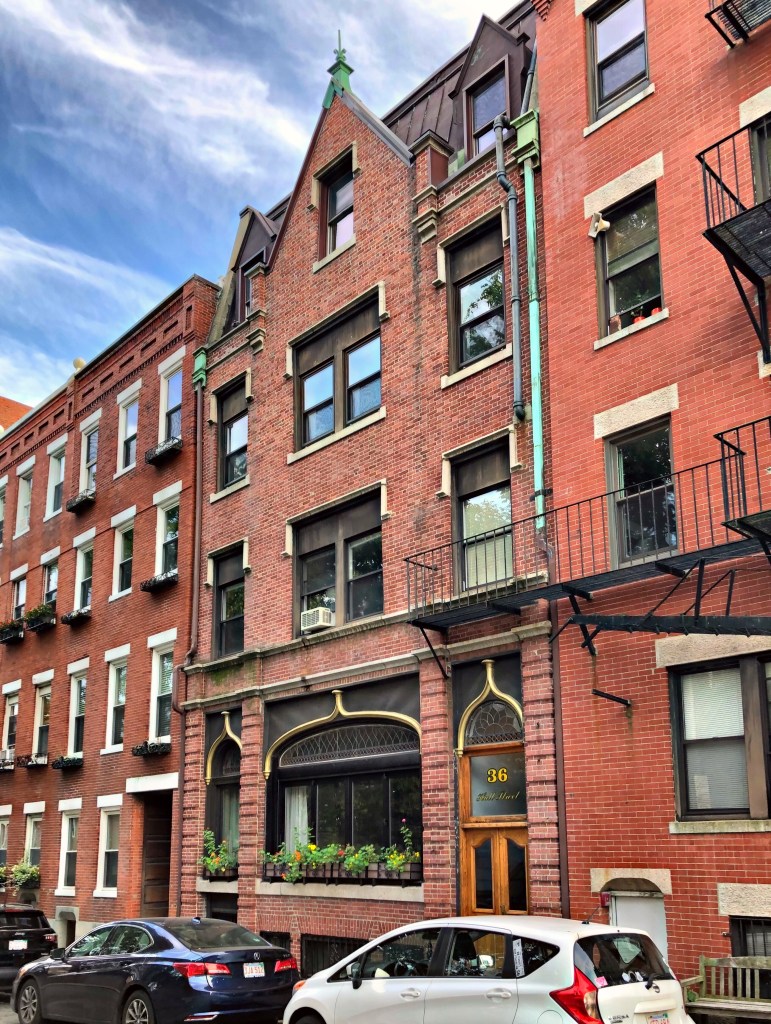
Constructed for the Woman’s Home Missionary Society of the Methodist Church of New England, this building was associated with the Hull Street Medical Mission from the time of its construction, in 1901, to about 1950. The mission was one of a number of church-related social service programs established in the North End in the late 19th and early 20th centuries to address the needs of recent immigrants, namely the Russian Jews, Italians, and Portuguese residing in this area of the neighborhood. In 1909-1910 alone, 14,574 treatments were given in the clinic, providing a huge medical service to the widely low-income immigrant community of the North End [29th Annual Report, 154]. The Medical Mission closed in the early 1950s and the property was later sold and converted to apartments. It was designed by architect Walter Forbush, who utilized ogee arches and leaded glass windows, adding much flair to the building’s design.
It is impossible to overstate the significance of the railroad in the 19th century to the industrial growth and economy of New England and American cities. In order to connect Boston and its ports to the Hudson Valley in New York, a western rail line was constructed in the southern part of Massachusetts but was not an ideal route. In response, businessmen and politicians began to envision a more direct rail line across Massachusetts, but with one problem: trains hate climbing mountains! Instead of going around Hoosac Mountain, a massive detour, engineers thought they could tunnel through it, and that’s what they did, creating the Hoosac Tunnel. The tunnel through Hoosac Mountain is just under 5 miles long. Its active construction period consumed roughly a quarter-century and cost at least $17 million in 1870s dollars – an enormous sum. The cost was paid in dollars and the lives of nearly 200 miners (many of whom suffered terrible deaths as you can imagine). The first train passed through the tunnel in 1875, with the eastern portal wall constructed in 1877 (seen here). By 1895, roughly 60% of Boston’s exports traveled through the tunnel. Since then, some small collapses and deferred maintenance have left their mark on the tunnel, though it is still in operation today!
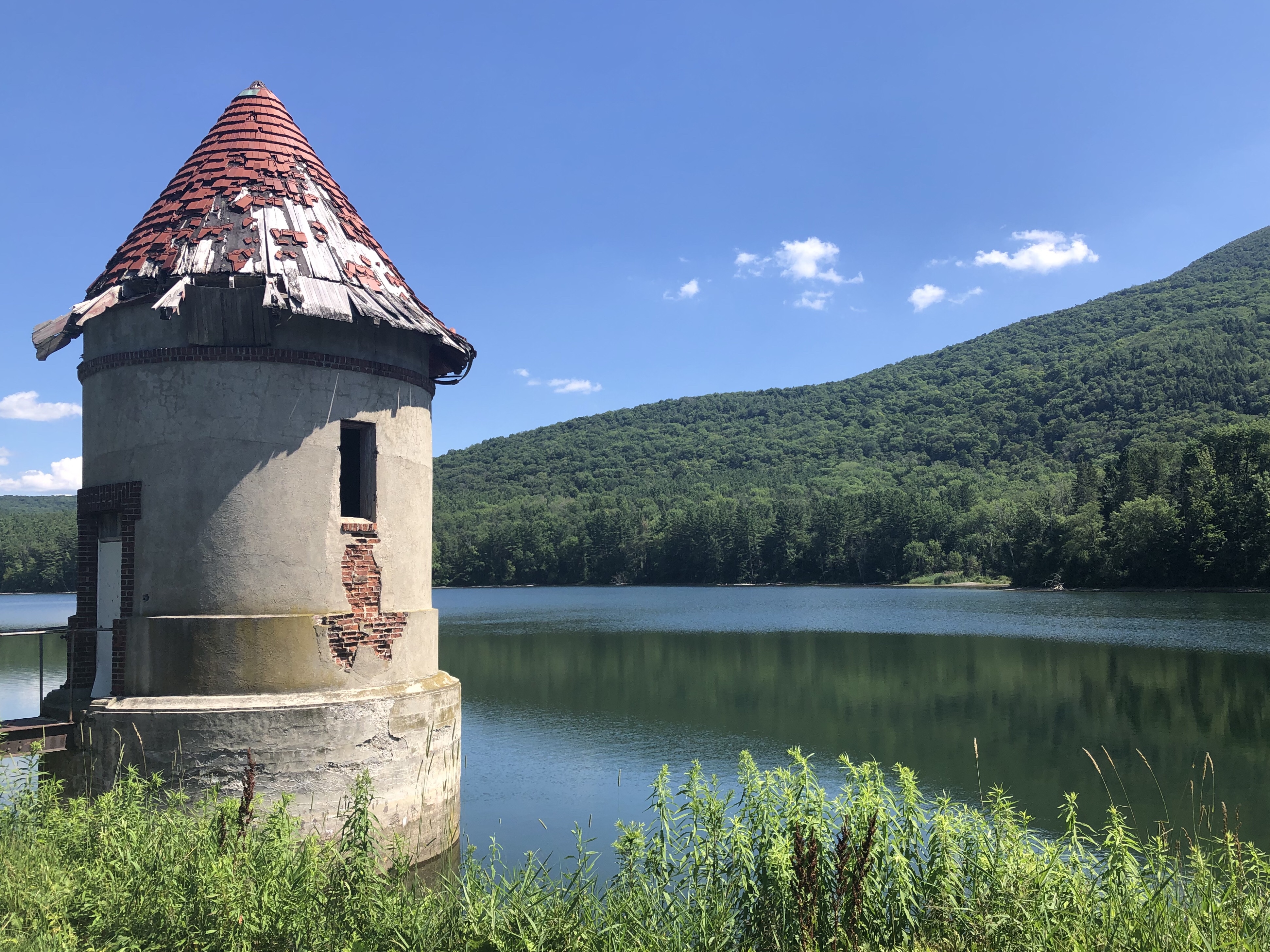
An adequate water supply for the residents and industry of North Adams was from the late 19th century, an issue of paramount importance to residents. For the next several decades the population grew at such a high rate that a reservoir was required, and in 1914, the Mount Williams Reservoir was planned and constructed. Land was selected where a small Brook passed through and a concrete core dam was designed and built that year to impound the brook. At the waters edge, a gatehouse, once perched upon the shore like a castle, is decaying. The gatehouse is a cylindrical brick structure clad in stucco, capped with a red tiled conical roof. The structure remains active to this day with a more modern structure nearby providing support to North Adams’ waterworks system.
The year after Trinity Methodist Church was constructed, the Martha’s Vineyard Camp Meeting Association at Wesleyan Grove, built the wrought-iron Tabernacle, the most significant single building in the campground. The beautiful iron Tabernacle, which seats over 2,000, was designed and built in 1879 by John W. Hoyt of Springfield, Massachusetts. The building was completed in less than four months after the contract was signed. The Tabernacle covers the original consecrated ground of 1835 where the first Methodists erected canvas tents to worship under the trees. By 1869, the attendees at the revival meetings needed more protection from the sun and rain because the large oaks that had attracted the founders 35 years before had begun to die. Since 1870, the Association erected a mammoth canvas tent supported on tall poles every summer. The tent proved unsatisfactory because of ventilation problems and a tendency to collapse in storms. In 1878 the Association solicited designs for a large wooden tabernacle a building of vast roofs, minimal supports, and open walls. The plans it received, which were elaborate versions of the wooden tabernacles or “arbors” of southern camp meetings, proved too expensive to build on this site. Campground resident John W. Hoyt solved the problem with a much cheaper wrought iron structure that was largely prefabricated and could be speedily erected on the uneven site. The gorgeous Victorian Gothic tabernacle remains today as the centerpiece of the Wesleyan Grove National Historic Landmark District, an esteemed historical designation.
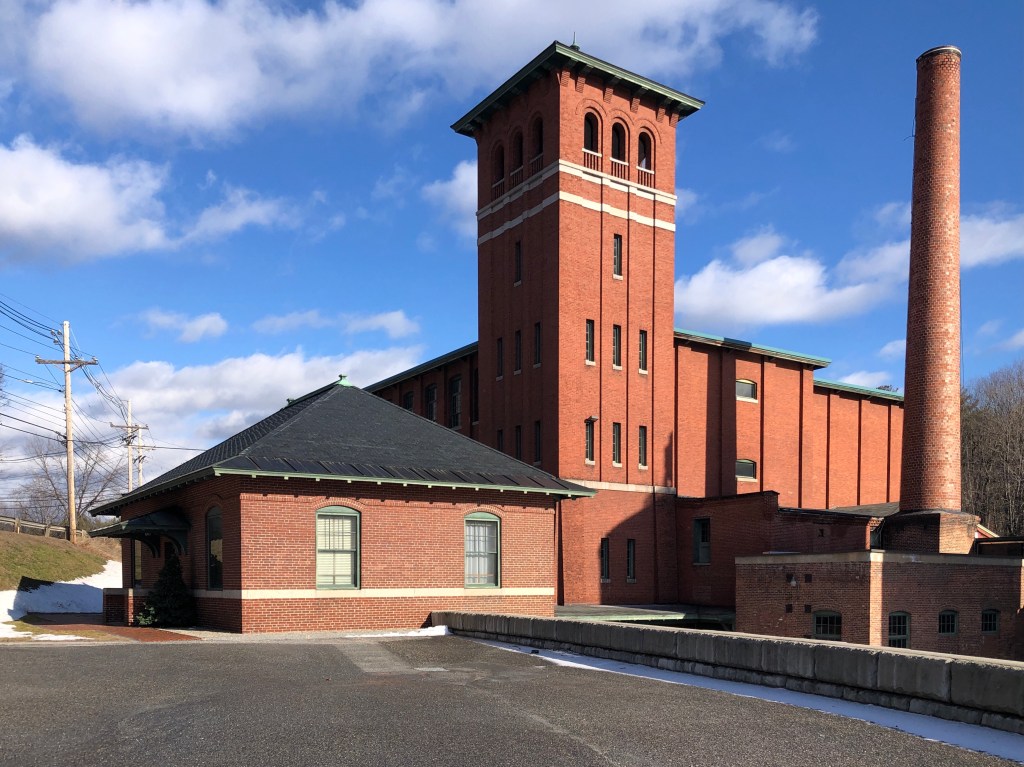
On a last-minute trip to the Berkshires, I couldn’t help but stop at the recently re-opened Massachusetts Museum of Contemporary Art (Mass MoCA) in North Adams. Being a huge nerd for industrial history and repurposed mills and factories, it was an absolute treat to walk through the large brick and steel buildings and wings lined with steel casement windows providing the perfect scenery for some amazing artworks. What is now known as Mass MoCA, – one of the premier art museums in New England – was once Arnold Print Works, a one time world leader in textile manufacturing with offices in New York City and Paris.
The Arnold Print Works were built on the Hoosac River near the center of North Adams. The company was the town’s largest industry during the city’s economic heyday from the Civil War until the early 20th century. The company was founded in 1861 by the John, Oliver, and Harvey Arnold, who began production of printed cloth at an existing cotton mill. At the dawn of the American Civil War, the newly formed company became flush with money due to government contracts for manufacturing Union Army uniforms. The company expanded after the war until a fire destroyed nearly all of the wooden buildings on the site. After the fire, a majority share of the company was purchased by Albert Charles Houghton, who became the first mayor of North Adams, and he oversaw the expansion and prosperity of the company, starting with new buildings of fire-proof construction.
By the early 20th century, many textile and cotton manufacturing shifted to the American South severely crippling the mill’s profits. In 1929, Sprague Electric Company moved to North Adams from Quincy, Massachusetts, and began buying the Arnold Print Works buildings. The print works moved much of its operation to nearby Adams and concentrated on a few particular products in its North Adams plant. The print works was finally sold in 1942 for just $1.9 million dollars, a far departure from its once prosperous past. The plant was shortly thereafter acquired by Sprague Electric Company.
While largely leaving the building exteriors as they were, Sprague made extensive modifications to the interiors to convert the former textile mill into an electronics plant. Sprague physicists, chemists, electrical engineers, and skilled technicians were called upon by the U.S. government during World War II to design and manufacture crucial components of some of its most advanced high-tech weapons systems, including the atomic bomb.
[Outfitted with state-of-the-art equipment, Sprague was a major research and development center, conducting studies on the nature of electricity and semi-conducting materials. After the war, Sprague’s products were used in the launch systems for Gemini moon missions, and by 1966 Sprague employed 4,137 workers in a community of 18,000, existing almost as a city within a city. From the post-war years to the mid-1980s Sprague produced electrical components for the booming consumer electronics market, but competition from lower-priced components produced abroad led to declining sales and, in 1985, the company closed its operations on Marshall Street.] (Mass MoCA History)
The complex sat vacant briefly before the Williams College Museum of Art, led by its director, Thomas Krens—who would later become Director of the Solomon R. Guggenheim Museum—advocated for a museum space for contemporary art that would not fit in traditional art galleries. The nearby Arnold Mills seemed like a perfect, yet daunting task to repurpose. Bruner/Cott Architects of Cambridge were hired to repurpose the mills and oversee the massive adaptive reuse project which today totals nearly 300,000 square feet of galleries and art venues.
One of the more unique summer cottages in Kennebunkport is the Talbot Cottage, a ca.1890 eclectic Shingle style home. The home features curvilinear Flemish gables crowned with ball finials, diamond paned windows, gabled dormers with finials and pendants, and a wrap-around Colonial Revival porch with fluted columns. The stunning home was built for Julian Talbot, of the Talbot Family who ran a mill in Lowell, MA. The home was soon after sold to George Hubbard Clapp, a Pittsburgh pioneer in the American aluminum industry, who summered in Kennebunkport.
One of the more identifiable buildings in Dock Square in Kennebunkport Village is one of the first you typically see when arriving from neighboring Kennebunk. The wood-frame building perched on stilts at the edge of the Kennebunk River features a prominent pyramidal roof and stunning windows. Through some digging, it appears the building was built in 1919 as the Lyric Theater, a 350-seat motion-picture cinema, that catered to the summer residents. Sometime after the 1970s, the theater was converted to retail use and now is home to Saxony Imports a place where you can pick up some presidential swag, gag gifts, or touristy clothing.
Built in 1793, the Eastham Windmill on the old Town Green is the oldest workable gristmill on Cape Cod. Typical of Cape Cod, Eastham’s windmill is an octagonal , “hat and smock” or Flemish design in which the revolving top or hat can be rotated to direct the sails into the wind. Local historians contend that Thomas Paine, a noted early millwright and resident of Eastham, most likely built the Eastham Windmill in the late eighteenth century. Some sources state that the windmill was likely built in Plymouth and later moved to Truro and eventually to Eastham in 1793. In 1895, the women of the Village Improvement Society raised money to purchase the windmill and two adjoining properties from private ownership for $ 113.50. Around the turn of the twentieth century, the windmill became a local tourist attraction and the subject of postcards and souvenirs. The windmill is now the main attraction of the annual Eastham Windmill Weekend.
In 1838, three brick lighthouses served as aids to navigation off the Nauset Beach shores in Eastham on Cape Cod; these lights were replaced by three wooden towers in 1892. From 1911 to 1923, only one of these Beacons were used, as technology had evolved sufficiently enough to install a revolving light. Nauset was thus distinguished from the single light of Highland to the north in Truro and the twin lights of Chatham to the south. The forty-eight-foot-tall, brick-lined, cast-iron Chatham tower, originally built in 1877, was dismantled, hauled up the cape, and rebuilt atop a cement foundation 200 feet from the cliff’s edge at Nauset Beach. To provide accommodations for the keepers of the relocated cast-iron tower, the 1876 dwelling built for the Three Sisters was relocated farther away from the edge of the bluff. The cliff continued to fall into the sea over time and the lighthouse and dwelling were moved again in the 1990s. Both structures are owned and maintained by the Nauset Light Preservation Society.
Learn more on the history of the site in the Three Sisters Lighthouse post.
The first lighthouse station for Eastham, known as the Nauset Beach Light Station (nicknamed The Three Sisters), was completed in 1838. The name Nauset, which came from a local Native American tribe, formerly referred to the fifteen-mile stretch of Cape Cod from what is now Brewster almost to modern-day Truro. The lighthouse station actually consisted of a group of three lights atop 15-foot high brick towers located on a bluff looking over the Atlantic. Even though there were three lighthouses, the station was staffed by only one keeper up until 1867, when the position of assistant keeper was added. The assistant lived with the head keeper and his family in the station’s one dwelling (talk about cozy)!. The Lighthouse Board in 1873 noted the inadequacy of these accommodations in a report stating, “The dwelling-house should be enlarged, or a small cottage built for the accommodation of the assistant keeper, as the building now occupied is entirely too small”. Congress allocated $5,000 in 1875 for a keeper’s dwelling at Nauset Beach, which was erected in 1876.
After the relentless Atlantic Ocean brought the three brick towers to the brink of disaster due to the eroding land under them, in 1892, three new towers were constructed thirty feet west of the originals along with a brick oil house. The replacements were constructed of wood so they could be readily moved if the need occurred again. By 1911, it was determined that there was a need for only one lighthouse (as three could get confusing), and two of the three lighthouses were auctioned off, the third was attached to the keeper’s house. The two towers (minus their lanterns) were sold in 1918 to the Cummings family of Eastham for $3.50. The family moved the two towers to a nearby location and joined them together as a summer cottage called “The Towers” on Cable Road. In 1923, the smaller wooden lighthouse was retired and replaced with the current Nauset Light. In 1983 after much uncertainty as to their future, the National Park Service united the Three Sisters in a park, just west of their original location for history geeks like us to enjoy!