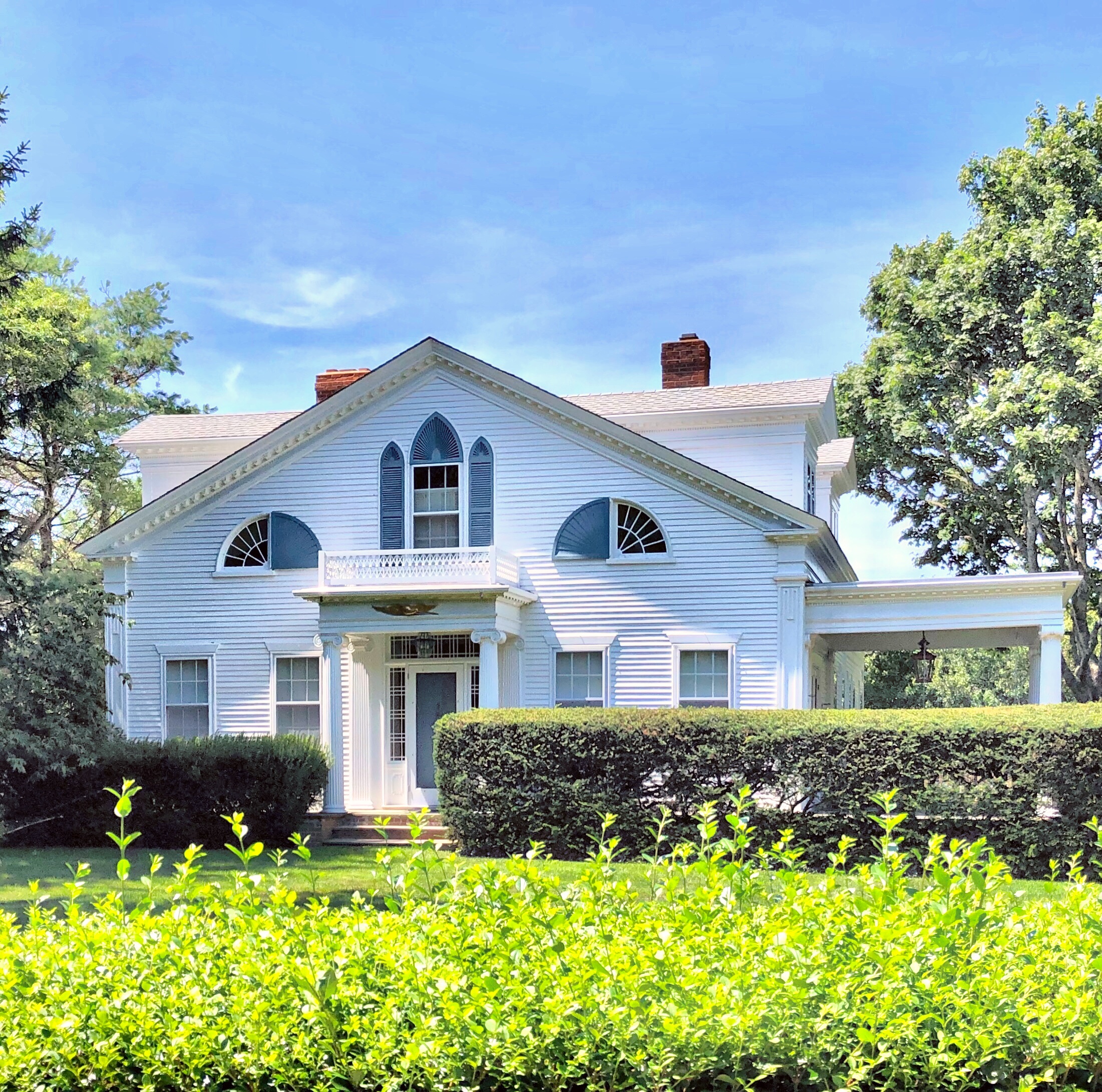
This stunning Gothic Revival house in Edgartown was built around 1848 for Captain Joseph Holley and his wife Lucy. Captain Holley was a whaler who embarked on at least four long excursions of multiple years at a time, with a break between 1847-1852, at that time, he likely had this home built. Gothic Revival homes are rare in New England, especially in Edgartown where there is a matching house across the street. The home features a large dormer with a steep pitch with lancet window and appropriate shutters.
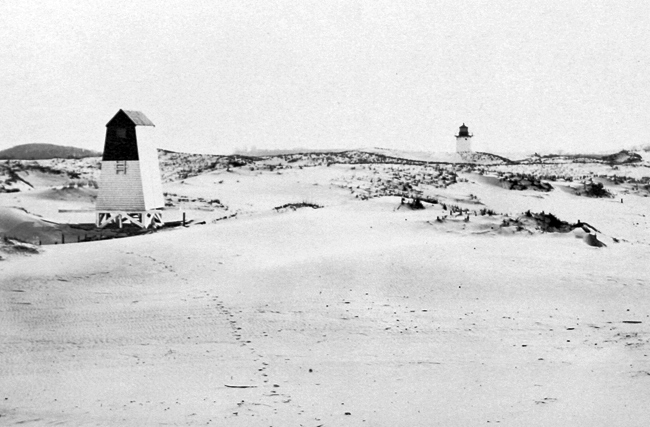
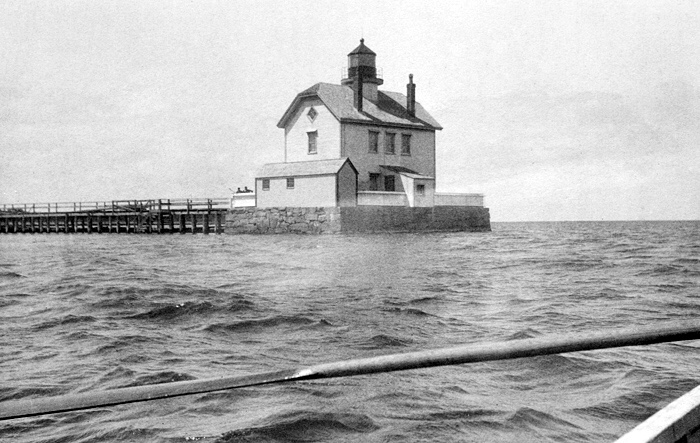
Pre-1939 image of original lighthouse with walkway to the left.
With Edgartown being synonymous with the whaling and the ocean, its obvious the town has long had a lighthouse to guide weary travellers. In 1828, Congress approved $5,500 for “building a pier and light-house on the Point of Flats, at the entrance to Edgartown Harbor.” That first lighthouse was a two-story dwelling with a side-gabled roof atop which was centered the lantern room. The structure was erected on wooden pilings out in the water, requiring its first keeper to row a short distance to get to the tower. In 1830, a 1,500-foot-long wooden walkway was built at a cost of $2,500 to connect the lighthouse to the shore. In 1840, the rotten wooden pilings supporting the lighthouse were replaced by a stone pier. The keeper’s house was drafty and leaky, and vulnerable to the sea and weather due to its exposed location. This resulted in a greater than average turnover of keepers, and some keepers refused to live in the official quarters preferring to seek lodging on the nearby shore. The lighthouse was restored numerous times through the early 20th century until The Great Hurricane of 1938 inflicted significant damage to the lighthouse. Upon taking control of the nation’s lighthouses in 1939, the U.S. Coast Guard quickly tore down the building.
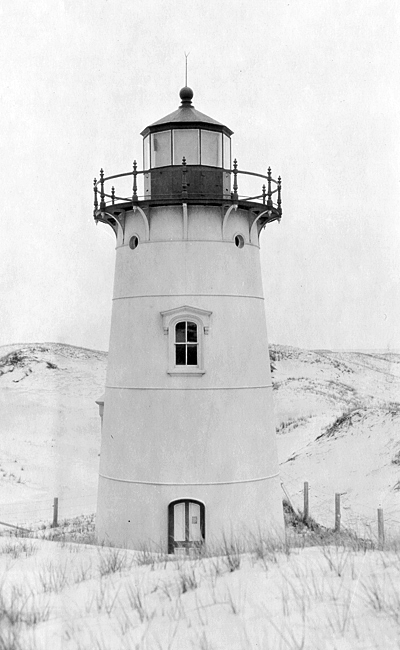
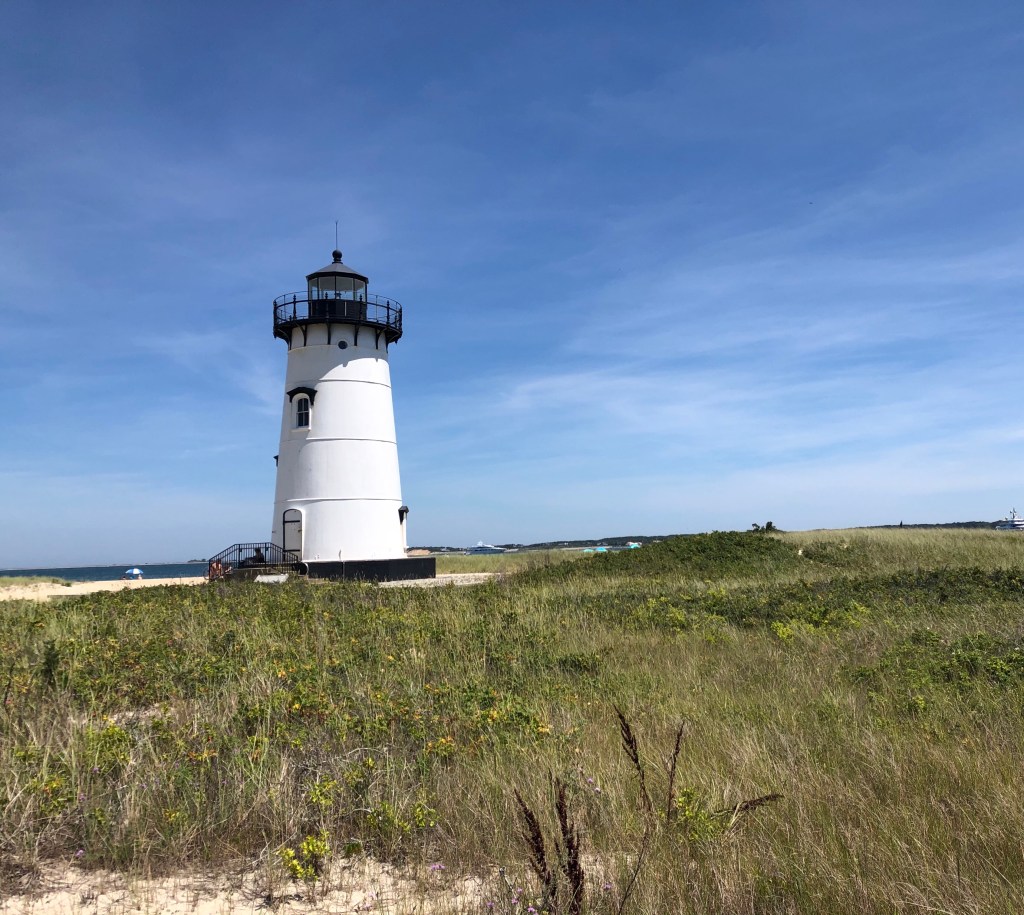
The original plan was to replace the lighthouse with a steel skeleton tower, but instead a disused 1881 lighthouse that served as a rear range light on Crane’s Beach in Ipswich, Massachusetts was dismantled and barged, minus its brick lining, to Edgartown. The relocated forty-five-foot cast-iron tower was soon in service at Edgartown and remains an active aid to navigation today, showing an automated flashing red light every six seconds. The lighthouse remains a must-see spot when visiting Edgartown.
This stunning house on Starbuck Neck in Edgartown was originally built on Main Street by Frederick Baylies Jr., as his own residence. Baylies was the architect of the town’s original Methodist church, the Old Whaling Church, and a couple other extant churches in town in the early 19th century. The home was sold to William Cooke Pease, a shipbuilder and merchant. In 1839, he joined the United States Revenue Cutter Service, an armed customs enforcement service, and he quickly rose in rank, spanning the transition from sail to steam. Capt. Pease designed and built new Cutter ships for the Great Lakes and refitted many aging vessels on the West Coast. Today, he is regarded as a founder of the modern Coast Guard, which in 1915, was created by the consolidation by an act of Congress of the U.S. Revenue Cutter Service the United States Life-Saving Service to form the United States Coast Guard as we know it today.
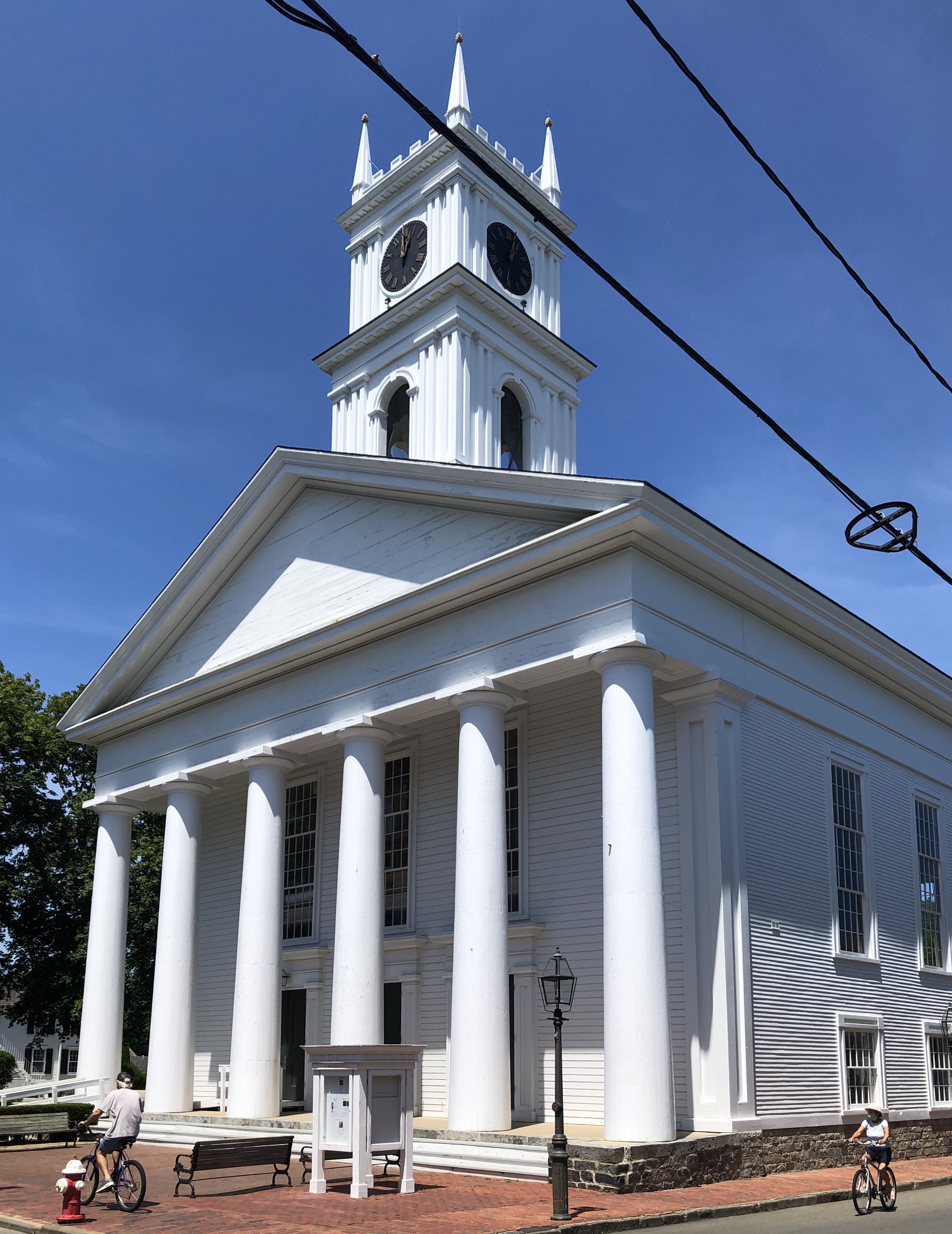
Methodists on Martha’s Vineyard arguably left the largest lasting mark between religious groups on the island between Wesleyan Grove in Oak Bluffs and this stunning church in Edgartown. The Methodists in Edgartown grew with the success of the whaling industry there and their former church was outgrown, requiring a larger and more prominent worshipping space in town. Designed by Frederick Baylies, Jr., the Old Whaling Church was built by skilled shipwrights for Edgartown’s Methodist whaling captains and is regarded as one of the finest examples of Greek Revival architecture in New England. The Old Whaling Church was not only funded by mariners and those dedicated to seafaring trades, it was quite literally built by them, too. Baylies hired a crew of local carpenters who were equally as skilled in building churches as they were in constructing ships. The church is topped by a Gothic Revival clock tower which has crenellations, rounded arches, engaged pilasters, dentil cornice moldings and four spires capped with gilded acanthus leaf finials. The church was acquired by the Vineyard Trust in 1980, and they converted the old sanctuary into a performing arts space. The congregation meets in the former sanctuary in the summer months and in the vestry in the winter with its smaller numbers.
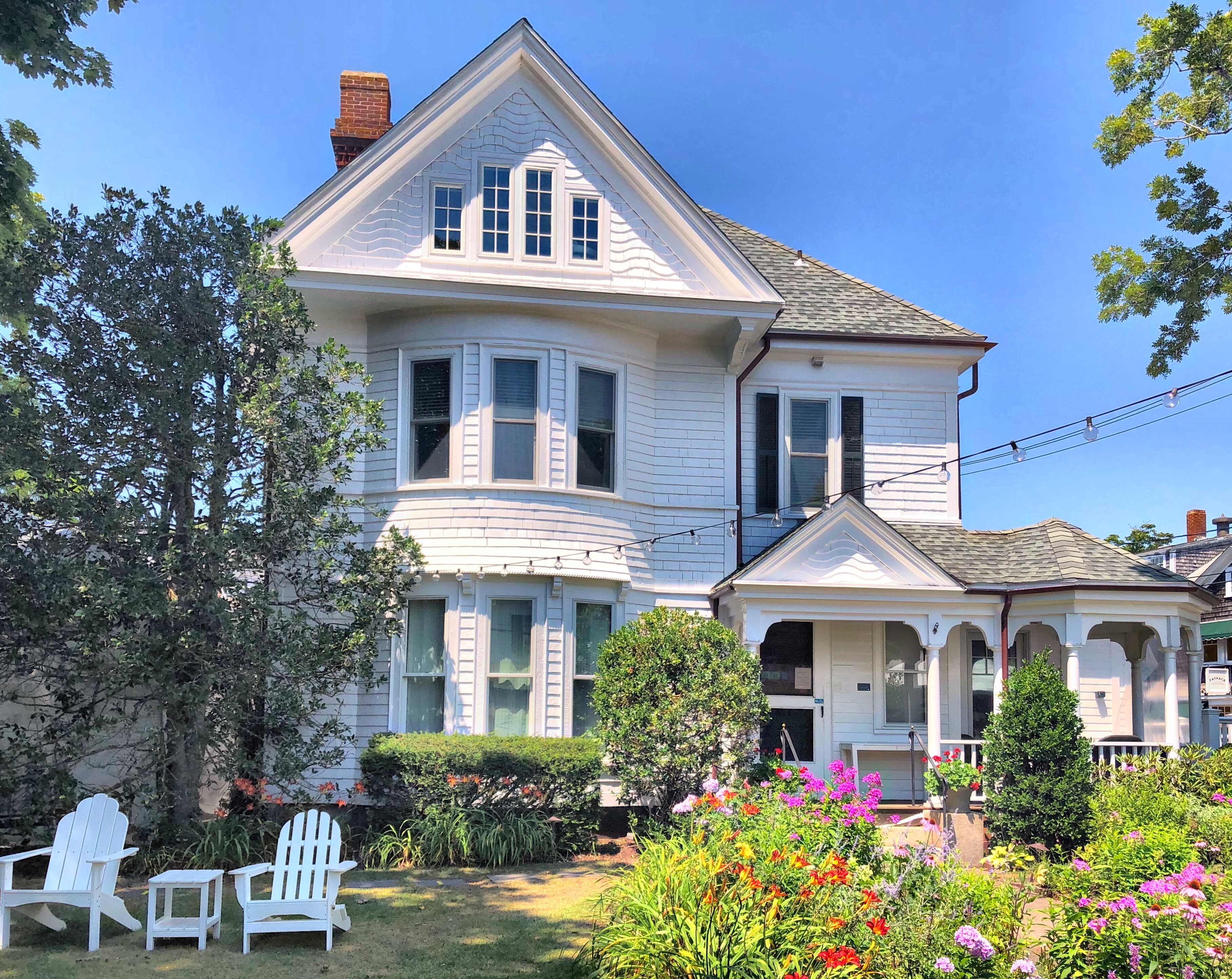
Standing out amongst the Federal and Greek Revival homes in Edgartown, this Victorian home was constructed in 1892 by Captain Charles W. Fisher (1835-1905) for his new wife. The Fisher family includes many members who were active in the local whaling industry. Fisher is said to have caught the largest sperm whale on record in 1884 and apparently loved being on the open ocean. The next year he married Parnell Pease and she sailed with him to the Pacific on a whaling voyage, lasting five years! At the time of their marriage, Fisher was in his 50s and his new wife in her 20s. Upon their return, Fisher built his wife this “modern style house on the pretentious side with Victorian ornamentation.” Unfortunately, his wife preferred her former house, which was a block a way and obscured any views of the water. Tradition states that apparently, Mrs. Fisher had seen enough of the water during her voyage, as her diary on the five year trip detailed her many unfortunate bouts with sea-sickness, a stay on an island, and dangerous storms.
Believe it or not, living on an island in the 19th century wasn’t as easy as you may think. Before this bank building was constructed in 1855, all banking was done off-island. The bank was constructed to house the newly formed Martha’s Vineyard National Bank, whose first president was Dr. Daniel Fisher, who made his money as a merchant and operator of one of the largest whale and sperm oil processing facilities in the country. The bank relocated to Vineyard Haven and the Edgartown National Bank was created to fill the void in town. Amazingly, the building is still to this day occupied by a bank, Rockland Trust, seemingly adding to the continuous occupancy of the building by banking facilities for well over a century. The structure is one of the oldest brick buildings in town and is a late iteration of the Greek Revival style.
Located on the idyllic Main Street in Edgartown, on Martha’s Vineyard, this historic building stands out for its design. It was built in 1828 as the first meeting house for the Methodists of Edgartown, the former building was shared with the Baptists there, but was quickly outgrown. Ten years after this church was built, the space was already becoming too cramped with the booming population of the town due to the success of the whaling industry here. The Methodists then constructed a larger church (known as the Old Whaling Church nearby and sold this structure to the town as a new Town Hall. After the Town bought it, the first floor was remodeled to accommodate the fire engine and also the Town’s police station. Today, it contains town offices on the ground floor and the former upstairs church auditorium is now used as a movie theater. The infamous nails on the chalkboard scene in the movie Jaws was filmed in this building!
Located north of downtown Oak Bluffs, this oceanfront summer estate exemplifies the grandeur of Martha’s Vineyard at the end of the 18th century. This home was built in 1890 for Frank A. Ferris, a Manhattan meat dealer who processed and shipped his product to wealthy customers, markets, luxury hotels and restaurants all over the east coast. His processing plant on Mott Street in Manhattan remains an excellent example of Romanesque Revival architecture in the city. He lived at 5 Russell Terrace in Montclair, NJ, and in summers, stayed in this waterfront mansion overlooking the Atlantic. His summer home is a great blending of the Queen Anne and Shingle styles, both very common at the time.
This grand home was built in 1871 for George Hills, one of the original investors in the Oak Bluffs Land & Wharf Company development, a development to the east of Wesleyan Grove. The home was designed by Samuel Freeman Pratt, a Boston carpenter turned premier architect of Oak Bluffs, who likely designed the home in his distinct Stick Style with intricate wood carvings and posts. In 1877, the home was purchased by Governor William Claflin after his time in office as a summer retreat from his home in Newton, MA. The governor was an ardent Methodist who was involved with liberal causes such as abolition and Native American and female enfranchisement. Within 10 years of his purchasing of the home, he modified and enlarged it with Colonial Revival motifs including the gambrel roof, Tuscan columned porch, and simplified dormers.
Prior to 1866 the area now called Oak Bluffs was largely undeveloped with the exception of the famed Methodist meeting camp at Wesleyan Grove that had been established in 1835. By the 1860s the meeting camp was attracting large numbers of middle class visitors from Boston and surrounding towns who came for summer retreats; in 1868 approximately 600 tent and cottage lots were being leased in the Methodist compound. The Land & Wharf Company catalyzed this success into profit, by developing a more commercial presence on Circuit Avenue and developed housing on large lots to the east.
The first major structure built by the Land & Wharf Company was the Arcade Building. In it, they established their office from which they directed development of the resort. The central open arcade provided access to the campground from the heart of Oak Bluffs’ commercial area. The Arcade was designed by Boston carpenter/architect/inventor Samuel Pratt (1824-1920) who was also responsible for many of the cottages in Oak Bluffs. The Arcade remains a historically significant and well-preserved commercial building in town. My bad photo doesn’t do it justice! 😦



 Buildings of New England