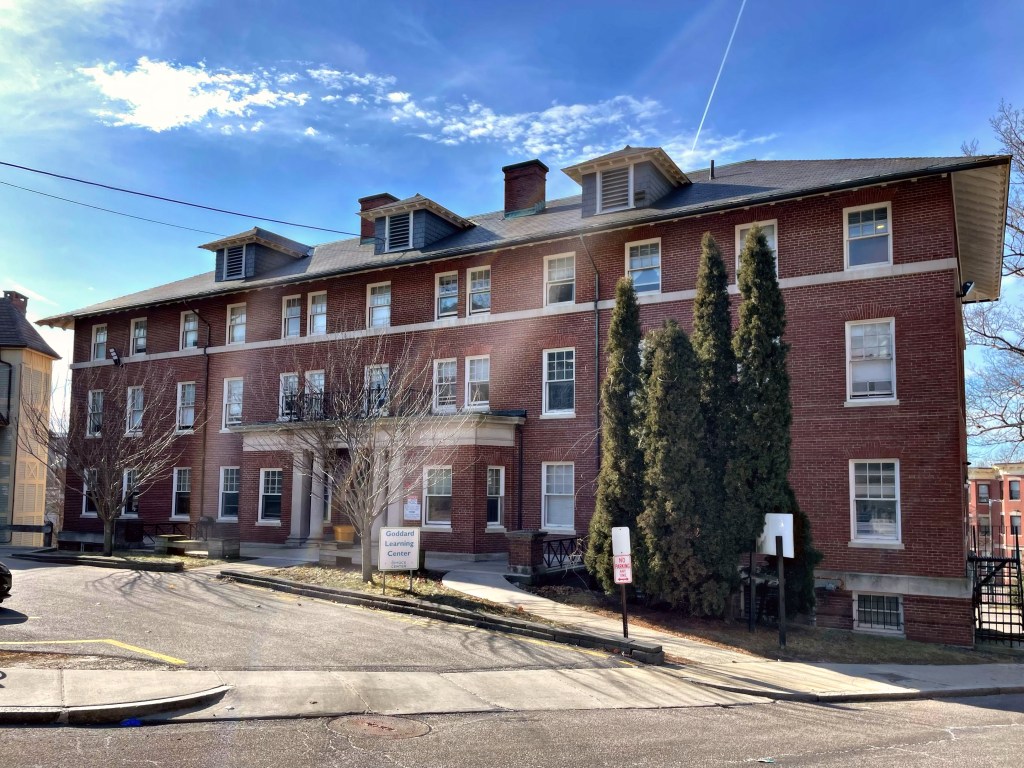
Dimock Center – Goddard Nurses Home // 1909

Located adjacent to the Zakrzewska Building and Cary Cottage at the former New England Hospital for Women and Children is the 1909 Goddard Nurses Home, designed by John A. Fox. This three story brick building typifies the Classical Revival style with its recessed central entranceway and symmetrical fenestration with flared brick keystone lintels. The slate hipped roof is perforated by three dormers on the front facade. The broad overhanging eaves have exposed rafters which is an element of Craftsman design, common at the time. The Goddard Nurses Home provided living accomodations for up to fifty nurses who worked at the hospital. It was named after Lucy Goddard, one of the original incorporators of the women’s hospital, she served as president for twenty-five years.

Talitha Cumi Home // 1912

One thing I love about Boston is that nearly every old building has such a rich history that takes so much time to compile and write up (this account keeps me busy)! Located on Forest Hills Street in Jamaica Plain, this stucco building caught my attention when driving by, so much so, that I had to stop and go back. The building was constructed in 1912 as a home for unwed mothers called Talitha Cumi Home (a phrase from the Bible meaning “Arise, young woman”). The charitable organization outgrew their space in the South End and sought greener pastures and open space in Jamaica Plain. The group had been organized in 1836 by “earnest Christian women” who longed to open a “door of hope” to “those hopeless and helpless girls who found themselves facing the sadness and shame and wrong of unwed motherhood.” The Talitha Cumi Home allowed pregnant women to reside and birth their children before their pregnancy began to show. The site originally included an administration building and a hospital with both structures connected by a covered breezeway. The home closed in the 1950s and the former home for unwed mothers has since been converted to a middle school.

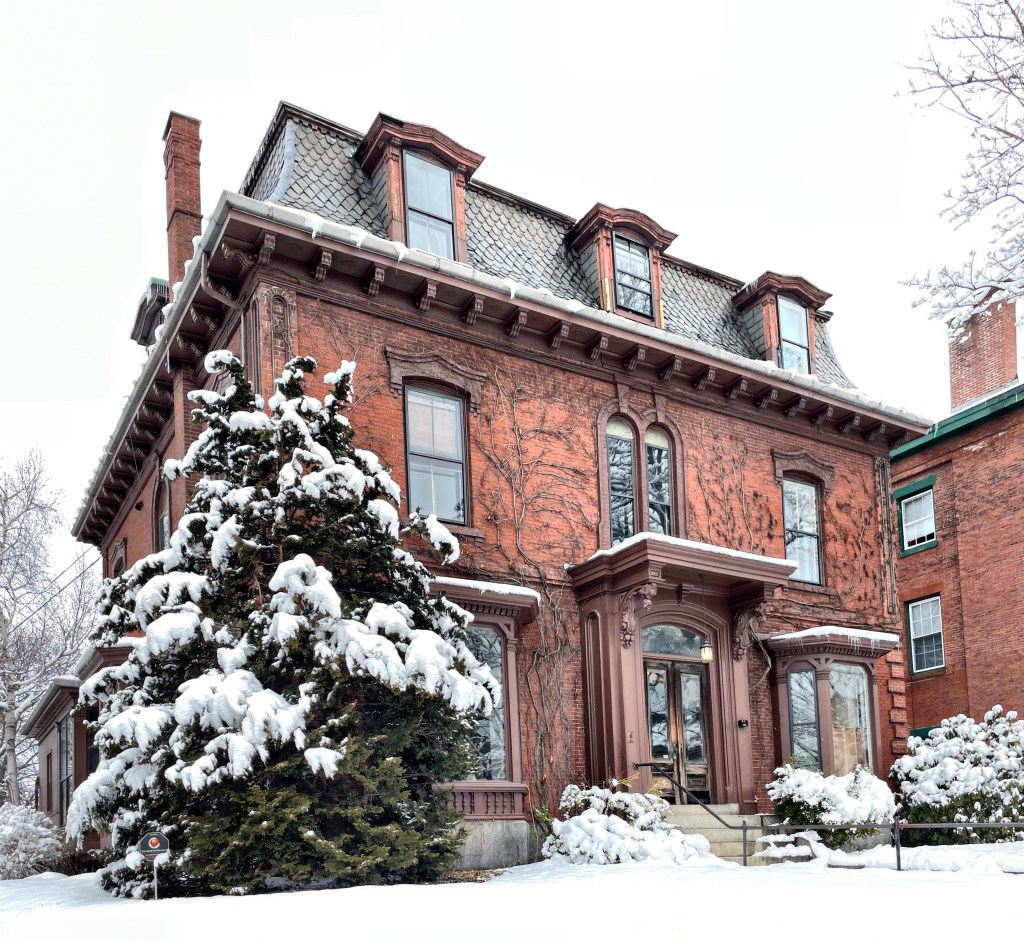
William Allen Jr. House // 1866

Italianate style houses dominate the Deering Street area of Portland architecturally, but there are definitely some great Second Empire residences and other styles seen here. This house (like seemingly every building in Portland in the 1860s) was designed by architect George M. Harding for William Allen Jr. The house would soon be Harding’s neighbor, so he made an effort to site and design this residence with care. The brick building is capped by a slate mansard roof and it has a beautiful projecting door hood with pendants carved of grapes. Sadly, like some others on the street, the belvedere was removed in the mid-20th century.

Francis Waldron House // 1867

Francis Ashby Waldron (1816-1898) was born in Buckfield, Maine to an old New England family. He moved to Portland for job opportunities and worked as a merchant, eventually establishing Waldron and True with business partner Samuel True. The firm was engaged in dealing grain, salt, corn, and more. After a few years of profits, Francis had this Italianate style mansion built on the fashionable Deering Street just west of Downtown. The property was passed down to his children after his death in 1898, and it remained in the family until 1950. The house originally had a prominent belvedere at the roof, but it was eventually removed. The former Waldron House is now maintained as a law office.

Academy of the Holy Family // 1914

Built adjacent to and just a few years after the St. Mary of the Immaculate Conception Church in Baltic (last post), the Academy of the Holy Family stands as a high-style Colonial Revival building in the town. The building stands four full floors with a raised basement and attic story, and is symmetrical in its design. A large fan-light transom and stone trimmings add much depth to the buildings large massing. The structure was built in 1914, and has housed the Academy of the Holy Family, a private, Roman-Catholic all-girls prep school, which is still active today.

Sprague Former Town Hall and Fire Station // 1911

At the turn of the 20th century, the town of Sprague (including Baltic Village), had 1,300 residents. Just ten years later, in 1910, the population doubled, largely due to Frederick Sayles‘ purchase of the Sprague Mill and re-investment in the village’s housing and buildings. The need for new town offices and a fire station was evident, and this building in the village was constructed in 1911 to serve both needs. The old Town Hall and Fire Station is a late example of Romanesque Revival style architecture with the arched windows at the second floor and in the dormer. The space was outgrown again and the town offices relocated to a Modern building down the street after WWII.

Giddings Homestead // c.1800

This old gambrel-roofed home sits on the beginning of Pautipaug Hill Road just outside the industrial village of Baltic, in Sprague, Connecticut. The house’s history is a little unclear, but it shows up on historic maps as being owned by W. Giddings. This appears to have been Walter Giddings (1788-1854). Walter may have built or inherited this property from his father Nathaniel, who died in 1809. Walter married Laura Lucretia Fillmore in 1811 and they had four children. Laura died in 1827 at just 37 years old and Walter remarried within a year to Lydia Lathrop Ladd. The property remained in the Giddings Family at least into the second half of the 19th century. It was later “Victorianized” with two-over-two windows, side and front porches, and a octagonal bay window. The home has been suffering from deferred maintenance for over 15 years (as far back as Google maps goes) and was listed for sale, so here’s to hoping this old beauty survives!

United Methodist Church of Nantucket // 1823

The United Methodist Church of Nantucket stands prominently at the top of Main Street on land was obtained from Peleg Mitchell in 1822. Construction on the site began in 1823 with the massive structure originally built with a pyramidal hip roof of enormous timbers brought to the island on whaling vessels. In 1840, the roofline was amended with the present gable roof, constructed over the original hip roof. The church is a highly significant example of Greek Revival architecture on the island and a more rare example of the temple-front form seen there. Deferred maintenance threatened the building to the point that in 1995, the building was listed as one of the most endangered buildings in Massachusetts. A restoration was undertaken funded by private contributions and the Massachusetts Preservation Project Fund, preserving the building for another 200 years.

Gorham Hussey House // c.1820

This Colonialized Federal period house sits just down Vestal Street from the Maria Mitchell Association campus on the ever-charming island of Nantucket. The home was built around 1820 for Gorham Hussey (1797-1879), who would have been around 23 at the time. He married Lydia Macy in 1820 and the couple had twin daughters that same year, likely right after this house was completed (talk about a busy year)! The home was later owned by photographer John W. McCalley, who photographed this and other houses in the area. The home retains a high-style Colonial Revival fanlight over the door, likely added in the first three decades of the 20th century as colonial homes were romanticized.

Maria Mitchell House and Observatory // 1790 & 1908

Although Hezekiah Swain built this house in 1790, the property is better known as the home of Maria Mitchell and is to this day, preserved to interpret her amazing legacy. Maria Mitchell’s father William bought the house in 1818, and Maria was born there later that year. Maria grew up on Nantucket and she became the first female astronomer in America. After she discovered a comet in 1847 (which was named Miss Mitchell’s Comet), her international recognition led to many awards and that acclaim enabled her to continue her work. She accepted a position as professor of astronomy at Vassar College by its founder, Matthew Vassar, in 1865 and became the first female professor of astronomy She established the Association for the Advancement of Women and became the first female member of the American Academy of the Arts and Sciences. She was also very involved in the anti-slavery movement in New England. After Maria Mitchell died in 1889, the Maria Mitchell Association, was established in Nantucket to preserve the sciences on the island and Mitchell’s work. On July 15, 1908, the Observatory on Vestal Street near the Science Library and Mitchell House was dedicated. The Observatory, built by the Nantucket Maria Mitchell Association, stimulated local interest in science. The success of the Observatory’s programs prompted the construction of an astronomical study in 1922, joining the existing facility with the Maria Mitchell Birthplace. The museum operates in Summers to this day, and continues Maria’s rich legacy in the sciences.