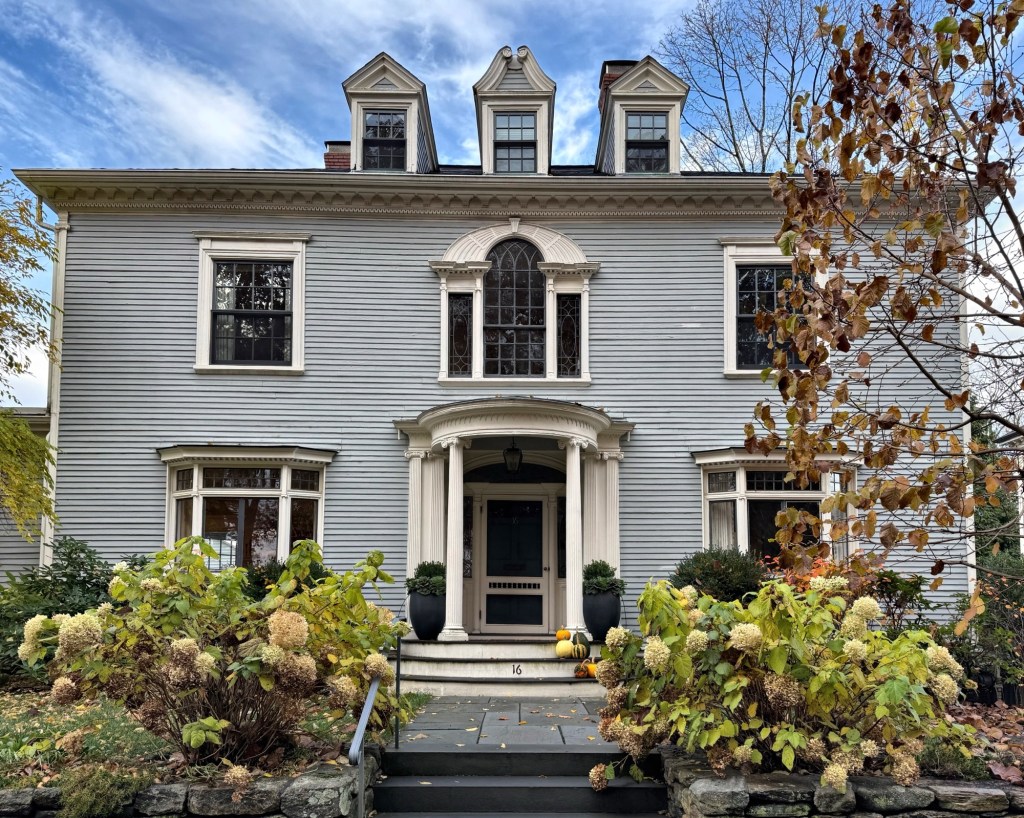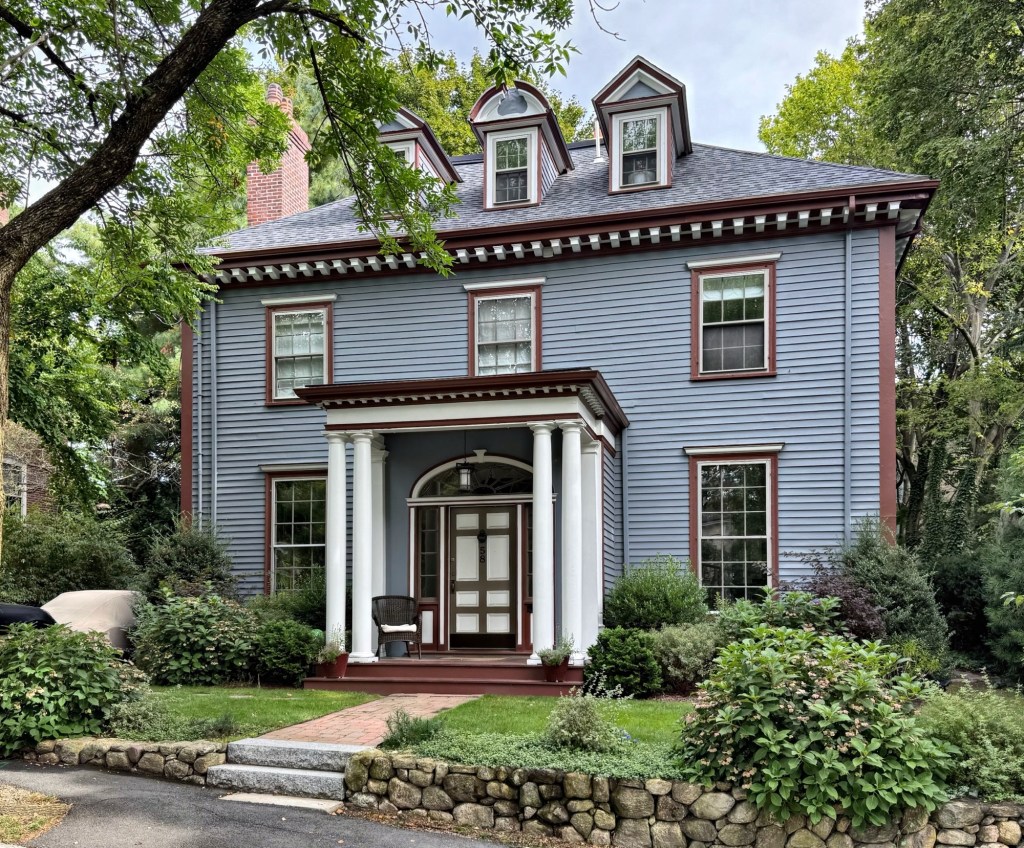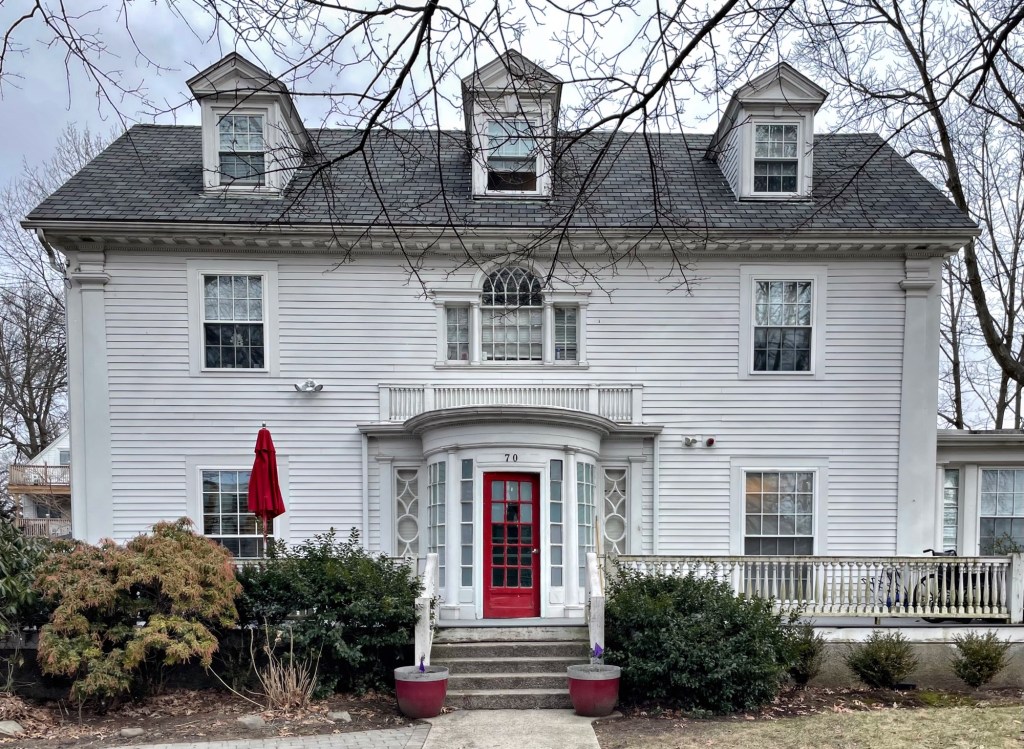
This Colonial Revival style single-family house on Emerson Street in Brookline Village, was built in 1893 on the former Emerson Estate, that was subdivided by the heirs of Elijah Emerson as Brookline Village filled in during the late 19th century. This house was seemingly built for Elijah’s daughter, Sarah C. Emerson Davis, and her husband, George Peabody Davis from plans by Boston architect, Olin Wesley Cutter. Of particular note, the Davis House features a symmetrical facade with round entry portico, Palladian stairhall window with leaded glass, and pedimented dormers, with the center dormer in a swan’s neck pediment. The oddly proportioned pilasters with tiny Ionic capital on the corners of the house were great to see as well!
The Russell-Hayes House at 58 Allerton Street in Brookline, Massachusetts, was built in 1899 in the highly popular Colonial Revival style for Mr. and Mrs. Russell. Francis Henry Russell (1832-1919) was born in Plymouth and married Elizabeth Stevens (1835-1922) of Lawrence, and had one daughter together. Francis attended Harvard College and eventually worked as the Treasurer of the Bates Manufacturing Company, doing well enough to purchase a house lot in the fashionable “Pill Hill” neighborhood of Brookline to build his home here. Mr. Russell hired Plymouth-born architect, Joseph Everett Chandler, to design his suburban residence for himself, his wife, and daughter. After the death’s of Francis (1919), Elizabeth (1922) and their unmarried daughter, Mary (1926), the property was purchased in 1927 by African American musician, Roland Hayes. Just years prior to purchasing this stately home in Brookline, Roland Hayes performed abroad in Europe, even a private performance for King George V and Queen Mary at Buckingham Palace. He returned to the United States of America in 1923 and made his official debut on November 16, 1923, in Boston’s Symphony Hall, which received critical acclaim. He was the first African-American soloist to appear with the Boston Symphony Orchestra, who would later hire him, with a reported salary of $100,000 a year. Roland and his family lived in this house for 50 years until his death in 1977. His legacy lives on here with a plaque in front of the home, and a public school named after him.
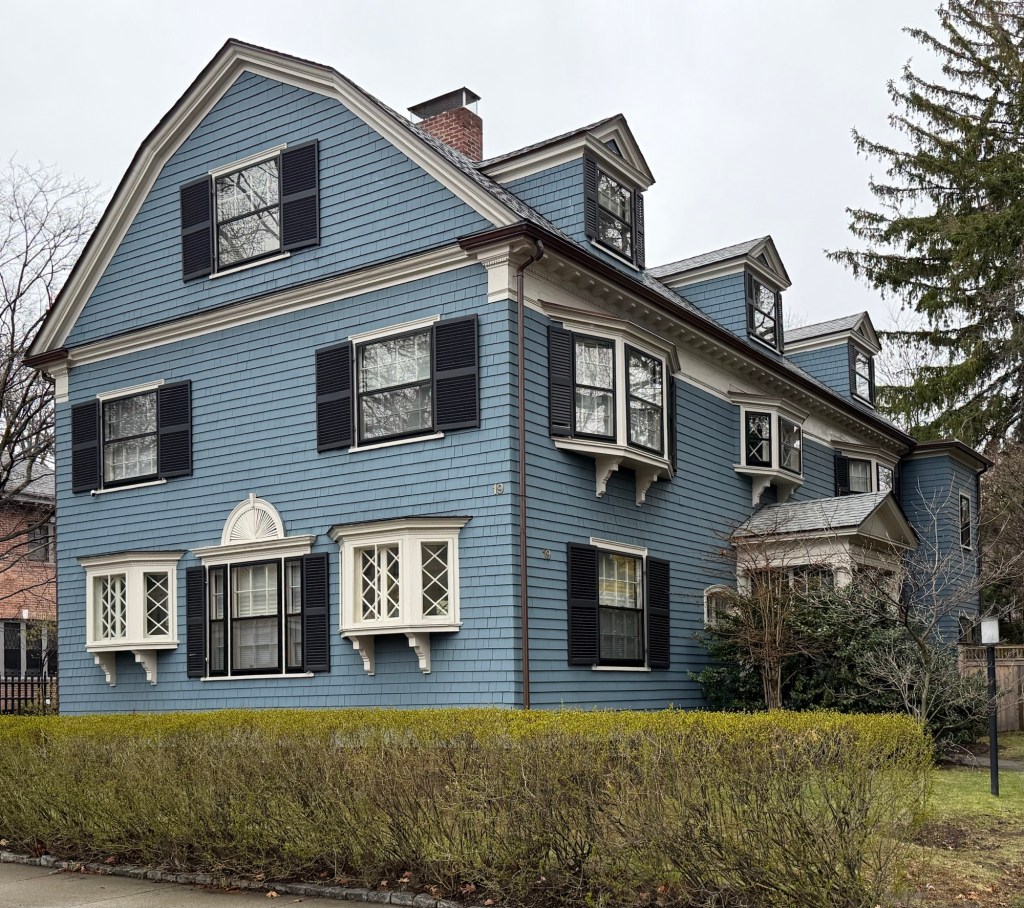
This lovely Colonial Revival style house on Powell Street in Brookline was built in 1904 for Charles H. Owens, Jr., an interior designer who just two years later, built another home next door that he would reside in with his own family. This house was rented to John R. Perry, who was also listed as a “decorator” in city directories and president of Perry, Lewis & Whitney, a design firm. The house (like its neighbor built two years later), was designed by the architectural firm of Loring and Phipps and was oriented southward to face the side yard. The Perry House features small projecting oriel windows, a broad gambrel roof, and an entrance portico supported by Tuscan columns.
As much of the streets north of Franklin Park were developed in the early 20th century, a mix of middle-class apartment buildings and stately single-family homes began to sprout up. Boston contractor Hugh Nawn hired architect Julius Adolphe Schweinfurth to design this house, seemingly on spec, as an income-producing venture. Schweinfurth was employed by the architectural firm of Peabody and Stearns and worked as chief designer there until 1895, when he opened his own practice. His design for Mr. Nawn was this stately Colonial Revival style mansion, similar to Nawn’s own home just across the street, which overlooked Franklin Park. After WWII, Roxbury’s population saw an increase in Black residents, who began to be pushed out of the South End due to increased cost of living. This home was purchased by Dr. Charles A. Pinderhughes (1919-1998), Chief of Psychiatry at the Veterans Administration Medical Center in West Roxbury who also taught at Boston University, Tufts, and Harvard. He was engaged in the local chapter of the NAACP and advocated for African American residents when Urban Renewal began to destroy much of the surrounding neighborhood by the Mayor and Boston Redevelopment Authority. The Pinderhughes House is a well-preserved architectural landmark that also has ties to a more recent and overlooked history of the neighborhood. I hope this house stays like this forever!