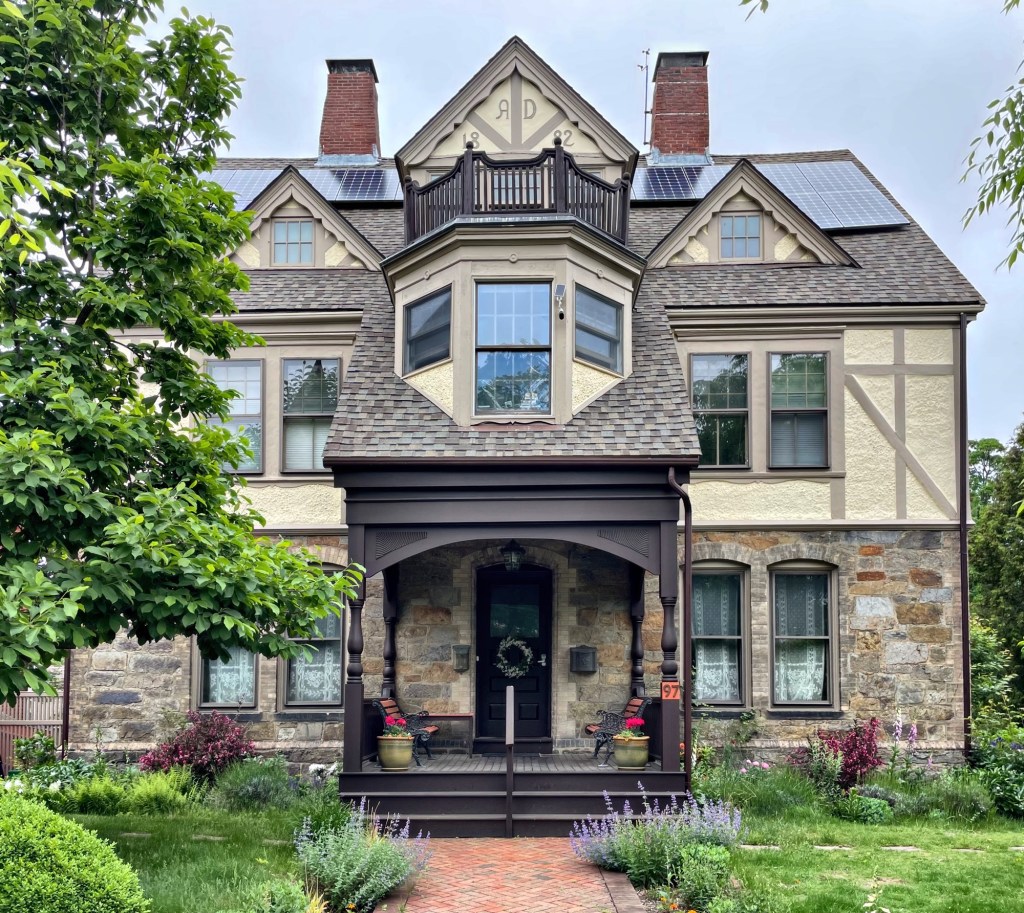
One of the many “hidden” gems of old houses in Brookline is this charmer on Francis Street, just west of the Longwood district. The residence was built by 1882, by Henry Savage Chase (1825-1885) who lived in a larger stone mansion across St. Paul Street (no longer extant). This house was rented out by Chase, possibly to friends and remained in the family for decades. This early Queen Anne style dwelling (and likely the main house) was designed by architect Edgar Allen Poe Newcomb, a relatively unknown architect of the period. The house has an irregular plan with varied siding and materials, with applied ornament that has survived intact for nearly 150 years.
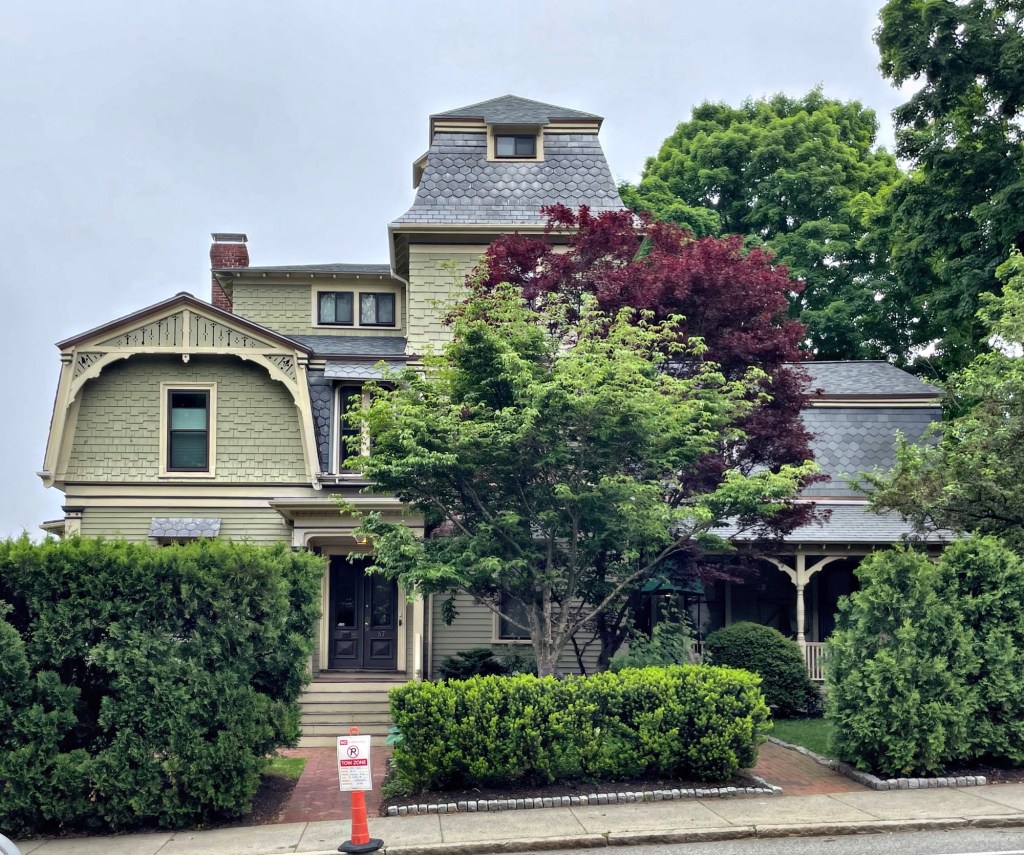
In 1868, James Wilkinson Clapp (1847-1931) married Eliza Tuckerman and they soon after moved into this large Victorian-era house on St. Paul Street in Brookline. James was the second son of Otis Clapp, a politician, publisher, and promoter of homeopathy. Otis Clapp operated a large homeopathic pharmacy, Otis Clapp & Son, which continued as a business after his death, evolving to encompass different areas of medical technology. It was one of the oldest-operating pharmaceutical manufacturers in the United States by the time it was acquired by Medique in 2008. The business allowed James, at about 22 years old, to build this stately home for him and his new wife to move into. The residence is Second Empire in style with Stick style ornamentation, and while mostly obscured by vegetation all year, it commands the heavily trafficked corner of Brookline.
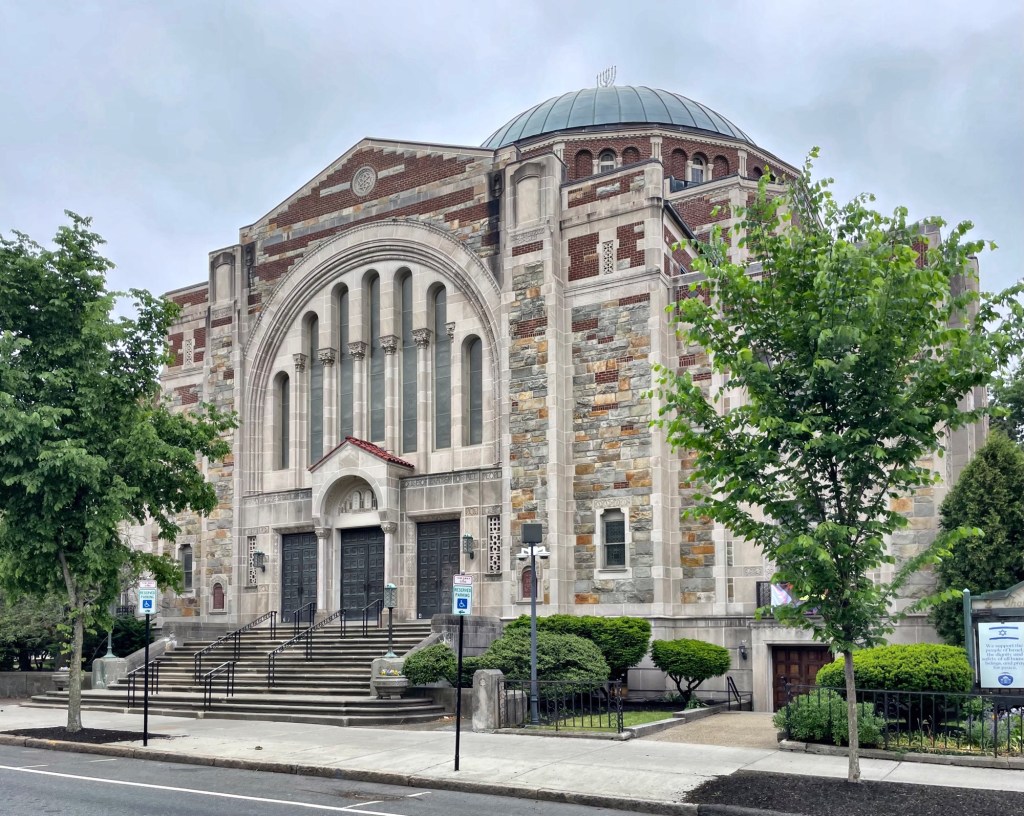
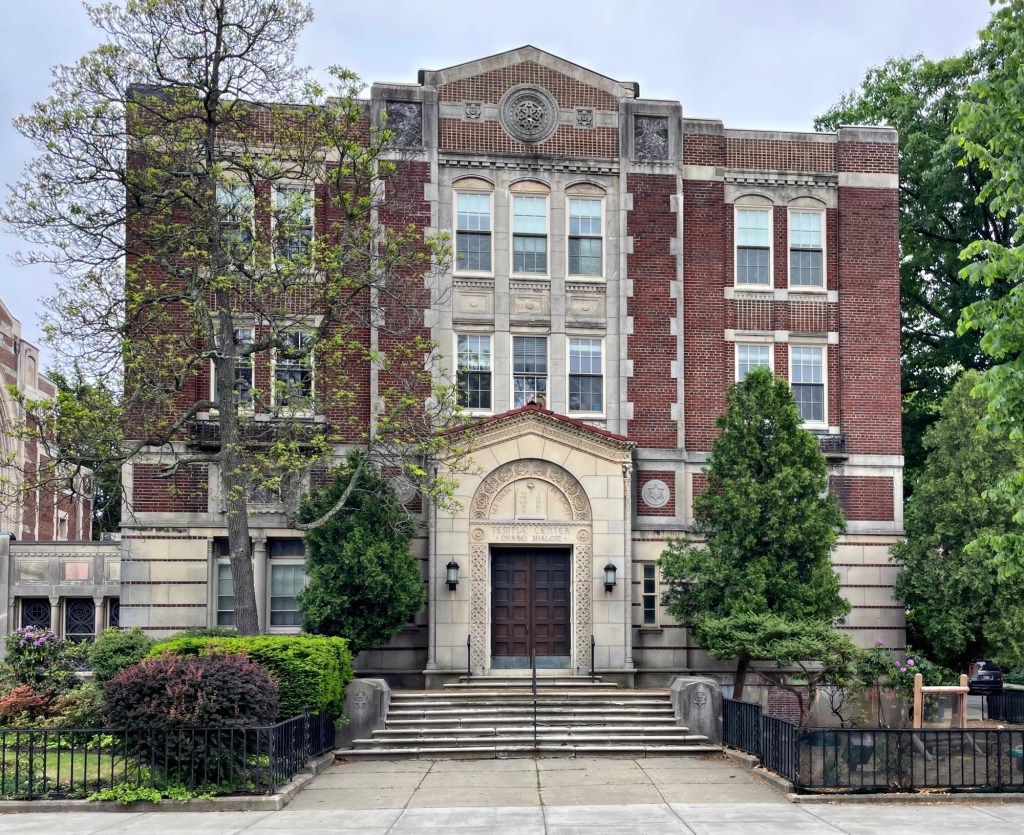
The congregation of Ohabei Shalom is the oldest jewish congregation in the greater Boston area and the second oldest in New England. It was formed in 1843 and was the first formal congregation in Boston. After a smaller space, they purchased the former South Congregational Unitarian Church on Union Park Street in the South End of Boston. The congregation split over ideological differences and the decision was made for one half of the congregation to build a new temple in Brookline, where many of the members began to move to. Land on Beacon Street, just west of the Longwood section of Brookline was purchased in 1921, and it would be four years until a temple center (now the hebrew school) was built in 1925. The larger temple was built just after on the corner of Beacon and Kent streets in Brookline from plans by Clarence Blackall, a noted architect in the area. With its lively use of polychromatic masonry and Byzantine ornament, all surmounted by a great copper dome, the congregation boasts the most architecturally outstanding synagogue in the Boston region and it has been maintained well for the almost 100 years since it was built.
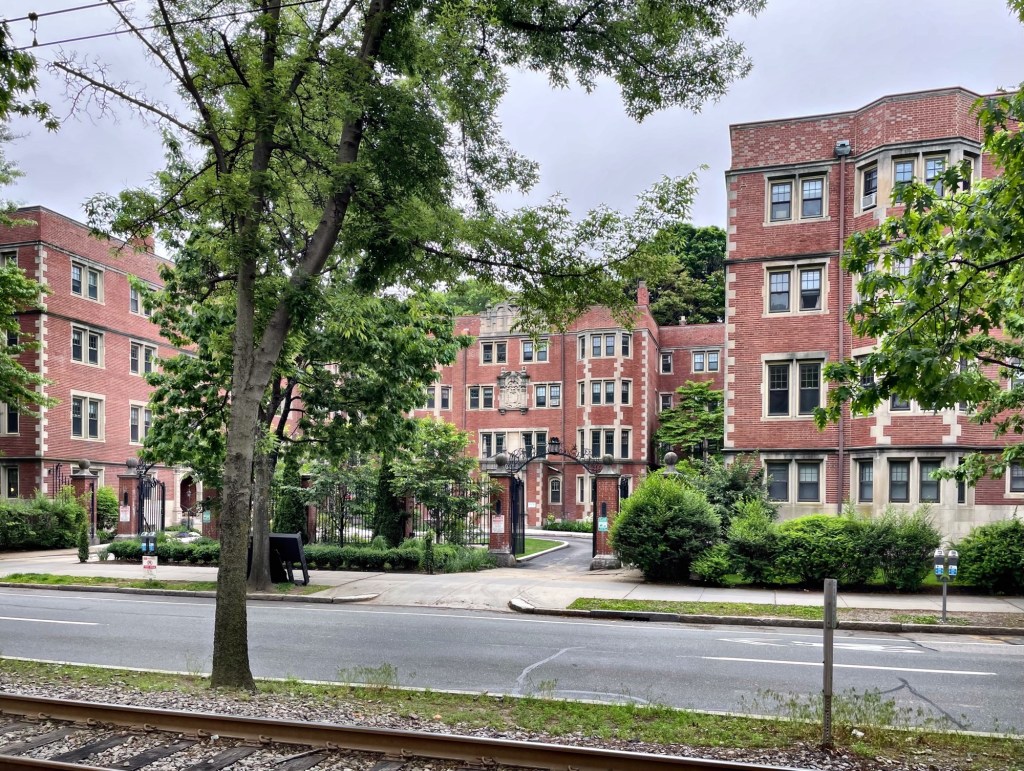
Believe it or not, but this apartment building on Beacon Street in Brookline, Massachusetts is one of the most significant buildings of the type in the Boston area! This is Richmond Court, which is one of the oldest (if not the first) apartment house built in the northeastern United States that resembled an English Tudor manor house. The apartment building was constructed in 1898 from plans by architect Ralph Adams Cram, one of the best American architects of the late 19th and 20th centuries. Cram even moved into the building briefly before moving into a townhouse in the Back Bay neighborhood of Boston. The building set the tone architecturally for later apartment buildings in the Boston area, with many architects attempting (largely not as effectively) to design Tudor-influenced apartment buildings regionally. The development is also significant in that at a time when most Boston-area developers were building apartment houses that maximized the buildable square footage, as they do to this day, Richmond Court included a landscaped courtyard to provide residents with more light and air circulation. The development also included two separate town houses on either side of the apartment block.
Located on Beech Road overlooking the “village common” of Longwood Mall, this 1920s Georgian Revival mansion showcases the curb appeal and perfect siting of suburban houses of the period . The home was built in 1927 for Benjamin Green, a real estate dealer and his family. The Green’s hired architect Harry Morton Ramsay, a noted area architect who specialized in suburban single-family homes of this period, to design the Georgian Revival style home. The brick residence features a symmetrical facade, half-round portico with Corinthian columns, round arched first floor and dormer windows, and decorative brickwork.
If you love Colonial Revival style homes, the Longwood neighborhood in Brookline is a must-visit area to stroll around! This house is tucked away in the neighborhood and was a treat to stumble upon. This large home was designed by the underappreciated architect, James Templeton Kelley for a George G. Quincy. The Colonial Revival style dwelling is actually built of wood with a brick veneer and has an open pedimented entry with fanlight and transom surround. The round-headed windows on the first floor are especially notable.
No trip to Longwood in Brookline would be complete without checking in on one of the finest multi-family housing developments of New England… This is Longwood Towers. The development was originally built in 1925 from plans by architectural/engineering firm Kenneth DeVos and Co. who built three near-identical developments in the early 1920s: Detroit (1922), Brookline (1925), and finally Philadelphia (1928). The complexes were all originally called Alden Park Manor. Kenneth DeVos worked with local architects for each project to oversee construction details and furnish interior detailing as needed. For Brookline, he hired Harold Field Kellogg, who earlier served as the first director of the Boston Housing Authority. The design is Tudor Revival in style with towers connected by social spaces and a lobby linking the towers with a dining room for residents, a ballroom, lounge, day care facilities, barber and beauty shops, and a garage. The idea of a parking garage incorporated into an apartment complex was a very new idea when these were built, so much so it was written about as a new amenity for future developments to emulate. Another interesting tidbit about the complex is that it was featured in architectural journals in 1926 as it solved the “garbage problem” with trash chutes on each floor which terminated down in a brick incinerator (no longer in use). The Longwood Towers in Brookline were eyed as innovative and set trends for later developments, here’s to hoping future developers take cues to what makes good design and finishes rather than just profit with so many new boxy, uninspiring 5-over-1 apartment buildings going up all over the region.
In the early 20th century, the suburban development of Longwood in Brookline saw another period of rapid development. Larger estates were subdivided and developed with all kinds of housing from single-family mansions to middle-class homes to large apartment buildings. One of the more modest-sized houses built in the first decades of the 20th century was this house, one of a collection of stuccoed homes on Colchester Street. The house was purchased by Judge Philip Rubenstein, the first member of the Jewish faith to serve on the Massachusetts bench and one of the first three judges of Boston’s juvenile court, the first in the country. The unique home is clad with stucco with a terracotta shingle roof and Colonial Revival style entry, showing an effective blending of the Arts and Crafts and Colonial styles.
Another of the early homes of the affluent Longwood subdivision of Brookline, Massachusetts is this painted brick house which dates to the 1850s. The house was developed by Amos A. Lawrence, who developed much of the neighborhood, renting out suburban houses to wealthy Boston-area residents. In 1866, Lawrence sold the property to Samuel S. Allen of Roxbury and it would change ownership a half-dozen times in the next century. The property was added onto and modernized a few times, notably during the ownership of Henry A. Christian, MD, the first Chief-of-Medicine at Peter Bent Brigham Hospital over the Muddy River in Boston. The streamlined late-Colonial Revival look with vestibule side entry, windows, and shallow hipped roof are all likely later alterations from the 1850s house.
Prior to 1850, the area today known as the Longwood neighborhood of Brookline remained largely farmland on the banks of the Muddy River, the border of Boston. In the first half of the 19th century David Sears (1787-1871) and Amos Lawrence (1814-1886), both prominent Boston businessmen, bought up large tracts of what had been Sewall’s estate. The arrival of the Brookline Branch Railroad (now the MBTA Green Line D branch) served as an impetus to develop the area more fully. Some of the houses built by Lawrence and Sears became homes to friends and business associates, but neither lived in the area. One of the rented houses built and rented by David Sears is this Second Empire cottage likely built in the 1860s. The house was long-rented to wealthy families until the Sears heirs sold the house to Nathan Leo Amster and his wife, Estelle Dreyfus who was raised in Boston. Nathan L. Amster was a railroad executive who eventually became president of the Manhattan Railway Company. When the purchased the cottage, the Amster’s hired Boston architect Clarence Blackall to renovate and “modernize” the home, which added the Classically inspired elements. The couple did not appear to live in the house long, as they spent most of their years in their Fifth Avenue NYC residence. The Sears-Amster Cottage remains an important early house in the Longwood development of Brookline.


 Buildings of New England