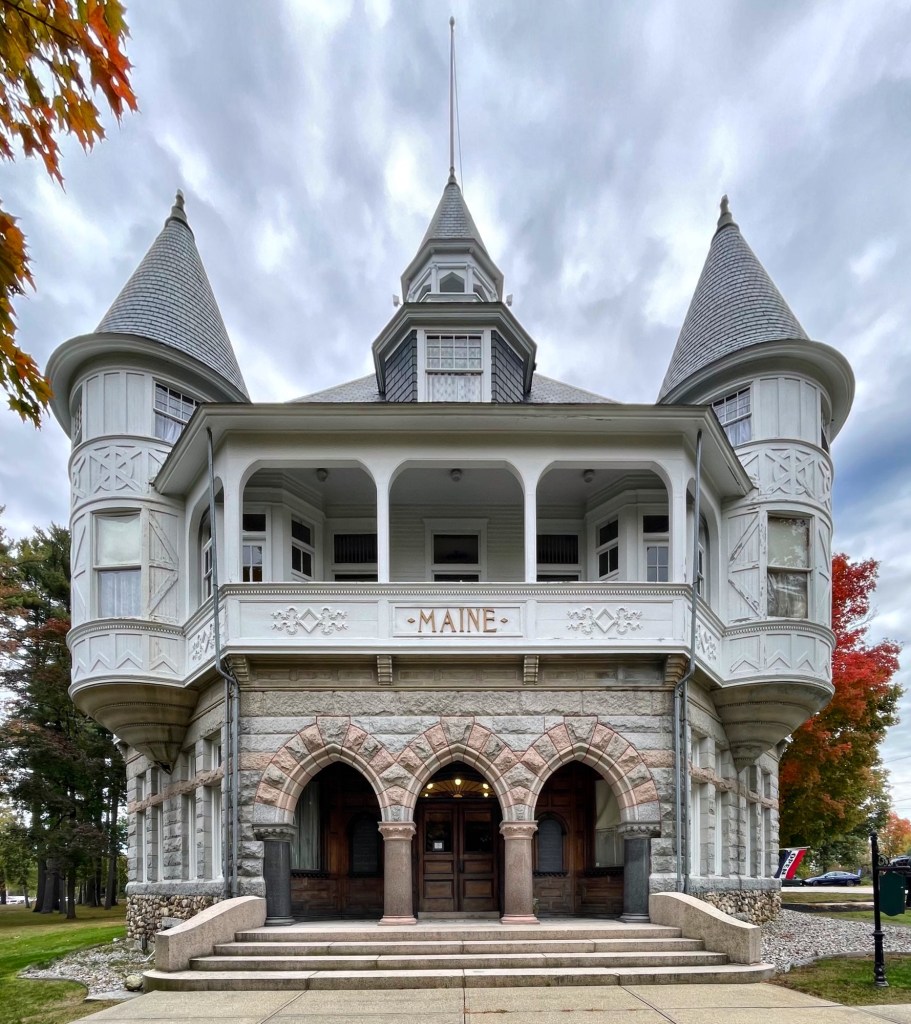
Soldier’s Memorial Library of Mansfield // 1901

Arguably the most beautiful building in Mansfield, Massachusetts is the Soldier’s Memorial Library in the center of town. Constructed in 1901, the Soldiers’ Memorial Library is a well-preserved example of 19th
century High Victorian architecture with Shingle style elements, designed by the prominent Boston architectural firm of Peabody & Stearns. In as early as 1896, the idea of constructing a building as a memorial to the soldiers who died in the Civil War had prominent local members of the community. In 1898, a relatively new resident in town, Mrs. Elizabeth Noble, donated a parcel of land for the building with the stipulation that the first floor was to be used as a library and the second floor as an “audience room”,
banquet room, and kitchen for the use of the G.A.R. The architects created one of their most significant civic buildings with an interesting juxtaposition of Gothic elements with Shingle style details. The Gothic lancet window and door surround blends surprisingly well with the use of rubblestone on the first story with buttresses and shingle siding above which give the building a fortress-like appearance.

Ashton Croft Mansion and Carriage House // c.1892

Tucked behind the Jesse Lee Memorial Church on Main Street in Ridgefield, you will find this stately Queen Anne/Tudor Revival estate. The ‘Ashton Croft’ Manor House, now called Wesley Hall, is part of the Jesse Lee Memorial United Methodist Church complex and it has been modified several times blending two distinct styles into a single, pleasing composition. This house was originally constructed by Henry and Elizabeth Hawley circa 1892 in the Queen Anne style. The house was later sold to Electa Matilda Ziegler, a wealthy New York City widow in 1912, who reconfigured the structure to include half-timbering on the gables and upper story walls in the Tudor Revival style. She spent summers at a mansion in Darien, Connecticut, and would sell her Ridgefield property to Sanford H.E. Freund, a New York City attorney. The local order of Odd Fellows bought the estate from the Freund family in 1956. Three years later, the organization sold most of the property — retaining the carriage house for its lodge — to Jesse Lee Methodist Church, which planned to eventually build a new church there to replace the old one at Main and Catoonah Streets. Today, the entire former Ashton Croft estate is owned by the local Methodist Church and is known as Wesley Hall.

Head Tide Church // 1838

In the early 19th century, Head Tide was a bustling village within the Town of Alna, Maine, supported by mills at the dam, agriculture and apple orchards, boat building, fishing and forestry. As Head Tide grew in population, village leaders determined to build their own Congregational church so they would not have to travel the three miles to the 1789 Meeting House in Alna Center. The Head Tide Church in Alna, Maine was dedicated in November 1838 and sits on a hill overlooking the village. The Head Tide Church is a handsome rural Maine house of worship which exhibits a combination of Federal style, Greek Revival, and Gothic Revival elements in its design. The facade displays the outline of a Grecian temple front with its six pilasters and strongly accented triangular pediment. The Federal fan motif appears above the two facade windows as well as in the center of the pediment and the Gothic Revival influence is felt in the two pointed arch windows on either side of the church and in the simple pinnacle at the top of each corner of the belfry. The church is a high-style building for the rural Maine village and is kept very well by the community. The congregation disbanded, but the church remains an important part of the town and is rented for memorial services, events, weddings.

Bowen-Newton-Tobin House // c.1825

Who would have ever imagined that the Federal and Second Empire architectural styles could work so well together?! This is the Bowen-Tobin House on Spring Street in Newport, Rhode Island. The house was originally built around 1825 by Stephen Bowen as a typical two-story Federal style house with five-bay facade and entry with pedimented fanlight above. The property and it remained in the Bowen Family until 1892, when it was sold by his heirs to Mary Bailey Newton, the wife of Dudley Newton, a prominent local architect who designed dozens of summer cottages for wealthy residents in Newport. Dudley Newton “modernized” this house, adding a towered mansard roof, bracketed cornice, new two-over-two windows, and a full-length front porch wrapping around the side. The couple later moved the house, which was formerly set back behind a front garden, to the side and at the sidewalk to lay out Green Place (originally Bowen Ct.) and house lots behind this home, removing the front porch in the process. The house was later sold to the Tobin Family.

Stephen S. Albro House // 1876

Stephen Stedman Albro (1817-1895) was born in Newport, Rhode Island, the son of James and Rhoda Albro. After attending local schools, he entered into a mason’s trade, eventually starting his own contracting business. He split his time as a contractor and as a Deacon of a local Baptist Church. He was engaged in local politics, serving as a alderman for Newport and even was a director of the National Exchange Bank in Newport for some years. He built this home on Green Street after his marriage to his second wife, Emma, possibly designing and constructing the house himself. The Albro House is a stunning example of a late-Italianate style dwelling with later Queen Anne/Colonial Revival embellishments. This is a special house!

John Reed House // c.1840

The John Reed House at 37 Orange Street in Nashua, New Hampshire is a testament that houses can be updated over time with thoughtful renovations, and still be pretty darn amazing! The house was originally constructed in 1840 in the then-popular Greek Revival architecture style. Within a decade, to ‘keep up with the Jones”, the house was “modernized” with Italianate style detailing, including the brackets at the eaves and the large, square cupola with round arched windows and shutters. Decades, later, Queen Anne/Colonial Revival changes were made, with the full-length front porch with turned, fluted posts, enlarged windows, and an oversized front door. The house today blends these very different styles very well and adds to the house’s significance.

Arthur Jones Double House // 1896

As Brookline Village developed in the mid-late 19th century, house lots were scarce. Demand for housing saw the demolition of a number of older 1840s Greek and Gothic Revival style cottages for multi-unit dwellings as duplexes and three-deckers which surged in popularity in the Village from the late 1890s to the 1910s when three-deckers were effectively banned in Brookline. In 1896-1897, Arthur R. Jones had large double houses built here and nextdoor, which were rented out to families. Newton architect Henry McLean designed these double houses as pairs of attached single-family dwellings separated by a brick party wall blending both Queen Anne and Colonial Revival styles under one roof. The homes show what housing was available to middle-class residents of the Boston area, a price-point that is unattainable to most in the area today. Though, it is great to see these old homes lovingly preserved so well by their owners!

“Reach View” // 1797

Reach-View has been home to members of the Currier family and their descendants since the late 1700s. Richard Currier (1773-1837) first built a small home on land he bought in 1797 from his future father-in-law, Rev. Ebenezer Eaton, one of the original proprietors and settlers of the future town of Sedgwick, Maine. In 1799, Richard married Abigail Eaton, daughter of Ebenezer and Abigail Herrick Eaton. They lived together in Reach View until Richard died in 1859. Richard willed Reach View to their unmarried son Ebenezer “Eben” Eaton Currier, who lived there with his mother until her death in 1870. He was responsible for rebuilding much of the house after 1864. Eben’s sister would later purchase Reach-View and add the piazza (porch), bays, and interior detailing. The home remains a true family estate in the sleepy coastal town of Sedgwick.

Riverside Hall // c.1860

Located across the street from the Sedgwick Baptist Church at 28 High Street, this modified Greek Revival style building in Sedgwick, Maine stopped me in my tracks. Sadly, I could find little on the building besides the fact that the building is absent from an 1860 map of Hancock County, but it appears in an 1881 map listed as “Hall”. The building exhibits flush siding which is scored to resemble ashlar/stone construction, overhanging eaves with a hipped roof which was common in the Italianate style, and a full-length one-story portico supported by square posts with applied Ionic detailing. That’s something I’ve never seen before! Upon a little more digging, I found a historic image of the building titled, “Riverside Hall”. The photograph shows a Second Empire style building with a mansard roof and cupola. The unique portico is shown as well. The local library lists the Riverside Hall as a community hall where events and gatherings were held. A fire destroyed the roof and much of the interior, but it was renovated and converted into a single-family home.

Oliver Walker House // c.1809

The Oliver Walker House in Kennebunkport Village is one of the better examples that shows how overlapping architectural styles can work really well on an old house (when done right)! The original house was constructed around 1809 for Oliver Walker (1788-1851), a sea captain who later accepted the call and became a deacon for the South Congregational Church in Kennebunkport. Walker died in 1851 and the Federal style property was inherited by his only surviving child, daughter Susan, who had married Portland native, Captain John Lowell Little. Under their ownership, the traditionally designed Federal house was modernized with fashionable Italianate style modifications of the decorative brackets and an enclosed round arched window in the side gable. A later Colonial Revival projecting vestibule adds to the complex, yet pleasing design. I have a feeling the interiors of this house are just as spectacular as the exterior.