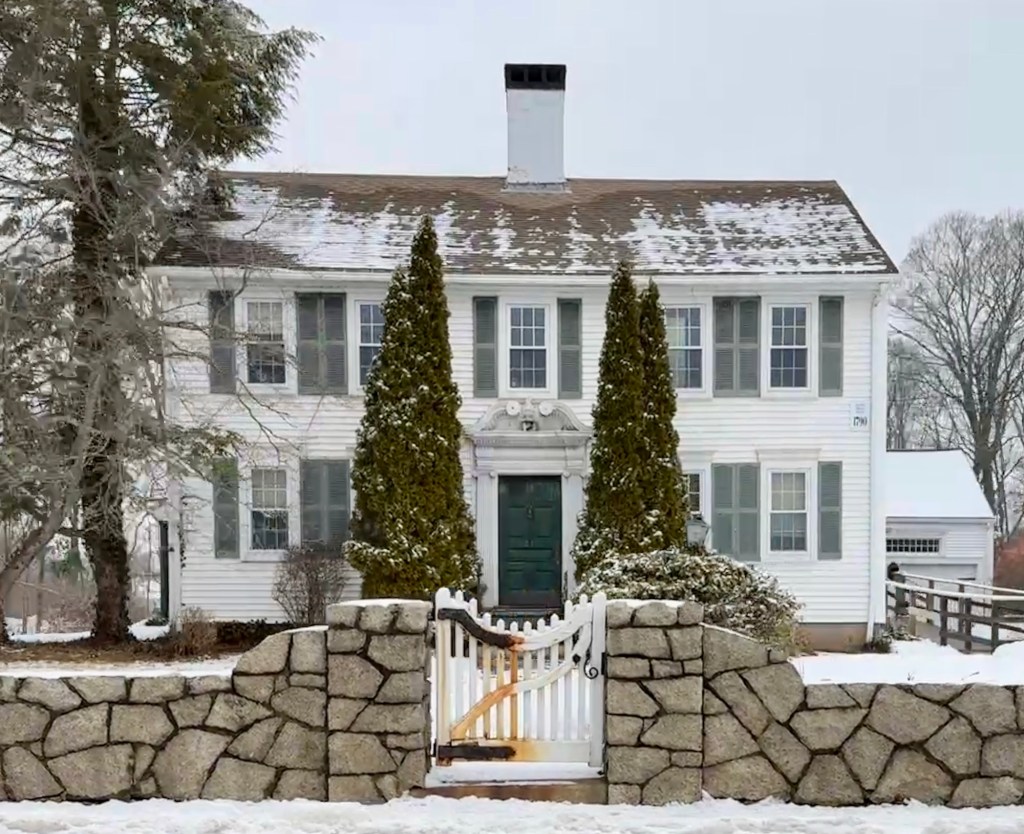
In 1787, Oliver Druce (1760-1797) married Sarah “Sally” Kollock (1764-1789) and had this large residence built overlooking the Town Common in Wrentham, Massachusetts. The young couple raised one daughter here until Sarah died in 1789 at 25 years old, followed years later by Oliver, who died in 1797 at 37 years old. By the turn of the 19th century, the late-Georgian residence was owned by John Francoeur, a French Huguenot. The Druce-Francoeur House is one of the finest Georgian style residences in Wrentham, which retains its magnificent doorway framed by fluted Ionic pilasters with broken scrolled pediment above.
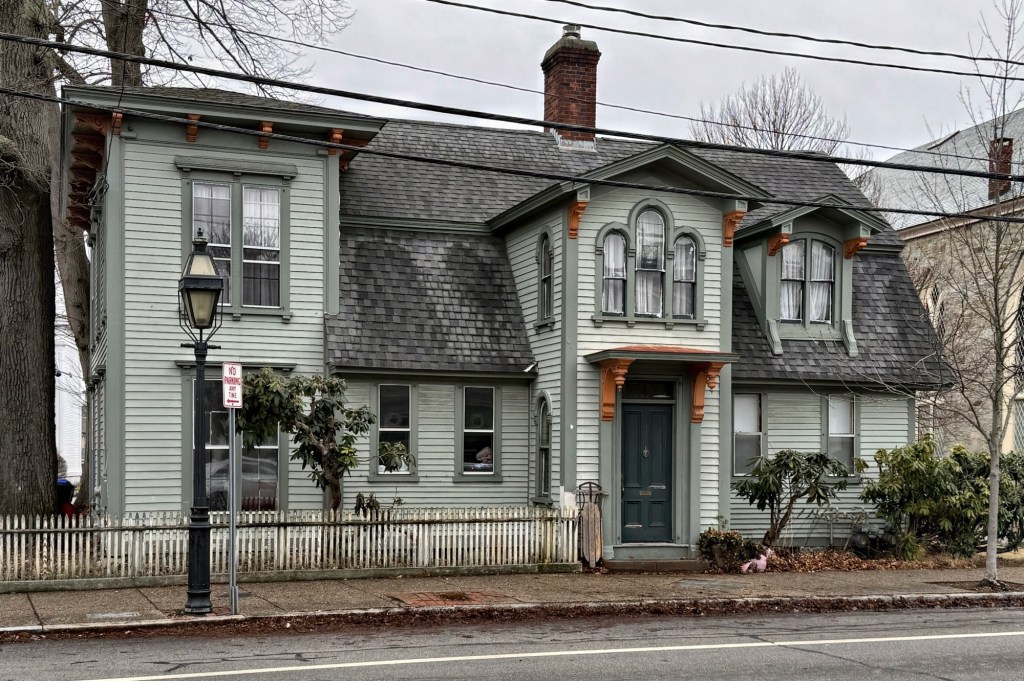
One of the most historic and architecturally unique houses in Warren, Rhode Island, is this pre-Revolutionary cottage on Main Street, that was modernized in the mid-19th century for later owners. Historians state that the house was built by Jesse Baker (1708-1751), who must have died shortly after its completion. At the time of the British burning of Warren during the Revolution in May 1778, Jesse’s widow resided here and saved the modest cottage from the hot embers of the adjacent burning Baptist Church, parsonage and arsenal by wetting every blanket and sheet in the house and spreading them over the roof of the home. The once modest, gambrel-roofed Georgian cottage, was purchased in 1868 by Dr. Joseph Merchant, a physician and surgeon, who “Victorianized” the house to the eclectic beauty we see today. Dr. Merchant added the projecting two-story corner tower, two-story front entry vestibule with Rundbogenstil tripartite window which reads like a Palladian window, projecting eaves with brackets, and stickwork in the north gambrel roof. The home was later inherited by Dr. Merchant’s daughter, Mary, and her husband, Howard K. DeWolf.
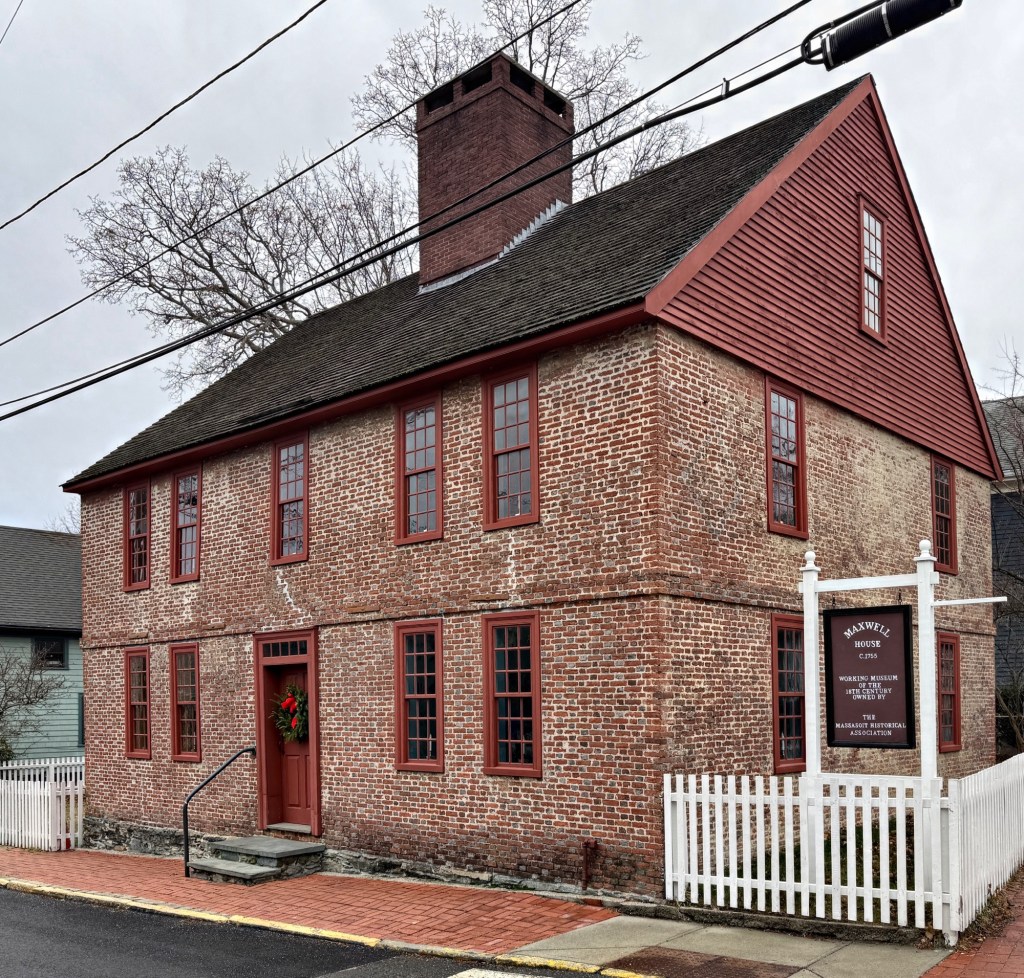
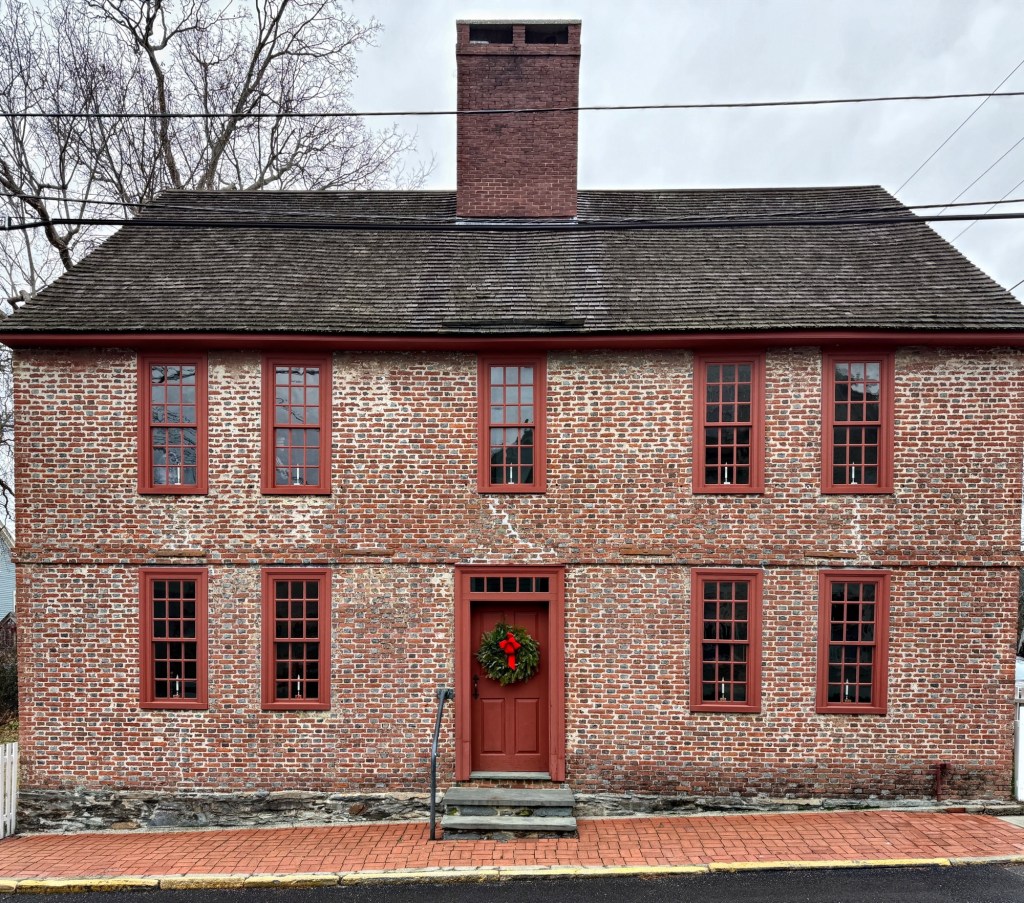
The Maxwell House in Warren, Rhode Island, is a striking example of mid-18th-century colonial architecture and one of the oldest brick dwellings in the waterfront town. Built before 1755, the house is one of the finest brick Georgian-era residences in New England with its characteristic Flemish bond brickwork, fieldstone foundation, wood-frame gable ends, and massive central chimney that anchors its historic pre-Revolutionary form. Originally constructed for the Reverend Samuel Maxwell (1688-1778) and later home to members of the Maxwell family, prominent shipowners, merchants, and slave-owners in town. The Maxwell family’s wealth was tied to the maritime economy of the era, which tells the story of many Rhode Island merchants of the time, who participated in the trans-Atlantic slave trade that enriched local elites and shaped the region’s economic growth, a history that communities are increasingly confronting alongside preservation efforts to this day. Today, the Maxwell House serves as a house museum preserved by the Massasoit Historical Association, who (hopefully) share the full story of the house, from its architecture to funding to construct it.
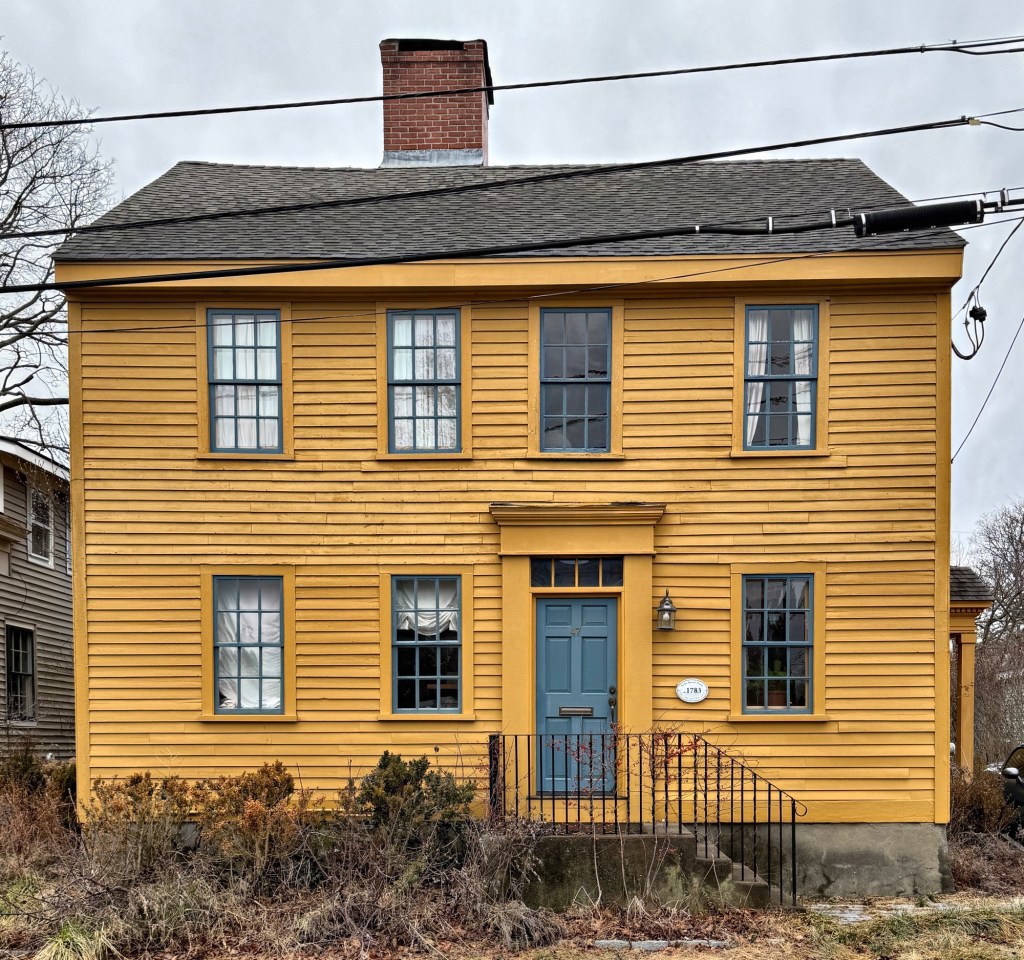
This charming house on Broad Street in Warren, Rhode Island, was built by 1783 for Rufus Barton and his wife, Prudence Cole. Rufus Barton and his family moved to New York and sold the property to Nathan Burr for $775 in 1797, who . Nathan Miller Burr sold the home to William Eastabrook two years later. Captain Eastabrook/Easterbrook had just returned from an illegal slave voyage on the “Betsey” to Africa that resulted in the enslavement of 79 Africans who were sold into slavery in Havana. He would go on to captain at least two more illegal voyages on the “Little Ann” (1806) and the “Hannah” (1807) from Bristol. These three voyages accounted for the death or enslavement of 229 people. The home has been lovingly restored by later owners, who removed the vinyl siding and replaced the cheap, vinyl windows with historically appropriate windows.
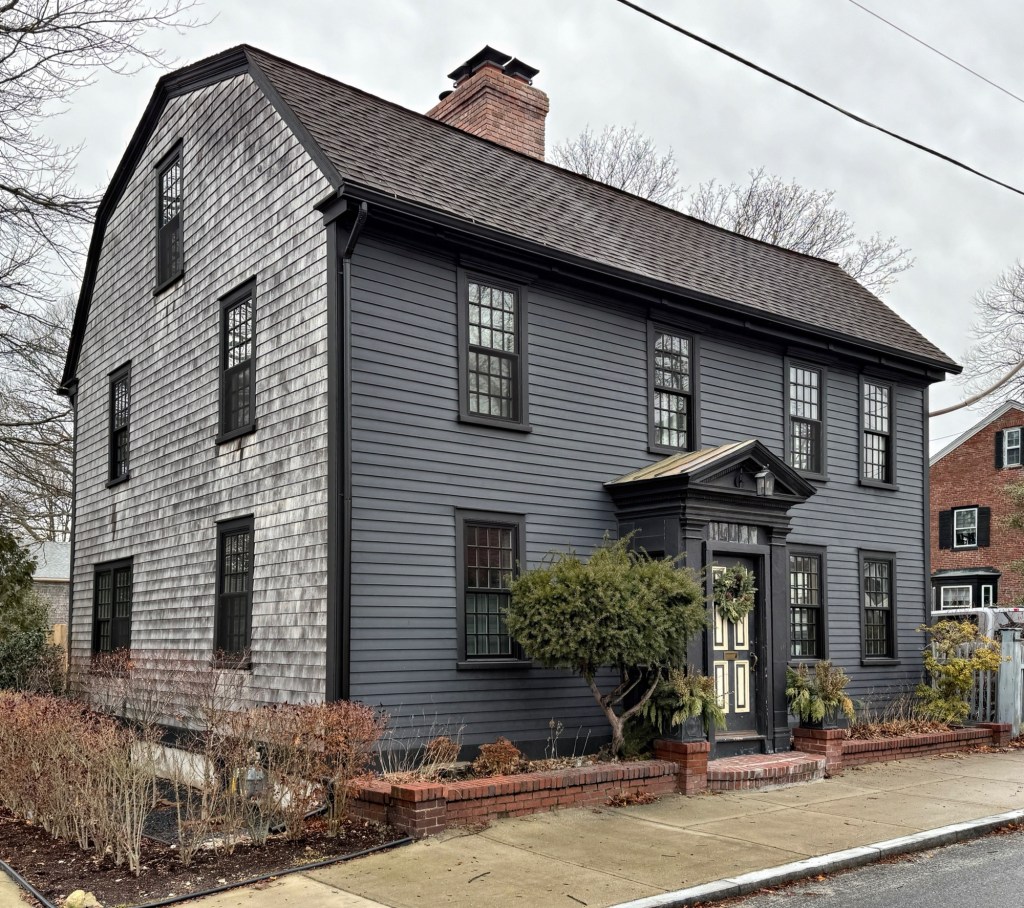
One of the more significant old homes in Warren, Rhode Island, the Gov. Josias Lyndon House on the aptly named Lyndon Street, dates to 1767 or earlier, and has connections with a colonial governor. It is not clear who originally owned this property, but the residence is best-known for its most famous resident, Governor Josias Lyndon (1704-1778), who lived here during the final years of his life with his wife and enslaved Africans. Lyndon worked as Clerk of the Assembly for the colony and in 1768, he was appointed Rhode Island’s last Colonial Governor, serving until 1769. His election is believed to have been a compromise between Samuel Ward and Stephen Hopkins, both of whom had already served multiple terms as governor. After his one term, Lyndon declined reelection and served as chief clerk for the General Assembly of the Superior Court of the County of Newport. At the time of the British occupation of Aquidneck Island (Newport), Gov. Lyndon moved to this home in Warren, where he remained until his death from smallpox in 1778. An often undertold fact about Josias Lyndon is that he enslaved a man named Caesar Lyndon. Caesar was highly literate and was entrusted to carry out Lyndon’s business, acting as both a purchasing agent and secretary. Caesar also held his own small lending business with enslaved as well as free Blacks and whites borrowing money from him. Josias allowed Caesar to marry, which he did to Sarah Searing. It is not clear if/when Caesar was granted his freedom, or if he accompanied Josias to Warren or remained in Newport.
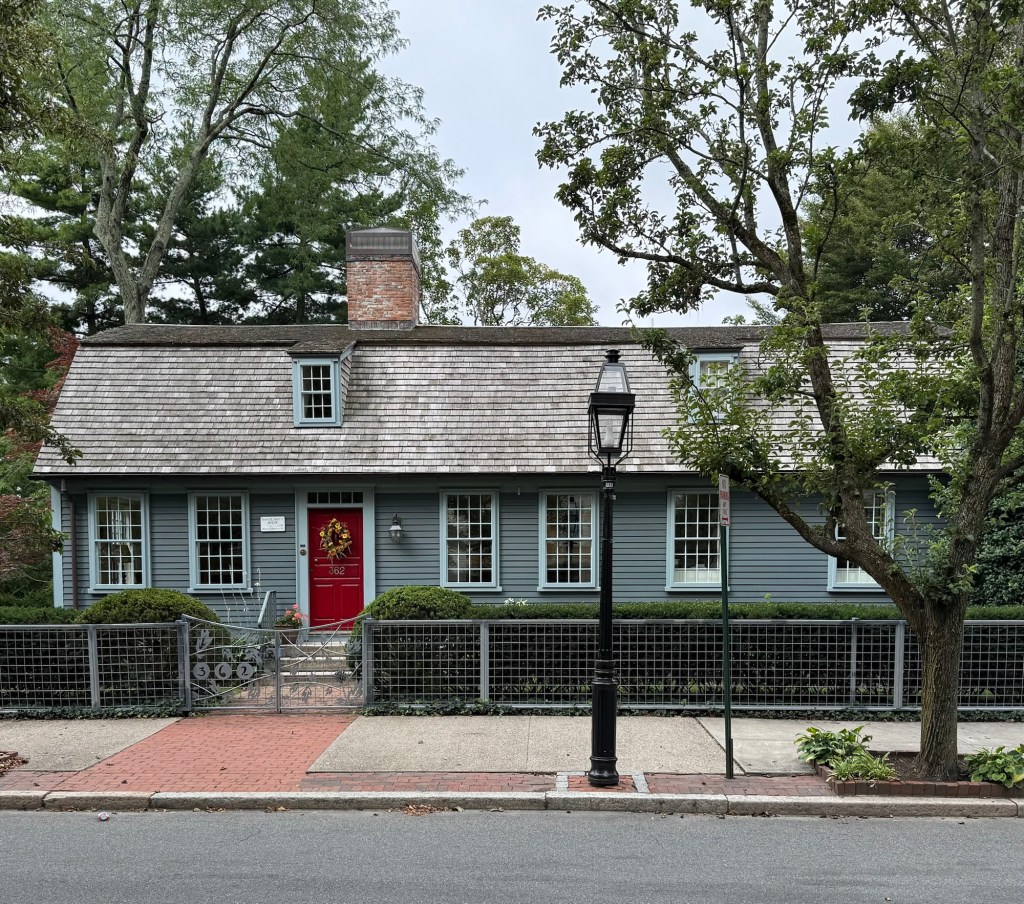
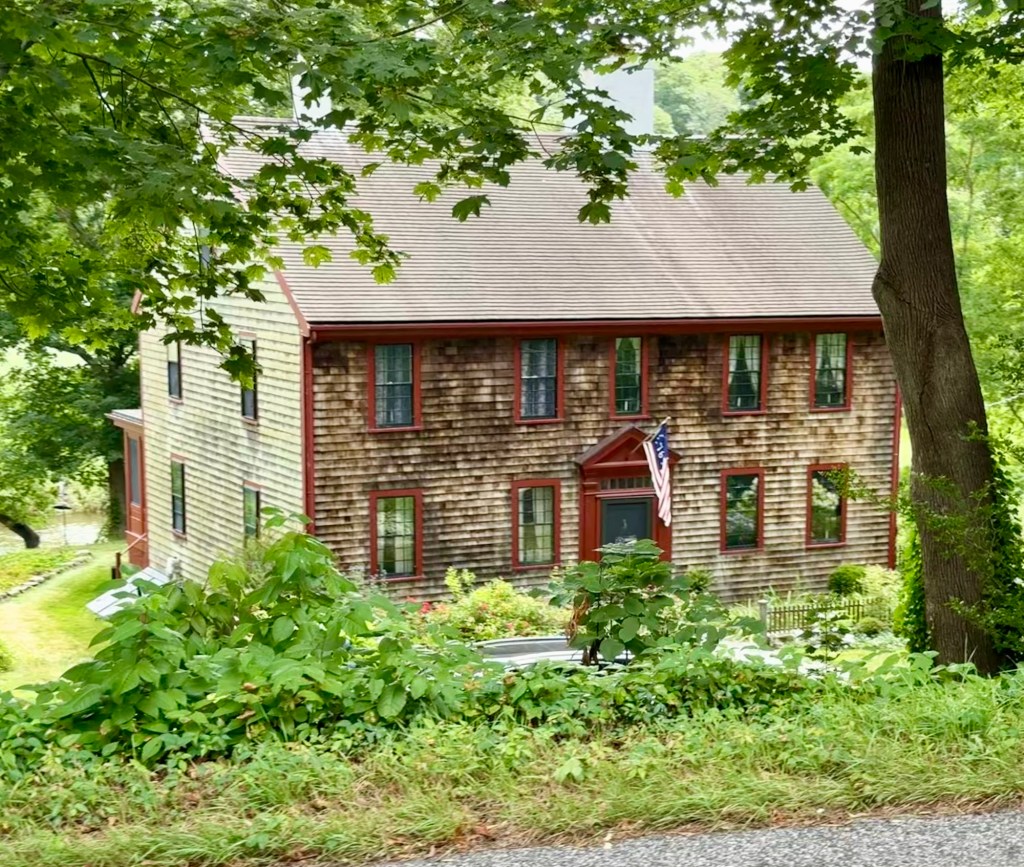
The Daniel Smith House at 362 Benefit Street in Providence, Rhode Island, stands out in the neighborhood as an uncommon gambrel-roofed Georgian-era residence, but it was not built here! The home was built by about 1750 for Daniel Smith, and may possibly date to around 1725 a year after he was deeded land from his father and the same year he married his wife, Dorcas Harris. If the home does indeed date to around 1725, it would likely be the oldest extant house in Providence! The home was originally located across town on Chalkstone Avenue, and moved to the present site on Benefit Street in 1982 to save it from institutional expansion by Roger Williams Hospital. The hospital set a date to demolish the farmhouse, then covered in asbestos siding, and offered the building for free to someone who could move it off the site. After tense weeks and a nearing deadline, Angela Brown Fischer, a real estate executive, agreed to pay the costs to move the building across town to a site on Benefit Street, where it remains today. The home was put back together and restored by Newport-based architect, Richard Long, who worked as principal architect for the Restoration Foundation of Newport before opening a private architectural practice. What a great preservation success story!
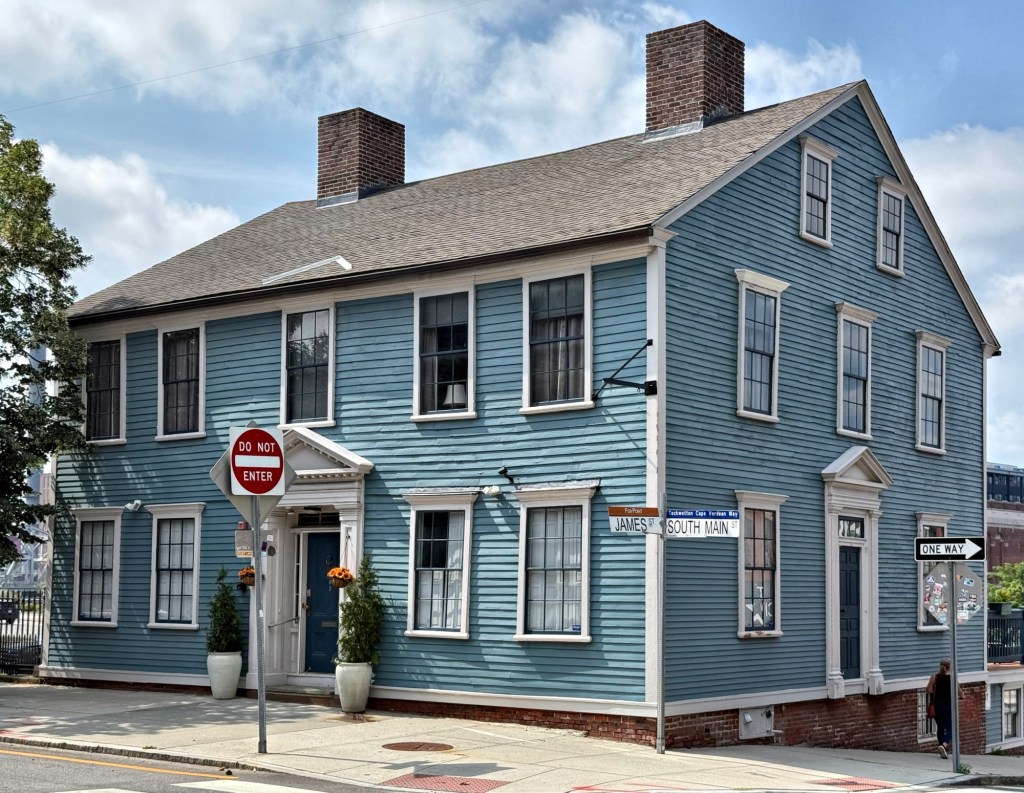
This Georgian house at 403 South Main Street in Providence’s East Side was built by Captain Joseph Tillinghast (1734-1816) a wealthy merchant and participant in the Gaspee Affair, a significant event in the lead-up to the American Revolution. The Gaspee Affair occured in 1772, when a group of men from Providence attacked and burned the British customs schooner, HMS Gaspee. The incident was fueled by colonial resentment towards British customs enforcement, and took place not too long after the Boston Massacre. Joseph built this house for his family on land he inherited from his family, who claimed the land in 1645. Tillinghast was also the owner of a line of packet boats (light shipping of domestic freight and mail) operating between Providence and Newport. After Joseph died in 1816, the property was occupied by members of the Tillinghast family until 1847. By the mid-20th century, urban renewal and the proximity to the new highways caused the surrounding area to suffer, with this historic home threatened. Throughout 2008, the building’s condition continued to rapidly deteriorate, and local preservationists advocated for the home’s future. After attention was brought to the residence and its significance, the house was restored with the assistance of the Providence Revolving Fund, including the stabilization of the foundation, roof and chimneys rebuilt, with clapboards and windows repaired.
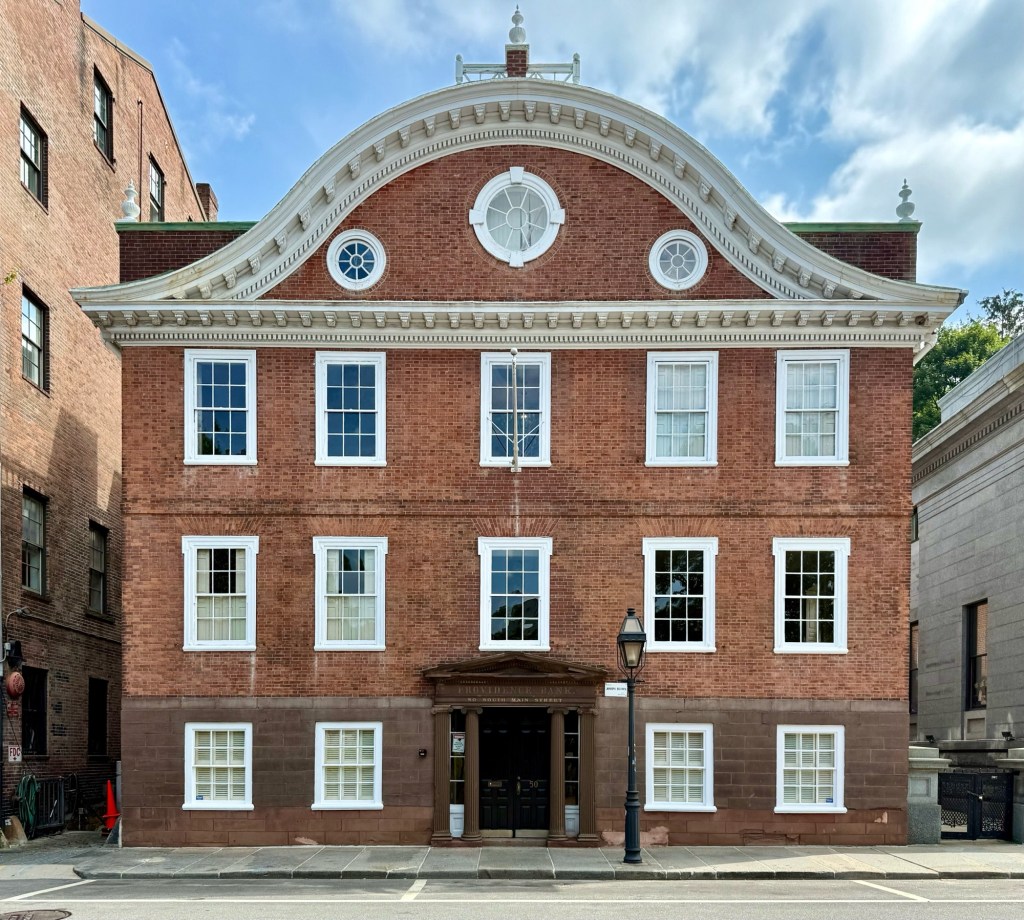
Constructed in 1774 by architect Joseph Brown (1733-1785) of the Brown family of Rhode Island as his personal residence, the John Brown House of Providence, stands as one of the oldest (if not the oldest) house built by an American architect for his own use. Joseph Brown, while a member of the Brown Family, was not as much in the shipping business as others in his family, instead turning his attention to scientific matters, becoming an expert in astronomy, electrification, and architecture. He was an architect in the Thomas Jefferson-gentleman mode, owning English architectural books from which he selected motifs for inclusion in his designs. It is believed that the eccentric curved ogee gable that caps the façade was adapted from the roof design of a garden house published in William Salman’s Palladio Londinensis, owned by Joseph Brown’s builder, Martin Seamans. The same ogee gable was later replicated in the Colonial Revival period in Providence. The residence’s entrance was originally raised above ground and accessed via symmetrical flights of stairs; in the late 18th century, the entrance was moved to street level in the brownstone basement level. Over a decade after Joseph’s death in 1785, the structure was acquired by the Providence Bank, an enterprise founded by Brown’s brothers John and Moses, and used as an office. The bank occupied the structure until 1929, and the Joseph Brown House was subsequently owned by the Counting House Corporation, and still appears to be owned by descendants of the Brown Family.
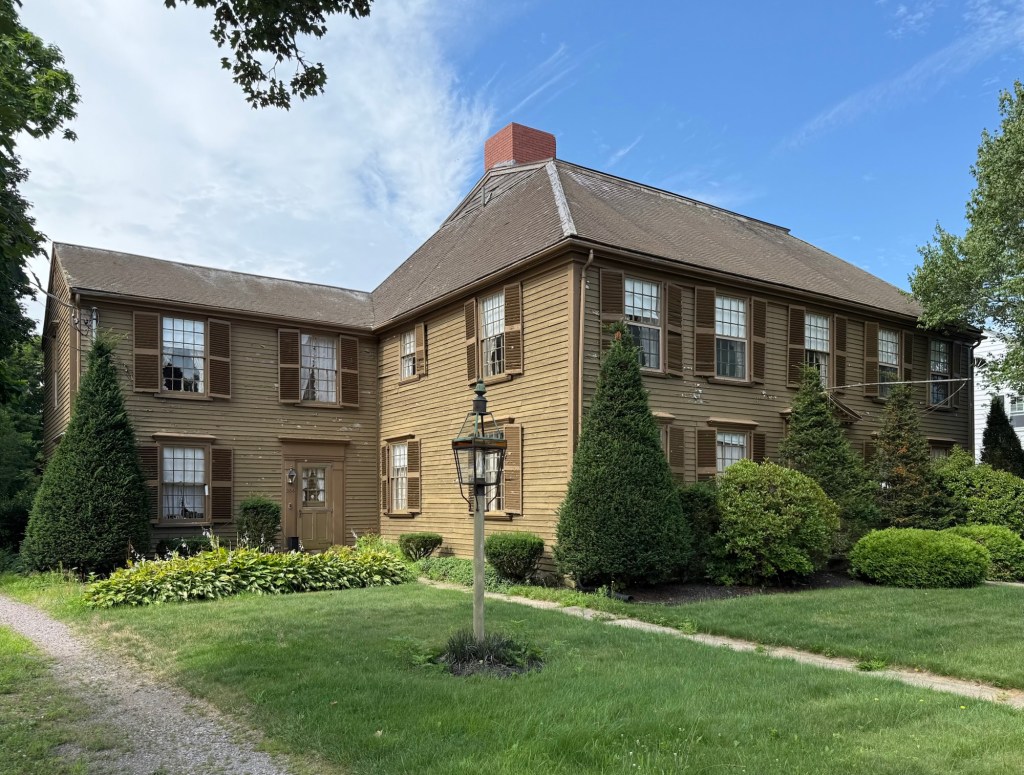
Built on the banks of the Jones River in Kingston, Massachusetts, this large residence is said to date to 1772 and was the home to a prominent ship-building family as well as to hundreds of destitute residents of the community who lived and worked here as the town’s poor house. Land (and possibly an earlier house) was acquired in 1772 by Zenas Drew (1735-1822), the son of Cornelius Drew, a wealthy shipbuilder who employed his many sons to work in the same industry, and the existing house was constructed for his family. From the house, numerous shipyards would be seen with large brigs travelling down the Jones River into Plymouth Bay and the Atlantic. After Zenas Drew’s death in 1822, the Town of Kingston acquired the property for use as the town’s almshouse or poorhouse, and likely expanded the property to its current Federal style configuration. Throughout the 19th and early 20th centuries, almshouses were a reality for society’s most vulnerable people, where these locally run institutions provided living and working conditions in a time before Social Security, Medicaid and Section 8 housing became a reality. These facilities were designed to punish people for their poverty and, hypothetically, make being poor so horrible that people would continue to work at all costs. Being poor began to carry an intense social stigma, and increasingly, poorhouses were placed outside of public view, as was the case here in Kingston outside of the town center at the banks of the river. By the 1920s and 1930s, these institutions began to close, with Kingston’s closing in 1923. The property was sold to a private owner, and has remained as a single-family residence ever since.
This stately Georgian style house on Main Street in Kingston, Massachusetts, was originally built in nearby Marshfield and later moved to its current location just decades later. The house was built on the Winslow estate in Marshfield in about 1774 by either Dr. Isaac Winslow or his brother, Maj Pelham Winslow. In 1796, the property was purchased by Bildad Washburn, a noted gravestone carver, and the house was moved to its present site. Reports state that the house was moved by boat and oxcart to its current location, where it became a tavern and residence of Mr. Washburn. In 1804, the house was sold to Major George Russell, a merchant and town clerk, who later served in the War of 1812, who converted the ell into a store where he sold, East and West India goods from his ships. After his death, his daughter ran a dame’s school from the house. The Washburn Tavern is significant as a large Georgian-era house that remains in a great state of preservation.
 Buildings of New England