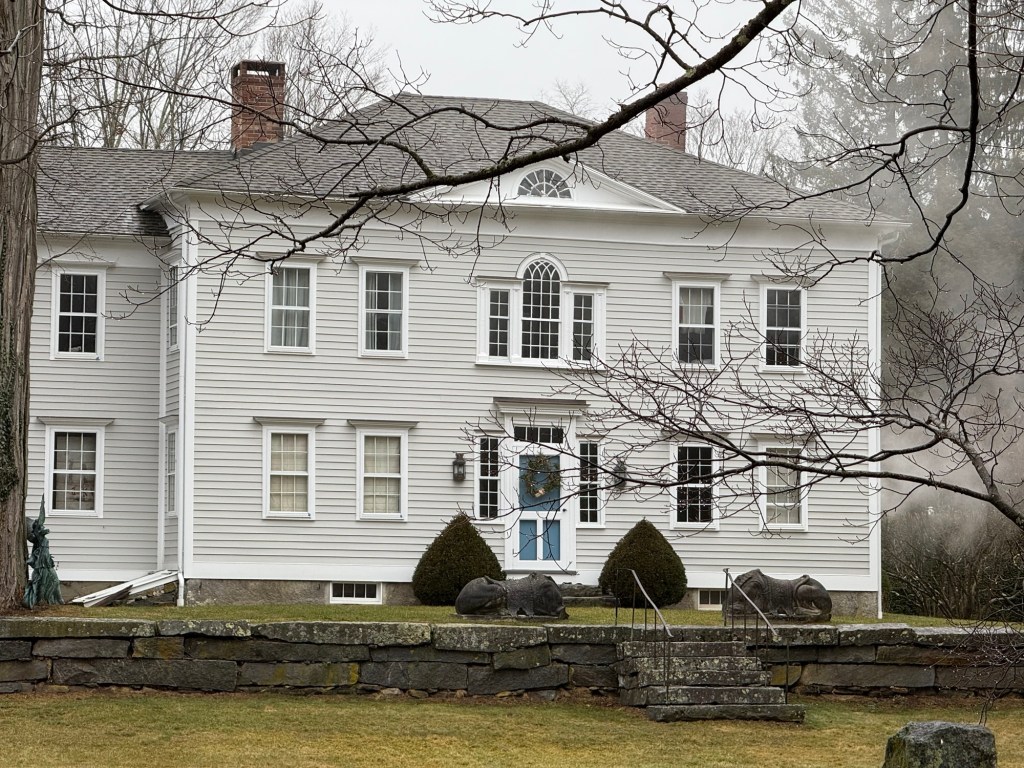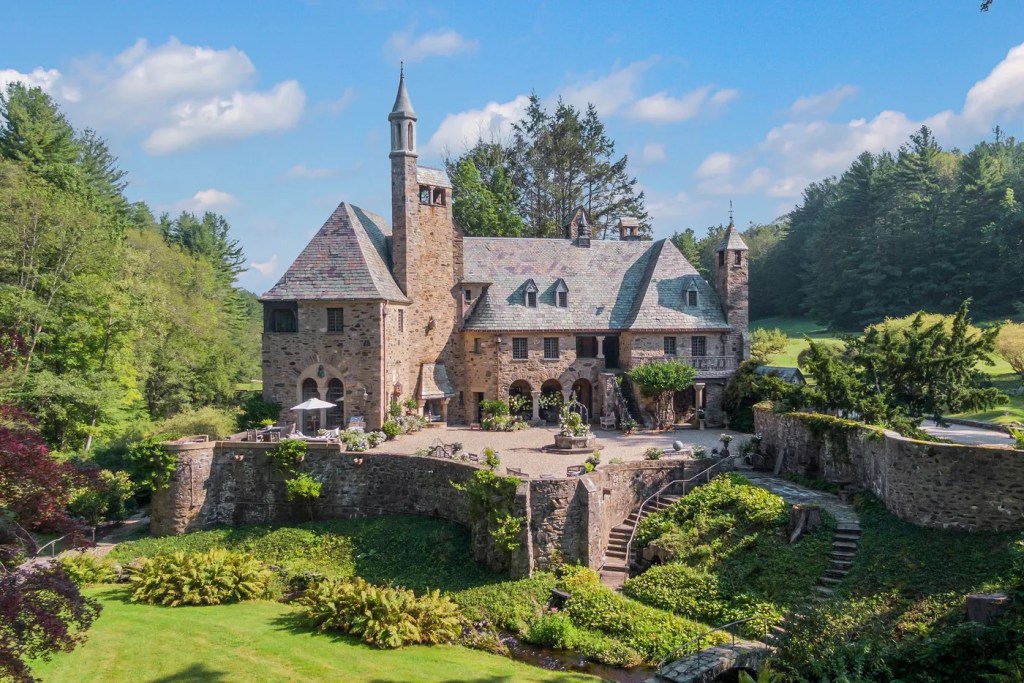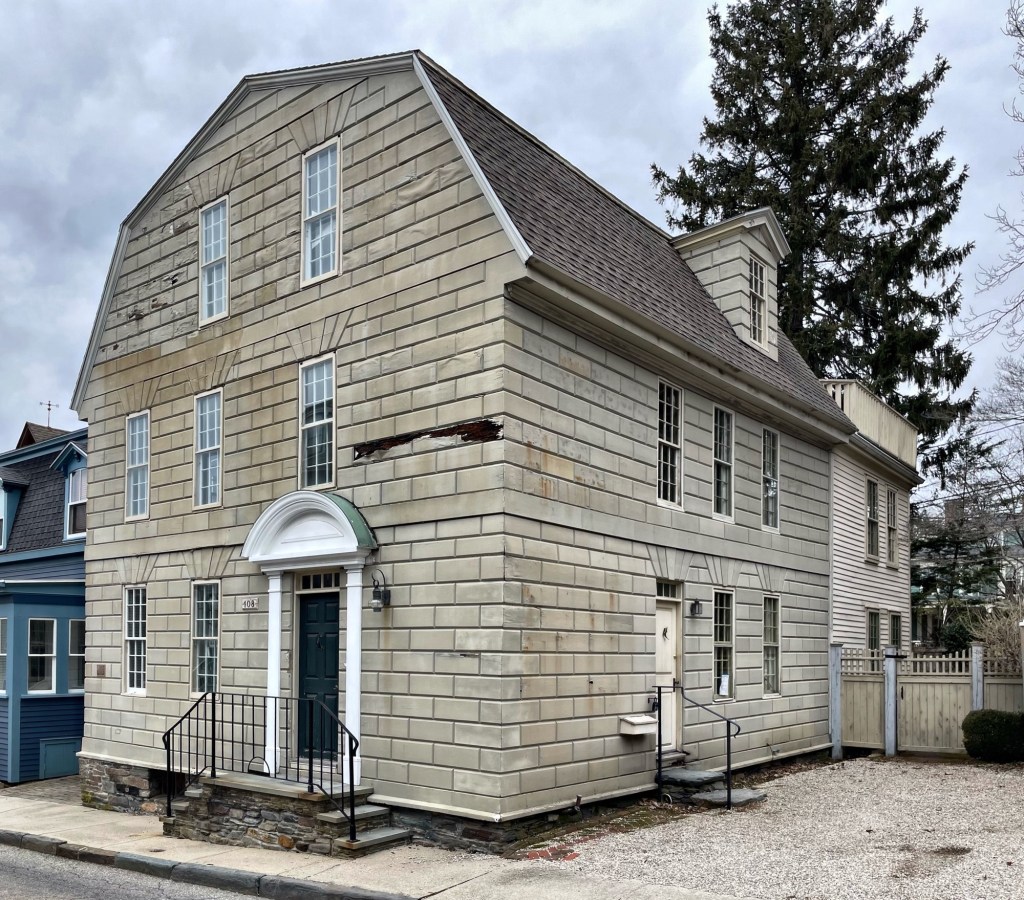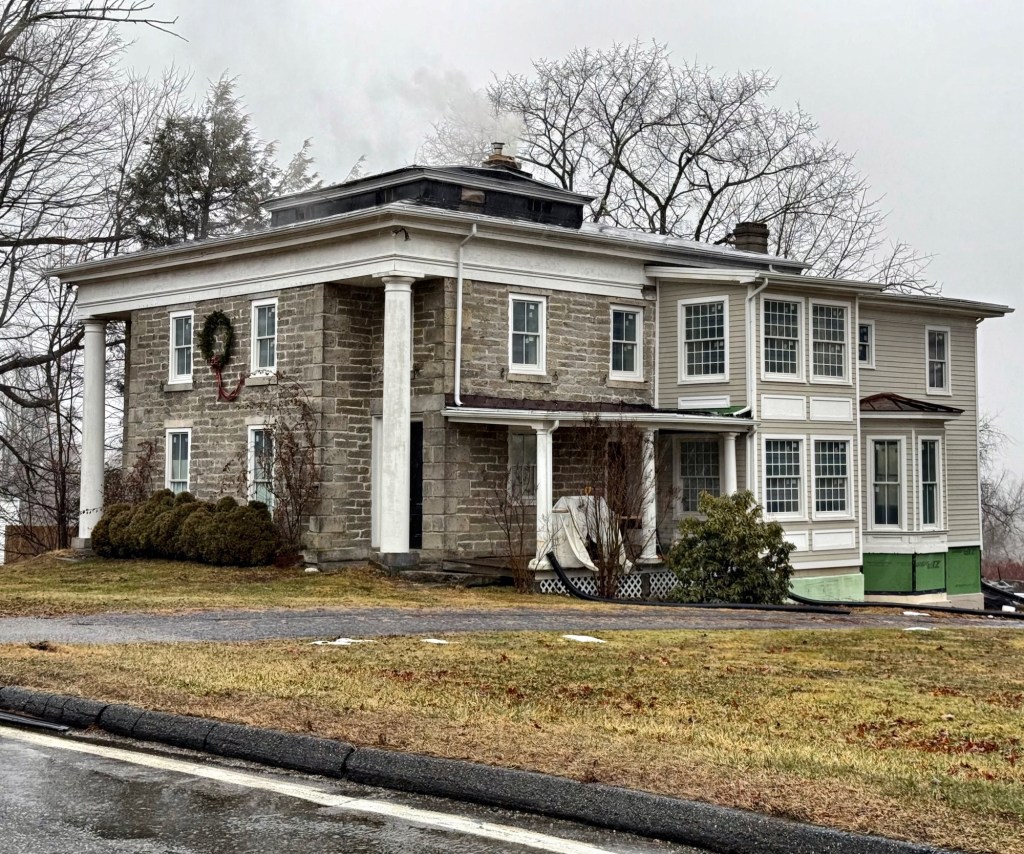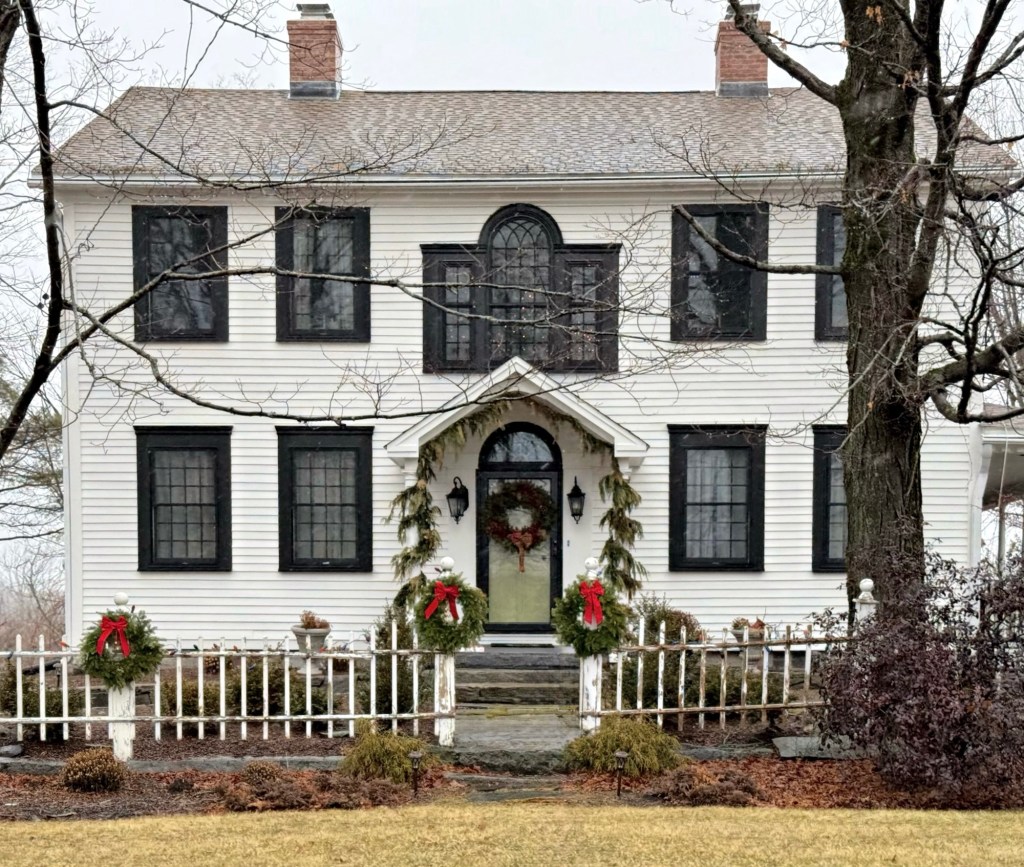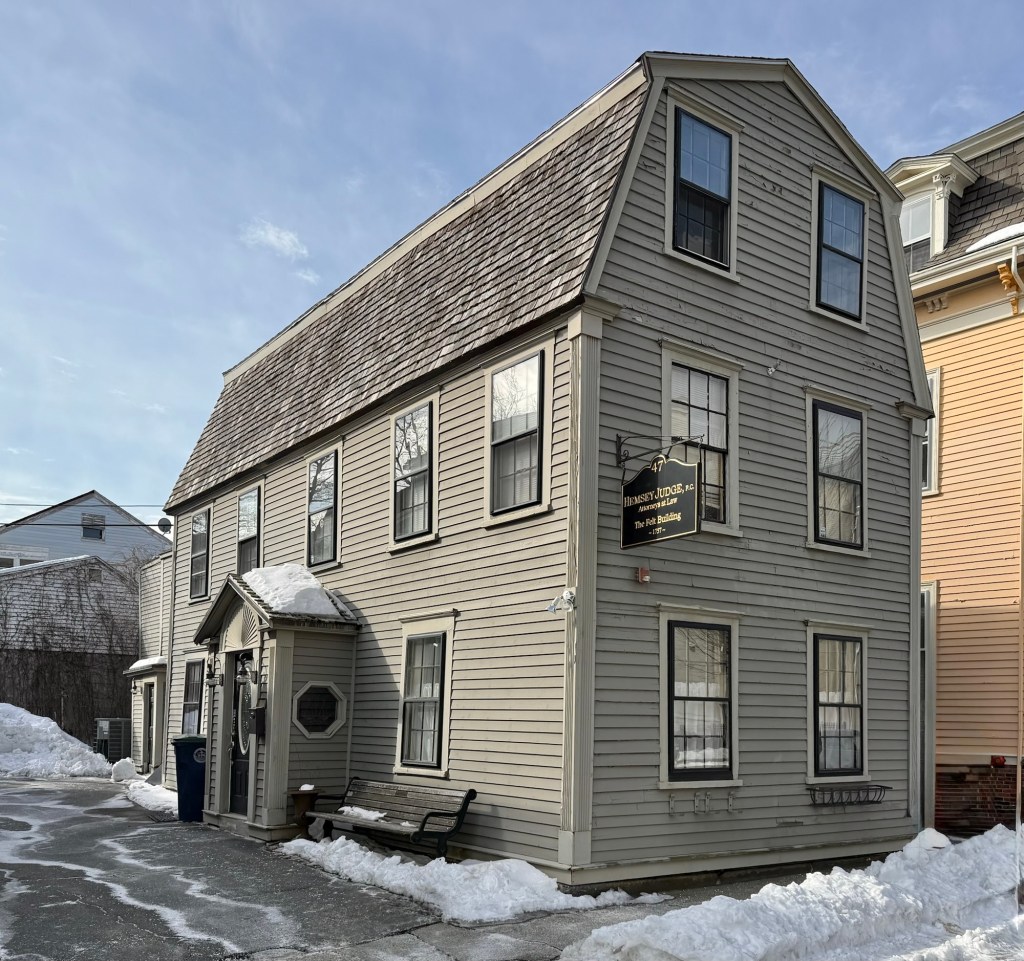
Adams Hall // c.1828

According to local histories, this significant Greek Revival style property on Elm Street in Georgetown, Massachusetts, was owned by Josiah Adams (1757-1852), a farmer, a Revolutionary War veteran, and a fourth-generation descendant of the immigrant Robert Adams, who arrived here from Devonshire, England by about 1629. In March 1849, the town’s Congregational Society purchased Adams Hall for eight hundred dollars to house the church vestry, which remained in the building for forty-one months until a new building was built for that purpose next door. Later, Adams Hall was owned by Moses Tenney (1808-1903), operator of a prosperous saw mill in Georgetown, and served at one time in the state senate. The structure retains its significant temple-front with four, two-story Doric columns supporting the portico. Also special on this residence is the use of flush-board siding and the oversized first floor windows.

Whitman-Fessenden-Coombs House // c.1800

This important Federal-period house sits in the middle of New Gloucester village in Maine, and dates to the early 19th century with mid-19th century alterations. The original owner was Obediah Whitman, who sold the house soon after to General Samuel Fessenden (1784-1869) lived here while practicing law in New Gloucester. He was an avid abolitionist who served as a congressman and in 1828, he declined the presidency of Dartmouth College. The General’s son, William Pitt Fessenden, resided there from ages three to fourteen. William later became a U.S. Senator and Lincoln’s Secretary of the Treasury. The third notable owner was artist, Delbert Dana “D.D.” Coombs, who used the second floor for his studio for some years. The update from the mid-19th century of the modest bracketed eaves and two-over-one windows showcases how later owners can update a home without diminishing the original design.

Nathaniel C. Allen House // 1793

The Nathaniel C. Allen House is a two-story Federal style residence located in New Gloucester, Maine. The house was built in 1793 by Shubael Marsh, a local builder (and father of Shubael Jr. (1797–1867), who moved to Texas with Stephen F. Austin) and sold to Nathaniel Coit Allen, an early settler in New Gloucester, who served as a General during the American Revolution. The property was purchased by Col. James Madison Thompson, then owner of the Glen House, an early White Mountains hotel in New Hampshire, who renovated the home by replacing the central chimney with two narrow ones and raised the ceilings and introduced Victorian interior woodwork. A subsequent owner added large Colonial Revival porches on the front and side entrances along with a new entry. The house showcases the changing tastes from Federal style to Victorian back to traditional tastes.

Morrill House // c.1830

This stunning brick Federal style home sits in the center of Gray Village in Maine. The house dates to the early 19th century and was long-owned by members of the Morrill Family, seemingly first by William C. Morrill and remaining in the family for generations. The residence is a high-style example of the Federal style with recessed elliptical entrance with fanlight transom and sidelights with a Victorian-era front door. The house was likely built by a local mason or housewright who employed the designs of a Federal style plan book for the architectural detailing at the entry.

Barrett House // 1800

The Barrett House (also known as Forest Hall) is a Federal style mansion located in New Ipswich, New Hampshire and one of the finest buildings in the entire state. The mansion was built around 1800 by Charles Barrett Sr. for his son Charles Jr. and daughter-in-law Martha Minot as a wedding gift. Its grand scale was encouraged by Martha’s father, who promised to furnish the house in as lavish a manner as Barrett Sr. could build it. The interiors are elegantly furnished, and numerous reception rooms were designed for entertaining in a cosmopolitan manner. An elaborate allée was later added to the landscape, with a flight of stone steps flanked by maples rising up the hillside behind the house and leading to an elegant summerhouse. After Charles and Martha died, the estate remained in the family. However, after the railroad bypassed New Ipswich, the town entered into a decline. Charles Barrett’s descendants stayed on, but today Forest Hall remains essentially a relic of the Federal era. After 1887, the family used the house only in the summer-time. It was donated to Historic New England in 1948. Historic New England has ever-since opened up the property to those who want to see one of the best examples of a rural, Federal style estate in New England and its well preserved interior and grounds.

Wellington-Sears House // c.1810

One of the many Federal period houses in Ashby Center is this lovely c.1810 residence on Main Street. The house is known as the Wellington House, and was possibly built by Darius Wellington, a carpenter who assisted with building the town’s First Parish Church in 1809. The house exhibited a symmetrical facade with stunning fanlight transom over the main entrance and eight-over-twelve sash windows. In the latter half of the 19th century, the property was owned by Cyrus Sears, a prominent sea captain, who sought a life inland with his family. He would serve in the Civil War, but had the half-decade house “modernized” with new bay windows and an entry porch. He would later move to Baltimore and serve as a port captain and consul to Cuba. In the past few years, the owners have restored the home to its original Federal design, re-emphasizing the stunning fanlight transom and sidelight details.

Lord Mansion // 1822

Isaac Lord (1772-1838) was born in Maine, but would spend much of his time transforming the small town of Effingham, New Hampshire. Isaac married the love of his life, Susanna Leavitt in Exeter in 1793 and the couple moved to Effingham, living and working in a tavern he built. Isaac prospered as an innkeeper, merchant, farmer, and entrepreneur, becoming Effingham’s wealthiest citizen, making the village he owned buildings to be called Lord’s Hill in his name. From 1818 to 1822, Isaac and Susanna lived in Portland, but he was ridiculed for “having money but no culture”. Growing tired of the city, he decided to return to Effingham. Mrs. Lord found the village too quiet and longed for the social life to be had in Portland, Maine. To convince his wife to remain with him, Isaac promised her a mansion that rivaled the homes in wealthy seaports like Portland and Portsmouth and began working on his mansion in Effingham in 1822. After years, the massive estate was completed, but Susanna remained in Portland. A heartbroken Isaac moved into the large mansion and continued business until his death in 1838. The Isaac Lord House consists of a three-story main block with a grand cupola on its roof and a three story ell to its rear. Stables and a carriage house are also on the lot today. I would do anything to see the inside of this beauty!

Thorndike-Conway House // 1769

This homestead is one of the earliest homes in the Camden–Rockport area of Maine. Originally built inland from the harbors, the house was a one room cabin with an open sleeping loft above. Allegedly built in 1769 by Robert Thorndike (1734-1834) one of the earliest settlers of Rockport the house has served as a significant piece of the town’s history ever since. There were two additions to the house in 1806 and 1826. The first addition in 1806 consisted of the front door entry and the front parlor, a birthing room and a chamber and loft above. The 1826 addition in the back of the home provided a kitchen area that was later divided to provide a small parlor. In 1826, Frederic Conway bought the property from Robert Thorndike Jr., which remained in the family until 1916. The property is now owned by the Camden-Rockport Historical Society as a house museum and the organization is further documenting the history of this house and the two towns.

McInnis House // 1901

Located next door to Ms. Matchett’s house on Chatham Street in the suburban Longwood neighborhood of Brookline, Massachusetts, you will find this very unique example of a Colonial Revival style single-family home. Built by 1901 for lawyer Edwin G. McInnis (sometime spelled McInnes) and his wife, Mabel, the house is high-style Colonial Revival with symmetrical facade, rustication, two-story Corinthian pilasters framing the bays, Palladian window, and Federal style entry with fanlight transom. No records of the architect could be located sadly.

Lincoln-Chrysler House // c.1830

This charming brick Federal house sits on the main street in the quaint village of Chaplin, Connecticut. Due to its style, the house likely dates to 1830 as a late-Federal home as the village was seeing development. The original owner is not known, but the property was later occupied by Mason Lincoln in the mid-late 19th century. By the early 20th century, the property was owned by members of the Chrysler family, first by Mintin Asbury Chrysler (1871-1963), a botanist, mycologists and paleobotanist. The house was later inherited by Mintin’s son, Sidney Chrysler, who was a known puppeteer who converted some spaces in the property for puppet shows until his death in 1999.