Ames Gate Lodge // 1880

In 1880, twenty years after Frederick L. Ames built his rural estate “Langwater”, he felt the need to give the property more rural character, especially given the close proximity to the Ames Shovel Works. Emulating old European estates with gatehouses, Ames hired star-chitect Henry Hobson Richardson, to design a gate lodge at the entrance to his property, fitting of one of the richest men in Massachusetts. Richardson’s design for the gate lodge was oriented longitudinally and is bisected by the arched entry to the estate. The large room on the left was intended to serve as a storeroom for flowering plants, and the two-story portion had a caretaker’s residence on the lower floor and a “bachelor hall” for men’s socializing and spill-over bedroom. The building uses glacial boulders found on the expansive grounds and older stone walls, with trim of Longmeadow brownstone. The bright red terracotta roof contrasts boldly with the rough stone walls. The building is one of the most beautiful structures I have seen, but can be difficult to photograph without trespassing. Ugh!

Langwater // 1859

The country estate of Frederick Lothrop Ames (1835-1893), “Langwater” sits in North Easton amongst a collection of some of America’s greatest architectural treasures, all thanks to the Ames Family. The Ames family was a wealthy family which had lived in Easton for many generations. Frederick’s grandfather Oliver Ames Sr. founded the Ames Shovel Works in Easton, Massachusetts. The Shovel Works earned the family a huge fortune, during a time when aggressive canal and railroad expansion was built by the hands of thousands of men using shovels. Frederick’s father Oliver Jr. was president of the Union Pacific Railroad during the building of the transcontinental railroad. Frederick’s cousin Oliver Ames was governor of Massachusetts 1887–1890. Frederick himself was Vice President of the Old Colony Railroad and director of the Union Pacific railroad. At the time of his death, Ames was reported to be the wealthiest person in Massachusetts. With this immense wealth, Frederick built a castle where he would spend most of the year, overseeing his various businesses, in his hometown of Easton, Massachusetts. The mansion was designed by architect George Snell and built around 1860, with a couple additions and updates until Frederick’s death. A few years before his death, Frederick hired famed architect Henry Hobson Richardson, who he already worked with in designing the Oakes Ames Memorial Hall(Easton’s Town Hall), to design a gate house leading to Langwater (more on that later).

Oakes Ames Shooting Lodge // c.1905

Located near the banks of Leach Pond in Borderlands State Park, this handsome stone structure set the style for one of the most iconic and beautiful buildings in Easton, the Ames Mansion. The one-story concrete and stone structure was designed and constructed under the supervision of Blanche Ames, and may have been a prototype for the construction technique used in the Ames Mansion, built just years later. Blanche was an amazing woman. She was an artist, political activist, inventor, writer, and prominent supporter of women’s suffrage and birth control. In 1900, she married Harvard University botany professor Oakes Ames (no relation). She took the married name Blanche Ames Ames. She illustrated her husband’s botanical research on orchids, and later got involved in designing the family’s country retreat. Originally designed as a warming hut during hunting season, this lodge was originally minimally designed with exposed stone walls. In the 1930s, the lodge was renovated to contain a living space, a kitchen, and a bedroom. When the Commonwealth of Massachusetts acquired the Ames Estate in the 1970s for a state park, the Lodge was restored to its original condition. The hunting lodge is open to the elements and the public, who can warm themselves in one of the two six-foot fireplaces.

Old Brick Tavern // 1804

The Brick Tavern was an important stopping point on the old Union Turnpike, and the original two-story brick structure was completed about the time of the turnpike construction by Paul Willard, who with his heirs, operated the inn for 25 years. In the first years of the 1800s, the Union Turnpike Company planned and built a road providing a link for travel from Boston to Albany. Realizing the possibility for an inn along the first leg of the route, Willard financed this substantial brick building for travellers to stop, eat and spend the night. The tollroad was later made free, and less people stayed at the inn. After subsequent ownership, the building started to suffer from deferred maintenance and it was sold to a local Quaker group. The Quakers modernized the building by constructing the mansard roof and updating the interior. They never occupied it, but rented it to tenants for income. After, it was a hospital, boarding house, and in WWII, as a barracks of sorts for soldiers training nearby at a military base. The building is now a house!

Hawthorn Hill Estate // 1903

The only estate in Lancaster that can rival the Nathaniel Thayer Estate in size and grandeur is the OTHER Thayer estate, built for Bayard Thayer. Sitting on over 55 acres of forests and gentle rolling fields, Hawthorn Hill is one of the most impressive mansions in Central Massachusetts. The property is so secluded that I had to rely on real estate photos to share! The listings mention that there are over 40 bedrooms and 27 bathrooms… Bayard Thayer (1862-1916) is the grandson of Nathaniel Thayer, Unitarian minister of the First Church of Christ in Lancaster and son of Nathaniel Thayer, a banker. When his brother was willed the family estate (featured previously) after the death of their father, Bayard used the opportunity to build a modern estate high upon a hill in town. The mansion was built in 1903-1904 under the direction of Guy Lowell, a renowned Boston architect of the time. In 1907-1908, Little and Browne were commissioned for landscape alterations and in 1914-15, Ogden Codman Jr. was commissioned to renovate the interiors. Bayard died one year later, and the property remained in the family until around WWII. In 1953, the property was acquired by the Boston Cenacle Society, who added a massive dormitory addition to the building. Recent plans were unveiled to subdivide the land and build house lots on half the estate, which gives me mixed feelings.

Newhall-Lane House // 1809

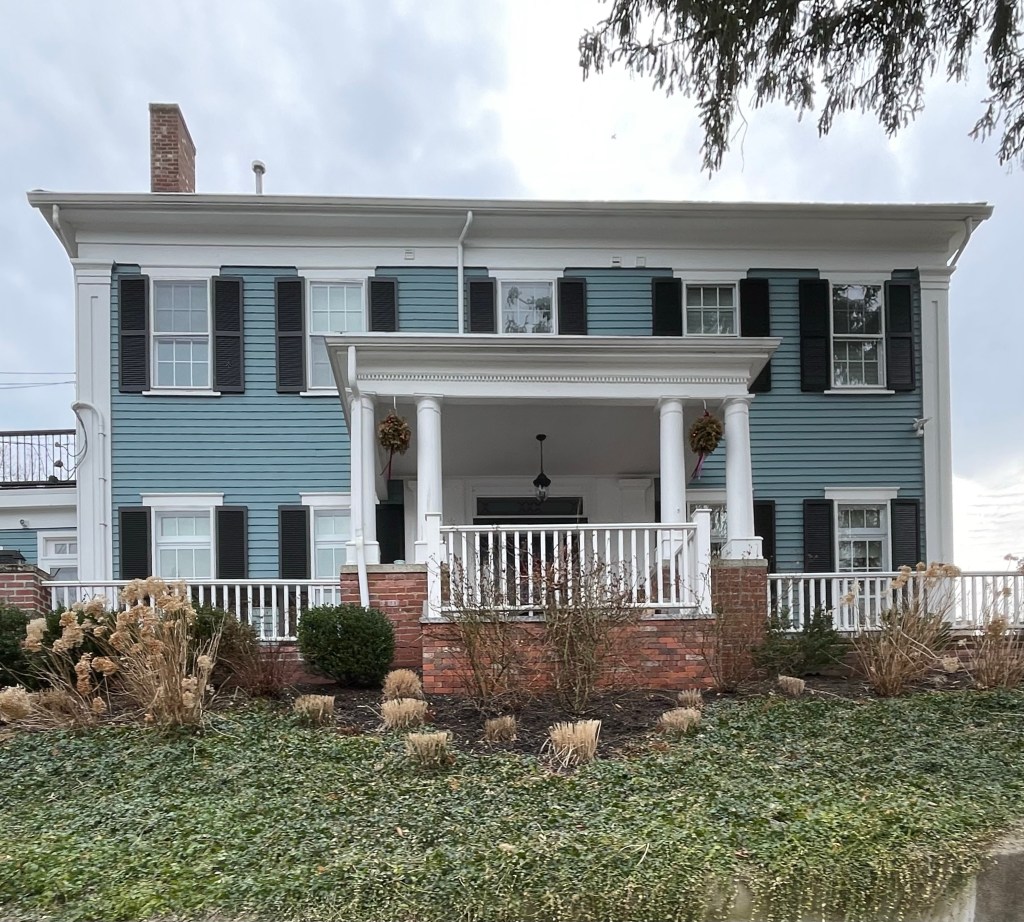
The Newhall-Lane House (could be the home of many wives) was built in 1809 by Pliny Newhall, a bricklayer. He purchased the land here at a prominent crossroads in Lancaster in 1808 from his employer who owned a brickyard across the street. At a previous home in town, Newhall’s wife Patty died giving birth to their son, at just 23 years old. Their son also died during childbirth. He remarried and had a full family to grow into the couple’s new house. They relocated to Lincoln and the home was sold to Captain Anthony Lane, who was the son of Deacon Jonas Lane, an important figure in Lancaster town history. Jonas had four wives, outliving three of them. Captain Lane himself, was married twice while living in this house; he had no children from either marriage. Although he was a talented craftsman and cabinetmaker, Captain Lane listed his occupation as farmer. The house is significant architecturally, as a fine example of Federal style architecture in Lancaster . Its sophisticated design is reflected in the graceful entrance. One of the unique features of the house is the pedimented gable of the facade which in combination with the narrow plan of the house, creates a delightful massing in this distinctive combination of Greek Revival and Federal styles.

Carter House and Publishing Company Building // 1820

Here is a two-for-one post! These two absolutely gorgeous Federal style buildings on Main Street in Lancaster were built in 1820 for George Carter and his brothers who ran a publishing company in the sleepy town. The Carter family was very active in the Swedenborgianism, a very small church in the general realm of Christianity, and they helped create a small enclave of worshippers in town. The brick, Carter and Andrews Publishing Company building (on the other side of a dead end street from this house) was built at the same time as the Carter home. The company was extremely popular in publishing children’s books, textbooks, and maps. One of my favorite publications the company made was “Peter Piper’s Practical Principles of Plain and Perfect Pronunciation”, now say that three times fast!

Boston Police Department Headquarters – Loews Boston // 1925

I love historic hotels, so when I decided that I was overdue for a “stay-cation” in Boston, spending time unwinding in an old building was mandatory. When walking around the Back Bay, I always loved the old Boston Police Department Headquarters building and used this as an opportunity to learn more about its history! The Boston Police Department Headquarters building on Berkeley Street was built in 1925, and was designed by the architectural firm of Ritchie, Parsons & Taylor, a firm that specialized in civic and institutional buildings. Prior to this building, the Boston Police Department was based out of an old townhouse in Pemberton Square. By the 1920s, such an out-dated and small building was not a good symbol for one of America’s premier police forces, so the City of Boston purchased a lot in the Back Bay and funded the new modern building. The structure is a late example of Italian Renaissance Revival architecture in the city, and is classically refined. The brick building is clad with limestone, which is rusticated on the ground two floors. The building housed police department offices for over 70 years until 1997, when they built a new, Modern building in Roxbury. This building was boarded up for years until it was sold to an Irish hotel chain, who added two additional floors at the roof. They quickly went out of business and sold the hotel. The hotel today is operated by Loews, and they do a great job of highlighting the history of the building, from the meeting rooms named after significant police department employees of the past, the appropriately named Precinct Bar, to the Police-blue lanterns flanking the main entrance.

Carter-Hussey-Whitney House // 1827

Architecture and history is often layered, so it’s always a treat to find a building that showcases different eras in design. This cute house on Main Street in Lancaster was built in 1827 for a James Carter. The home was a side-hall two-story gable end house, with a Federal style fanlight over the front door (which remains). By 1847, the property was sold to Captain Francis Hussey, a sea-captain from Nantucket who seemingly wanted to get away from the sea, settling in central Massachusetts. He is likely the one who added the corner pilasters, giving the home an update in the Greek Revival style, which is very common on his native Nantucket. Hussey died in 1863 and the home went through the hands of a couple owners until Anna Henshaw Whitney purchased the property in 1887. Ms. Whitney was born in Cambridge, and after attending private schools, she moved to Lancaster in the 1860s as an assistant at Lancaster Academy, teaching there until her retirement in 1889 at 45 years old. It was Anna Whitney who constructed additions to the home, and the beautiful mansard roof which we see today. In her retirement, Anna farmed the massive property and opened one of the finest kennels for Saint Bernard dogs in the world. From this, she became the first woman judge with the Westminster Kennel Club.

Old Settlers’ Burying Ground // 1674+

I know.. I know.. It’s not a building, but I couldn’t help myself but to find this hidden cemetery and take some photos! Tucked way off a street, across railroad tracks and down into a grove of trees, I came across this Colonial-era cemetery known as the Old Settlers’ Burying Ground. Established by 1674, it is the town’s oldest formal cemetery with gravestones dispersed, both standing up to the heavens and seemingly jutting out of the ground like crooked teeth. The Old Settlers’ Burying Ground contains approximately 196 stones and an estimated 230 burials. The stones in the cemetery reflect the continuum of headstone iconography popular from the 17th through 19th centuries, depicting winged death’s head, soul effigy, heart, hourglass, skeleton, and cherubs, to name a few. The cemetery is thought to possibly have unmarked graves of the colonists who were killed during the Lancaster Raid, the first in a series of five planned raids on English colonist towns during the winter of 1675 as part of King Philip’s War. Metacom, known by English colonists as King Philip, was a Wampanoag sachem involved in leading and organizing Wampanoag warriors during the war. The tension that led to these raids began from the decline in the fur trade due to overhunting, the decrease in the native population due to European-derived diseases, and the invasion of English livestock on native land. According to one estimate, at least fourteen Lancaster inhabitants died and twenty-three were captured and taken as prisoners, some of those 14 are likely buried here in unmarked graves.