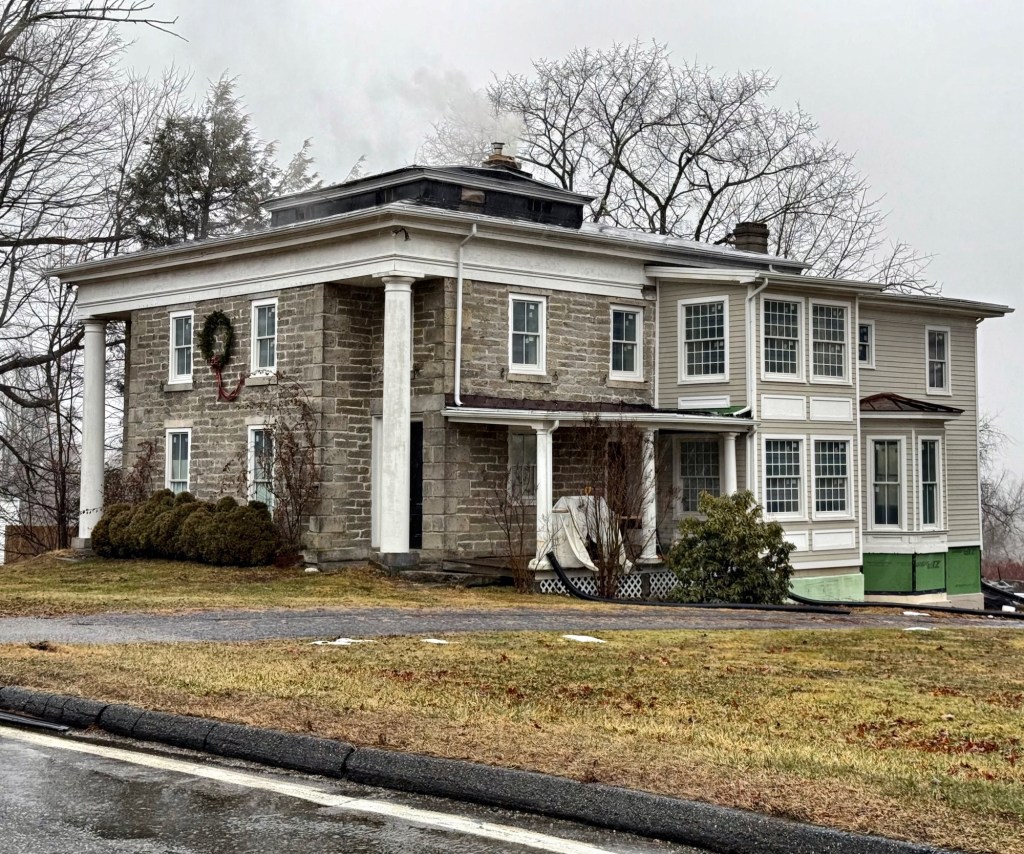
The Myron Norton House, built in 1840, is located in the central village in Goshen, Connecticut. Built of stone, the house is unique as the only example of a stone house in the village, and the only Greek Revival house that departs from the usual gable-roofed form, having a square plan and hipped roof with monitor. The home was built for Myron Norton (1788-1853) and his wife, Caroline (Marsh) Norton, who outlived her husband by 23 years, living here until her death in 1876. Myron Norton made his fortune patenting and selling pineapple cheese molds, where he pressed the curds from local cows in wooden pineapple-shaped molds to give them the desired shape. It is the house that cheese built!
The General Israel Putnam Housein Danvers, Massachusetts, was built circa 1648 by Lieutenant Thomas Putnam on farmland that then consisted of 100 acres. In 1692, his youngest son, Joseph Putnam, lived here, inheriting the property over his half-brother, Thomas Putnam, Jr. (1652-1699), causing friction within the family. During the infamous witch trials and hysteria in Salem Village, Joseph Putnam was one of two people who took notes during the examinations of the first three to be accused of witchcraft in 1692 – Sarah Good, Sarah Osborne, and Tituba. From that point forward, he was one of the most outspoken opponents of the proceedings, which put him in direct conflict with most of the Putnam family, especially that of his half-brother Thomas. Fearing accusations against him by his half-brother, Joseph was said to have kept horses saddled at all times, ready to escape at a moment’s notice. He was never accused, though Thomas Putnam was responsible for the accusations of 43 people, and his daughter was responsible for 62. In 1718, Israel Putnam, the son of Joseph Putnam, and later Commander of the colonial troops at the Battle of Bunker Hill, was born in this house. It is the only extant structure with direct ties to Commander Putnam. During the Battle of Bunker Hill, Putnam is thought to have ordered William Prescott to tell his troops, “Don’t fire until you see the whites of their eyes.” This command has since become one of the American Revolution’s notable quotations. It was given to make the best use of the low ammunition stocks that the troops had. The Putnam House remained in the family into the 20th century, and due to highway and commercial expansion, the property now sits in the middle of a cloverleaf intersection of two highways. The house was given by the Putnam family to the Danvers Historical Society in 1991, but as of 2020, the Putnam family once again owns the property. The house is not holding up well and I could not locate plans for restoration or preservation of it online. This house deserves to be preserved.
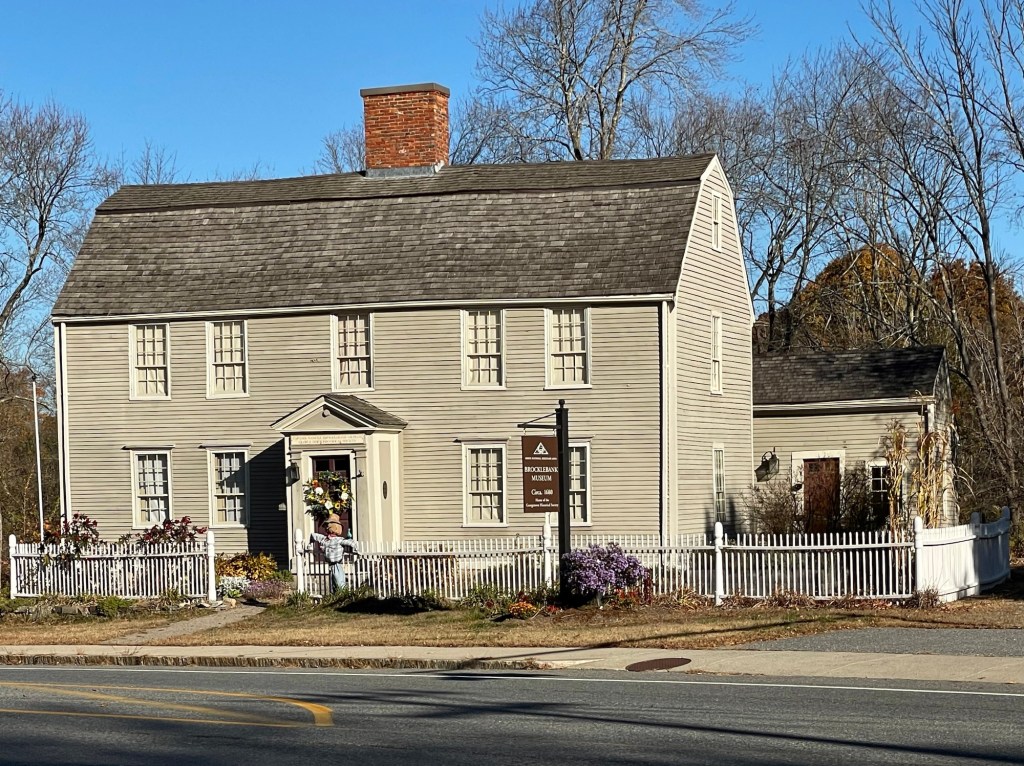
The Brocklebank-Nelson-Beecher House is a First Period structure in Georgetown, Massachusetts, believed to have been built in the 1660s. The land on which the house stands was granted in 1661 to Samuel Brocklebank (1628-1676) , a surveyor who, with his widowed mother and brother, left England and were among the first settlers of Rowley in 1639. It was built by Lieut. Samuel Brocklebank who also owned a farm of 72 acres on the site. Lieut. Brocklebank was appointed captain in a militia and was killed with his entire company in Sudbury in 1676 during a raid by Native people during the period of the King Philip’s War. Samuel’s wife remarried and moved to Newbury, and his son, Samuel Jr., resided in the family home which remained in the Brocklebank family until 1754. The house became a tavern by owner Solomon Nelson, who purchased the property in 1765 and made substantial additions and renovations to the house in its current Georgian style. In 1858 the house was bought by Rev Charles Beecher, brother of Harriet Beecher Stowe and Henry Ward Beecher. An ardent abolitionist, he was the pastor of the town’s Old South Congregational Church. Today, the Brocklebank-Nelson-Beecher House is owned by the Georgetown Historical Society, who maintain and showcase the town’s rich history from this important early residence.
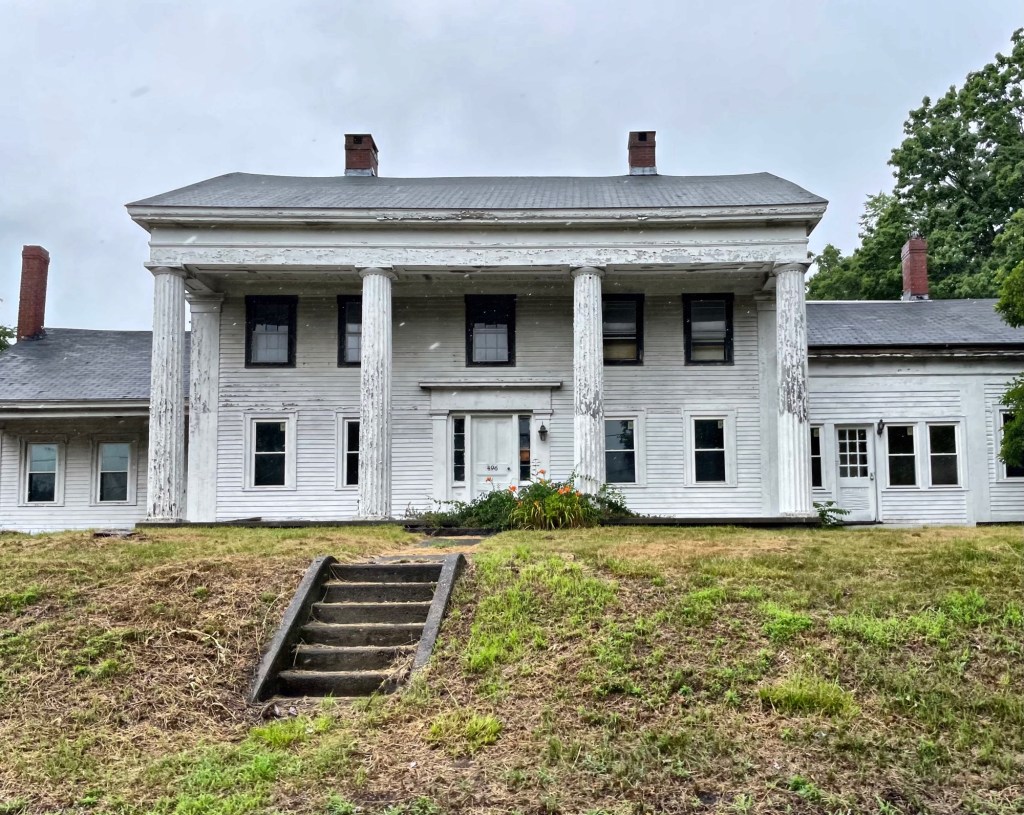
Located in the Dayville section of Killingly, Connecticut, you can find a row of large mansions built for mill owners and managers from the 19th century. This house dates to the 1840s and by the 1860s, was owned by Harris Sayles (1817-1893) and his brother, Sabin L. Sayles (1827-1891) who together, co-owned and operated a large woolen mill in the town (featured previously). It is not clear if the Sayles brothers lived in the home, but they likely rented it to higher-level employees at the mill as they both had other homes in town. The two-and-a-half story mansion is a great example of the Greek Revival style in the town, with the side gable roof extending over the full-height portico with doric columns. The mansion was built across the street from the village church, also in the same style, but that building was demolished by 2011.
One of the most historic houses in Ashford, Connecticut was listed for sale! The house at 14 Westford Road dates to 1710, when John Mixer purchased the property which at the time totaled 100 acres, and applied for a license to operate a tavern. John Mixer was born in 1668 in Watertown, Massachusetts and married Abigail Fiske in 1695. Mixer worked as a tanner in Watertown before moving to Connecticut, becoming the first settler of Ashford in 1710. Mixer became Ashford’s first Town Clerk, Treasurer, Tavern Keeper, Select Man, and Deacon. Mixer and his family would eventually move to Suffield, Connecticut, but the old tavern remains in impeccable condition, largely due to its later owners and preservation as an inn and restoration in the 1920s.
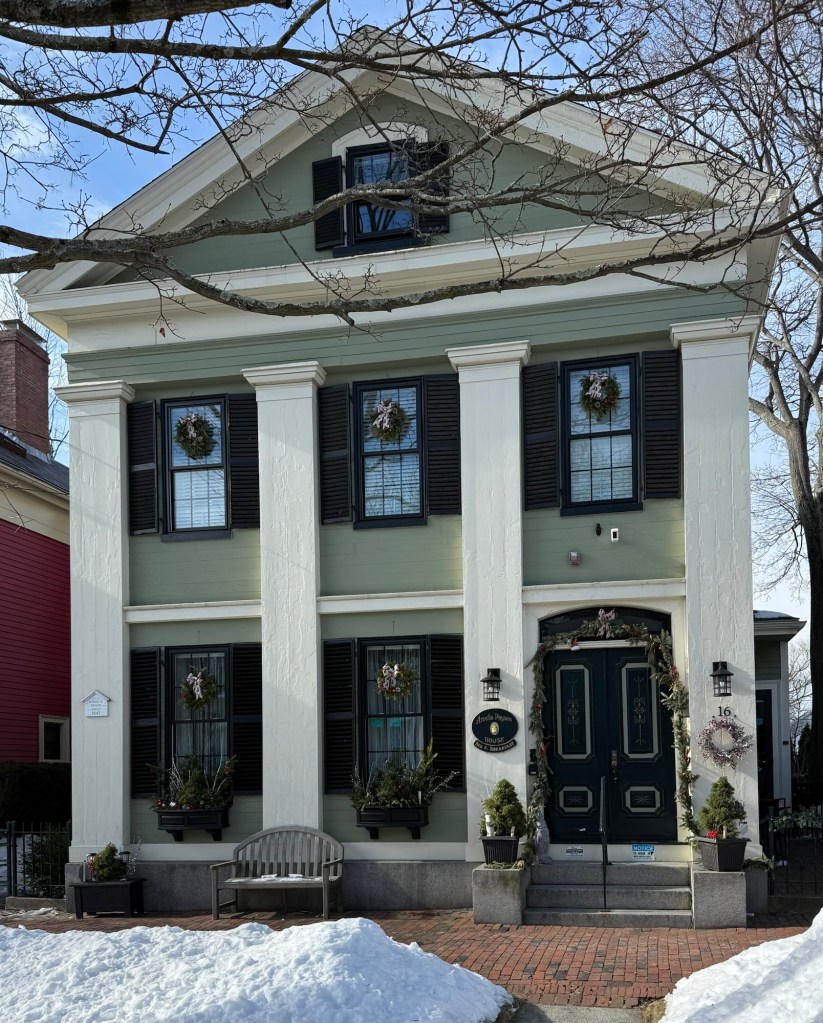
One of the more unique Greek Revival style houses I have yet seen in New England is the Levi Starbuck Houseon Orange Street on Nantucket. The house was built in 1838 by housewright William M. Andrews who sold the completed property that year to Levi Starbuck, a wealthy sea captain for $5,000. When he bought the house, Levi Starbuck (1769-1849) was 69-years-old. Levi Starbuck is credited by some as inspiration for the character Starbuck in “Moby Dick.” He would spend the last ten years of his life in this opulent new house on Orange Street. Architecturally, the house is clad with flush siding with projecting paneled pilasters with fret patterns on the top and bottom breaking up the bays of the house.
Tucked away on a side street in Mansfield, I was pleasantly surprised to stumble upon this charming example of a Craftsman bungalow, a style and form not too common in New England. The style, synonymous with the western United States’ population growth in the early 20th century, never took off the same way here as Yankee homeowners and builders often stayed true to the Colonial Revival style (even today). This building is said to date from the early 1800s and was built as a Federal style cape. It was owned by a Margaret Lane in the late 19th century. By the 1930s, the house was significantly altered with a full-length porch supported by tapered shingled columns atop fieldstone bases and new dormers at the roof with flared eaves. The building has been home to a local chapter of the Daughters of the American Revolution (DAR). What a charmer!
Originally built as a Federal period farmhouse, this gorgeous estate is the epitome of what happened to Ridgefield… city money! By the end of the 19th century, wealthy New Yorkers were flocking to small towns every summer for clean air, rest, and relaxation. Ridgefield, Connecticut became an obvious option for its close proximity to New York and bucolic setting of farmlands bounded by old stone and rolling hills. As a result, wealthy summer residents purchased older estates and either demolished or renovated the homes there. Aaron Lockwood Northrop was raised in Ridgefield and was educated in its private schools before moving to New York as a young man, being awarded an apprenticeship as a dentist. Dr. Northrop went on to establish a prominent dental practice and would serve as President of the American Dental Association. As a wealthy adult, he acquired a circa 1820 house on this lot and renovated it, doubling its size and giving the residence its current Victorian flair. The summer house was affectionately named “Good Cheer”. Aaron died unexpectedly in 1908 while overseas in Paris, France. His widow, Caroline, resided at Good Cheer until her own death in 1927.