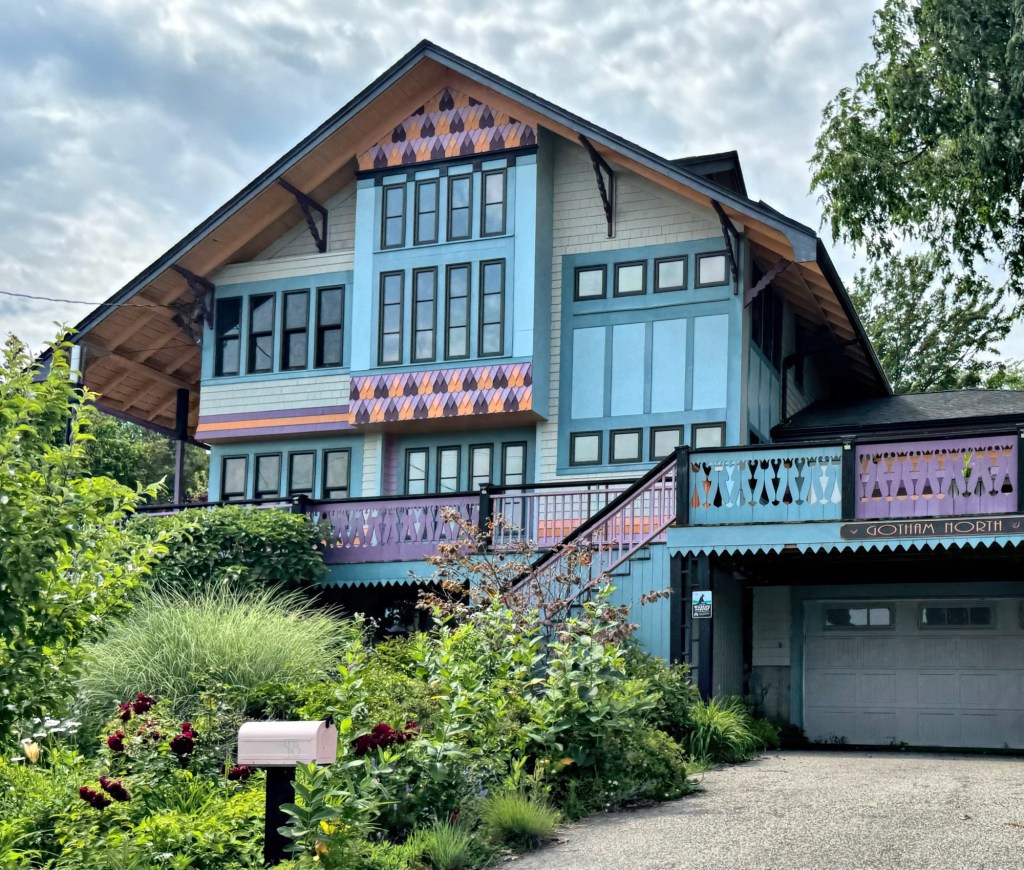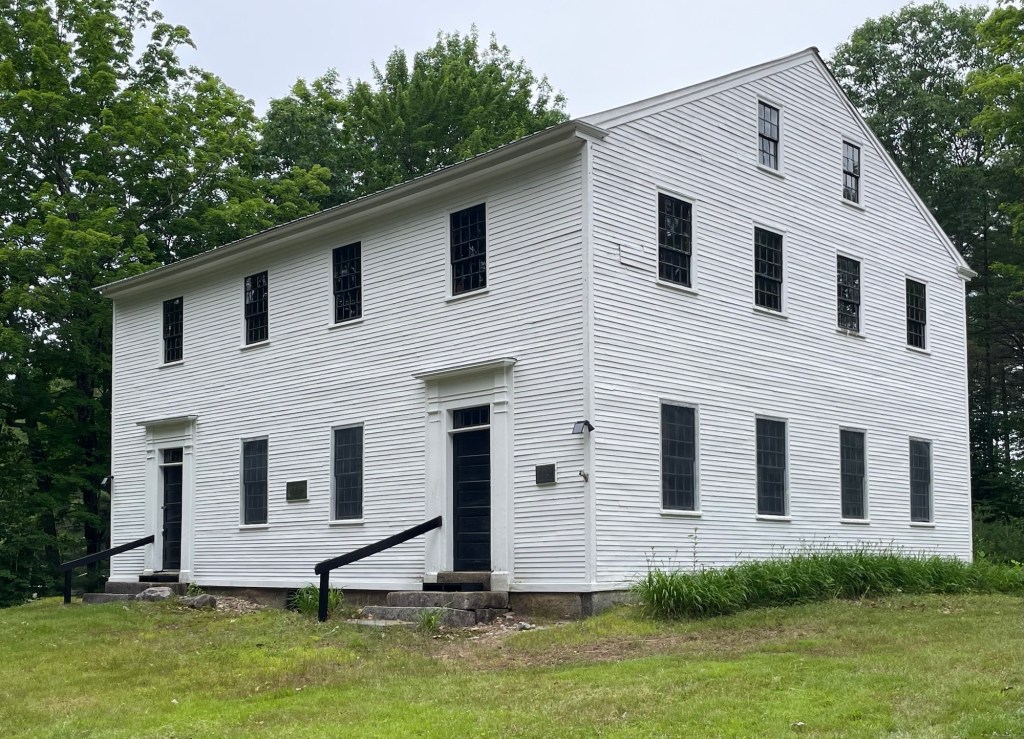
Kaffenburgh House – Bertram Inn // c.1910

Across the street from the C. D. Hammer House on Sewall Avenue in Brookline, Massachusetts, this later take on the Queen Anne style with Tudor Revival elements is about to go through quite a transformation!

A little history before I share the proposal for the site… This house was built around 1910 for Bessie V. and Carl J. Kaffenburgh, a tobacco dealer with a store in Downtown Boston. The house was  from plans by architect Harry E. Davidson, who had previously designed stucco houses with Tudor influences for both the Vorenberg and Kaffenburgh family including 20 Amory Street in the nearby Cottage Farm neighborhood. By 1940 the house was owned by Hazen Blood and his wife. The Bloods had rented out rooms in the house totalling 13 lodgers here as a rooming house in the 1940 directory. In 1987, owner, Bryan Austin purchased the property restored it, and opened it as the Bertram Inn.

In recent years, the adjoining lots were eyed for redevelopment and demolition was proposed for this property. Neighborhood opposition and the demolition delay process allowed for review of the plans, which now includes the “restoration” of the main house with a six-story boxy addition on the rear containing condominium units. While the proposed addition is not contextual to the historic Tudor Revival house, it does save the original building and provides much-needed housing for others, so I guess this is a win! What do you think?

C. D. Hammer House // 1893

This lovely Queen Anne style residence near the Longwood section of Brookline was built in 1893 for C. D. Hammer, the General Agent for the Provident Life and Trust Company of Philadelphia. The stately suburban dwelling was designed by architect Julius A. Schweinfurth, a noted architect who designed many buildings in the region. While some of the stickwork and applied ornament has been covered by vinyl siding, much of the original detailing and some windows remain. The dropped pendants in the gables with flared bargeboard and highly ornamental corbels are a great touch and remain to this day. I bet all of the original details are still under that vinyl, just waiting to be shown again!

Potter-Leland House // c.1888

Francis Street in Brookline, Massachusetts, has some of the finest Queen Anne Victorian residences in the Boston area. This is the Potter-Leland House, built by 1888 by William Potter, a wealthy shoe manufacturer and businessman who developed rental housing in the neighborhood not far from his house on Kent Street. He built this just before the larger Queen Anne duplex was built nextdoor from plans by Rand & Taylor, architects, and it was rented out as a single-family income-producing property. Various exterior wall textures, irregular massing, and turned supports on the front porch contribute to the Queen Anne character of this house, but the real showstopper is the rounded bay projection with three, 25-over-1 (yes you heard that right) curved sash windows! The property was later purchased by Herbert M. Leland, a broker.

William Potter Rental House // 1889

William W. Potter, a shoe manufacturer and businessman, and his wife, Isabella Abbe Strickland Potter, lived in the Longwood section of Brookline and became active in the surround areas development in the last decades of the 19th century. William bought land off Kent Street and began to lay out house lots, becoming a developer overseeing construction of stately Queen Anne Victorian rental properties marketed to upper-middle-class residents. For this house on Francis Street, he commissioned architects George Rand and Bertram Taylor, who were known for producing stylish residential designs for the middle class in the Boston area. The massive property was a duplex, providing units to two lucky families! The building has just about every hallmark feature of the Queen Anne style including: the conical roof on a rounded corner bay, a complex roofline, asymmetrical plan, varied siding/materials, and applied ornamentation. In the 1920s, the house was owned by Simmons College, and used as a boarding house. Luckily, the property was restored and now is one of the finest residences in the neighborhood.

Orlando & Ellen Alford House // 1883

Orlando Hiram Alford (1840-1908) was an industrious and hardworking Vermonter who settled in the Boston area to make his wealth. He was a member of Bliss, Fabyan & Co., a large drygoods dealer, and would also become a director of the First National Bank, the City Trust Company, and the Franklin Savings Bank. In manufacturing, he serves the role of director of the Bates Manufacturing Company, the Merrimac River Towing Company, the Columbian Manufacturing Company, the Cordis Mills, and the Thorndike Company (among others). From his many positions and roles, he and his wife Ellen, were able to afford a house lot on Kent Street in the neighborhood between Longwood and Brookline Village. The Alford House, a stunning example of the Queen Anne style remained in family until after Ellen’s death in 1929, when it was purchased by the Boston Hospital for Women as a nurse’s residence. It was later used as apartments and was clad with vinyl siding, obscuring much of the original wood trim detailing. In the 2000s, later owners sought to demolish this house, which served as a rallying cry for neighborhood residents who understood the importance of the house and its context with surrounding lots. After the demolition delay process lapsed, they petitioned for a local district designation, effectively preserving the house for more generations to come! The Lawrence Local Historic District has since provided protection for houses in the area, but does not require a homeowner maintains or keeps up a property in a certain condition. Hopefully the Alford House will be restored soon!

Wightman-Pope House // 1910

In 1910, Ralph Linder Pope (1887-1966) graduated from MIT and later became Chairman of the Board of Directors of the Northwestern Leather Co., Boston. He married Elizabeth S. Wightman two years earlier and her father, George Wightman, purchased a house lot near his own 1902 mansion in the Longwood section of Brookline, Massachusetts and had this brick residence built in 1910 for the new couple. Mr. Wightman commissioned the famed architectural firm of Shepley, Rutan & Coolidge to design his daughter’s home in the Colonial Revival style.

Webber Duplex // c.1890

In the late 19th century, the Longwood section of Brookline, saw a second surge of development when larger pieces of land were sold by heirs of the original developers. On the lot across from the Longwood Towers and near the Longwood rail station, Maine-born lumber dealer, John Prescott Webber, built this two-family residence and rented it out for supplemental income. Webber lived in a large home on Beacon Street while renting this and other properties in town to middle-class commuters to Boston. The Queen Anne style residence exhibits a unique rusticated stone first floor with wide arched entry with Richardsonian Romanesque carved detailing.

Captain Oliver Amsbury House // 1858

Oliver Amsbury (1812-1867), a master mariner and resident of Rockport, Maine, built this large home on the crest of one of the hills overlooking the harbor. The residence is an excellent example of the Italianate style with segmental door and window hoods, a round arched window in a unique Palladian center bay window, and large brackets at the eaves. After Captain Amsbury died in 1867, the house was purchased by Charles F. Richards a lime manufacturer and later a treasurer of the Camden Savings Bank. The old Amsbury house is well-preserved and one of many old sea captain’s houses in the Pine Tree State!

Phinney-Bigelow House // c.1899

Before the turn of the 20th century, William L. and Elizabeth G. Phinney purchased a narrow house lot at the corner of Hawes and Chatham streets in the desirable Longwood neighborhood of Brookline. They then retained the young architect Thomas Marriott James, to design this massive Federal Revival style mansion. After William died in 1911, Elizabeth remained in the house until 1920, when it sold to C. Willard Bigelow a wool dealer and his wife, Ruth. The Phinney-Bigelow House is an exemplary Federal Revival style house on a narrow lot which takes full advantage of its boxy form. The slightly asymmetrical facade with Palladian window, limestone trimmings, and bold entrance are all great additions to the design.

McInnis House // 1901

Located next door to Ms. Matchett’s house on Chatham Street in the suburban Longwood neighborhood of Brookline, Massachusetts, you will find this very unique example of a Colonial Revival style single-family home. Built by 1901 for lawyer Edwin G. McInnis (sometime spelled McInnes) and his wife, Mabel, the house is high-style Colonial Revival with symmetrical facade, rustication, two-story Corinthian pilasters framing the bays, Palladian window, and Federal style entry with fanlight transom. No records of the architect could be located sadly.