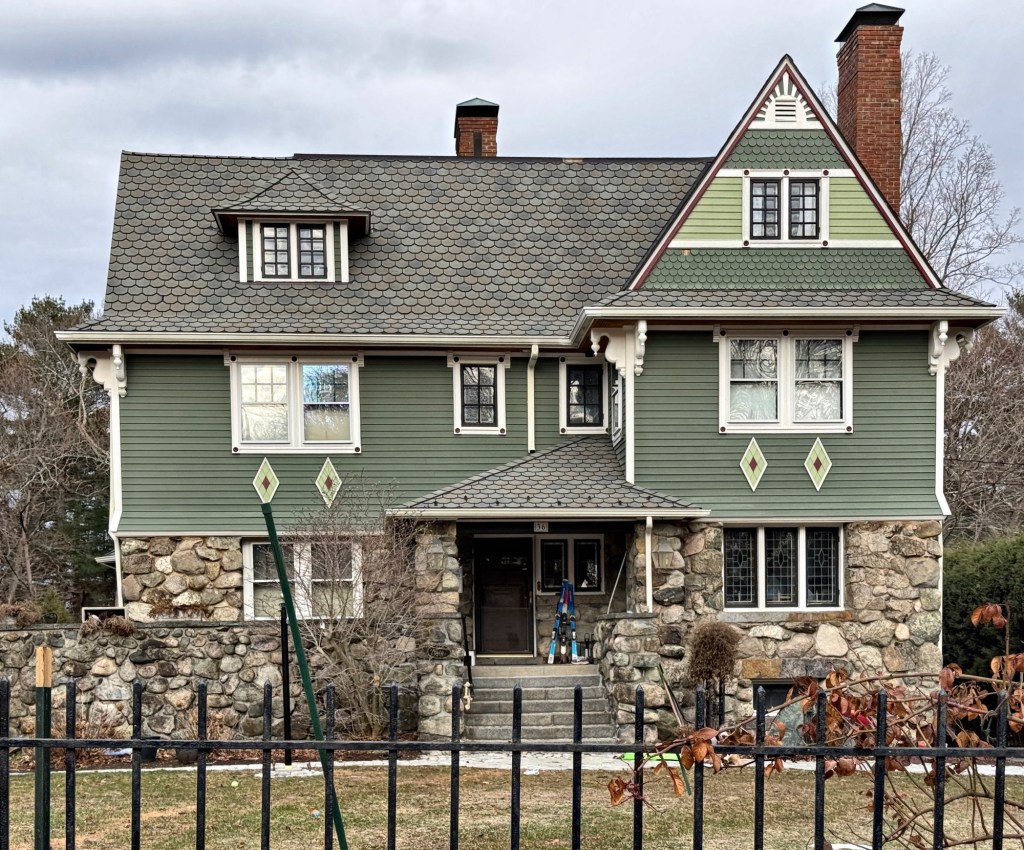
The John G. Phillips House on Pleasant Street in Sharon, Massachusetts, is a playful and eclectic example of early 20th century residential architecture showcasing the blending of many styles into a single composition. The house was built in 1901 for John Goddard Phillips, who moved to Sharon from Boston to retire in this large home, and serve as President of the Sharon Historical Society. The house blends typical Queen Anne and Shingle style forms but with interesting brackets common in styles popular a half-century earlier.
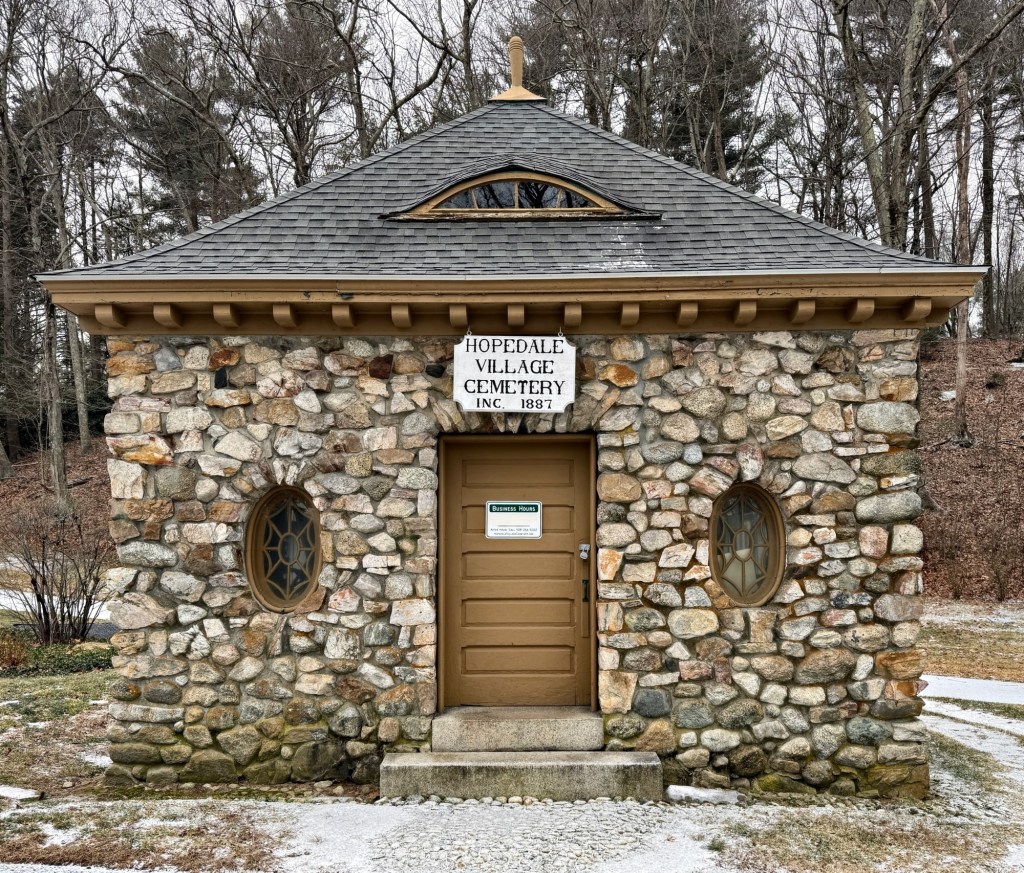
At the heart of the Hopedale Village Cemetery, this diminutive historic tool shed and office showcases that even for functional buildings set within a cemetery, high-quality materials and good design can enhance the landscape. The cemetery was laid out in 1845 in connection with Hopedale’s Utopian settlement, but expanded later in the 19th century as a formal landscaped cemetery in about 1887. The growth and investment of the cemetery coincides with the growth of the community as it prospered with the success of the Draper Corporation factories in town. Landscape architect, Warren Henry Manning updated the landscape here, with scenic vistas and hills, which followed the popular Rural cemetery movement of the 19th century. The cemetery contains many graves and mausoleums of the wealthy factory managers and benefactors of the community, which dot the sprawling landscape. In 1894, architect, Robert Allen Cook, designed this stone tool shed, which may have also contained a small office with cemetery records. The one-story, hip-roofed building features rough rubblestone walls with an eyebrow dormer centered on the façade, and has been preserved by the community for well over 100 years.
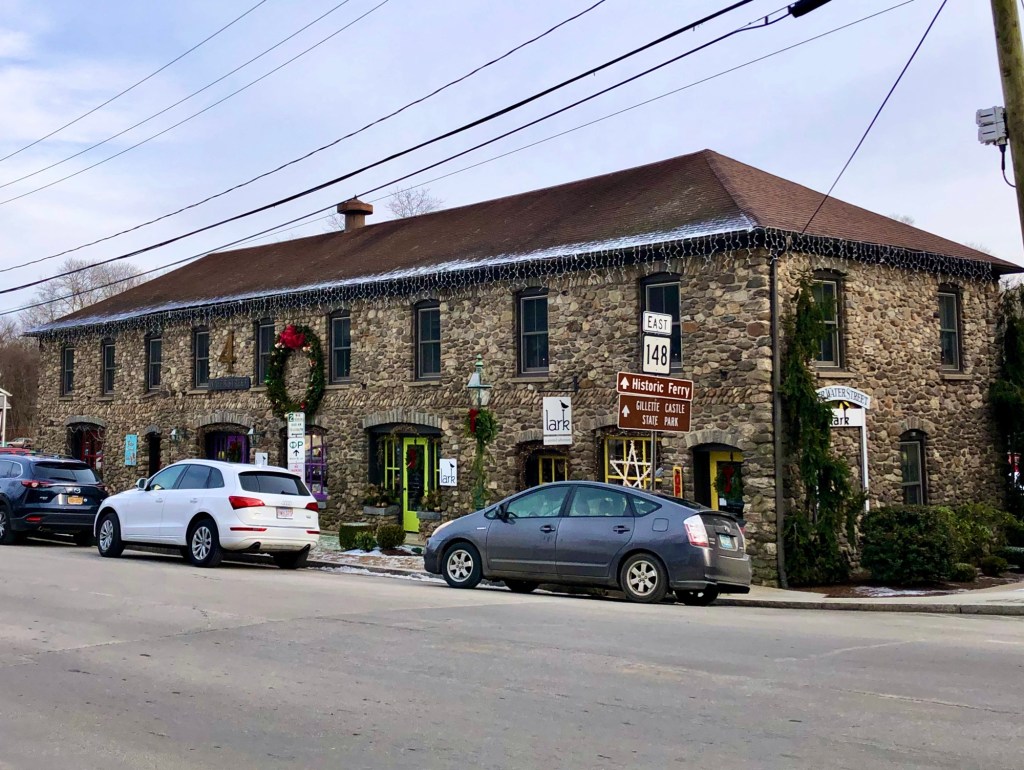
The handsome rubblestone commercial block at the corner of Main and Water streets in Chester, Connecticut, was built in 1909 by Italian stone masons for Joseph H. Leet and contained a grain and feed store, with other spaces in the building rented out. Decades later, the old Leet Store became a auto repair shop and the upstairs space was used as a meeting hall and theater for the community. The building was restored in 1979 and expanded at the rear with a two-story wood-frame addition for additional commercial space.
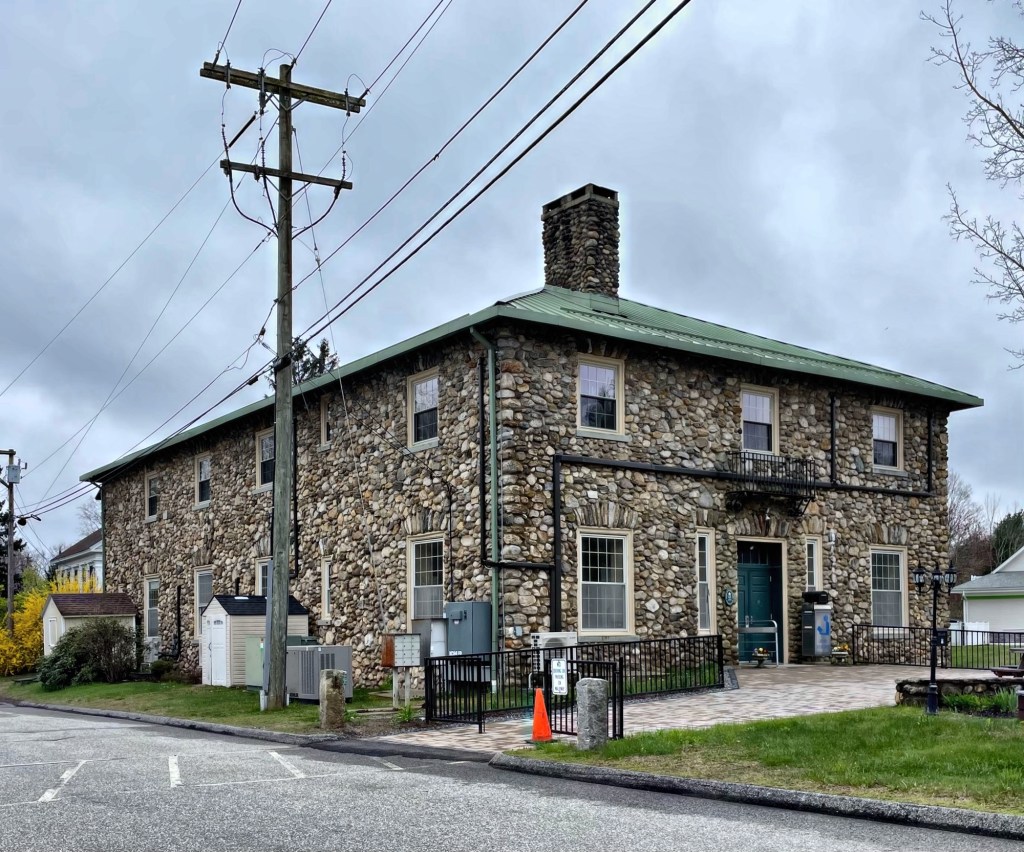
In the 1840s, Archibald Babcock (1780-1862) from Ashford, Connecticut, went west to engage in the California Gold Rush to seek his fortune. He did well and upon his return, moved to Charlestown, Massachusetts and began purchasing property for redevelopment. Upon his death in 1862, Mr. Babcock bequeathed $3,000 to the Town of Ashford start a “free” library there. For the next 60 years the library was located in a variety of private homes and country stores in town until the 1920s when this stone structure was built to house the town hall and library. Construction was made possible by a gift from Charles Knowlton, whose family had lived in the area since the 18th century. When built, it featured a number of modern innovations, including electrical service (generated on site), and steam heat. In addition to town offices and the library, the building also has an auditorium which is used for town meetings. Architect Herbert Loud furnished plans for the building which is rustic Arts and Crafts in style with randomly laid fieldstone walls with wide mortared joints. The roof eaves show exposed rafter tails below the shallow hipped roof.
One of Maine’s most charming libraries is right in the coastal village of Ogunquit, and like many of the greatest, it was built as a memorial to someone. George Mecum Conarroe was born Nov. 9, 1831. His father, George Washington Conarroe, was an accomplished Philadelphia portrait artist who provided his family with every advantage mostly from an inherited family fortune. The Conarroes and their cousins, the Trotters, who summered at Cape Arundel, had been associated in a very successful steel venture for several previous generations. George M. Conarroe apprenticed in a Philadelphia law firm and was admitted to the Bar in 1853. He ran a successful probate law practice and his prudent real estate development investments enhanced his formidable fortune. Nannie Dunlap, daughter of another leading Philadelphia lawyer married George M. Conarroe in 1868, they were inseparable. He built a summer estate in York Cliffs, a burgeoning Summer colony just south of Ogunquit (then a part of Wells). George died in 1896, and Nannie fought to keep her late husband’s legacy living in the coastal area he loved so much. She hired Philadelphia architect Charles M. Burns to design a new summer chapel in York and this beautiful village library in Ogunquit. The library was constructed of fieldstone taken from the site and is a lovely example of the Romanesque Revival and Queen Anne architectural styles in Maine.
When Ridgefield, Connecticut was settled in 1708 by Europeans, there was only one Episcopal Church in the state, and the general assembly allowed dissenters their own churches so long as they continued to pay taxes to support the Congregational Church. Ridgefield’s first Episcopal church, St. Stephen’s was built in 1740 on land granted by the Proprietors who founded the town and laid out lots along the towns new Main Street. In 1776, St. Stephen’s minister, Epenetus Townsend, a Tory (loyal to the British), was ordered to leave town with his wife and five children when the Revolution picked up steam. He was appointed chaplain to a British regiment and in 1779, the battalion was ordered to Nova Scotia. En route by vessel, a severe storm arose and all passengers were lost. The church was taken over by the commissary department of the American Army. During the Battle of Ridgefield, British troops set it on fire as a statement to the townspeople. The church was replaced two more times until 1914 when the present building was constructed. The Colonial Revival church is absolutely stunning and built from plans by (unknown to me) architect Walter Kerr Rainsford. The rubblestone church is one of the most pleasing designs I have seen in Connecticut!
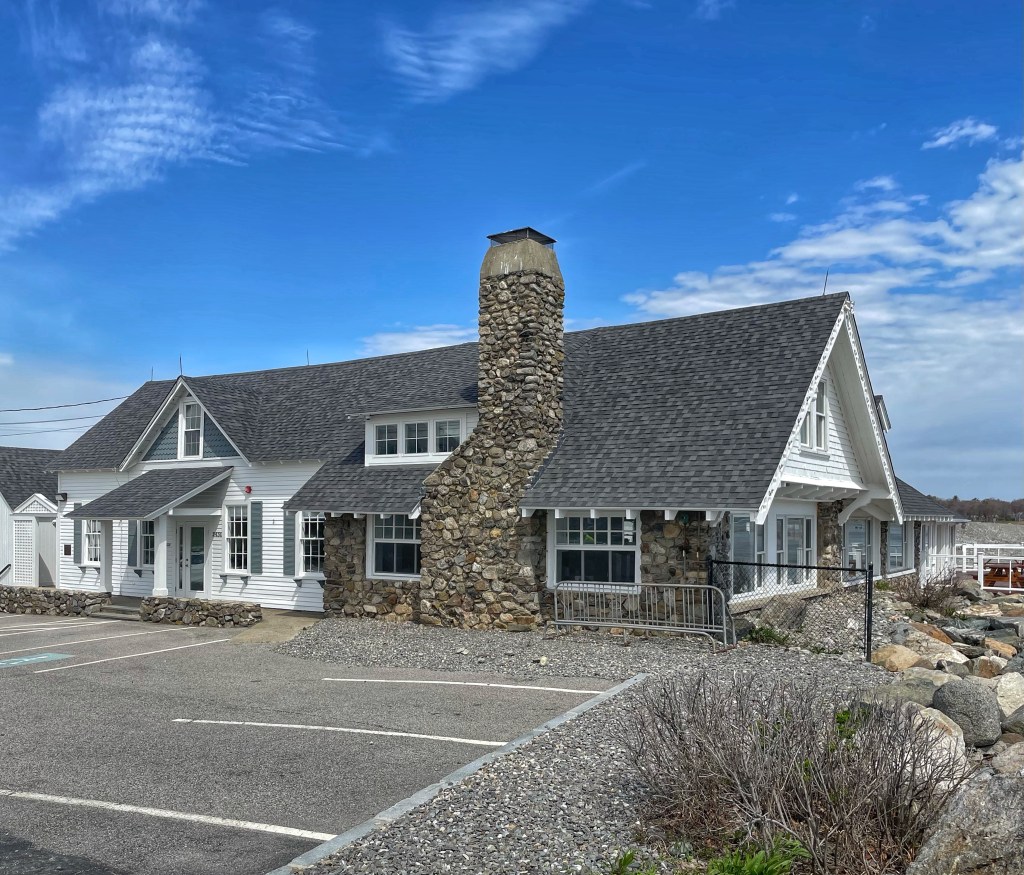
The Rye Beach Club is located right on Rye Beach, one of New Hampshire’s most upscale seaside communities, one whose history as a fashionable summer resort dates back to the 1840s. The Beach Club was established in 1925 in the decade after the First World War as the nation was experiencing a social transformation fueled by the postwar boom of the “Roaring Twenties”. As automobile ownership rates increased by the 1920s, the average motorist was no longer dependent upon schedules and the fixed routes of streetcars, railroads and steamboats. As one early historian of American recreation noted tongue-in-cheek, “The wealthy could make the fashionable tour in 1825, the well-to-do built up summer resorts of the 1890s, but every Tom, Dick and Harry toured the country in the 1930s.” As a result, many wealthy communities created private, exclusive recreation and social clubs where they would not be forced to mingle with the “average” American. Rye Beach residents formed the Rye Beach Club in 1925, which comprises of a rubblestone building with various wood-frame additions.


 Buildings of New England