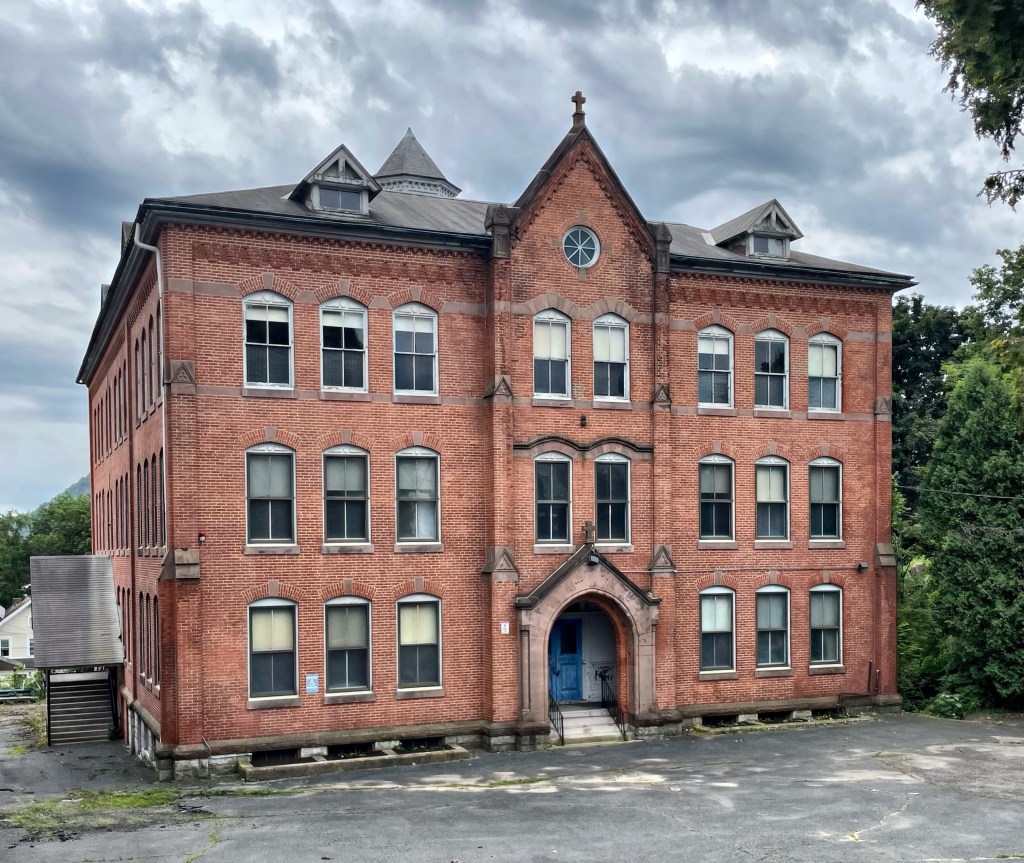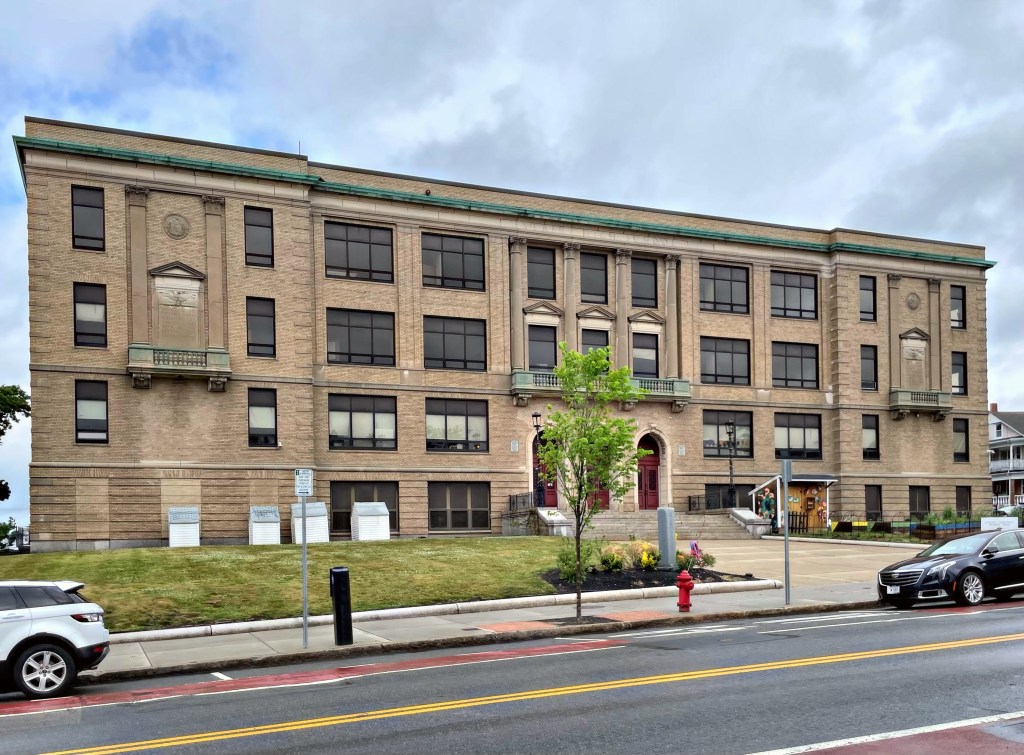
Academy of the Holy Family // 1914

Built adjacent to and just a few years after the St. Mary of the Immaculate Conception Church in Baltic (last post), the Academy of the Holy Family stands as a high-style Colonial Revival building in the town. The building stands four full floors with a raised basement and attic story, and is symmetrical in its design. A large fan-light transom and stone trimmings add much depth to the buildings large massing. The structure was built in 1914, and has housed the Academy of the Holy Family, a private, Roman-Catholic all-girls prep school, which is still active today.

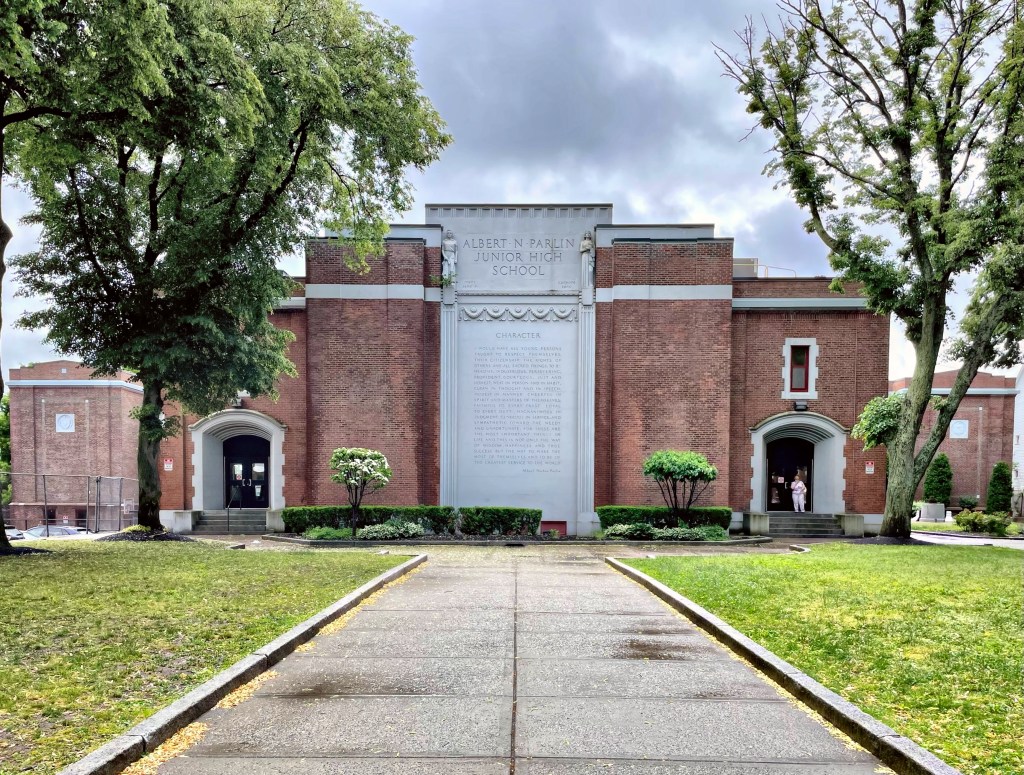
Albert Parlin School // 1931

Albert Norton Parlin (1848-1927) was born in Everett, Massachusetts to Ezra Parlin and Nancy Pickering-Parlin. At a young age, Albert lost both his parents – his mother passed in 1853 at the age of 26 and his father passed in 1858 at the age of 37, both succumbing to “consumption” (tuberculosis). At the age of nine, young Albert had become an orphan, and was raised by his grandmother at the Pickering Estate. He found his first job as a floor-sweep and errand boy in a retail cloak store. At seventeen, Albert Parlin began working with Magee Furnace Company, a Boston-based company where Mr. Parlin spent twenty-eight years of his professional career, moving up the ranks to become treasurer of the company. After he became successful, he gave back to his hometown, when in 1892, he donated his familial home and money to the City of Everett for the erection of the Parlin Memorial Library, to honor his late son. Parlin was not done giving to his hometown. He also left funds and a large piece of land to the City of Everett for a new Junior High School in 1915. The architectural firm of Desmond & Lord was commissioned to design the school which is set deep on the lot to give the building a beautiful front lawn. The 1931 building blends Art Deco and Tudor Revival styles with a large central panel.

Second Everett High School // 1922

In 1892, the growing municipality of Everett, Massachusetts incorporated as a city. While Everett’s population had remained small compared to nearby towns throughout much of the nineteenth century, its close proximity to Boston resulted in dramatic population growth between 1885 and 1915. During this late industrial period Everett’s population was one of the fastest growing in the state, doubling between 1870 and 1880, nearly tripling from 1880 to 1890 and doubling again between 1890-1900. This massive population growth put a strain on public facilities, necessitating new housing construction, new public utilities, and schools. By 1889, planning for the first purpose-built high school had begun. The resulting first Everett High School, first known as the Home School, in 1893, the year after Everett’s incorporation as a city. That building was almost immediately outgrown and the city acquired a new site for a school that was large enough to educate the ever-growing town’s students. The City of Everett selected the architectural firm of Ritchie, Parsons, and Taylor for the construction of the new high school. The firm was led by Scottish-born James H. Ritchie, who designed the Classical Revival building. In the early 2000s, the building was again deemed inadequate and a third high school was built about a mile away. The building is now occupied by the Everett Community Health and Wellness Center and the Webster School Extension.

Peter Parley Schoolhouse // 1756

The Peter Parley Schoolhouse (also known as the West Lane Schoolhouse) in Ridgefield, CT, is an excellent example of a well-preserved one-room school building in Fairfield County. The little red schoolhouse was originally built in 1756 and either replaced or enlarged in the early 1800s. As Ridgefield in the early days was primarily an agricultural community, many children split their time either helping family on the farm or in school, with work almost always coming before education. The school is named for its most famous student, Samuel Griswold Goodrich. Goodrich went by the alias Peter Parley and was born in Ridgefield, attending the school between 1799-1803. He was a prolific writer, with over 170 books to his credit, and is believed by many to have written the first American textbooks. Samuel wrote about his experiences as a student there, giving locals and historians a look into early life in the town. In the early 1900s, the town consolidated schools and this building was closed. The town seemed to simply close the building and it saw some neglect over time until the Ridgefield Historical Society assumed a lease of the property, recently restoring it.

Everett Schoolhouse // 1860-1965

c. 1910 image courtesy of Boston City Archives.

The Everett Schoolhouse opened in 1860 as Boston’s most modern school at the time, serving students in the South End and Roxbury. The school was located on Northampton Street, just off Tremont Street, and stood four stories with lawns surrounding it. The building was architecturally beautiful, with brick walls and stone trim and basement, large double-hung windows, and a slate roof capped by a bell tower. The building was so special, the opening ceremonies were documented in the New York Times in 1860. The school was named after Edward Everett (1794-1865), a Boston-native who served as a U.S. Senator, the 15th Governor of Massachusetts, Minister to Great Britain, and United States Secretary of State. He also taught at Harvard University and served as its president. My favorite tidbit of history on Edward Everett is that he was a great orator, and was the featured speaker at the dedication ceremony of the Gettysburg National Cemetery in 1863, where he spoke for over two hours—immediately before President Abraham Lincoln delivered his famous two-minute Gettysburg Address! The Everett Schoolhouse in Boston saw thousands of children graduate before a fire on the top floor of the building in 1965 and subsequent water damage from fire hoses necessitated its demolition.

Grass Hill School // 1861

In western Millbury, the Grass Hill school was constructed to provide a place of learning for children in the agricultural section of town. The district school, a remnant of the system of autonomous school districts that characterized the educational system of Massachusetts in the 19th century, this is a larger example of many of them. West Millbury had many wealthy farmers and they financed a district school here as far back as 1814. After two earlier, smaller school buildings, this two-story school was erected and was one of the most substantial. At one time, students in eight grades taught there, all at the same time, with grades 1-4 downstairs and 5-8 upstairs. As there weren’t many students, each grade only took up one or two rows. The building remained as a school for the town until 1968, and the building was leased to the Millbury Historical Society long term. They just completed a massive restoration project for the building, it looks great!

South Canton Center School // 1848

Located across the street from the Canton Congregational Church (last post) you can find the cutest one room schoolhouse in central Connecticut. The schoolhouse, built in 1848, was one of nine one-room schoolhouses in Canton at the time. The perfectly proportioned classically designed school features two front doors, one on each side of the recessed entry, with the right door for girls and the left for boys. There were also two outhouses behind the building for students and the teacher. This building served the community as a school until 1942. In the years following, the building was used as a meeting place for women from the congregational church, a community library, and a small public space for members of town. It is owned by the Congregational Church, who maintain it to this day.

North Canton Schoolhouse // 1872

Built in 1872, the old North Canton Schoolhouse really brings us back to how life was like in the 19th century. The saying “when I was a kid, we would have to walk to and from school in the snow, uphill both ways” comes to mind when I think of how students would have to walk long distances to attend rural schools. The school was originally built at a nearby fork in the road, but moved in the 1920s when the street was widened. The building was used as a school until 1942, when a newer, central school was built in the center of town.

Canton Center Schoolhouse // 1872

Canton, Connecticut, the only town in the state named after a city in China! The land which we now know as Canton had long been inhabited, specifically by the Wappingers, a group in the larger Algonquin speaking tribes. Canton was incorporated out of Simsbury in 1806, and named after the City of Canton in China (now known as Guangzhou), though I am not sure why. The town quickly developed two main villages. Collinsville sits on the Farmington River and its power was harvested for industry; while the center village grew differently as an agricultural village of farms. At the center of town sat a green for civic and town functions and gatherings. The town constructed a school here as far back as 1759, when the rural village was still a part of Simsbury. This is the fourth building on the green and it was built in 1872, and can be classified as Italianate in style. The building was occupied as a school until 1949, and it was used for other city uses until 1971, when the building was rented to the Canton Artist’s Guild and the building was renamed Gallery on the Green. The building remains community-focused and holds exhibits of local artists! Much of the rest of Canton Center lost all of its bucolic charm when the main road became commercialized, prioritizing speeding cars over a walkable village.

Old Stone School, Newmarket // 1841

Perched high on a hill, next to the Stone Church (featured previously), the old Stone School in Newmarket is one of a handful of iconic stone buildings in the town. Built in 1841, its stonework executed by William and Robert Channel, local farmers and stonemasons, who likely got their skill from building stone walls on farms. The building was used continuously as a school until 1966, when it was given to the Newmarket Historical Society, which now operates it as a local history museum.

Tabor Hall // c.1880

This beautiful Italianate building was constructed around 1880 for the newly established Tabor Academy, which was founded in Marion, Massachusetts by Ms. Elizabeth Taber in 1876. After Ms. Taber funded the constructed of a town library and museum and oversaw construction of the new academic building for her school, she endowed money for Tabor Hall, which was to house the school’s Principal, some boarding students, and most importantly, herself. The structure was located on Spring Street, just north of the library, until 1937, when the “Tabor Swap” was finalized. The swap was a deal between the academy and the Town of Marion, who exchanged properties in 1937. The town received the library building, the academic building (soon after converted to Town Hall) and land where this building once sat. The town erected Sippican Elementary, a public school on the land, and Tabor Academy moved this building a block over.

Newington Stone Schoolhouse // 1921

When the first floor of the Old Town Hall was deemed too cramped for the students of Newington, NH, to receive their education, the town worked out a solution, build a new school. Town revenue from timber-cutting in the Town Forest (the oldest Town Forest in the United States) helped finance construction of the school. Additionally, many landowners and farmers were asked to gather and donate stones on their properties and in stone walls for the material of the new building, which many contributed. The school closed in 1959, not long after the Pease Air Force Base was expanded and destroyed much of the southern edge of town. The U.S. Government acquired many parcels of land in Newington and Portsmouth and redeveloped the site over time in the mid 20th century. In Newington, the government leveled 26 local homesteads an action that left a deep scar on the town’s collective memory. The town has used the building for years, but only recently acquired the property from the Federal Government when they de-accessioned some of their properties here. Hopefully this building will be restored and serve as an educational tool for the town’s later generations.

Boxborough District Schoolhouse #2 // 1857

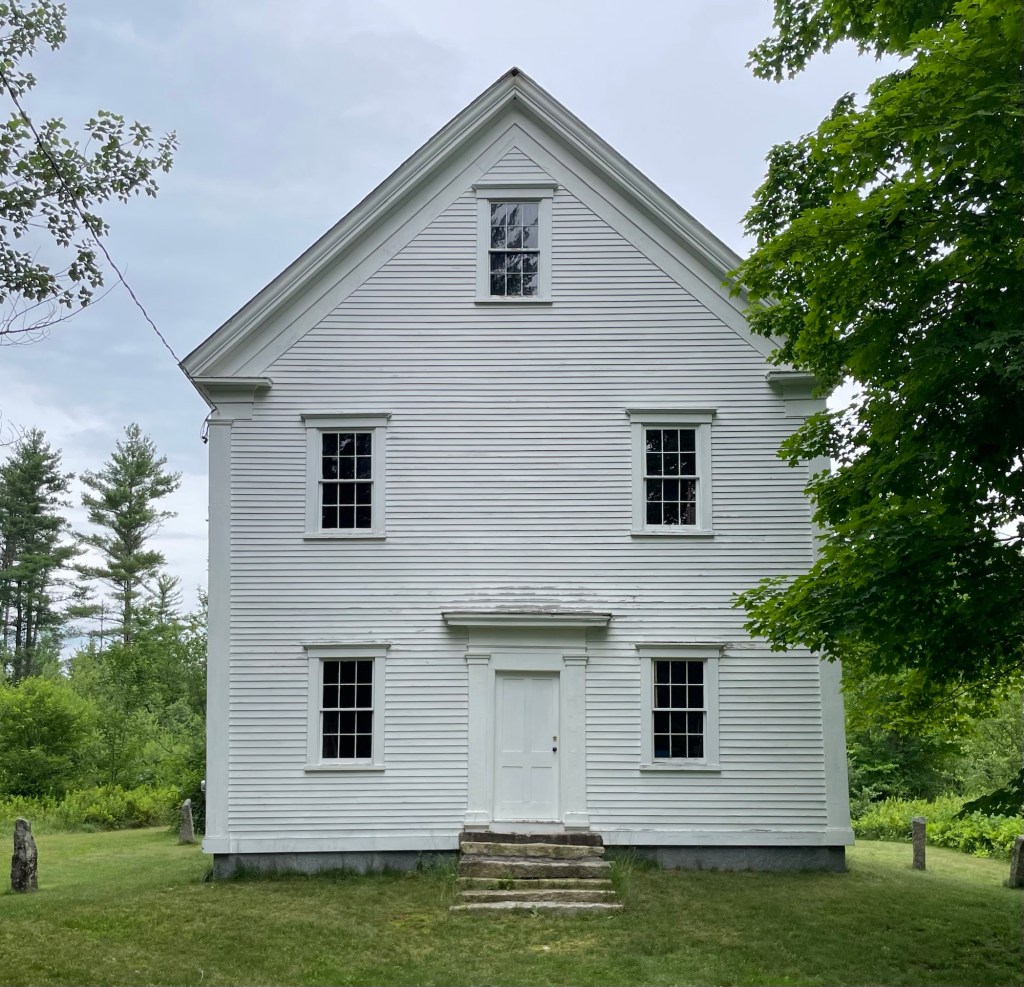
Before most small New England towns had single school buildings for elementary, middle and high school, small one-room schoolhouses like this dotted the landscape, especially in rural towns. Having smaller schools spread out allowed for a greater number of students to attend school without traveling by horseback long distances, and more local school buildings was a great solution. This c.1857 school building was in use until 1949, and it didn’t even have heat, running water, or electricity until the 1930s, making smart design a necessity to get the most out of the building. Large windows would provide natural light to flood the classroom and the steep gable roof would ensure snow to slide off the roof. Sadly, many towns have lost these buildings, but some have been restored or even repurposed as homes!

Tewksbury Center School // 1934-2021

Built in 1934 as the fourth high school for the town of Tewksbury, this Neo-Classical school building has seen better days. The Center School was designed by Miller and Beal architects of Portland, Maine, and likely funded with assistance of New Deal program funding during the Great Depression. The next year, Tewksbury Stadium was dedicated in 1938, which was a Works Progress Administration (WPA) project. The Tewksbury Center School retains many of the details that characterize its Neo-Classical Style including: the front gable entry portico supported by two-story Corinthian columns and pilasters, the wide frieze band with the band of dentil molding, the decoratively clad end bays framed by Corinthian pilasters, the broken pediment of the door surround, and keystones in the brick lintels. The town needed to expand at the end of the 20th century, and hired Architectural Resources Cambridge to design the John F. Ryan Elementary School, located behind this building. The Ryan Elemetary School is a pleasing design which is Post-Modern in style. The Center School has been used as offices for the School Department and was recently proposed to be demolished for surface parking, and a new school constructed elsewhere on the site. This seems very wasteful, and epitomizes the lack of regard for environmental or historical conservation in many cities and towns.

Oak Hill Middle School // 1936

In the 1930s, America was in the throes of the Great Depression, and towns and cities struggled to provide services for the ever-growing populations, all the while suffering from lower tax revenues. The New Deal was enacted as a result, which provided a series of programs, public work projects, financial reforms, and regulations enacted by President Franklin D. Roosevelt between 1933 and 1939. One of these programs was the Public Works Administration (PWA), which funded and built large-scale public works projects such as dams, bridges, hospitals, and schools, to provide jobs and bolster local economies. In Newton, the developing Oak Hill Village required a new public school, and the town received funding for the Oak Hill Middle School in 1935. Architects Densmore, LeClear, and Robbins were hired to provide designs for a new school, and builders completed the building the next year. The Georgian Revival building is constructed with red brick with cast stone trim. The 16-over-16 windows and cupola also work to showcase the beauty of the design.

Do you know of any PWA projects near you?