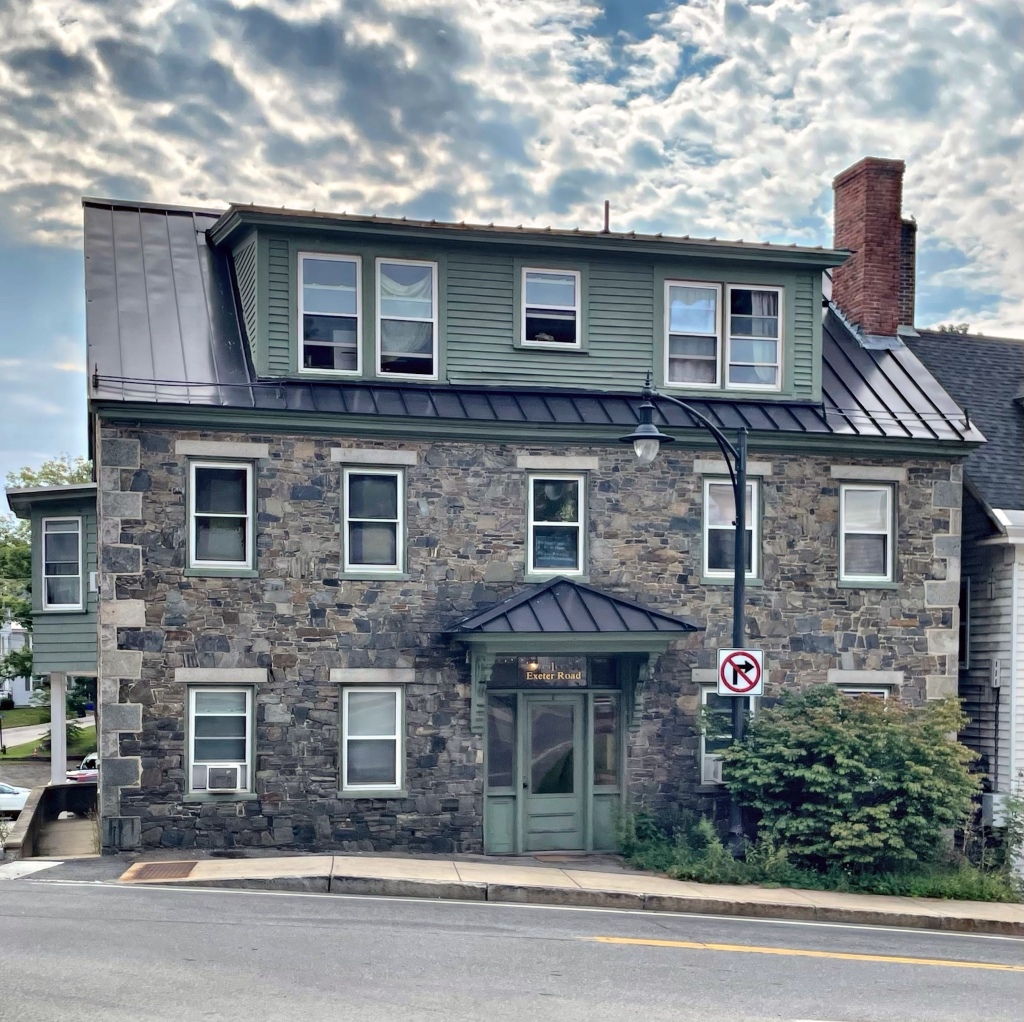
Porphyry Hall // 1880

The Jacob E. Spring Mansion, also known as Porphyry Hall, is a high-style estate house located in Danvers, Massachusetts, that is one of the finest and most unique in the state! The house was built in 1880 for Jacob Evans Spring (1825-1905), who was born in Brownfield, Maine, and at the age of twenty, he went to Argentina and amassed a fortune in the wool business in Buenos Aires between 1845 and 1865, when he returned to the United States. Jacob and his wife, Sara Duffy, would purchase a large farm in Danvers and began planning for their family country home. Their residence was built on a high hill over two years and constructed of over 40 types of stones of irregular size and color with door and window sills of Nova Scotia freestone with arches of the doors and windows and corners of brick. The mansion was designed by architect George M. Harding of Boston, and built by several skilled masons over many months. Mr. Spring named his estate, “Porphyry Hall” with Porphyry meaning an igneous rock with large crystals in a fine-grained matrix; suitable for the walls of their mansion. The Spring’s lived lavishly at this home and spent nearly all of their fortune, selling the property after just ten years to the Xaverian Brothers, who opened it as Saint John’s Normal College. In 1907, the compound was re-organized as a Catholic boys prep school. In 1915, a chapel was added to the rear of the building, constructed from gray fieldstone to blend with the main house. Have you ever seen a building like this?

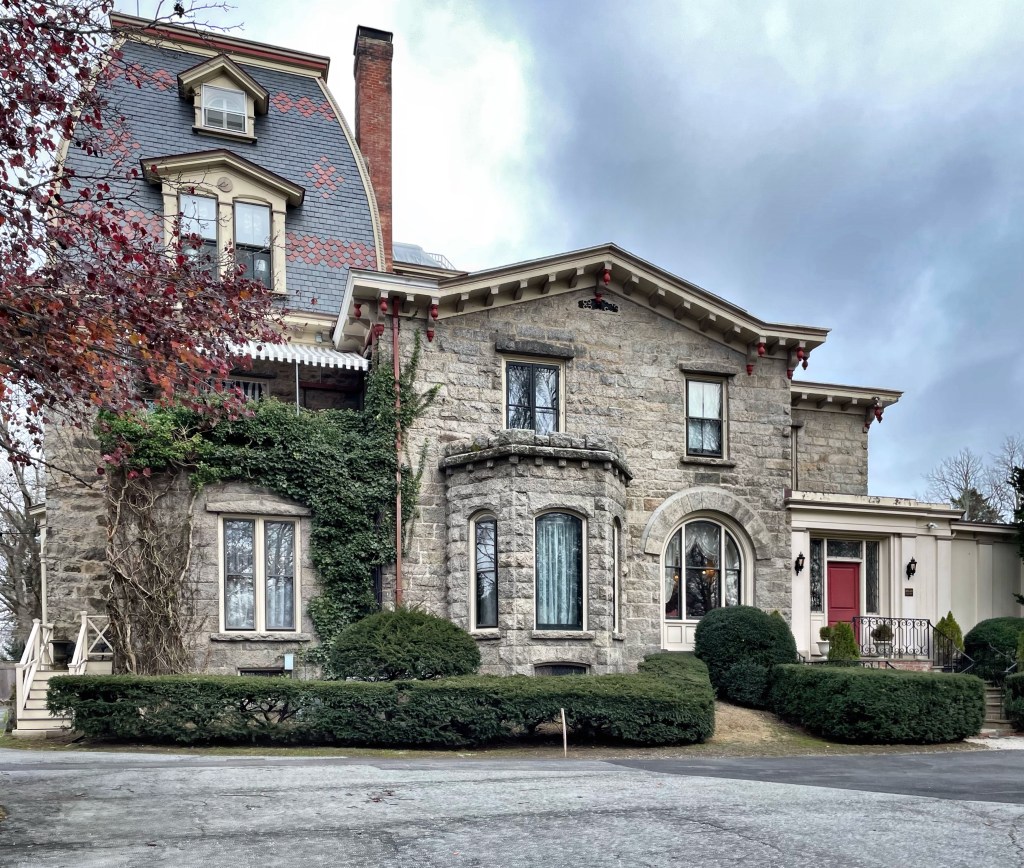
Bethshan Cottage // 1884

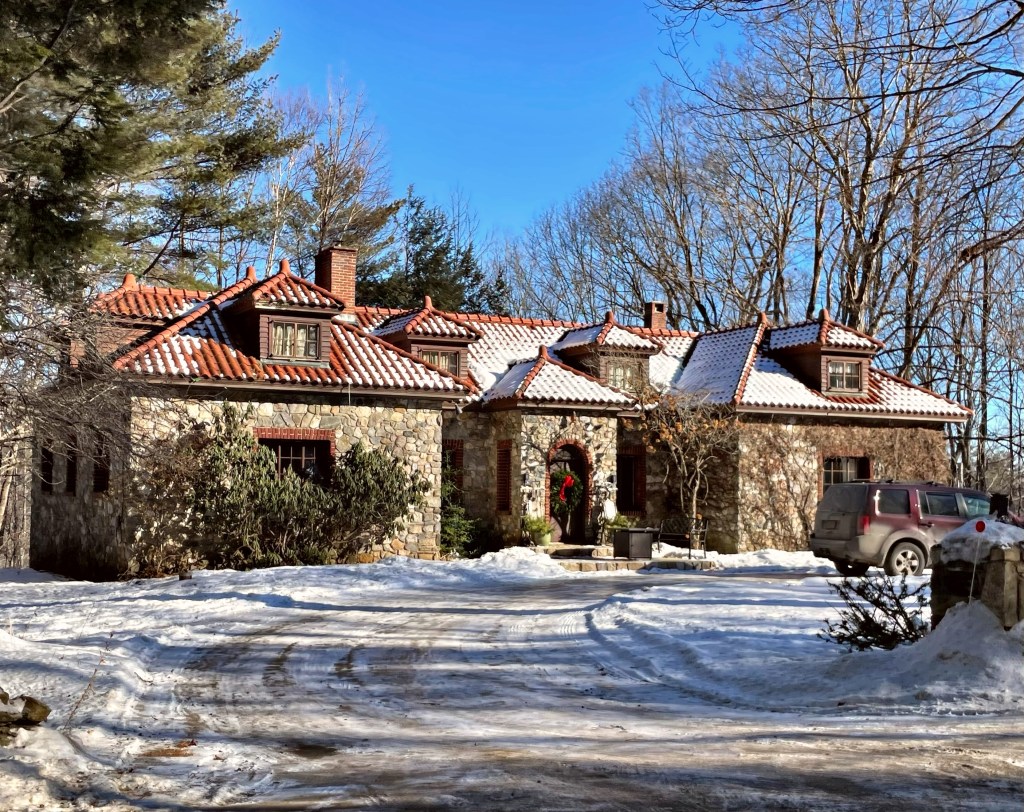
Bethshan Cottage is one of Newport’s (many) “hidden” gems that gets far too little attention from publications! Located on Gibbs Avenue, down the block from Eveherdee and William Barton Rogers‘ summer cottage, “Morningside”, Bethshan was built in 1884 on land purchased by Major Theodore Kane Gibbs. Theodore was the son of William C. Gibbs, the 10th Governor of Rhode Island, and served in the Union Army during the American Civil War, mustering out as a Major in 1870. Newport-based architect Dudley Newton designed this cottage for Gibbs, which blends nearly every major architectural style of the late 19th century under one, beautiful gambrel roof. The red granite stone walls, red brick trim, red fish-scale slate roof, even the rust-colored mortar, all work together to create a lovely composition, unlike anything else seen in Newport. According to Newport’s Assessor, the house is presently an apartment house.

Cornelius Person House // c.1770

The Cornelius Person House is a pre-Revolution stone dwelling built in the Katsbaan village of Saugerties, New York. The residence was constructed around 1770 by Cornelius Person (1744-1827) a merchant who held a store just south of this home. The store was apparently used as a meeting place for Patriots during the Revolutionary War and Cornelius fought in the local militia at the time. After the war, John Jacob Astor was said to have traded with local fur trappers at the store. The Person Stone House was originally a smaller dwelling and was expanded multiple times to give it the center hall appearance and later saltbox rear. Later alterations include the porches, but the house retains so much of its original charm.

Sewall-Scripture House // 1832

Levi Sewall (1805-1880), a native of Maine, built this stunning granite Federal style house in Rockport, Massachusetts in 1832 in preparation for his marriage to Mary Ann Robards. The granite blocks used to build the house were hauled by oxen from Sewall’s own quarry in Pigeon Cove, which is said to have produced stone of excellent quality. Sewall was one of the towns earliest entrepreneurs in the granite business and did quite well, supplying the building material to many of the region’s buildings in the mid 19th century. The property was inherited by Levi and Mary’s son-in-law, Frank Scripture, who took over the family business. Levi Sewall’s descendants occupied the Sewall-Scripture House until 1957, and ever since, it has been home to the Sandy Bay Historical Society and Museum.

Winthrop-Eckley Double House // c.1855

Newport has no shortage of amazing architecture. From the grand Gilded Age mansions along the coast to the pre-Revolutionary Colonial houses, there are always new buildings to stumble upon and learn about. This charming stone double-house on Corne Street was built in the mid-19th century and had two owners by the 1870s, John Winthrop (1809-1886) and Julia Ann Eckley (1800-1874), a widow, who owned the smaller side. The stone cottage sits atop a raised basement with bold stone quoins at the corners. Dormers with delicate wood trim are at the roofline with the detail reflected in the porch on the Winthrop half. This double-house is one of the many “hidden” treasures in Newport’s warren of narrow streets.

Hutchings-Pfaff Gatehouse // c.1884

Once located at the entrance to the Hutchings-Pfaff Mansion, this small stone gatehouse is all that remains of a great Roxbury estate. Built of locally quarried Roxbury Puddingstone decades after the main house was completed, the Victorian Gothic style cottage surprisingly survived the subdividing of the large property and was sold as a private home in the early 20th century. It is uncommon to see these types of outbuildings survive into the 21st century, so I hope to see this charming cottage survive another 150 years!

Abbotsford Mansion // 1872

The Abbotsford Mansion in the Roxbury neighborhood of Boston was designed in the High Victorian Gothic style and was built of Roxbury puddingstone, which was quarried locally. Abbotsford, originally named “Oakbend”, was built in 1872 as the residence of Aaron Davis Williams, Jr., (1821-1899) an industrialist and son of the founder of the Roxbury Institution for Savings. Roxbury-based architect Alden Frink designed the country estate and it is his most notable work. When Davis lost his fortune, James M. Smith, a brewer who had a passion for Sir Walter Scott, acquired the estate and renamed the house Abbotsford after Sir Walter Scott’s ancestral keep of the same name. The house continued to serve as a private residence until 1924, when the City of Boston acquired it for use as an elementary school and a disciplinary school for boys. The parcel was subdivided and the David A. Ellis School was built on the former grounds. After the building slipped into decline in the 1970s, the National Center for Afro-American Artists purchased the property, filling in the windows to create exhibit space. They have maintained the building to this day.

John Bottume House // c.1858

The John Bottume House in Stoneham, Massachusetts was built c.1858, this stone house was one of several built along the shore of Spot Pond by a Boston businessman as a retreat, and is the only one to survive. The coursed granite residence is an excellent and high-style example of the Italianate architecture style. It is owned today by the Massachusetts Department of Conservation and Recreation, and houses the visitors center for the Middlesex Fells Reservation.

Belair Mansion // 1850

One of the most stunning summer “cottages” in Newport, Rhode Island is this stone behemoth named “Belair”. The house is set back way off the street and was one of the first summer estates built in this section of Newport. Belair was built in 1850 for New York oil baron H. Allen Wright in the Italianate style and constructed of roughly dressed stone and was originally about half of the size of the current footprint. The mansion was designed by architect Seth C. Bradford, who is also credited as architect of the similarly designed Chateau-sur-Mer, built one year later. Wright sold this house to George H. Norman two years after its completion. Norman (1827-1900), founded the Newport Daily News in 1848 and made his fortune as an engineer, first establishing gas works and later water works systems across New England, New York, and the Midwest. Norman made a fortune, and renovated and expanded his mansion in 1870 from plans by Newport architect Dudley Newton, with grand Second Empire additions, including the high convex-mansard corner tower. The original four acre Belair property has been extensively subdivided, and this house now occupies a lot of about an acre; with the original outbuildings sold off, and Belair is now 11 condominium units!
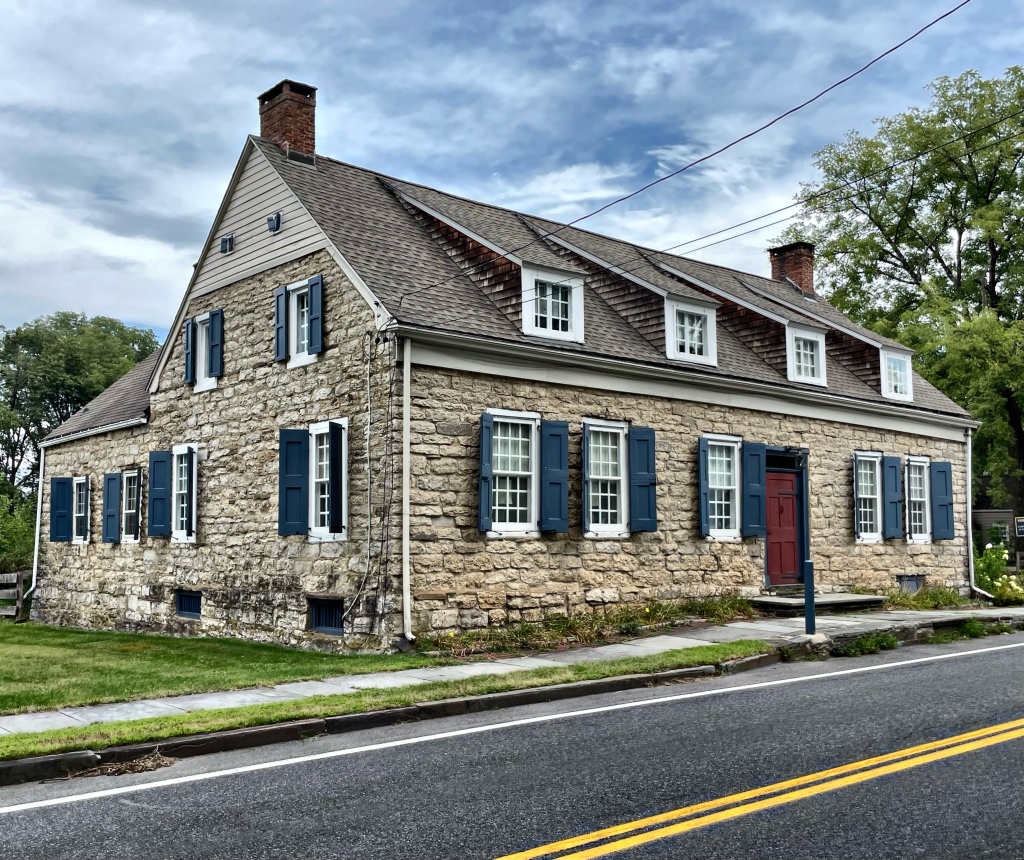
Roosa-Van Deusen House // 1744

For my last building feature in New York in this series, I feature the Roosa-Van Deusen House on Hurley’s Main Street village of old stone homes. This house dates to 1744 and was built upon land owned by Jan Alderts Roosa, who emigrated to New Netherland (New York) with his family on the Spotted Cow in 1660, when he was 14 years old. The house was likely built by Jan Van Deusen (Jan Roosa’s grandson), a blacksmith who worked in town. The Van Deusen House famously became the capital building of New York when in 1777, the newly formed New York state government moved here for two months while Kingston was being rebuilt after the British Army had burned it in retaliation for the creation of the state. It is thus the second of the state’s three capital cities, the present, Albany, being the third.