Governor Draper Mansion // 1905

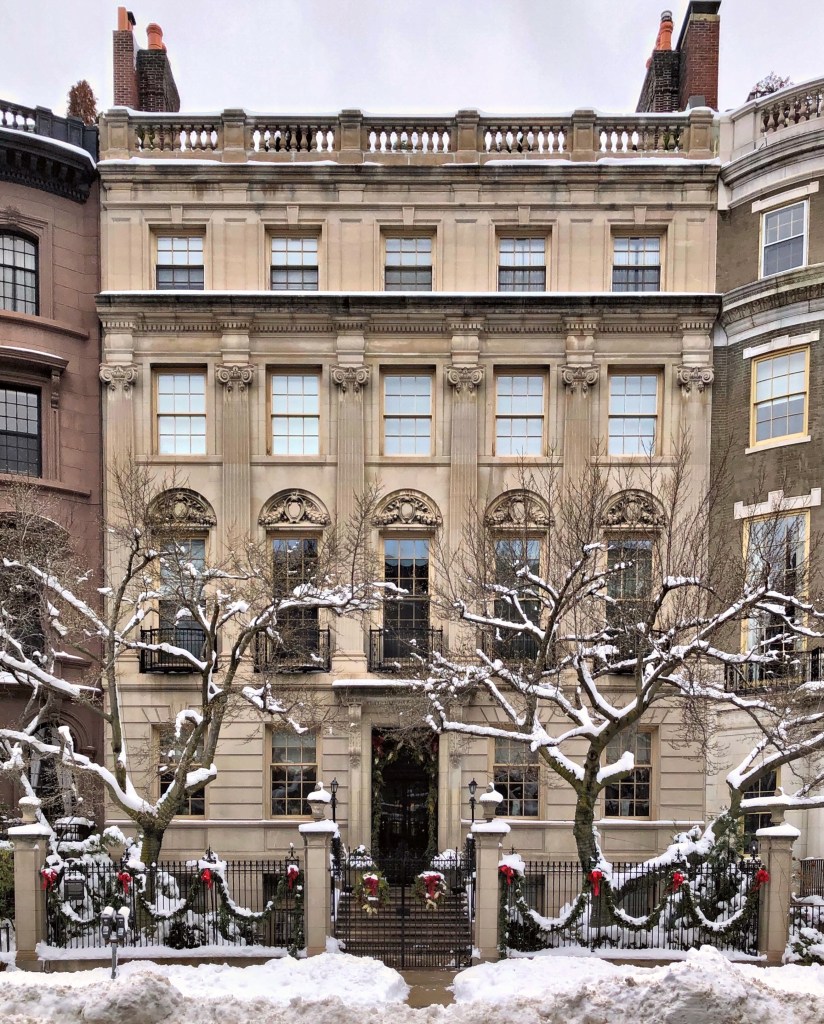
Adjacent to the Warren House (last post) on Beacon Street in Boston’s Back Bay neighborhood, this massive mansion is one of my favorites on the street. Built in 1905, and designed by architect Alexander Wadsworth Longfellow, Jr. an amazing local architect, and nephew of poet Henry Wadsworth Longfellow. The grand mansion was the home of Eben Sumner Draper and his wife, Nancy. Eben Draper was a manufacturer of cotton machinery in the Draper Corporation, founded by his father in Hopedale, MA. Draper graduated from MIT and entered his fathers business, which upon the time of his graduation, was the largest plant for manufacturing cotton machinery in the world. In 1905, Draper was nominated and elected as Lieutenant Governor of Massachusetts, the same year he had this mansion constructed. In 1908, Draper was elected Governor, and served two terms under the Republican Party, pushing a pro-business, and anti-reform agenda, a bill legalizing the merger of the Boston and Maine Railroad with the New York, New Haven and Hartford Railroad, signaling approval of what was seen as monopolistic business practices, something the Draper Corporation was known for in Hopedale. The former single-family home was converted to six condominium units in 2000. Fun fact: the Draper Mansion replaced the 1860 home David Stewart, a merchant from New York, built as a wedding present for his daughter, Isabella Stewart, and John (Jack) Lowell Gardner. Isabella would later create the beloved and iconic Isabella Stewart Gardner Museum. The couple purchased the adjacent townhome in 1880 to store their growing art collection.

Warren House // 1913

This stunning townhouse on Beacon Street in the Back Bay neighborhood of Boston was constructed in 1913 for George Eddy Warren and his wife Frances Knowles Warren. The home, designed by Parker, Thomas & Rice, is one of the more elegant Classical Revival townhomes in the city, with its symmetrical, prominent bowfront, piano nobile with full-height windows, classical lintels, and thoughtful use of brick and stone construction. George E. Warren was a coal dealer, who was selected to head the U.S. Army’s Raw Materials Division during WWI for his expertise. During the war he was in charge of the fuel and forage division, overseeing an important aspect of 20th century warfare, petroleum manufacturing and distribution. His wife Frances was the daughter of Francis B. Knowles, a co-founder of Rollins College in Florida, the oldest institution of higher learning in the state of Florida. Frances volunteered her time in Boston as President of the YWCA, progressing women’s empowerment and social justice in the city. After successive ownership, the townhome was acquired by Emerson College and combined with its neighbor on the interior. In 2000, the home was reverted back to a residence and houses two condominium units.

Flour and Grain Exchange Building // 1892

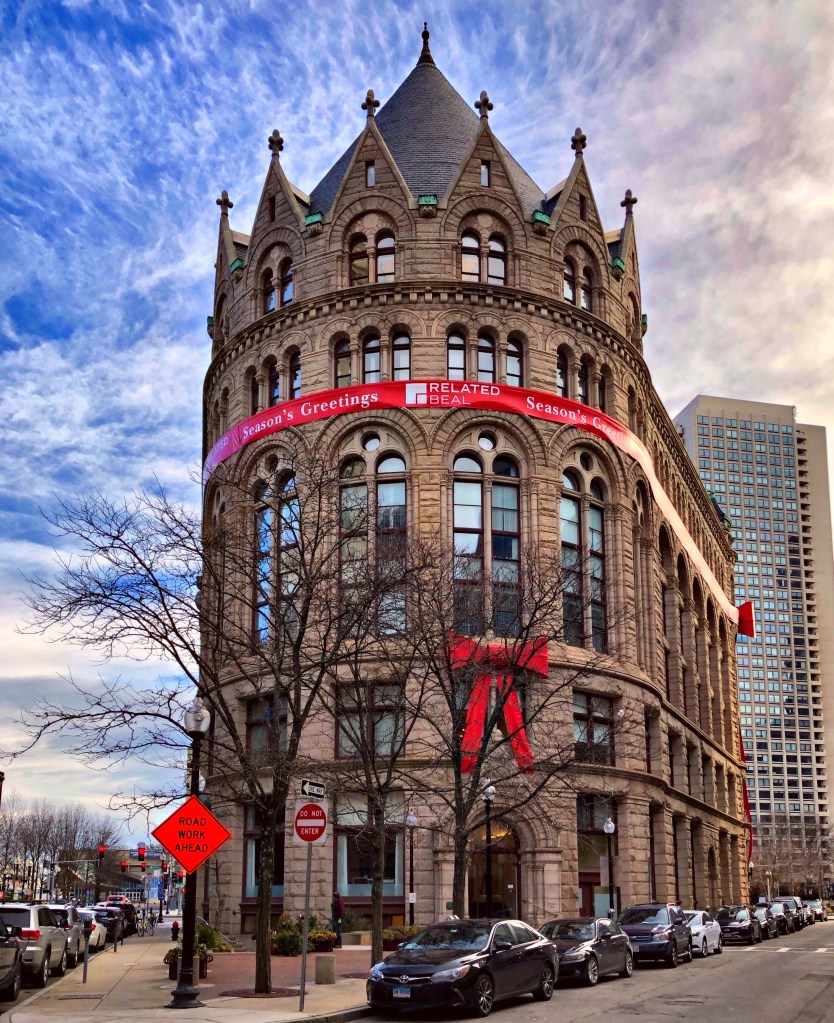
One of my favorite buildings in Boston (and always dressed up with a big red ribbon for the holidays) is the Flour and Grain Exchange Building in Downtown Boston. The third Boston Chamber of Commerce was incorporated in 1884 to promote just and equitable principles of trade, solve disputes between members and acquire and disseminate information related to mercantile interests. There was, however, a feeling among the members that the organization could not attain its full stature until it had a building of its own, one that would be both an ornament to the city and a credit to itself. In 1889, a triangular site was donated to the organization by members, who then hired prominent Boston architectural firm, Shepley, Rutan and Coolidge, the successor to Henry Hobson Richardson‘s practice. It appears the firm was inspired by H.H. Richardson’s F. L. Ames Wholesale Store which was built nearby just years before. The steel-frame building is constructed of rough hewn Milford granite pierced with engaged columns and arched openings, both common in Richardsonian Romanesque buildings. The prominent corner at Milk and India Streets features a rounded corner tower with conical roof, surrounded by a crown of dormers. The building was restored by owners Beal Properties in the late 1980s who own it to this day.

Hollis Hunnewell House // 1870

In 1870, when Boston’s new Back Bay neighborhood was being developed, Hollis Hunnewell and his wife Louisa, decided to erect a mansion to establish themselves in the burgeoning neighborhood. Hollis was the first son of Horatio Hollis Hunnewell, the businessman and railroad tycoon who made a fortune, eventually developing a family compound in nearby Wellesley. The couple hired esteemed architect Charles Brigham to design a home on the prominent corner lot that would live up to the Hunnewell name, and he did not disappoint. Just three years after the home was completed, they added a one-story addition, adjacent to the alley to quell a wind-tunnel effect that was occurring down the alley. In December, 1876, a fire broke out in the home, trapping maid Annie O’Hara at the top floor where she died. After the fire, the Hunnewell’s decided to renovate the home, adding the prominent corner tower with cresting. Hollis died in 1884, leaving his wife and two children alone in the home (along with the housekeepers, maids, and other help) until her death in 1890. The home is an excellent example of late Second Empire architecture in Boston, and it showcases the immense wealth some distinguished families had in the region in the 19th century. Today, the 13,000 square foot home is occupied as a single family home, assessed at over $17.5 million!

Commonwealth Trust Company // 1908-c.1974

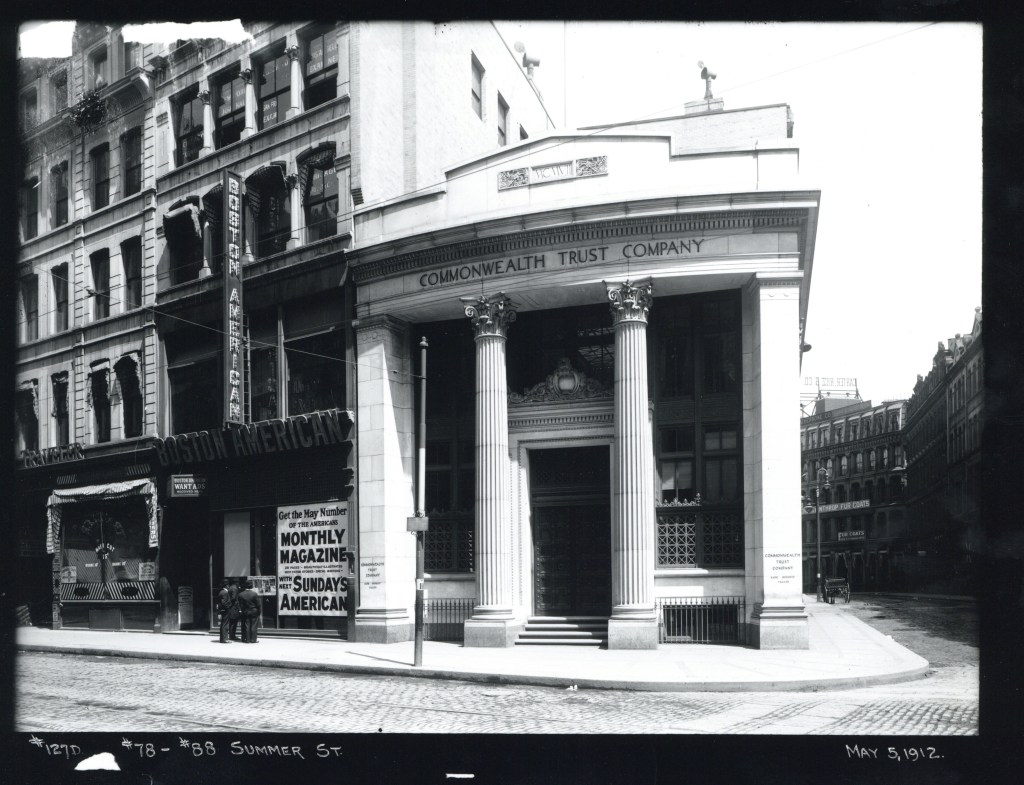
Ca. 1910 image courtesy of Boston Public Archives.

Located at the corner of Summer and Devonshire Streets in Downtown Boston, the Commonwealth Trust Company’s two-story marble banking house commanded the corner, despite its short stature. The building, completed in 1908, was constructed with Lee marble and decorated with ornate wrought and cast-iron grilles over windows. The building was designed by the architectural firm of Parker, Thomas & Rice in the Classical mode with large, fluted Corinthian columns and boxed corner pilasters framing the recessed center entrance, Corinthian pilasters ran along the side facade. At the inside, the building was coated with Cararra and Blanco marble with paneled oak offices. At the ground floor, offices and banking stations framed the outer walls, with the safety deposit boxes located on the second floor. The building was demolished by the 1970s and replaced with a one-story minimalist Modern building (I could not figure out why the former building was razed). The new building was demolished after a few decades with a larger building, better fitting the commercial district.

125 Summer Street // 1989

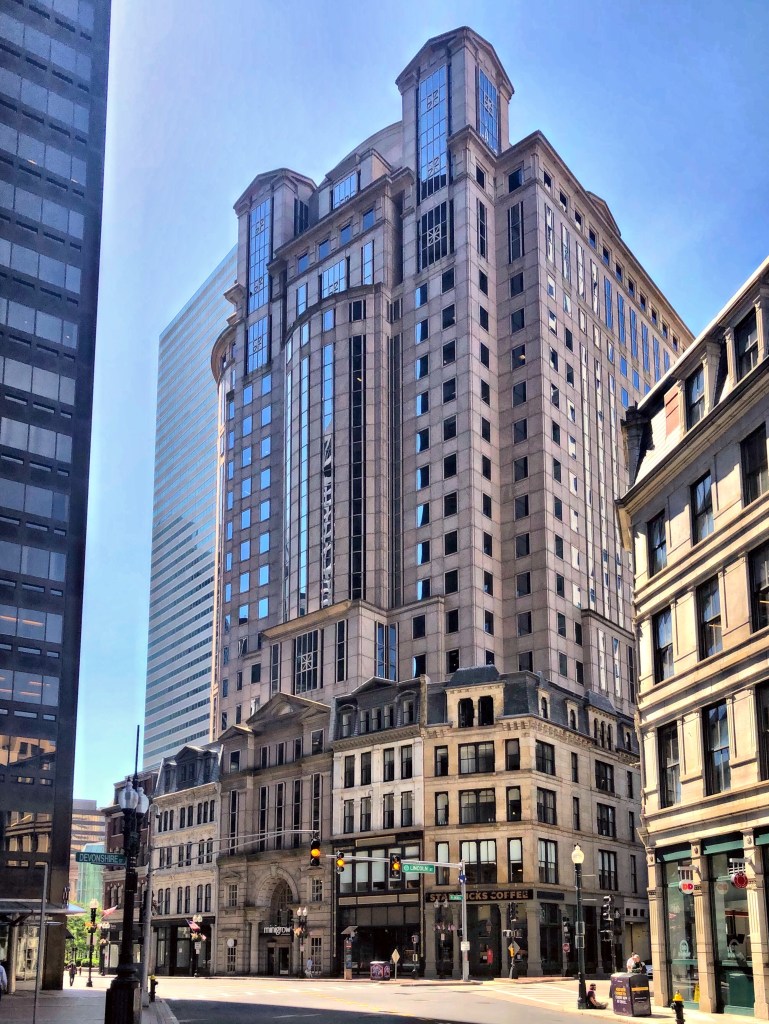
The late 1980s were a time of financial success for developers and banking companies all over the country. It seems that more skyscrapers were constructed in Boston this decade than any other of the 20th century, but working within the confines of the historic downtown of the city, left architects and developers to come up with creative ways to build here. The architectural firm of Kohn Pederson Fox was hired to construct a 20+ story office tower at the southern edge of the Financial District in Boston, while preserving the small-scale commercial buildings there. A row of four-story commercial blocks constructed after the Great Boston Fire of 1872 were retained with the tower seemingly growing out of them. The process here is known as “facadism” which is a valuable preservation tool to balance preservation with density in historic downtowns, though not always done right. This KPF design with its Post-Modern tower in concrete and granite fits well within the streetscape and maintains a walkable block downtown.

What do you think of this design?

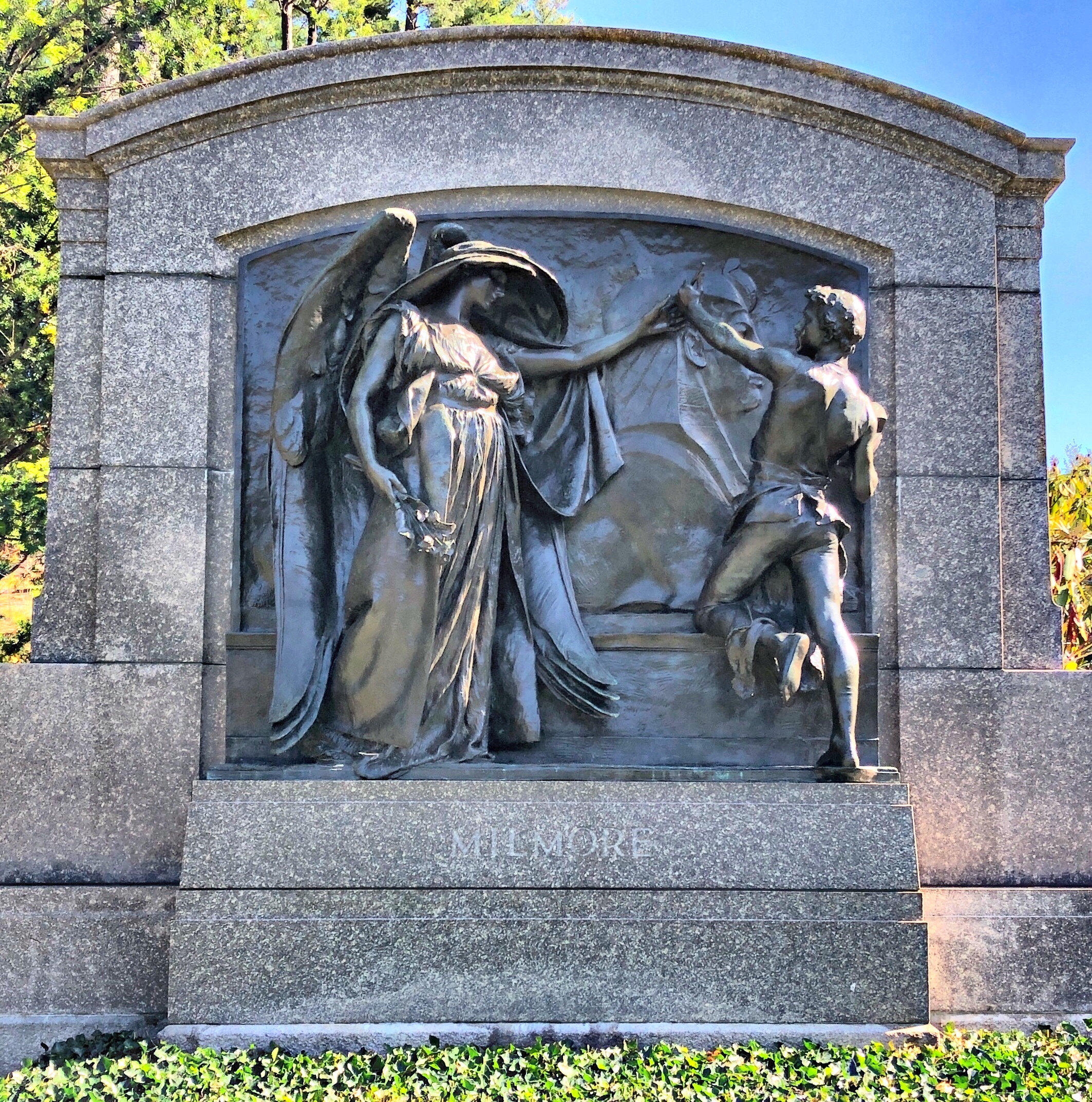
The Angel of Death and the Young Sculptor // 1893

While not a building, I must feature one of the most stunning pieces of art I have seen, at a cemetery! Titled “The Angel of Death and the Young Sculptor“, this massive monument was is a sculpture in bronze, and one of the most important and influential works of art created by sculptor Daniel Chester French and is located at Forest Hills Cemetery in Boston. Also known as the Milmore Monument, it was commissioned after the death of brothers, Joseph, James, and Martin Milmore (1844–1883). The Milmore brothers immigrated to the United States from Ireland in 1851, Joseph becoming a stone carver and Martin a sculptor. The will of Martin Milmore’s older brother, Joseph, called for creation of the monument, which was to commemorate the life of his older brother, Martin. As Martin Milmore had been a sculptor himself, French decided to depict the artist at work, with the Angel of Death interrupting his work, with death grabbing the chisel from Martin’s hand as he works. Martin Milmore was 39 years old when he died.

Forest Hills Administration Building & Chapel // 1884

Located adjacent to the Entrance Gate at Forest Hills Cemetery in Boston, the Administration Building and Chapel perfectly compliments the Gothic Revival collection of structures welcoming all visitors to the cemetery. Designed by the firm of Van Brunt & Howe, the building was completed in 1884, when the cemetery’s popularity with visitors (alive and deceased) was at a high. The building is in the Gothic Revival style and is constructed of
Roxbury puddingstone, with sandstone trim on the original parts of the building and yellow freestone trim on the 1921 addition. The building remains as a perfect partner to the entrance gate, serving as a physical portal between metaphorical life and death.

Forest Hills Cemetery Bell Tower // 1876

The bell tower at Forest Hills Cemetery is an octagonal Gothic revival structure located on Snowflake Hill just past the entrance gate and administration building and was completed in 1876. The 100-foot tower is constructed of Roxbury puddingstone and trimmed with granite. The roof is clad with granite tiles and topped with an ornate copper weathervane. Originally its swinging bell tolled, but it has since been replaced with an electronic carillon. The bell tower rises dramatically from massive
outcrop of Roxbury puddingstone known as Snowflake Hill which is offset by smooth lawns and Victorian planting beds. While the large trees surrounding partly obscure the tower, it truly is a stunning building.

Forest Hills Cemetery, Entrance Gate // 1865

Forest Hills Cemetery was founded in 1848 by Henry A. S. Dearborn, then mayor of Roxbury. He designed this magnificent cemetery to offer the citizens of his community a place to bury and remember friends and family in a tranquil and lovely setting. Forest Hills embodies the ideals of the rural cemetery movement, which begun at nearby Mount Auburn Cemetery, in Cambridge in 1831, which was co-founded by Dearborn. Many rural cemeteries have elaborate entrance gates, possibly serving as a dramatic transition from the secular world to the spiritual realm of the cemetery, and perhaps as a metaphor for the journey from life to death. This entrance gate was built in 1865, replacing an earlier Egyptian Revival gate constructed in 1848. Designed by Charles Panter, the gate is constructed of local Roxbury puddingstone, with three arched openings with ornate iron gates surmounted by decorative scrolled ironwork. The central gateway is
framed by two conical spires and a central stone pediment, all topped with stone crosses.