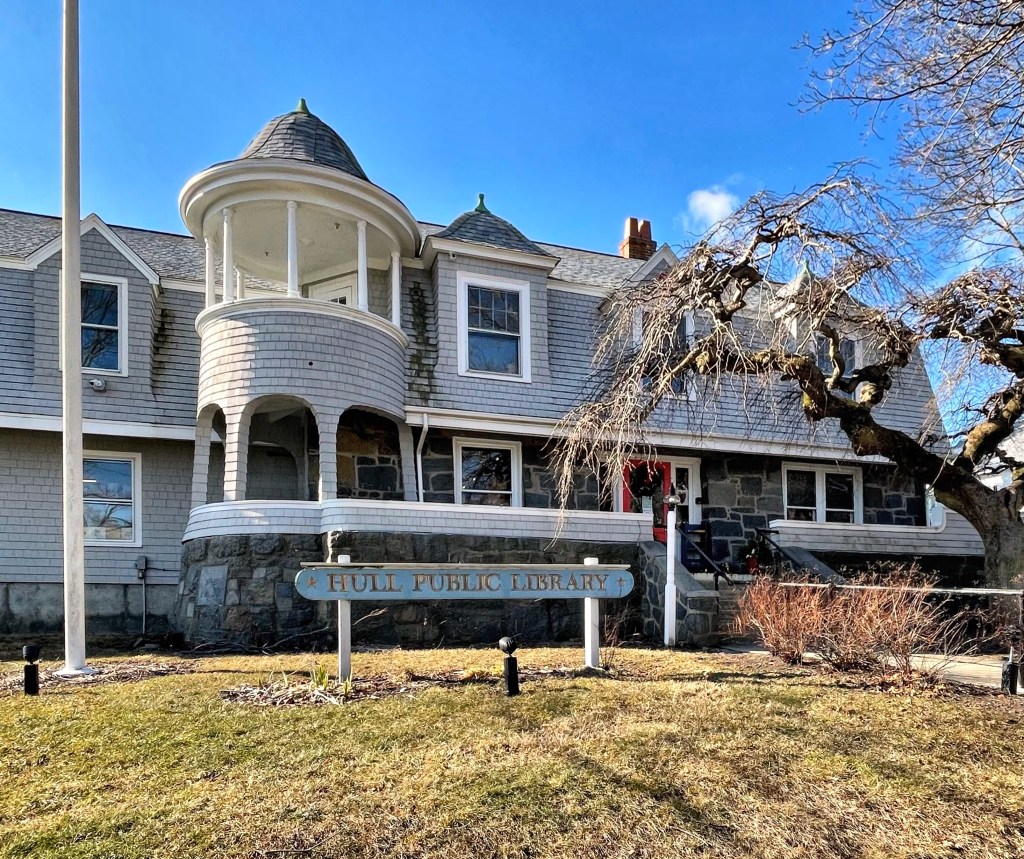
Hull Public Library // 1879

“We must not be Irish or African, or black or white. Not in America. We are gathering here … not to build up any petty community but to make the greatest nation and the strongest brotherhood that God ever smiled upon.”-John Boyle O’Reilly. This home (now the Hull Public Library) replaced the old Hunt House, which was the first parsonage of Hull, which was built around 1750. John Boyle O’Reilly, an Irish-American poet, journalist, author and activist bought the Hunt House in the 1870s and soon after demolished it as he felt it could not be salvaged. There are books about O’Reilly’s life story, so I recommend checking out his Wikipedia page. He constructed this house as a summer home by 1879, an excellent example of an early Shingle-style home. I cannot locate the architect, but am dying to learn! In the summer of 1890, O’Reilly took an early boat to his residence in Hull, Massachusetts from Boston. He had been suffering from bouts of insomnia during this time. That evening he took a long walk with his brother-in-law hoping that physical fatigue would induce the needed sleep.Later on that night he took some of his wife’s sleeping medicine and he apparently suffered an overdose of the medicine at this home, passing away at 46. Thousands of Bostonians mourned O’Reilly, and memorials were erected in the city, including the iconic 1896 John Boyle O’Reilly Memorial by Daniel Chester French.

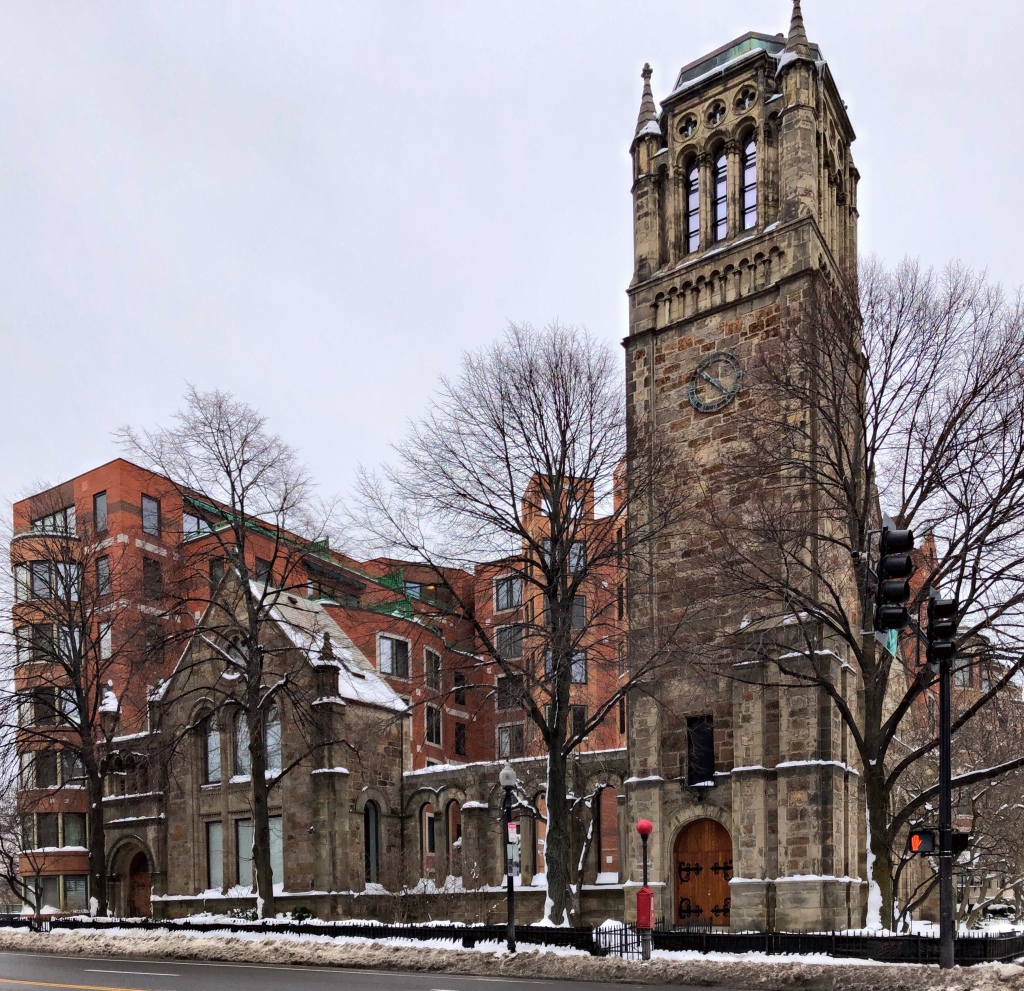
Mount Vernon Congregational Church // 1892 & 1984

The Mount Vernon Congregation Church was founded in 1842 and originally was located in Ashburton Place on Beacon Hill (which I featured previously). As its members moved to the Back Bay, the congregation decided to build a new church in the western portion of the neighborhood. They hired architect C. Howard Walker to design the new church building, with stained glass windows by John LaFarge and Louis Comfort Tiffany added as memorials to several members of the congregation over subsequent years. As originally designed, the church had a 45-foot high steeple on top of its 85-foot square tower, but over the years it became structurally unsound, and it was removed just before the Hurricane of 1938, which toppled many steeples all over the region. In 1970, the church merged with the Old South Church in the Back Bay. In 1977, developers proposed to remodel the church building into retail and office space. The proposal was approved by the Boston Redevelopment Authority in January of 1978. Before work could commence, a fire destroyed much of the church building leaving a shell of Roxbury Puddingstone walls and the tower, the developer pulled its funding and the building’s future was uncertain. One year later, architect Graham Gund purchased the building. Gund was familiar with adaptive reuse projects, like his restoration of the Middlesex County Courthouse in Cambridge for his own office in Cambridge in the 1970s. Gund redesigned the building into 43 condominium units called Church Court. What are your thoughts on the architecture?

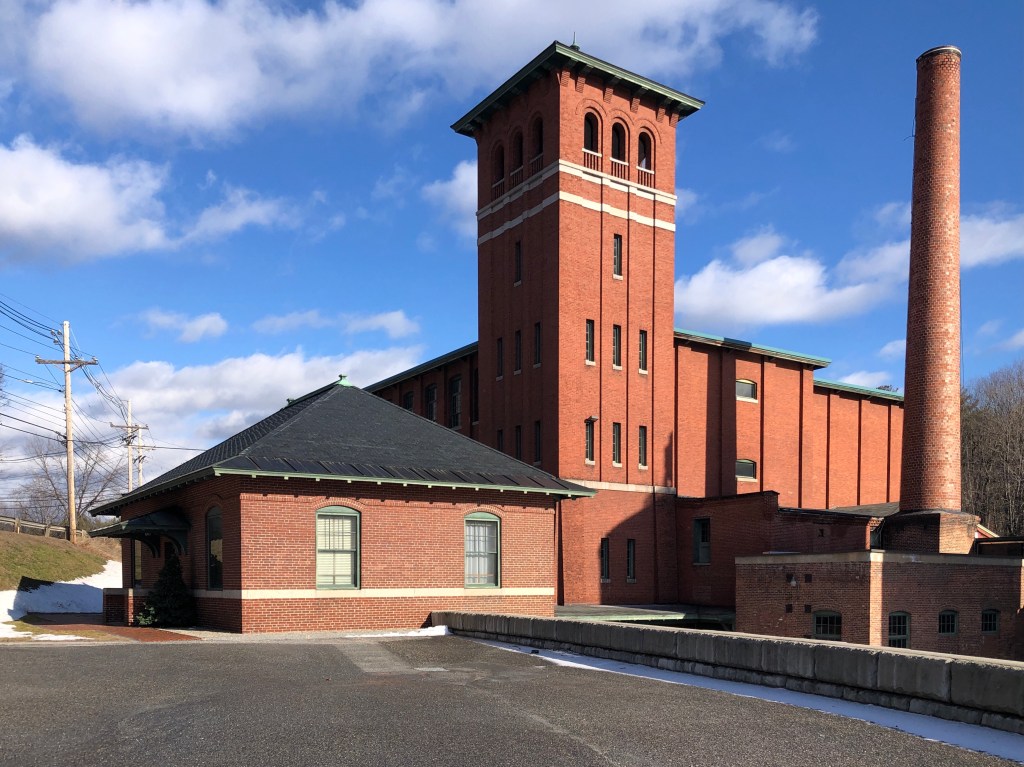
Dexter Richards and Sons Woolen Mill // 1905

The Dexter Richards and Sons Woolen Mill is the last surviving textile mill in Newport, New Hampshire. It was one of the city’s largest and most successful industries and employers. Built in 1905 on the banks of the Sugar River – which supported industrial activity as early as 1768 – the mill reflects the evolution of water-powered mills throughout the city and the region for more than a century. Designed by Peterborough native Edward A. Buss, Richards Woolen Mill is a typical three-story brick mill building from the early 20th century with granite, brick and metal architectural flourishes; it stands out for its five-story Romanesque tower with three tall arched windows on each side. At the base of the tower, above the entrance, are two slate roundels with the dates “1848” and “1905,” marking when both a previous mill on the site and the existing mill were built. In addition to running the mill, the Richards family was instrumental in establishing the Newport Electric Company (1892) and brought both Western Union Telegraph service (1866) and the Concord & Claremont Railroad (1871) to Newport. Richards and Sons, Inc. dissolved in 1926. The property was purchased by Harry W. Brown and Associates and was renamed the Gordon Woolen Mill. That business made wool linings for Army clothing during World War II. The mill was later owned by William Ruger Jr. an heir to the Ruger Firearms Company. Within the last couple years, the mill was purchased for redevelopment into housing, which has not yet materialized.

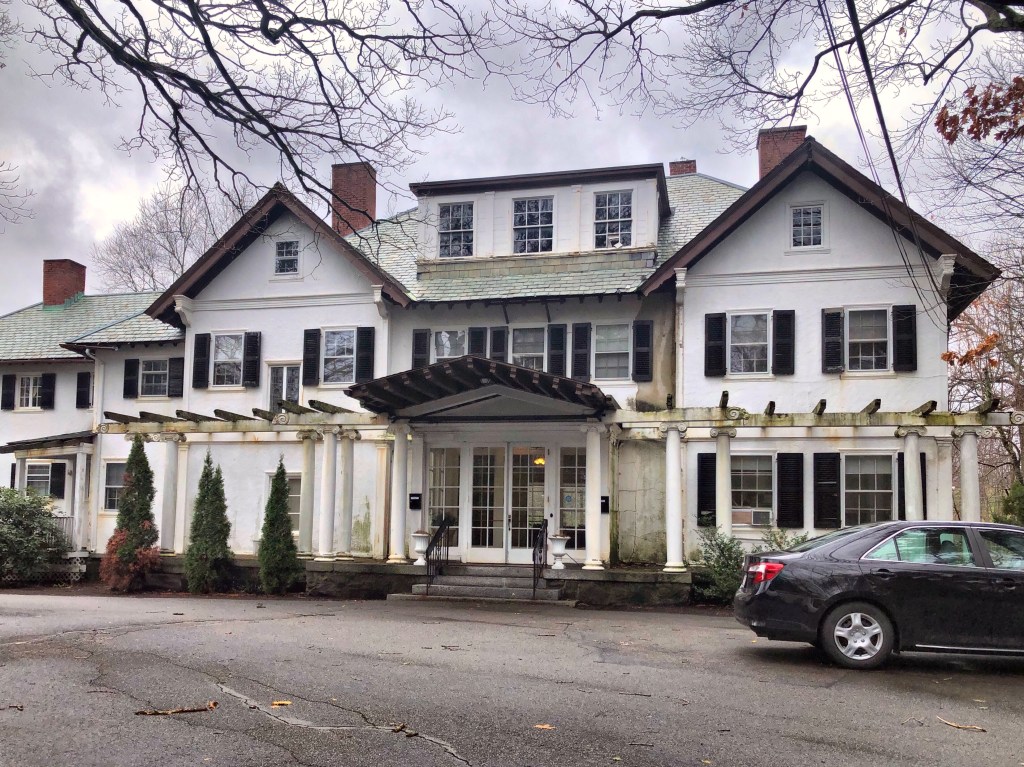
Hartt House // 1899

The area just west of Jamaica Pond between Boston and Brookline can be characterized as a neighborhood of well-preserved 19th and 20th century homes and large, former estates converted to institutional use. The Hartt House in Brookline, off Goddard Ave, was built in 1899 for Arthur Hartt and his wife Augusta Batchelder. Arthur worked as a clerk with the New England Mutual Life Insurance Company in Downtown Boston and built a couple large estates in Massachusetts, including a summer home in Marion. The Colonial Revival home sits on a hill, setback off the street, with a landscape designed by the Olmsted Brothers. The property was bought in the 1970s by the Hellenic Association of Boston, who turned the home into offices and the former barn into a chapel. The home appears to be suffering from some deferred maintenance, but is in overall good shape.

Oliver Ames High School // 1896

I’m starting to see a trend in Easton, almost everything is named after the Ames Family! In 1893, Oliver Ames (1831-1895), a grandson of shovel company founder Oliver Ames and son of Oakes Ames, offered to fund the construction of a new high school building if the town would pay the cost of building its foundation and grading the site. While governor of the Commonwealth of Massachusetts (1887-90), Ames had hired Boston architect Carl Fehmer as consulting architect to the State for the extension to the Massachusetts State House, and it was Fehmer who secured the design contract for the new school in Easton. The refined Colonial Revival school building features a central pavilion with an entrance set within an ornate stone architrave with a Classical entablature with central pediment. The school was outgrown in 1957 and became the town’s middle school, outgrown again in the 1990s. The town sold the school to a developer with preservation restrictions and it is now used as apartments!

Arnold Print Works – Mass MoCA // 1872

On a last-minute trip to the Berkshires, I couldn’t help but stop at the recently re-opened Massachusetts Museum of Contemporary Art (Mass MoCA) in North Adams. Being a huge nerd for industrial history and repurposed mills and factories, it was an absolute treat to walk through the large brick and steel buildings and wings lined with steel casement windows providing the perfect scenery for some amazing artworks. What is now known as Mass MoCA, – one of the premier art museums in New England – was once Arnold Print Works, a one time world leader in textile manufacturing with offices in New York City and Paris.

The Arnold Print Works were built on the Hoosac River near the center of North Adams. The company was the town’s largest industry during the city’s economic heyday from the Civil War until the early 20th century. The company was founded in 1861 by the John, Oliver, and Harvey Arnold, who began production of printed cloth at an existing cotton mill. At the dawn of the American Civil War, the newly formed company became flush with money due to government contracts for manufacturing Union Army uniforms. The company expanded after the war until a fire destroyed nearly all of the wooden buildings on the site. After the fire, a majority share of the company was purchased by Albert Charles Houghton, who became the first mayor of North Adams, and he oversaw the expansion and prosperity of the company, starting with new buildings of fire-proof construction.

By the early 20th century, many textile and cotton manufacturing shifted to the American South severely crippling the mill’s profits. In 1929, Sprague Electric Company moved to North Adams from Quincy, Massachusetts, and began buying the Arnold Print Works buildings. The print works moved much of its operation to nearby Adams and concentrated on a few particular products in its North Adams plant. The print works was finally sold in 1942 for just $1.9 million dollars, a far departure from its once prosperous past. The plant was shortly thereafter acquired by Sprague Electric Company.

While largely leaving the building exteriors as they were, Sprague made extensive modifications to the interiors to convert the former textile mill into an electronics plant. Sprague physicists, chemists, electrical engineers, and skilled technicians were called upon by the U.S. government during World War II to design and manufacture crucial components of some of its most advanced high-tech weapons systems, including the atomic bomb.

[Outfitted with state-of-the-art equipment, Sprague was a major research and development center, conducting studies on the nature of electricity and semi-conducting materials. After the war, Sprague’s products were used in the launch systems for Gemini moon missions, and by 1966 Sprague employed 4,137 workers in a community of 18,000, existing almost as a city within a city. From the post-war years to the mid-1980s Sprague produced electrical components for the booming consumer electronics market, but competition from lower-priced components produced abroad led to declining sales and, in 1985, the company closed its operations on Marshall Street.] (Mass MoCA History)

The complex sat vacant briefly before the Williams College Museum of Art, led by its director, Thomas Krens—who would later become Director of the Solomon R. Guggenheim Museum—advocated for a museum space for contemporary art that would not fit in traditional art galleries. The nearby Arnold Mills seemed like a perfect, yet daunting task to repurpose. Bruner/Cott Architects of Cambridge were hired to repurpose the mills and oversee the massive adaptive reuse project which today totals nearly 300,000 square feet of galleries and art venues.