Faxon Block // 1886

This impressive commercial block is prominently sited at the corner of Beach and South streets in Boston’s Leather District, a wonderful enclave of late 19th and early 20th century mercantile buildings, historically centered around the leather and shoe-making industries. Like many in this block, the building was developed by the Faxon Brothers, some of the major developers of this district and areas of Quincy. Also like many other buildings in the Leather District, the block was designed by 1886 in the Romanesque Revival style, constructed of brick and brownstone with a clipped corner and Syrian arches and an oculus window at the fifth floor. The building was designed by relatively unknown architect, John H. Besarick and today houses professional offices.

Beebe Building // 1886

Located at 127-133 South Street in the under-appreciated Leather District of Boston, the 1886 Beebe Building is an excellent vestige of the leathergoods trade and commercial architecture of the late 19th century. This building was constructed by J. Franklin Faxon (1832-1912), a business owner who engaged in real estate development and built a number of commercial blocks in this part of Boston. Rand & Taylor, architects, designed the building in an effective blending of Classical and Romanesque styles with rock faced brownstone ashlar above the storefronts, oculus windows, and segmental arched openings on the top floor. The Classical detailing of the two-story brick pilasters and modillion cornice add to its complexity. The building was originally occupied by the Thomas E. Proctor Leather Company and was later purchased by leather goods company Lucius Beebe & Sons and the storefront was renovated by Hutchins & French in 1930. The building has since been known as the Beebe Building and has been well-maintained by subsequent owners.  

United States Leather Company Warehouse // 1901

As far back as Colonial days, the boot and shoe industry was one of the State’s leading industries. Buyers came suburban towns to purchase supplies, and in the early 1800s, the larger manufacturers began to open offices and stores in Boston. Soon, most of the leading merchants had established places of business in Boston, by the late 19th century, many were located in the South Cove area, which became known as the Leather District. The Leather District is characterized today by large, brick structures with flat roofs and feature continuous floor levels, band courses, and cornice lines. This handsome brick building on Atlantic Avenue was built in 1901 for Charles G. Rice and the Heirs of Nehemiah W. Rice as a warehouse for the U.S. Leather Company. The building was designed by William Gibbons Rantoul, who studied architecture at Harvard, and apprenticed with Henry Hobson Richardson as a draftsman in the 1880’s before opening his own practice. In 1946, the subject property was purchased by Frank Einis, and the new tenants, Fur Merchants Cold Storage, Inc., used the building for the storage of skins and furs for manufacturing into soft goods. Architecturally, the building showcases the lasting influence of Richardson on architects and industrial buildings in Boston from the late 19th century into the early 20th century. The building can be classified as Romanesque Revival in style with its use of arches in the façade both structural and decorative, the Venetian arches at the 7th floor, as well as its arcaded corbelling over the 3rd level and at the cornice. I especially love the tall, engaged brick columns at the storefront, they are very unique!

Kennard Estate // 1907

A significant house and grounds are tucked away, hidden off Dudley Road in Newton, Massachusetts. This is the Kennard Estate. Frederic Hedge Kennard (1865-1937) was born in Brookline and attended Harvard College. He did graduate work for a time at the Bussey Institution and the Lawrence Scientific School, and entered the employ of Frederick Law Olmsted, the noted landscape architect, with his office in Brookline. By 1906, he decided to open his own landscape architecture office, opening locations in Boston and Philadelphia. He would purchase this expansive wooded property, and had this house built by 1907. He laid out the grounds, creating paths and gardens on the property and planted native trees. It is unclear who designed the house, sadly. Mr. Kennard was also a noted ornithologist (an expert on birds) and would host visiting scholars at his home, walking the grounds and studying birds there. After his death in 1937, the property was inherited by his son, Harrison Eisenbrey Kennard, and ultimately willed to the City of Newton upon his death in 1982. Since then, Newton Parks and Recreation have maintained the house (though they could be doing more to preserve it), and opened the grounds as Kennard Park, a free public park comprised of wooded trails and streams.

Former Schrafft’s Candy Factory – Converse HQ // 1907

Possibly my favorite building in the Bulfinch Triangle/North Station area of Boston is this brick behemoth. Known as the Schrafft’s Candy Factory, Hoffman Building, Lovejoy Wharf, Submarine Signal Building, etc., the building was constructed in 1907 from plans by Codman & Despradelle and first-occupied by the Schrafft’s Candy Company. It held the candy makers until 1928, when Schrafft’s moved to Charlestown, building their massive factory in Sullivan Square. A landmark in the Panel Brick style of architecture, prevalent in industrial and multi-family structures in the late 19th and early 20th centuries, the old factory saw many later uses from cold storage, to a Submarine Signal Co. before it was largely vacant by the end of the 20th century. Through Preservation Tax Credits and grants, developer Related Beal was able to reimagine the building, restoring it to its former glory. The Architectural Team (TAT) oversaw the renovations and expansion of the building with a glass crown with the project accommodating the corporate headquarters for world-renowned sneaker manufacturer, Converse.

Old Boston North Union Station // 1893-1927

Photo courtesy of Library of Congress.

By the 1890s, many of the regional train lines in New England consolidated and as a result, union stations were built. All north-bound train lines including the Boston & Lowell and Boston & Maine railroads would consolidate into North Union Station with southbound trains consolidated into South Station. North Union Station, actually three adjoined buildings, was completed in 1893 and included the former Boston & Lowell Station, a Second Empire masterpiece which dated from 1873. The other sections of Union Station were designed by the firm, Shepley, Rutan & Coolidge, and comprised of an office tower at the rightmost section and a central building serving as the main entrance and concourse with waiting rooms and baggage holding. The central entrance exhibited an elaborate columned block of brick with stone trimmings. The station lasted until 1927 when the entire complex was razed for the new North Station (The Boston Garden), which itself was replaced. The demolition of the Old North Union Station was one of the biggest architectural losses in Boston’s history, a stain on its historical legacy only compounded by the sterile development we see there today.

Old Pierce School // 1855

Located in the heart of Brookline Village, the old Pierce School sits tucked away behind the Brookline Town Hall and other municipal and institutional buildings. The school was built in 1855 at a cost of $15,000 and later expanded in 1904 from plans by Julius Adolphe Schweinfurth, a prominent local architect. Julius had two brothers who also were architects:  A. C. Schweinfurth, who worked out of California and Charles F. Schweinfurth, out of Ohio. The Pierce School was named after Reverend John Pierce, noted pastor of the Walnut Street church during the mid 19th century. He and his wife, Lucy Tappan Pierce, were active leaders in the abolition movement in Brookline. The school was expanded a number of times until the 1970s, when the present Pierce Elementary School was built, in an unsympathetic Modern design that does little to enhance the busy street. As expected, the 1970s school will soon be demolished and replaced by a new, $212 million school. The old Pierce School will be incorporated into the new development.

Second Church of Christ, Scientist, Roxbury // 1915

Breaking ground in 1915, this early Modern church building must have turned heads when it was being built in Roxbury! In October, 1907, a fine lot of land with a house on it, at the corner of Elm Hill Avenue and Howland Street, was purchased for eighteen thousand dollars by a group of Christian Science followers. In October, 1911, a building committee of five was elected by the church, and by the summer of 1914 the building fund had made such satisfactory growth that ground was broken and work for the new structure begun in September. The congregation hired the illustrious architectural firm of Shepley, Rutan, and Coolidge to design the edifice of classic and imposing design. Constructed of gray tapestry brick with limestone trimmings, the auditorium seated upwards of one thousand members, under the dome roof. Today, the building is occupied by Grace Church of All Nations.

Pinderhughes House // c.1916

As much of the streets north of Franklin Park were developed in the early 20th century, a mix of middle-class apartment buildings and stately single-family homes began to sprout up. Boston contractor Hugh Nawn hired architect Julius Adolphe Schweinfurth to design this house, seemingly on spec, as an income-producing venture. Schweinfurth was employed by the architectural firm of Peabody and Stearns and worked as chief designer there until 1895, when he opened his own practice. His design for Mr. Nawn was this stately Colonial Revival style mansion, similar to Nawn’s own home just across the street, which overlooked Franklin Park. After WWII, Roxbury’s population saw an increase in Black residents, who began to be pushed out of the South End due to increased cost of living. This home was purchased by Dr. Charles A. Pinderhughes (1919-1998), Chief of Psychiatry at the Veterans Administration Medical Center in West Roxbury who also taught at Boston University, Tufts, and Harvard. He was engaged in the local chapter of the NAACP and advocated for African American residents when Urban Renewal began to destroy much of the surrounding neighborhood by the Mayor and Boston Redevelopment Authority. The Pinderhughes House is a well-preserved architectural landmark that also has ties to a more recent and overlooked history of the neighborhood. I hope this house stays like this forever!
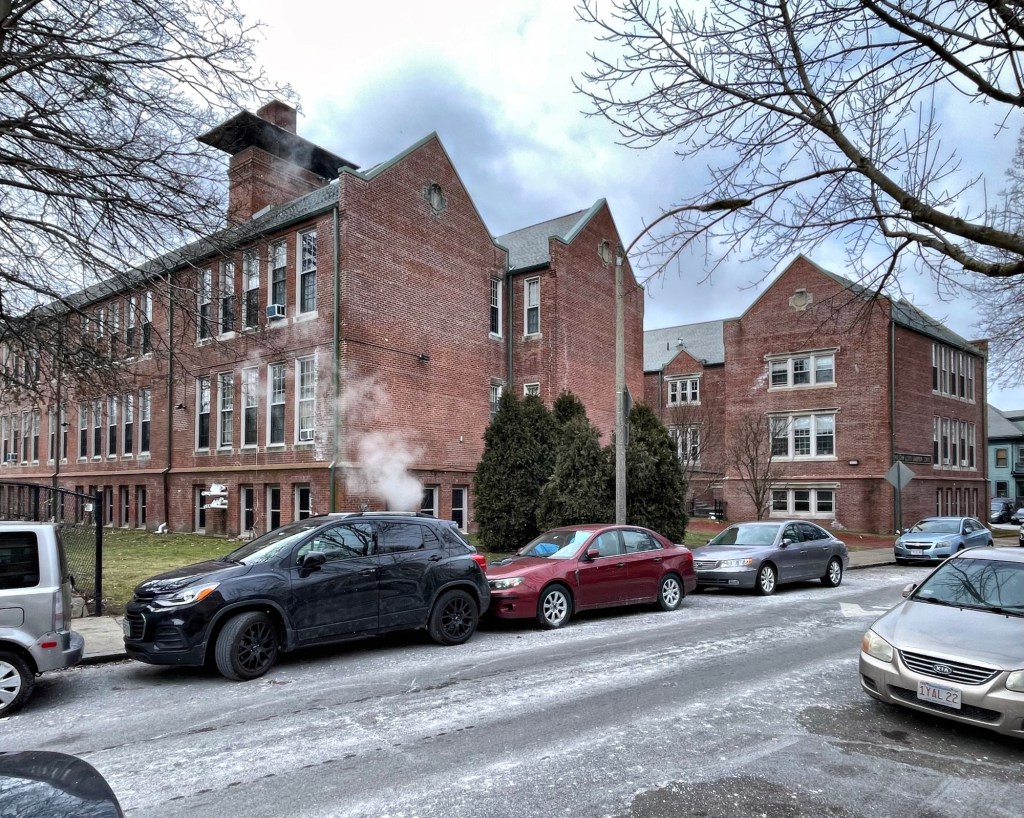
William Lloyd Garrison School // 1910

Tucked away in a residential neighborhood, the William Lloyd Garrison School in Roxbury’s Washington Park neighborhood is among one of the more successful school building designs of the early 20th century. Built in four stages between 1910 and 1929 to service a growing neighborhood over time, the school is named for abolitionist William Lloyd Garrison, who formerly lived in a home relatively closeby. The school complex consists of several different sections organized around a central courtyard and joined by passageways, all designed by the extremely underrated architectural firm of Newhall & Blevins in the Tudor style. Following the period of Urban Renewal in the neighborhood, the school district built contemporary schools and deaccessioned older schools. Today, the former William Lloyd Garrison School houses apartments.